



Sudoxicam
Based on 2 publication(s) in Google Scholar
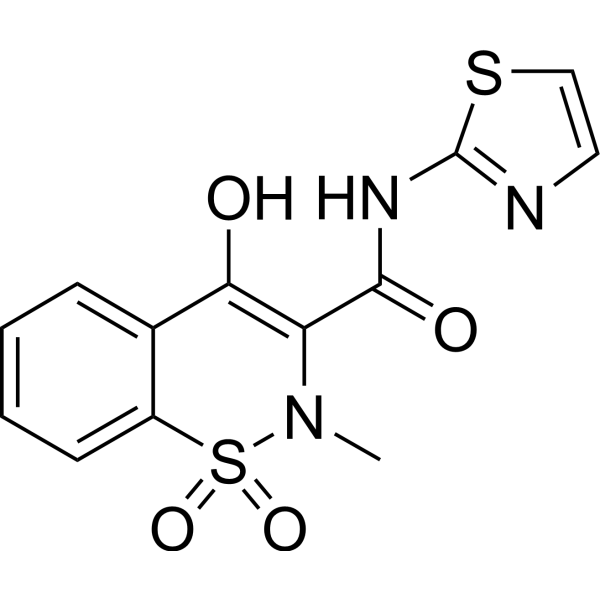
Sudoxicam is a reversible and orally active COX antagonist and a non-steroidal anti-inflammatory drug (NSAID) from the enol-carboxamide class. Sudoxicam has potent anti-inflammatory, anti-edema and antipyretic activity.
Nos produits utilisent uniquement pour la recherche. Nous ne vendons pas aux patients.
- Pureté : 99.96%
- CAS No.: 34042-85-8
- Formule: C13H11N3O4S2
- Masse moléculaire:337.37
-
Stockage:Powder -20°C, 3 years , 4°C, 2 years ; In solvent -80°C, 6 months , -20°C, 1 month

To place orders, for customer services and technical support, please contact: MedChemExpress USA
Tel: 609-228-6898 E-mail: [email protected] [email protected]


-
 Activité biologique
-
Chemical Information
-
Solvant et solubilité
- Protocole
- Pureté et documentation
- Références
-
 Help & FAQs



Publications Citing Use of MedChemExpress (MCE) Sudoxicam
More

Activité biologique
Description
IC50 & Target
COX[3]
In Vitro
Sudoxicam demonstrates NADPH-dependent covalent binding to human liver microsomes. With addition of glutathione (GSH) in microsomal incubations, about half of the covalent incorporation of Sudoxicam is blocked by addition of GSH[1].
Metabolite identification studies on [14C]-Sudoxicam in NADPH-supplemented human liver microsomes indicated that the primary route of metabolism involved a P450-mediated thiazole ring scission to the corresponding acylthiourea metabolite (S3), a well-established pro-toxin[1].
In vitro, Sudoxicam underwent the oxidative thiazole-open biotransformation, resulting in the formation of an acylthiourea and the subsequent hydroxylated metabolite[3].
MedChemExpress (MCE) has not independently confirmed the accuracy of these methods. They are for reference only.
In Vivo
In the intact rat, Sudoxicam significantly inhibited edema formation at doses as low as 0.1 mg/kg, p.o[2].
Sudoxicam inhibits the erythema caused by ultraviolet irradiation in the guinea pig. Sudoxicam (3.3 mg/kg, i.p.) is capable of counteracting the pyrexia induced by the intraperitoneal injection of typhoid/paratyphoid vaccine in rats, maintaining body temperature about that of uninjected control rats[2].
The plasma half-life of Sudoxicam ranged between 8 hours (monkey), 13 hours (rat), and 60 hours (dog)[2].
MedChemExpress (MCE) has not independently confirmed the accuracy of these methods. They are for reference only.
-
Animal Model:Rats injected with ,i>M. butyrieum[2]
-
Dosage:1 mg/kg, 3.3 mg/kg, 10 mg/kg
-
Administration:Oral administration; daily; for 7 days
-
Result:Were both effective in reducing plasma inflammation units, in reducing the swelling of inflamed hind-paws.


Chemical Information
-
CAS No. 34042-85-8
-
Appearance Solid
-
Masse moléculaire 337.37
-
Formule C13H11N3O4S2
-
Color Off-white to yellow
-
SMILES
OC(C1=CC=CC=C12)=C(C(NC3=NC=CS3)=O)N(C)S2(=O)=O
-
Livraison
Room temperature in continental US; may vary elsewhere.
-
Stockage
Powder -20°C 3 years 4°C 2 years In solvent -80°C 6 months -20°C 1 month


Publications (2)
-
Journal Impact Factor
-
Most Recent
-
ACS Environ Au
Machine Learning-Assisted Recognition of Environmental Sulfur-Containing Chemicals in Nontargeted Mass Spectrometry Analysis of Inadequate Mass Resolution. [Abstract]2025 Aug 5;5(6):573-582. PMID: 41277996 -
Anal Chem
Exposome-Scale Investigation of Cl-/Br-Containing Chemicals Using High-Resolution Mass Spectrometry, Multistage Machine Learning, and Cloud Computing. [Abstract]2025 Jun 3;97(21):11099-11109. PMID: 40401576


Solvant et solubilité
In Vitro:
DMSO : 83.33 mg/mL (247.00 mM; ultrasonic and warming and heat to 80°C; Hygroscopic DMSO has a significant impact on the solubility of product, please use newly opened DMSO)
Please refer to the solubility information to select the appropriate solvent. Once prepared, please aliquot and store the solution to prevent product inactivation from repeated freeze-thaw cycles.
Storage method and period of stock solution: -80°C, 6 months; -20°C, 1 month. When stored at -80°C, please use it within 6 months. When stored at -20°C, please use it within 1 month.
Please refer to the solubility information to select the appropriate solvent. Once prepared, please aliquot and store the solution to prevent product inactivation from repeated freeze-thaw cycles.
Storage method and period of stock solution: -80°C, 6 months; -20°C, 1 month. When stored at -80°C, please use it within 6 months. When stored at -20°C, please use it within 1 month.
Concentration (start) × Volume (start) = Concentration (final) × Volume (final)


Pureté et documentation
-
Fiche technique (281 KB)
-
SDS (479 KB)
- English - EN (479 KB)
- Français - FR (479 KB)
- Deutsch - DE (479 KB)
- Norwegian - NO (479 KB)
- Español - ES (479 KB)
- Swedish - SV (479 KB)
- Italian - IT (479 KB)
- Korean - KR (479 KB)
- Portuguese - PT (479 KB)
-
Instruction de manipulation (2659 KB)
Références
[1]. Obach RS, et al. In vitro metabolism and covalent binding of enol-carboxamide derivatives and anti-inflammatory agents sudoxicam and meloxicam: insights into the hepatotoxicity of sudoxicam. Chem Res Toxicol. 2008 Sep;21(9):1890-9. [Content Brief]
[2]. Wiseman EH, et al. Anti-inflammatory and pharmacokinetic properties of sudoxicam N-(2-thiazolyl)-4-hydroxy-2-methyl-2H-1,2-benzothiazine-3-carboxamide 1,1-dioxide. Biochem Pharmacol. 1972 Sep 1;21(17):2323-34. [Content Brief]
[3]. Zhi-Yi Zhang. Sudoxicam. Handbook of Metabolic Pathways of Xenobiotics. September 2014.


Complete Stock Solution Preparation Table
Please refer to the solubility information to select the appropriate solvent. Once prepared, please aliquot and store the solution to prevent product inactivation from repeated freeze-thaw cycles.
Storage method and period of stock solution: -80°C, 6 months; -20°C, 1 month. When stored at -80°C, please use it within 6 months. When stored at -20°C, please use it within 1 month.
| Optional Solvent | Concentration Solvent Mass | 1 mg | 5 mg | 10 mg | 25 mg |
|---|---|---|---|---|---|
| DMSO | 1 mM | 2.9641 mL | 14.8205 mL | 29.6410 mL | 74.1026 mL |
| 5 mM | 0.5928 mL | 2.9641 mL | 5.9282 mL | 14.8205 mL | |
| 10 mM | 0.2964 mL | 1.4821 mL | 2.9641 mL | 7.4103 mL | |
| 15 mM | 0.1976 mL | 0.9880 mL | 1.9761 mL | 4.9402 mL | |
| 20 mM | 0.1482 mL | 0.7410 mL | 1.4821 mL | 3.7051 mL | |
| 25 mM | 0.1186 mL | 0.5928 mL | 1.1856 mL | 2.9641 mL | |
| 30 mM | 0.0988 mL | 0.4940 mL | 0.9880 mL | 2.4701 mL | |
| 40 mM | 0.0741 mL | 0.3705 mL | 0.7410 mL | 1.8526 mL | |
| 50 mM | 0.0593 mL | 0.2964 mL | 0.5928 mL | 1.4821 mL | |
| 60 mM | 0.0494 mL | 0.2470 mL | 0.4940 mL | 1.2350 mL | |
| 80 mM | 0.0371 mL | 0.1853 mL | 0.3705 mL | 0.9263 mL | |
| 100 mM | 0.0296 mL | 0.1482 mL | 0.2964 mL | 0.7410 mL |


Sudoxicam Related Classifications
HY-106628 Related Classifications
 Powered by Bioz