



V-0219

Based on 1 Customer Validation
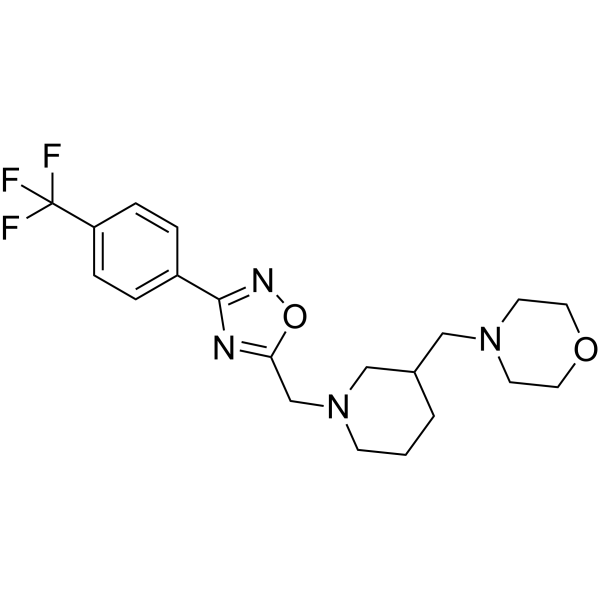
V-0219 is an orally active glucagon-like peptide-1 receptor (GLP-1R) positive allosteric modulator. V-0219 potentiates GLP-1R stimulation, and enhances GLP-1-induced cAMP production and insulin secretion. V-0219 potentiates glucose-dependent insulin secretion. V-0219 improves glucose handling in normal and diabetic rodents. V-0219 can be used for the research of obesity-associated diabetes.
For research use only. We do not sell to patients.
- Purity : 99.90%
- CAS No.: 878453-71-5
- Formula: C20H25F3N4O2
- Molecular Weight:410.43
-
Storage:Pure form -20°C, 3 years ; In solvent -80°C, 6 months , -20°C, 1 month

To place orders, for customer services and technical support, please contact: MedChemExpress USA
Tel: 609-228-6898 E-mail: [email protected] [email protected]


-
 Biological Activity
-
Chemical Information
-
Solvent & Solubility
- Protocols
- Purity & Documentation
- References
-
 Help & FAQs


-
HY-112185
OrforglipronGLP-1R Agonist -
HY-103546
BETPGLP-1 Agonist -
HY-P0014
LiraglutideGLP-1R Agonist -
HY-P0264
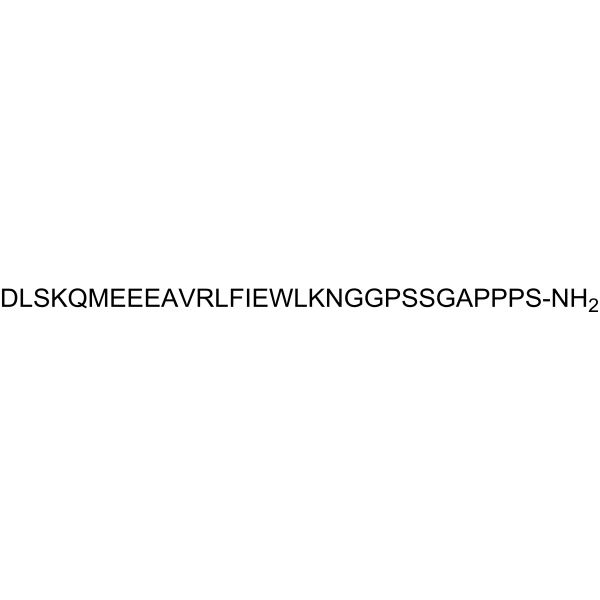
Exendin(9-39) amideGLP-1R Antagonist -
HY-125824
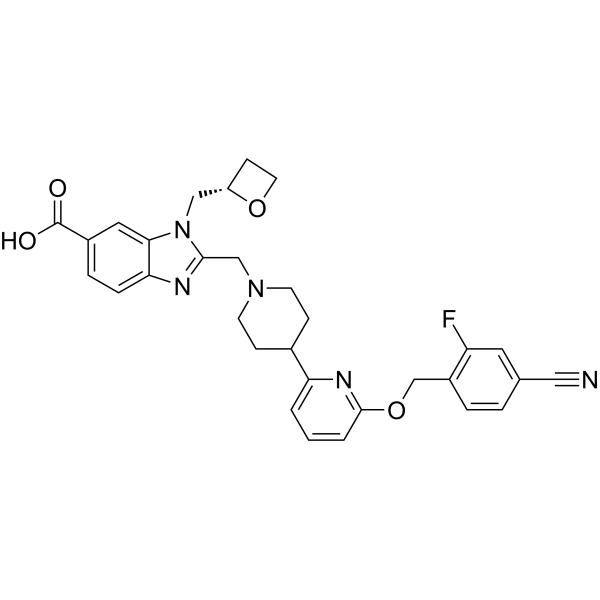
DanuglipronGLP-1R Agonist -
HY-116819
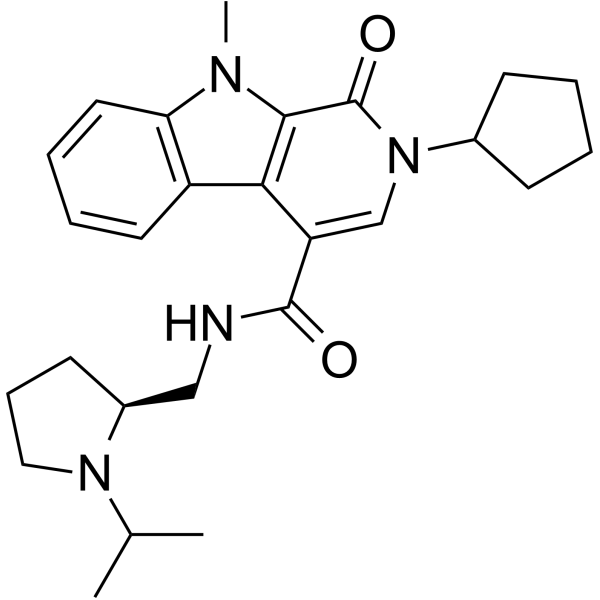
VU0453379GLP-1R PAM -

HY-114118
SemaglutideGLP-1R Agonist -
HY-142162
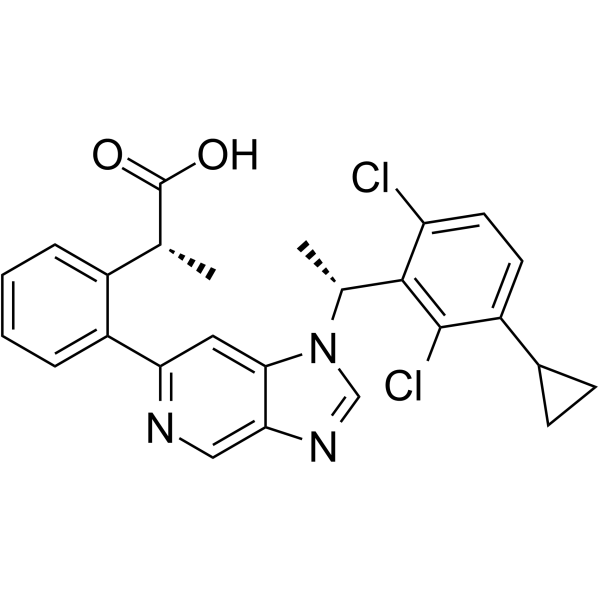
LSN3318839GCGR Modulator -
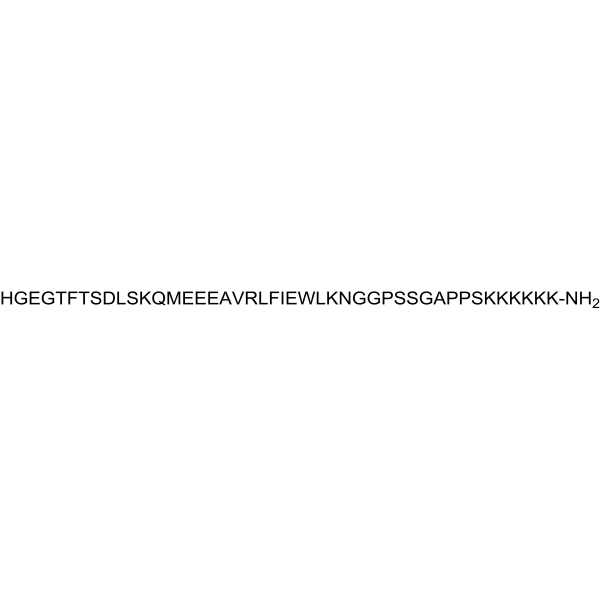
HY-P0119
LixisenatideGLP-1 Agonist -

HY-114118CP
Semaglutide (crude)Crude Semaglutide -
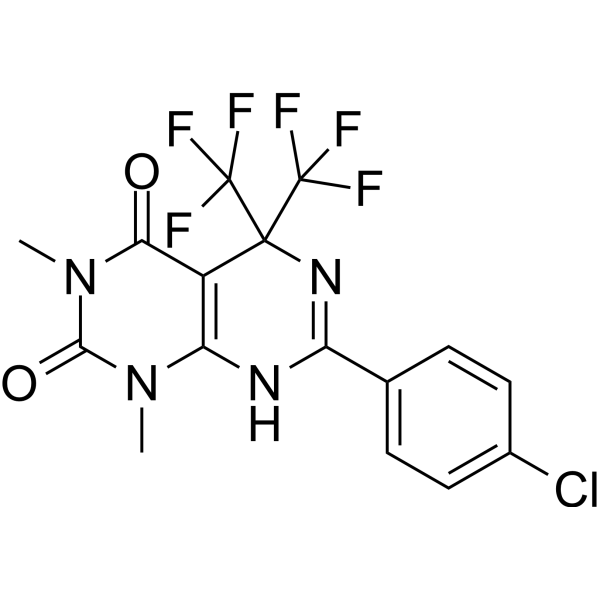
HY-101116
GLP-1R Antagonist 1GLP-1R Antagonist


Biological Activity
Description
IC50 & Target
[1]|
GLP-1 |
In Vitro
V-0219 (compound 9) (0.001-1 nM; 15 min) potently potentiates GLP-1-stimulated cAMP accumulation in HEK-293 cells expressing human GLP-1R[1].
V-0219 (0.01-1 nM; 30 min) potentiates GLP-1-induced insulin secretion in rat INS-1 β-cells, and this effect is mediated by the GLP-1R[1].
MedChemExpress (MCE) has not independently confirmed the accuracy of these methods. They are for reference only.
-
Cell Line:rat INS-1 insulinoma β-cells
-
Concentration:0.01, 0.1, 1 nM
-
Incubation Time:30 min
-
Result:Produced an 1.8-fold potentiation of GLP-1-induced insulin secretion at 0.1 nM, with an EC50 of 0.25 nM.
Reached a maximal response plateau at 0.1 nM when combined with a fixed 0.2 nM GLP-1, with an EC50 of 0.008 nM.
Parmacokinetics
In Vivo
V-0219 (1 μg/kg; i.c.v.; single dose) potentiates Exendin-4 (HY-13443)-induced feeding inhibition in rats[1].
V-0219 (1 mg/kg; i.p.; single dose 30 minutes prior to glucose load) improves glucose handling in normal Wistar rats by reducing hyperglycemia duration[1].
V-0219 (0.1 and 2 mg/kg; i.p.; single dose 30 minutes prior to glucose load) improves glucose handling in diabetic fatty Zucker rats via enhancement of first-phase insulin secretion[1].
V-0219 (0.5-1 mg/kg; i.p.; single dose) does not induce anxiety-like behavior in Wistar rats[1].
MedChemExpress (MCE) has not independently confirmed the accuracy of these methods. They are for reference only.
-
Animal Model:C57BL/6N (male, wild-type)[1]
-
Dosage:0.1 mg/kg
-
Administration:i.p.; single dose 30 minutes prior to glucose load
-
Result:Lowered post-load plasma glucose levels compared to vehicle control.
Showed no glucose-lowering effect in GLP-1R knockout mice at the same dose.
-
Animal Model:Wistar Rats (male, 400 g)[1]
-
Dosage:1 μg/kg
-
Administration:i.c.v.; single dose
-
Result:Potentiated Exendin-4-induced feeding inhibition.
Decreased the IC50 of Exendin-4's feeding inhibitory effect from 394 ng to 89 ng.
-
Animal Model:Wistar Rats (male, 400 g)[1]
-
Dosage:1 mg/kg
-
Administration:i.p.; single dose 30 minutes prior to glucose load
-
Result:Reduced the time spent in hyperglycemia after glucose load compared to vehicle control.
-
Animal Model:fatty Zucker (fa/fa) Rats (male, 12-16 weeks, 380-450 g)[1]
-
Dosage:0.1; 2 mg/kg
-
Administration:i.p.; single dose 30 minutes prior to glucose load
-
Result:Improved glucose handling, with the effect occurring during the first phase of insulin secretion promoted by the glucose load.
Showed no improvement at a 0.1 mg/kg dose.
-
Animal Model:Wistar Rats (male, 400 g)[1]
-
Dosage:0.5; 1 mg/kg
-
Administration:i.p.; single dose
-
Result:Caused no significant changes in time spent in closed arms or total arm entries compared to vehicle control.


Chemical Information
-
CAS No. 878453-71-5
-
Appearance Solid-Liquid Mixture
-
Molecular Weight 410.43
-
Formula C20H25F3N4O2
-
Color Light yellow to yellow
-
SMILES
FC(C1=CC=C(C2=NOC(CN3CC(CN4CCOCC4)CCC3)=N2)C=C1)(F)F
-
Shipping
Room temperature in continental US; may vary elsewhere.
-
Storage
Pure form -20°C 3 years In solvent -80°C 6 months -20°C 1 month


Solvent & Solubility
In Vitro:
DMSO : 100 mg/mL (243.65 mM; Need ultrasonic; Hygroscopic DMSO has a significant impact on the solubility of product, please use newly opened DMSO)
Please refer to the solubility information to select the appropriate solvent. Once prepared, please aliquot and store the solution to prevent product inactivation from repeated freeze-thaw cycles.
Storage method and period of stock solution: -80°C, 6 months; -20°C, 1 month. When stored at -80°C, please use it within 6 months. When stored at -20°C, please use it within 1 month.
Please refer to the solubility information to select the appropriate solvent. Once prepared, please aliquot and store the solution to prevent product inactivation from repeated freeze-thaw cycles.
Storage method and period of stock solution: -80°C, 6 months; -20°C, 1 month. When stored at -80°C, please use it within 6 months. When stored at -20°C, please use it within 1 month.
Concentration (start) × Volume (start) = Concentration (final) × Volume (final)
In Vivo:
Select the appropriate dissolution method based on your experimental animal and administration route.
- For the following dissolution methods, please ensure to first prepare a clear stock solution using an In Vitro approach and then sequentially add co-solvents:
- To ensure reliable experimental results, the clarified stock solution can be appropriately stored based on storage conditions. As for the working solution for In Vivo experiments, it is recommended to prepare freshly and use it on the same day.
- The percentages shown for the solvents indicate their volumetric ratio in the final prepared solution. If precipitation or phase separation occurs during preparation, heat and/or sonication can be used to aid dissolution.
Add each solvent one by one: 10% DMSO 40% PEG300 5% Tween-80 45% Saline
Solubility: ≥ 2.08 mg/mL (5.07 mM); Clear solution
This protocol yields a clear solution of ≥ 2.08 mg/mL (saturation unknown).
Taking 1 mL working solution as an example, add 100 μL DMSO stock solution (20.8 mg/mL) to 400 μL PEG300, and mix evenly; then add 50 μL Tween-80 and mix evenly; then add 450 μL Saline to adjust the volume to 1 mL.
Preparation of Saline: Dissolve 0.9 g sodium chloride in ddH₂O and dilute to 100 mL to obtain a clear Saline solution.
Add each solvent one by one: 10% DMSO 90% (20% SBE-β-CD in Saline)
Solubility: ≥ 2.08 mg/mL (5.07 mM); Clear solution
This protocol yields a clear solution of ≥ 2.08 mg/mL (saturation unknown).
Taking 1 mL working solution as an example, add 100 μL DMSO stock solution (20.8 mg/mL) to 900 μL 20% SBE-β-CD in Saline, and mix evenly.
Preparation of 20% SBE-β-CD in Saline (4°C, storage for one week): 2 g SBE-β-CD powder is dissolved in 10 mL Saline, completely dissolve until clear.
In Vivo Dissolution Calculator
Please enter the basic information of animal experiments:
-
-
-
-
Recommended: Prepare an additional quantity of animals to account for potential losses during experiments.
Please enter your animal formula composition:
-
%DMSO +
Recommended: Keep the proportion of DMSO in working solution below 2% if your animal is weak.
-
%+
-
+%Tween-80 + +
-
%Saline +
The co-solvents required include: DMSO, . All of co-solvents are available by MedChemExpress (MCE). , Tween 80. All of co-solvents are available by MedChemExpress (MCE).
Working solution concentration: 0.22 mg/mL
Method for preparing stock solution: mg drug dissolved in μL DMSO. Stock solution concentration: mg/mL.
1. Take μL DMSO stock solution;
2. Add μL .
μL , mix evenly;
3. Then add μL Tween 80, mix evenly;
4. Then add μL
Please ensure that the stock solution in the first step is dissolved to a clear state, and add co-solvents in sequence. You can use ultrasonic heating (ultrasonic cleaner, recommended frequency 20-40 kHz), vortexing, etc. to assist dissolution.


Purity & Documentation
-
Data Sheet (277 KB)
-
SDS (252 KB)
- English - EN (252 KB)
- Français - FR (252 KB)
- Deutsch - DE (252 KB)
- Norwegian - NO (252 KB)
- Español - ES (252 KB)
- Swedish - SV (252 KB)
- Italian - IT (252 KB)
- Korean - KR (252 KB)
- Portuguese - PT (252 KB)
-
Handling Instructions (2659 KB)
References


Complete Stock Solution Preparation Table
Please refer to the solubility information to select the appropriate solvent. Once prepared, please aliquot and store the solution to prevent product inactivation from repeated freeze-thaw cycles.
Storage method and period of stock solution: -80°C, 6 months; -20°C, 1 month. When stored at -80°C, please use it within 6 months. When stored at -20°C, please use it within 1 month.
| Optional Solvent | Concentration Solvent Mass | 1 mg | 5 mg | 10 mg | 25 mg |
|---|---|---|---|---|---|
| DMSO | 1 mM | 2.4365 mL | 12.1823 mL | 24.3647 mL | 60.9117 mL |
| 5 mM | 0.4873 mL | 2.4365 mL | 4.8729 mL | 12.1823 mL | |
| 10 mM | 0.2436 mL | 1.2182 mL | 2.4365 mL | 6.0912 mL | |
| 15 mM | 0.1624 mL | 0.8122 mL | 1.6243 mL | 4.0608 mL | |
| 20 mM | 0.1218 mL | 0.6091 mL | 1.2182 mL | 3.0456 mL | |
| 25 mM | 0.0975 mL | 0.4873 mL | 0.9746 mL | 2.4365 mL | |
| 30 mM | 0.0812 mL | 0.4061 mL | 0.8122 mL | 2.0304 mL | |
| 40 mM | 0.0609 mL | 0.3046 mL | 0.6091 mL | 1.5228 mL | |
| 50 mM | 0.0487 mL | 0.2436 mL | 0.4873 mL | 1.2182 mL | |
| 60 mM | 0.0406 mL | 0.2030 mL | 0.4061 mL | 1.0152 mL | |
| 80 mM | 0.0305 mL | 0.1523 mL | 0.3046 mL | 0.7614 mL | |
| 100 mM | 0.0244 mL | 0.1218 mL | 0.2436 mL | 0.6091 mL |


V-0219 Related Classifications
HY-143312 Related Classifications
 Powered by Bioz