



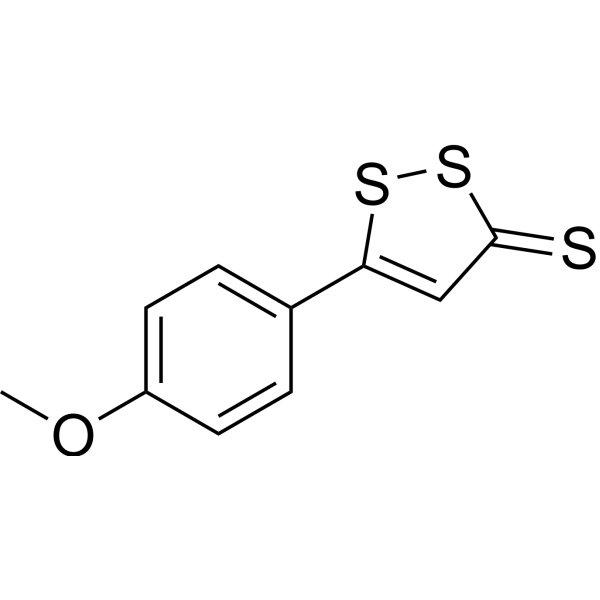
Anethole trithione
Based on 2 publication(s) in Google Scholar
Anethole trithione, a sulfur heterocyclic choleretic, is a bile secretion-stimulating agent. Anethole trithione enhances salivary secretion and increases mAChRs, and can be used for dry mouth research.
For research use only. We do not sell to patients.
- Purity : 99.76%
- CAS No.: 532-11-6
- Formula: C10H8OS3
- Molecular Weight:240.36
-
Storage:Powder -20°C, 3 years , 4°C, 2 years ; In solvent -80°C, 2 years , -20°C, 1 year

To place orders, for customer services and technical support, please contact: MedChemExpress USA
Tel: 609-228-6898 E-mail: [email protected] [email protected]


-
 Biological Activity
-
Chemical Information
-
Solvent & Solubility
- Purity & Documentation
- References
-
 Help & FAQs



Publications Citing Use of MedChemExpress (MCE) Anethole trithione
More

Biological Activity
Description
In Vitro
Anethole trithione, a slow-releasing H2S donor, is a bile secretion-stimulating drug or cholagogue that protects the liver via an increase in glutathione levels and phase II detoxifying enzymes. Anethole trithione is a potentially efficacious chemoprevention agent for lung cancer and exerts chemopreventive effects in several target organs, such as the liver and colon, by increasing the detoxification rate of carcinogens in these target organs. Anethole trithione protects blood-brain barrier integrity following cerebral ischemia[2].
MedChemExpress (MCE) has not independently confirmed the accuracy of these methods. They are for reference only. .
In Vivo
MedChemExpress (MCE) has not independently confirmed the accuracy of these methods. They are for reference only.


Chemical Information
-
CAS No. 532-11-6
-
Appearance Solid
-
Molecular Weight 240.36
-
Formula C10H8OS3
-
Color Orange to red
-
SMILES
S=C1SSC(C2=CC=C(OC)C=C2)=C1
-
Structure Classification
-
Initial Source
-
Shipping
Room temperature in continental US; may vary elsewhere.
-
Storage
Powder -20°C 3 years 4°C 2 years In solvent -80°C 2 years -20°C 1 year


Publications (2)
-
Journal Impact Factor
-
Most Recent
-
PLoS Biol
2024 Jun 27;22(6):e3002672. PMID: 38935621 -
bioRxiv
An efficient behavioral screening platform classifies natural products and other chemical cues according to their chemosensory valence in C. elegans. [Abstract]2024 Apr 3:2023.06.02.542933. PMID: 37333363


Solvent & Solubility
In Vitro:
DMSO : 12.5 mg/mL (52.01 mM; Need ultrasonic; Hygroscopic DMSO has a significant impact on the solubility of product, please use newly opened DMSO)
Please refer to the solubility information to select the appropriate solvent. Once prepared, please aliquot and store the solution to prevent product inactivation from repeated freeze-thaw cycles.
Storage method and period of stock solution: -80°C, 2 years; -20°C, 1 year. When stored at -80°C, please use it within 2 years. When stored at -20°C, please use it within 1 year.
Please refer to the solubility information to select the appropriate solvent. Once prepared, please aliquot and store the solution to prevent product inactivation from repeated freeze-thaw cycles.
Storage method and period of stock solution: -80°C, 2 years; -20°C, 1 year. When stored at -80°C, please use it within 2 years. When stored at -20°C, please use it within 1 year.
Concentration (start) × Volume (start) = Concentration (final) × Volume (final)
In Vivo:
Select the appropriate dissolution method based on your experimental animal and administration route.
- For the following dissolution methods, please ensure to first prepare a clear stock solution using an In Vitro approach and then sequentially add co-solvents:
- To ensure reliable experimental results, the clarified stock solution can be appropriately stored based on storage conditions. As for the working solution for In Vivo experiments, it is recommended to prepare freshly and use it on the same day.
- The percentages shown for the solvents indicate their volumetric ratio in the final prepared solution. If precipitation or phase separation occurs during preparation, heat and/or sonication can be used to aid dissolution.
Add each solvent one by one: 10% DMSO 40% PEG300 5% Tween-80 45% Saline
Solubility: ≥ 2.5 mg/mL (10.40 mM); Clear solution
This protocol yields a clear solution of ≥ 2.5 mg/mL (saturation unknown).
Taking 1 mL working solution as an example, add 100 μL DMSO stock solution (25.0 mg/mL) to 400 μL PEG300, and mix evenly; then add 50 μL Tween-80 and mix evenly; then add 450 μL Saline to adjust the volume to 1 mL.
Preparation of Saline: Dissolve 0.9 g sodium chloride in ddH₂O and dilute to 100 mL to obtain a clear Saline solution.
In Vivo Dissolution Calculator
Please enter the basic information of animal experiments:
-
-
-
-
Recommended: Prepare an additional quantity of animals to account for potential losses during experiments.
Please enter your animal formula composition:
-
%DMSO +
Recommended: Keep the proportion of DMSO in working solution below 2% if your animal is weak.
-
%+
-
+%Tween-80 + +
-
%Saline +
The co-solvents required include: DMSO, . All of co-solvents are available by MedChemExpress (MCE). , Tween 80. All of co-solvents are available by MedChemExpress (MCE).
Working solution concentration: 0.22 mg/mL
Method for preparing stock solution: mg drug dissolved in μL DMSO. Stock solution concentration: mg/mL.
1. Take μL DMSO stock solution;
2. Add μL .
μL , mix evenly;
3. Then add μL Tween 80, mix evenly;
4. Then add μL
Please ensure that the stock solution in the first step is dissolved to a clear state, and add co-solvents in sequence. You can use ultrasonic heating (ultrasonic cleaner, recommended frequency 20-40 kHz), vortexing, etc. to assist dissolution.


Purity & Documentation
-
Data Sheet (274 KB)
-
SDS (396 KB)
- English - EN (396 KB)
- Français - FR (396 KB)
- Deutsch - DE (396 KB)
- Norwegian - NO (396 KB)
- Español - ES (396 KB)
- Swedish - SV (396 KB)
- Italian - IT (396 KB)
- Korean - KR (396 KB)
- Portuguese - PT (396 KB)
-
Handling Instructions (2659 KB)
References
[1]. T Nagano, et al. Enhancement of salivary secretion and neuropeptide (substance P, alpha-calcitonin gene-related peptide) levels in saliva by chronic anethole trithione treatment. J Pharm Pharmacol. 2001 Dec;53(12):1697-702. [Content Brief]
[2]. Sheng Huang, et al. Synthesis, Characterization, and In Vivo Evaluation of Desmethyl Anethole Trithione Phosphate Prodrug for Ameliorating Cerebral Ischemia-Reperfusion Injury in Rats. ACS Omega. 2020 Feb 24;5(9):4595-4602. [Content Brief]
[3]. Y Ukai, et al. Chronic anethole trithione treatment enhances the salivary secretion and increases the muscarinic acetylcholine receptors in the rat submaxillary gland. Arch Int Pharmacodyn Ther. 1984 Oct;271(2):206-12. [Content Brief]


Complete Stock Solution Preparation Table
Please refer to the solubility information to select the appropriate solvent. Once prepared, please aliquot and store the solution to prevent product inactivation from repeated freeze-thaw cycles.
Storage method and period of stock solution: -80°C, 2 years; -20°C, 1 year. When stored at -80°C, please use it within 2 years. When stored at -20°C, please use it within 1 year.
| Optional Solvent | Concentration Solvent Mass | 1 mg | 5 mg | 10 mg | 25 mg |
|---|---|---|---|---|---|
| DMSO | 1 mM | 4.1604 mL | 20.8021 mL | 41.6043 mL | 104.0107 mL |
| 5 mM | 0.8321 mL | 4.1604 mL | 8.3209 mL | 20.8021 mL | |
| 10 mM | 0.4160 mL | 2.0802 mL | 4.1604 mL | 10.4011 mL | |
| 15 mM | 0.2774 mL | 1.3868 mL | 2.7736 mL | 6.9340 mL | |
| 20 mM | 0.2080 mL | 1.0401 mL | 2.0802 mL | 5.2005 mL | |
| 25 mM | 0.1664 mL | 0.8321 mL | 1.6642 mL | 4.1604 mL | |
| 30 mM | 0.1387 mL | 0.6934 mL | 1.3868 mL | 3.4670 mL | |
| 40 mM | 0.1040 mL | 0.5201 mL | 1.0401 mL | 2.6003 mL | |
| 50 mM | 0.0832 mL | 0.4160 mL | 0.8321 mL | 2.0802 mL |


Anethole trithione Related Classifications
HY-B1223 Related Classifications
 Powered by Bioz