



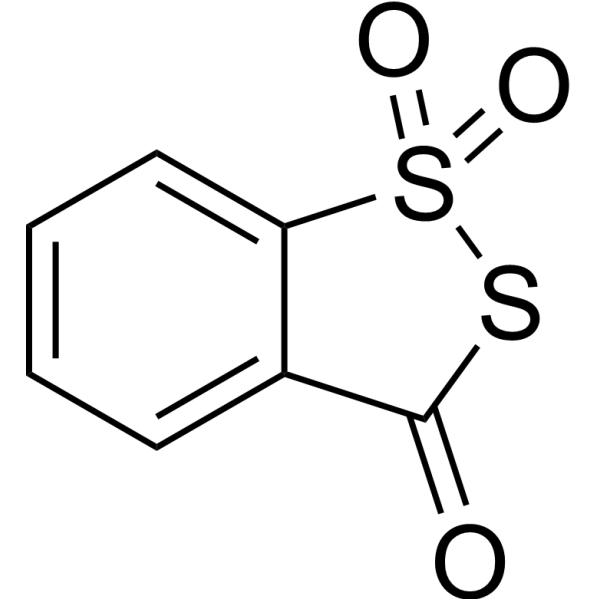
Beaucage reagent
Based on 1 publication(s) in Google Scholar
Beaucage reagent is found to be potent in causing DNA cleavage.
연구목적의 판매만을 진행합니다. 환자를 대상으로 한 판매는 하지 않습니다.
- Purity : 98.0%
- CAS No.: 66304-01-6
- 화학식: C7H4O3S2
- 분자량:200.24
-
보관:Powder -20°C, 3 years , 4°C, 2 years ; In solvent -80°C, 2 years , -20°C, 1 year

To place orders, for customer services and technical support, please contact: MedChemExpress USA
Tel: 609-228-6898 E-mail: [email protected] [email protected]


-
 Biological Activity
-
Chemical Information
-
용액&용해도
- 순도&문서
- References
-
 Help & FAQs



Publications Citing Use of MedChemExpress (MCE) Beaucage reagent
MoreAll DNA/RNA Synthesis Isoforms
More

Biological Activity
제품 설명
In Vitro
The synthesis of Beaucage reagent:[1]
Under the condition of 5°C, 2-amino-3-methyl benzoic acid is subjected to diazonium reaction following the procedure described by Allen andcoworkers[2]. Upon the diazonium salt formation, it was treated immediately with sulfide to generate disulfide under strongly alkaline conditions.Using activated zinc in refluxing glacial acetic acid, the disulfide bond was cleaved off to yield thiol 2-mercapto group-3-carboxyl benzoic acid. The reaction of thioacetic acid with 2-mercapto group-3-carboxyl benzoic acid in concentrated sulfuric acid gave rise to the cyclic compound. Employ dimethyldioxirane as potential oxidizing agent. A one-pot procedure in which OxoneTM was added to a solution of the cyclic compound in acetone led to the successful preparation of Beaucage reagent.
Beaucage reagent causes DNA cleavage:[1]
Assays were performed in 50 mM sodium phosphate buffer (pH 7.0) containing 0.5 mg of supercoiled pBR322 DNA in the presence of Beaucage reagent at different concentrations (total volume 20 mL) for 12 h. Beaucage reagent can effectively cause DNA-cleaving activities.
MedChemExpress (MCE) has not independently confirmed the accuracy of these methods. They are for reference only.


Chemical Information
-
CAS No. 66304-01-6
-
Appearance Solid
-
분자량 200.24
-
화학식 C7H4O3S2
-
Color White to off-white
-
SMILES
O=C(C1=CC=CC=C12)SS2(=O)=O
-
선적
Room temperature in continental US; may vary elsewhere.
-
보관
Powder -20°C 3 years 4°C 2 years In solvent -80°C 2 years -20°C 1 year


Publications (1)
-
Journal Impact Factor
-
Most Recent
-
J Mol Med (Berl)
2019 Aug;97(8):1183-1193. PMID: 31201471


용액&용해도
In Vitro:
DMSO : ≥ 100 mg/mL (499.40 mM; Hygroscopic DMSO has a significant impact on the solubility of product, please use newly opened DMSO)
H2O : 0.14 mg/mL (0.70 mM; Need ultrasonic)
* "≥" means soluble, but saturation unknown.
Please refer to the solubility information to select the appropriate solvent. Once prepared, please aliquot and store the solution to prevent product inactivation from repeated freeze-thaw cycles.
Storage method and period of stock solution: -80°C, 2 years; -20°C, 1 year. When stored at -80°C, please use it within 2 years. When stored at -20°C, please use it within 1 year.
* Note: If you choose water as the stock solution, please dilute it to the working solution, then filter and sterilize it with a 0.22 μm filter before use.
Please refer to the solubility information to select the appropriate solvent. Once prepared, please aliquot and store the solution to prevent product inactivation from repeated freeze-thaw cycles.
Storage method and period of stock solution: -80°C, 2 years; -20°C, 1 year. When stored at -80°C, please use it within 2 years. When stored at -20°C, please use it within 1 year.
* Note: If you choose water as the stock solution, please dilute it to the working solution, then filter and sterilize it with a 0.22 μm filter before use.
Concentration (start) × Volume (start) = Concentration (final) × Volume (final)
In Vivo:
Select the appropriate dissolution method based on your experimental animal and administration route.
- For the following dissolution methods, please ensure to first prepare a clear stock solution using an In Vitro approach and then sequentially add co-solvents:
- To ensure reliable experimental results, the clarified stock solution can be appropriately stored based on storage conditions. As for the working solution for In Vivo experiments, it is recommended to prepare freshly and use it on the same day.
- The percentages shown for the solvents indicate their volumetric ratio in the final prepared solution. If precipitation or phase separation occurs during preparation, heat and/or sonication can be used to aid dissolution.
Add each solvent one by one: 10% DMSO 40% PEG300 5% Tween-80 45% Saline
Solubility: 2.5 mg/mL (12.49 mM); Suspended solution; Need ultrasonic
This protocol yields a suspended solution of 2.5 mg/mL. Suspended solution can be used for oral and intraperitoneal injection.
Taking 1 mL working solution as an example, add 100 μL DMSO stock solution (25.0 mg/mL) to 400 μL PEG300, and mix evenly; then add 50 μL Tween-80 and mix evenly; then add 450 μL Saline to adjust the volume to 1 mL.
Preparation of Saline: Dissolve 0.9 g sodium chloride in ddH₂O and dilute to 100 mL to obtain a clear Saline solution.
Add each solvent one by one: 10% DMSO 90% (20% SBE-β-CD in Saline)
Solubility: 2.5 mg/mL (12.49 mM); Suspended solution; Need ultrasonic
This protocol yields a suspended solution of 2.5 mg/mL. Suspended solution can be used for oral and intraperitoneal injection.
Taking 1 mL working solution as an example, add 100 μL DMSO stock solution (25.0 mg/mL) to 900 μL 20% SBE-β-CD in Saline, and mix evenly.
Preparation of 20% SBE-β-CD in Saline (4°C, storage for one week): 2 g SBE-β-CD powder is dissolved in 10 mL Saline, completely dissolve until clear.
In Vivo Dissolution Calculator
Please enter the basic information of animal experiments:
-
-
-
-
Recommended: Prepare an additional quantity of animals to account for potential losses during experiments.
Please enter your animal formula composition:
-
%DMSO +
Recommended: Keep the proportion of DMSO in working solution below 2% if your animal is weak.
-
%+
-
+%Tween-80 + +
-
%Saline +
The co-solvents required include: DMSO, . All of co-solvents are available by MedChemExpress (MCE). , Tween 80. All of co-solvents are available by MedChemExpress (MCE).
Working solution concentration: 0.22 mg/mL
Method for preparing stock solution: mg drug dissolved in μL DMSO. Stock solution concentration: mg/mL.
1. Take μL DMSO stock solution;
2. Add μL .
μL , mix evenly;
3. Then add μL Tween 80, mix evenly;
4. Then add μL
Please ensure that the stock solution in the first step is dissolved to a clear state, and add co-solvents in sequence. You can use ultrasonic heating (ultrasonic cleaner, recommended frequency 20-40 kHz), vortexing, etc. to assist dissolution.


순도&문서
-
Data Sheet (283 KB)
-
SDS (393 KB)
- English - EN (393 KB)
- Français - FR (393 KB)
- Deutsch - DE (393 KB)
- Norwegian - NO (393 KB)
- Español - ES (393 KB)
- Swedish - SV (393 KB)
- Italian - IT (393 KB)
- Korean - KR (393 KB)
- Portuguese - PT (393 KB)
-
Handling Instructions (2659 KB)
References


Complete Stock Solution Preparation Table
Please refer to the solubility information to select the appropriate solvent. Once prepared, please aliquot and store the solution to prevent product inactivation from repeated freeze-thaw cycles.
Storage method and period of stock solution: -80°C, 2 years; -20°C, 1 year. When stored at -80°C, please use it within 2 years. When stored at -20°C, please use it within 1 year.
| Optional Solvent | Concentration Solvent Mass | 1 mg | 5 mg | 10 mg | 25 mg |
|---|---|---|---|---|---|
| DMSO | 1 mM | 4.9940 mL | 24.9700 mL | 49.9401 mL | 124.8502 mL |
| 5 mM | 0.9988 mL | 4.9940 mL | 9.9880 mL | 24.9700 mL | |
| 10 mM | 0.4994 mL | 2.4970 mL | 4.9940 mL | 12.4850 mL | |
| 15 mM | 0.3329 mL | 1.6647 mL | 3.3293 mL | 8.3233 mL | |
| 20 mM | 0.2497 mL | 1.2485 mL | 2.4970 mL | 6.2425 mL | |
| 25 mM | 0.1998 mL | 0.9988 mL | 1.9976 mL | 4.9940 mL | |
| 30 mM | 0.1665 mL | 0.8323 mL | 1.6647 mL | 4.1617 mL | |
| 40 mM | 0.1249 mL | 0.6243 mL | 1.2485 mL | 3.1213 mL | |
| 50 mM | 0.0999 mL | 0.4994 mL | 0.9988 mL | 2.4970 mL | |
| 60 mM | 0.0832 mL | 0.4162 mL | 0.8323 mL | 2.0808 mL | |
| 80 mM | 0.0624 mL | 0.3121 mL | 0.6243 mL | 1.5606 mL | |
| 100 mM | 0.0499 mL | 0.2497 mL | 0.4994 mL | 1.2485 mL |
* Note: If you choose water as the stock solution, please dilute it to the working solution, then filter and sterilize it with a 0.22 μm filter before use.


Beaucage reagent Related Classifications
HY-100951 Related Classifications
 Powered by Bioz