



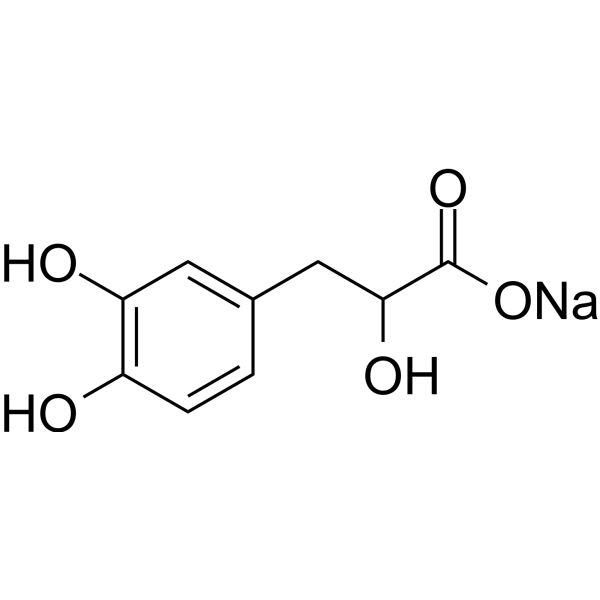
(Rac)-Salvianic acid A sodium
Based on 1 publication(s) in Google Scholar
(Rac)-Salvianic acid A sodium is the racemic form of Salvianic acid A (HY-N1913). Salvianic acid A is an orally active phenolic compound that induces Nrf2/HO-1 activation and inhibits the NF-κB pathway, and it also activates the mitochondrial antioxidant defense system (Mitochondrial Metabolism). Salvianic acid A exhibits anti-inflammatory, antioxidant, and anti-apoptotic properties (Apoptosis), demonstrating potential for research into inflammation and cardiovascular diseases.
For research use only. We do not sell to patients.
- Purity: 98.0%
- CAS No.: 67920-52-9
- Formula: C9H9NaO5
- Molecular Weight:220.15
-
Storage:
4°C, sealed storage, away from moisture
* In solvent : -80°C, 6 months; -20°C, 1 month (sealed storage, away from moisture)

To place orders, for customer services and technical support, please contact: MedChemExpress USA
Tel: 609-228-6898 E-mail: [email protected] [email protected]


-
 Biological Activity
-
Chemical Information
-
Solvent & Solubility
- Purity & Documentation
- References
-
 Help & FAQs
-

Bioactive Compound Library Max
HY-L181
-
Bioactive Compound Library
HY-L001
-
Anti-Infection Compound Library
HY-L002
-
Apoptosis Compound Library
HY-L003
-
Immunology/Inflammation Compound Library
HY-L007
-
Metabolism/Protease Compound Library
HY-L012
-
NF-κB Signaling Compound Library
HY-L014
-
Stem Cell Signaling Compound Library
HY-L017
-
Natural Product Library
HY-L021
-
Anti-Aging Compound Library
HY-L034
-
Antioxidant Compound Library
HY-L037
-
Differentiation Inducing Compound Library
HY-L038
-
Oxygen Sensing Compound Library
HY-L045
-
Anti-Cardiovascular Disease Compound Library
HY-L046
-
Ferroptosis Compound Library
HY-L051
-
Phenols Library
HY-L057
-
Pyroptosis Compound Library
HY-L059
-
Orally Active Compound Library
HY-L061
-
Glutamine Metabolism Compound Library
HY-L064
-
Traditional Chinese Medicine Active Compound Library
HY-L065
-
FDA Approved & Pharmacopeial Drug Library
HY-L066
-
Anti-Breast Cancer Compound Library
HY-L074
-
Anti-Pancreatic Cancer Compound Library
HY-L077
-
Anti-Blood Cancer Compound Library
HY-L079
-
Anti-Cancer Metabolism Compound Library
HY-L083
-
Anti-Obesity Compound Library
HY-L087
-
Mitochondria-Targeted Compound Library
HY-L089
-
Transcription Factor-Targeted Library
HY-L090
-
Glucose Metabolism Compound Library
HY-L092
-
Food-Sourced Compound Library
HY-L094
-
Anti-Liver Cancer Compound Library
HY-L101
-
Antidepressant Compound Library
HY-L108
-
Anti-inflammatory Traditional Chinese Medicine Active Compound Library
HY-L114
-
Plant-Sourced Natural Product Library
HY-L115
-
Human Metabolite Library
HY-L123
-
Anti-Prostate Cancer Compound Library
HY-L124
-
Anti-Pulmonary Fibrosis Compound Library
HY-L125
-
Cuproptosis Compound Library
HY-L133
-
Cancer Stem Cells Compound Library
HY-L135
-
Pain-Related Compound Library
HY-L139
-
Metabolic Enzyme Compound Library
HY-L146
-
Cell Death Library
HY-L162
-
Anti-Hematopathy Compound Library
HY-L171
-
Anti-Ovarian Cancer Compound Library
HY-L173
-
Multi-Target Compound Library
HY-L176
-
Radioprotector Library
HY-L178
-
Natural Product Library Plus
HY-L021P
-
Natural Product and Natural Product-Like Compound Library
HY-L021M
-
Anti-Fibrosis Compound Library
HY-L185
-
PBCRBS Traditional Chinese Medicine Compound Library
HY-L193
-
Non-Alcoholic Fatty Liver Disease (NAFLD) Compound Library
HY-L199
-
RO5 Drug-like Natural Product Library
HY-L200
-
Cell Proliferation Compound Library
HY-L201
-
High-Throughput Bioactive Compound Library
HY-L205
-
High-Throughput Natural Product Library
HY-L206
-
Diarrhea-Related Traditional Chinese Medicine Active Compound Library
HY-L224
-
Mongolian Medicine Compound Library
HY-L238
-
Lactylation Compound Library
HY-L249


Publications Citing Use of MedChemExpress (MCE) (Rac)-Salvianic acid A sodium
More

Biological Activity
Salvianic acid A (6-36 μM, 24 h) inhibits the decrease in vascular endothelial cell viability induced by Lipopolysaccharide (HY-D1056) in a dose-dependent manner[6]. Salvianic acid A (10 or 20 μM, 24 h) inhibits Lipopolysaccharide (HY-D1056)-induced apoptosis through regulating glutathione peroxidase activity and malondialdehyde level in vascular endothelial cells[6]. Salvianic acid A sodium (25 or 50 μM, 24 h) protects human umbilical vein endothelial cells against tert-butyl hydroperoxide induced oxidative injury via mitochondria-dependent pathway[7].
MedChemExpress (MCE) has not independently confirmed the accuracy of these methods. They are for reference only.
-
Cell Line:Lipopolysaccharide (HY-D1056)-induced human umbilical vein endothelial cells
-
Concentration:6-36 μM
-
Incubation Time:24 h
-
Result:Inhibited the decrease in cell viability in a dose-dependent manner.
-
Cell Line:Tert-butyl hydroperoxide induced human umbilical vein endothelial cell
-
Concentration:0, 25, 50, 100, 200 μM
-
Incubation Time:24 h
-
Result:Protected HUVEC cells against apoptosis induced by tert-butyl hydroperoxide.
-
Cell Line:Tert-butyl hydroperoxide induced human umbilical vein endothelial cell
-
Concentration:25 or 50 μM
-
Incubation Time:24 h
-
Result:Reversed the downregulation of MnSOD and Bcl-2 levels and the release of Cyt-c from mitochondria caused by tert-butyl hydroperoxide damage.
MedChemExpress (MCE) has not independently confirmed the accuracy of these methods. They are for reference only.
-
Animal Model:Atherosclerosis (AS) model induced by a high-fat diet in Sprague-Dawley rats (180-220 g)[4]
-
Dosage:3 or 10 mg/kg
-
Administration:Oral gavage (p.o.), once daily for 6 weeks
-
Result:Inhibited atherosclerotic lesion progression and reduced aortic lipid deposition by 58.2% and 72.8% in high-fat diet-induced AS rats. Improved lipid profiles by lowering triglyceri/brdes, total cholesterol, and LDL cholesterol while significantly increasing HDL cholesterol in AS rats. Enhanced antioxidant enzyme activity, upregulated the Nrf2/HO-1 pathway, and reduced the expression of p47phox and p22phox.


Chemical Information
-
CAS No. 67920-52-9
-
Appearance Solid
-
Molecular Weight 220.15
-
Formula C9H9NaO5
-
Color White to off-white
-
SMILES
OC1=C(O)C=CC(CC(C(O[Na])=O)O)=C1
-
Synonyms
(Rac)-Danshensu sodium; (Rac)-Tanshinol sodium
-
Structure Classification
-
Initial Source
-
Shipping
Room temperature in continental US; may vary elsewhere.
-
Storage
4°C, sealed storage, away from moisture
* In solvent : -80°C, 6 months; -20°C, 1 month (sealed storage, away from moisture)


Publications (1)
-
Journal Impact Factor
-
Most Recent
-
Int Immunopharmacol
Albiflorin contributes to Xuebijing-mediated protection against sepsis-associated acute kidney injury by modulating the succinate-PFKFB3 immunometabolic axis. [Abstract]2026 May 14:182:116841. PMID: 42134292


Solvent & Solubility
H2O : 100 mg/mL (454.24 mM; Need ultrasonic)
DMSO : 100 mg/mL (454.24 mM; Need ultrasonic; Hygroscopic DMSO has a significant impact on the solubility of product, please use newly opened DMSO)
Please refer to the solubility information to select the appropriate solvent. Once prepared, please aliquot and store the solution to prevent product inactivation from repeated freeze-thaw cycles.
Storage method and period of stock solution: -80°C, 6 months; -20°C, 1 month (sealed storage, away from moisture). When stored at -80°C, please use it within 6 months. When stored at -20°C, please use it within 1 month.
* Note: If you choose water as the stock solution, please dilute it to the working solution, then filter and sterilize it with a 0.22 μm filter before use.
Please refer to the solubility information to select the appropriate solvent. Once prepared, please aliquot and store the solution to prevent product inactivation from repeated freeze-thaw cycles.
Storage method and period of stock solution: -80°C, 6 months; -20°C, 1 month (sealed storage, away from moisture). When stored at -80°C, please use it within 6 months. When stored at -20°C, please use it within 1 month.
* Note: If you choose water as the stock solution, please dilute it to the working solution, then filter and sterilize it with a 0.22 μm filter before use.
Concentration (start) × Volume (start) = Concentration (final) × Volume (final)
Select the appropriate dissolution method based on your experimental animal and administration route.
- For the following dissolution methods, please ensure to first prepare a clear stock solution using an In Vitro approach and then sequentially add co-solvents:
- To ensure reliable experimental results, the clarified stock solution can be appropriately stored based on storage conditions. As for the working solution for In Vivo experiments, it is recommended to prepare freshly and use it on the same day.
- The percentages shown for the solvents indicate their volumetric ratio in the final prepared solution. If precipitation or phase separation occurs during preparation, heat and/or sonication can be used to aid dissolution.
Add each solvent one by one: 10% DMSO 40% PEG300 5% Tween-80 45% Saline
Solubility: ≥ 2.5 mg/mL (11.36 mM); Clear solution
This protocol yields a clear solution of ≥ 2.5 mg/mL (saturation unknown).
Taking 1 mL working solution as an example, add 100 μL DMSO stock solution (25.0 mg/mL) to 400 μL PEG300, and mix evenly; then add 50 μL Tween-80 and mix evenly; then add 450 μL Saline to adjust the volume to 1 mL.
Preparation of Saline: Dissolve 0.9 g sodium chloride in ddH₂O and dilute to 100 mL to obtain a clear Saline solution.
For the following dissolution methods, please prepare the working solution directly:
It is recommended to prepare fresh solutions and use them promptly within a short period of time.
The percentages shown for the solvents indicate their volumetric ratio in the final prepared solution. If precipitation or phase separation occurs during preparation, heat and/or sonication can be used to aid dissolution.
Add each solvent one by one: PBS
Solubility: 50 mg/mL (227.12 mM); Clear solution; Need ultrasonic
Please enter the basic information of animal experiments:
-
-
-
-
Recommended: Prepare an additional quantity of animals to account for potential losses during experiments.
Working solution concentration: 0.22 mg/mL
This product has good water solubility, please refer to the measured solubility data in water/PBS/Saline for details.


Purity & Documentation
-
Data Sheet (279 KB)
-
SDS (394 KB)
- English - EN (394 KB)
- Français - FR (394 KB)
- Deutsch - DE (394 KB)
- Norwegian - NO (394 KB)
- Español - ES (394 KB)
- Swedish - SV (394 KB)
- Italian - IT (394 KB)
- Korean - KR (394 KB)
- Portuguese - PT (394 KB)
-
Handling Instructions (2659 KB)
References
[1]. Wei Wang, et al. Danshensu alleviates pseudo-typed SARS-CoV-2 induced mouse acute lung inflammation. Acta Pharmacol Sin. 2022 Apr;43(4):771-780. [Content Brief]
[2]. V Bharath Kumar, et al. Sodium Danshensu Inhibits Oral Cancer Cell Migration and Invasion by Modulating p38 Signaling Pathway. Front Endocrinol (Lausanne). 2020 Sep 30:11:568436. [Content Brief]
[3]. Chen Yu, et al. Danshensu attenuates cisplatin-induced nephrotoxicity through activation of Nrf2 pathway and inhibition of NF-κB. Biomed Pharmacother. 2021 Oct:142:111995. [Content Brief]
[4]. Wu Y, et al. The Effect of Salvianolic Acid on Vascular Protection and Possible Mechanisms. Oxid Med Cell Longev. 2020 Sep 25;2020:5472096. doi: 10.1155/2020/5472096. [Content Brief]
[5]. Zhao QT, et al. Salvianic acid A inhibits lipopolysaccharide-induced apoptosis through regulating glutathione peroxidase activity and malondialdehyde level in vascular endothelial cells. Chin J Nat Med. 2012 Jan;10(1):53-7. [Content Brief]
[6]. Jia D, et al. Salvianic acid A sodium protects HUVEC cells against tert-butyl hydroperoxide induced oxidative injury via mitochondria-dependent pathway. Chem Biol Interact. 2018 Jan 5;279:234-242. [Content Brief]


Complete Stock Solution Preparation Table
Please refer to the solubility information to select the appropriate solvent. Once prepared, please aliquot and store the solution to prevent product inactivation from repeated freeze-thaw cycles.
Storage method and period of stock solution: -80°C, 6 months; -20°C, 1 month (sealed storage, away from moisture). When stored at -80°C, please use it within 6 months. When stored at -20°C, please use it within 1 month.
| Optional Solvent | Concentration Solvent Mass | 1 mg | 5 mg | 10 mg | 25 mg |
|---|---|---|---|---|---|
| H2O / DMSO | 1 mM | 4.5424 mL | 22.7118 mL | 45.4236 mL | 113.5589 mL |
| 5 mM | 0.9085 mL | 4.5424 mL | 9.0847 mL | 22.7118 mL | |
| 10 mM | 0.4542 mL | 2.2712 mL | 4.5424 mL | 11.3559 mL | |
| 15 mM | 0.3028 mL | 1.5141 mL | 3.0282 mL | 7.5706 mL | |
| 20 mM | 0.2271 mL | 1.1356 mL | 2.2712 mL | 5.6779 mL | |
| 25 mM | 0.1817 mL | 0.9085 mL | 1.8169 mL | 4.5424 mL | |
| 30 mM | 0.1514 mL | 0.7571 mL | 1.5141 mL | 3.7853 mL | |
| 40 mM | 0.1136 mL | 0.5678 mL | 1.1356 mL | 2.8390 mL | |
| 50 mM | 0.0908 mL | 0.4542 mL | 0.9085 mL | 2.2712 mL | |
| 60 mM | 0.0757 mL | 0.3785 mL | 0.7571 mL | 1.8926 mL | |
| 80 mM | 0.0568 mL | 0.2839 mL | 0.5678 mL | 1.4195 mL | |
| 100 mM | 0.0454 mL | 0.2271 mL | 0.4542 mL | 1.1356 mL |
* Note: If you choose water as the stock solution, please dilute it to the working solution, then filter and sterilize it with a 0.22 μm filter before use.


(Rac)-Salvianic acid A sodium Related Classifications
HY-N0106 Related Classifications
 Powered by Bioz