



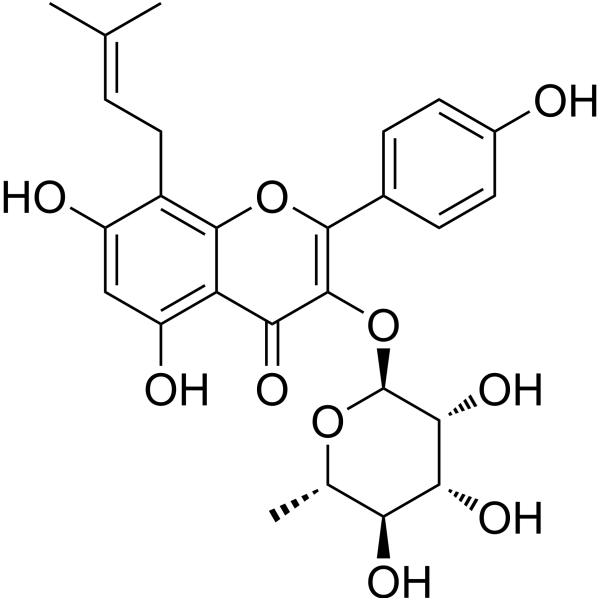
IKarisoside A
Based on 3 publication(s) in Google Scholar
IKarisoside A (Icarisoside-A) is a natural flavonol glycoside and has anti-inflammatory properties.
For research use only. We do not sell to patients.
- Purity : 99.44%
- CAS No.: 55395-07-8
- Formula: C26H28O10
- Molecular Weight:500.49
-
Storage:
4°C, protect from light
* In solvent : -80°C, 6 months; -20°C, 1 month (protect from light)

To place orders, for customer services and technical support, please contact: MedChemExpress USA
Tel: 609-228-6898 E-mail: [email protected] [email protected]


-
 Biological Activity
-
Chemical Information
-
Solvent & Solubility
- Protocols
- Purity & Documentation
- References
-
 Help & FAQs



Publications Citing Use of MedChemExpress (MCE) IKarisoside A
More

Biological Activity
Description
In Vitro
Ikarisoside A inhibited the expression of LPS-stimulated inducible nitric oxide synthase (iNOS) and the production of nitric oxide (NO) in LPS-stimulated RAW 264.7 cells and mouse bone marrow-derived macrophages (BMMs) in a concentration-dependent manner. In addition, Ikarisoside A reduced the release of pro-inflammatory cytokines, such as tumor necrosis factor-alpha (TNF-alpha) and interleukin-1 beta (IL-1 beta). Furthermore, Ikarisoside A inhibited the activity of p38 kinase and nuclear factor-kappaB (NF-kappaB)[1].
Ikarisoside A is a potent inhibitor of osteoclastogenesis in RANKL-stimulated RAW 264.7 cells as well as in bone marrow-derived macrophages.The inhibitory effect of Ikarisoside A resulted in decrease of osteoclast-specific genes like matrix metalloproteinase 9 (MMP9), tartrate-resistant acid phosphatase (TRAP), receptor activator of NF-kappaB (RANK), and cathepsin K. Moreover, Ikarisoside A blocked the resorbing capacity of RAW 264.7 cells on calcium phosphate-coated plates. Ikarisoside A also has inhibitory effects on the RANKL-mediated activation of NF-kappaB, JNK, and Akt[2].
MedChemExpress (MCE) has not independently confirmed the accuracy of these methods. They are for reference only.


Chemical Information
-
CAS No. 55395-07-8
-
Appearance Solid
-
Molecular Weight 500.49
-
Formula C26H28O10
-
Color Light yellow to yellow
-
SMILES
OC1=CC(O)=C2C(OC(C3=CC=C(O)C=C3)=C(O[C@H](O[C@@H](C)[C@H](O)[C@H]4O)[C@@H]4O)C2=O)=C1C/C=C(C)\C
-
Synonyms
Icarisoside-A; Baohuoside II
-
Structure Classification
-
Initial Source
-
Shipping
Room temperature in continental US; may vary elsewhere.
-
Storage
4°C, protect from light
* In solvent : -80°C, 6 months; -20°C, 1 month (protect from light)


Publications (3)
-
Journal Impact Factor
-
Most Recent
-
Food Chem
Effects of sun drying combined with baking processes on the flavor quality of Chongqing Tuocha raw tea. [Abstract]2025 Dec 30:497:146992. PMID: 41285060 -
Food Chem
Flavonoid-mediated metabolic underpinning quality variation in red bud-sport pear mutants. [Abstract]2025 Oct 15:489:144992. PMID: 40466530 -
J Pharm Pharmacol
Icariside I reduces breast cancer proliferation, apoptosis, invasion, and metastasis probably through inhibiting IL-6/STAT3 signaling pathway. [Abstract]2024 May 3;76(5):499-513. PMID: 37971302


Solvent & Solubility
In Vitro:
DMSO : 100 mg/mL (199.80 mM; Need ultrasonic; Hygroscopic DMSO has a significant impact on the solubility of product, please use newly opened DMSO)
Please refer to the solubility information to select the appropriate solvent. Once prepared, please aliquot and store the solution to prevent product inactivation from repeated freeze-thaw cycles.
Storage method and period of stock solution: -80°C, 6 months; -20°C, 1 month (protect from light). When stored at -80°C, please use it within 6 months. When stored at -20°C, please use it within 1 month.
Please refer to the solubility information to select the appropriate solvent. Once prepared, please aliquot and store the solution to prevent product inactivation from repeated freeze-thaw cycles.
Storage method and period of stock solution: -80°C, 6 months; -20°C, 1 month (protect from light). When stored at -80°C, please use it within 6 months. When stored at -20°C, please use it within 1 month.
Concentration (start) × Volume (start) = Concentration (final) × Volume (final)
In Vivo:
Select the appropriate dissolution method based on your experimental animal and administration route.
- For the following dissolution methods, please ensure to first prepare a clear stock solution using an In Vitro approach and then sequentially add co-solvents:
- To ensure reliable experimental results, the clarified stock solution can be appropriately stored based on storage conditions. As for the working solution for In Vivo experiments, it is recommended to prepare freshly and use it on the same day.
- The percentages shown for the solvents indicate their volumetric ratio in the final prepared solution. If precipitation or phase separation occurs during preparation, heat and/or sonication can be used to aid dissolution.
Add each solvent one by one: 10% DMSO 90% (20% SBE-β-CD in Saline)
Solubility: ≥ 2.5 mg/mL (5.00 mM); Clear solution
This protocol yields a clear solution of ≥ 2.5 mg/mL (saturation unknown).
Taking 1 mL working solution as an example, add 100 μL DMSO stock solution (25.0 mg/mL) to 900 μL 20% SBE-β-CD in Saline, and mix evenly.
Preparation of 20% SBE-β-CD in Saline (4°C, storage for one week): 2 g SBE-β-CD powder is dissolved in 10 mL Saline, completely dissolve until clear.
Add each solvent one by one: 10% DMSO 40% PEG300 5% Tween-80 45% Saline
Solubility: ≥ 2.08 mg/mL (4.16 mM); Clear solution
This protocol yields a clear solution of ≥ 2.08 mg/mL (saturation unknown).
Taking 1 mL working solution as an example, add 100 μL DMSO stock solution (20.8 mg/mL) to 400 μL PEG300, and mix evenly; then add 50 μL Tween-80 and mix evenly; then add 450 μL Saline to adjust the volume to 1 mL.
Preparation of Saline: Dissolve 0.9 g sodium chloride in ddH₂O and dilute to 100 mL to obtain a clear Saline solution.
In Vivo Dissolution Calculator
Please enter the basic information of animal experiments:
-
-
-
-
Recommended: Prepare an additional quantity of animals to account for potential losses during experiments.
Please enter your animal formula composition:
-
%DMSO +
Recommended: Keep the proportion of DMSO in working solution below 2% if your animal is weak.
-
%+
-
+%Tween-80 + +
-
%Saline +
The co-solvents required include: DMSO, . All of co-solvents are available by MedChemExpress (MCE). , Tween 80. All of co-solvents are available by MedChemExpress (MCE).
Working solution concentration: 0.22 mg/mL
Method for preparing stock solution: mg drug dissolved in μL DMSO. Stock solution concentration: mg/mL. * In solvent : -80°C, 6 months; -20°C, 1 month (protect from light)
1. Take μL DMSO stock solution;
2. Add μL .
μL , mix evenly;
3. Then add μL Tween 80, mix evenly;
4. Then add μL
Please ensure that the stock solution in the first step is dissolved to a clear state, and add co-solvents in sequence. You can use ultrasonic heating (ultrasonic cleaner, recommended frequency 20-40 kHz), vortexing, etc. to assist dissolution.


Purity & Documentation
-
Data Sheet (281 KB)
-
SDS (393 KB)
- English - EN (393 KB)
- Français - FR (393 KB)
- Deutsch - DE (393 KB)
- Norwegian - NO (393 KB)
- Español - ES (393 KB)
- Swedish - SV (393 KB)
- Italian - IT (393 KB)
- Korean - KR (393 KB)
- Portuguese - PT (393 KB)
-
Handling Instructions (2659 KB)
References
[1]. Choi HJ, et al. Ikarisoside A inhibits inducible nitric oxide synthase in lipopolysaccharide-stimulated RAW 264.7 cells via p38 kinase and nuclear factor-kappaB signaling pathways. Eur J Pharmacol. 2008 Dec 28;601(1-3):171-8. [Content Brief]
[2]. Choi HJ, eta l. Inhibition of osteoclastogenic differentiation by Ikarisoside A in RAW 264.7 cells via JNK and NF-kappaB signaling pathways. Eur J Pharmacol. 2010 Jun 25;636(1-3):28-35. [Content Brief]
[3]. Li X, Toyohira Y, Horisita T, et al. Ikarisoside A inhibits acetylcholine-induced catecholamine secretion and synthesis by suppressing nicotinic acetylcholine receptor-ion channels in cultured bovine adrenal medullary cells. Naunyn Schmiedebergs Arch Pharmacol. 2015;388(12):1259-1269. [Content Brief]


Complete Stock Solution Preparation Table
Please refer to the solubility information to select the appropriate solvent. Once prepared, please aliquot and store the solution to prevent product inactivation from repeated freeze-thaw cycles.
Storage method and period of stock solution: -80°C, 6 months; -20°C, 1 month (protect from light). When stored at -80°C, please use it within 6 months. When stored at -20°C, please use it within 1 month.
| Optional Solvent | Concentration Solvent Mass | 1 mg | 5 mg | 10 mg | 25 mg |
|---|---|---|---|---|---|
| DMSO | 1 mM | 1.9980 mL | 9.9902 mL | 19.9804 mL | 49.9510 mL |
| 5 mM | 0.3996 mL | 1.9980 mL | 3.9961 mL | 9.9902 mL | |
| 10 mM | 0.1998 mL | 0.9990 mL | 1.9980 mL | 4.9951 mL | |
| 15 mM | 0.1332 mL | 0.6660 mL | 1.3320 mL | 3.3301 mL | |
| 20 mM | 0.0999 mL | 0.4995 mL | 0.9990 mL | 2.4976 mL | |
| 25 mM | 0.0799 mL | 0.3996 mL | 0.7992 mL | 1.9980 mL | |
| 30 mM | 0.0666 mL | 0.3330 mL | 0.6660 mL | 1.6650 mL | |
| 40 mM | 0.0500 mL | 0.2498 mL | 0.4995 mL | 1.2488 mL | |
| 50 mM | 0.0400 mL | 0.1998 mL | 0.3996 mL | 0.9990 mL | |
| 60 mM | 0.0333 mL | 0.1665 mL | 0.3330 mL | 0.8325 mL | |
| 80 mM | 0.0250 mL | 0.1249 mL | 0.2498 mL | 0.6244 mL | |
| 100 mM | 0.0200 mL | 0.0999 mL | 0.1998 mL | 0.4995 mL |


IKarisoside A Related Classifications
HY-N0875 Related Classifications
 Powered by Bioz