



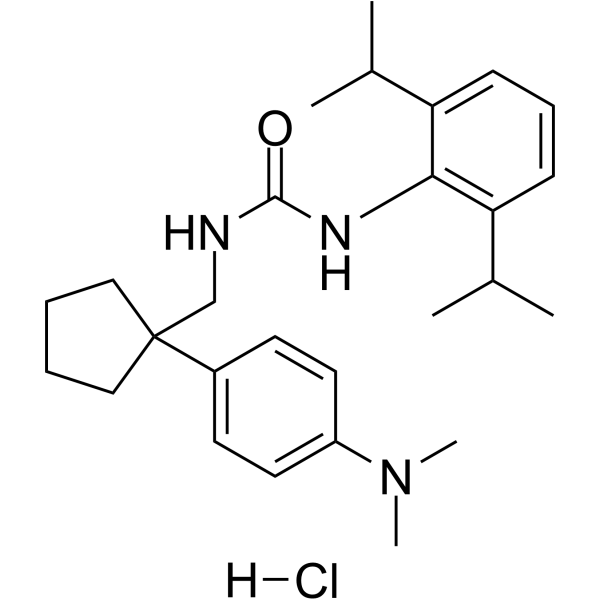
Nevanimibe hydrochloride
Based on 5 publication(s) in Google Scholar
Nevanimibe hydrochloride (PD-132301 hydrochloride) is an orally active and selective acyl-coenzyme A:cholesterol O-acyltransferase 1 (ACAT1) inhibitor with an EC50 of 9 nM. Nevanimibe hydrochloride inhibits ACAT2 with an EC50 of 368 nM. Nevanimibe hydrochloride induces cell apoptosis and has the potential for adrenocortical cancer.
For research use only. We do not sell to patients.
- Purity : 99.49%
- CAS No.: 133825-81-7
- Formula: C27H40ClN3O
- Molecular Weight:458.08
-
Storage:
4°C, sealed storage, away from moisture
* In solvent : -80°C, 6 months; -20°C, 1 month (sealed storage, away from moisture)

To place orders, for customer services and technical support, please contact: MedChemExpress USA
Tel: 609-228-6898 E-mail: [email protected] [email protected]


-
 Biological Activity
-
Chemical Information
-
Solvent & Solubility
- Protocols
- Purity & Documentation
- References
-
 Help & FAQs


-
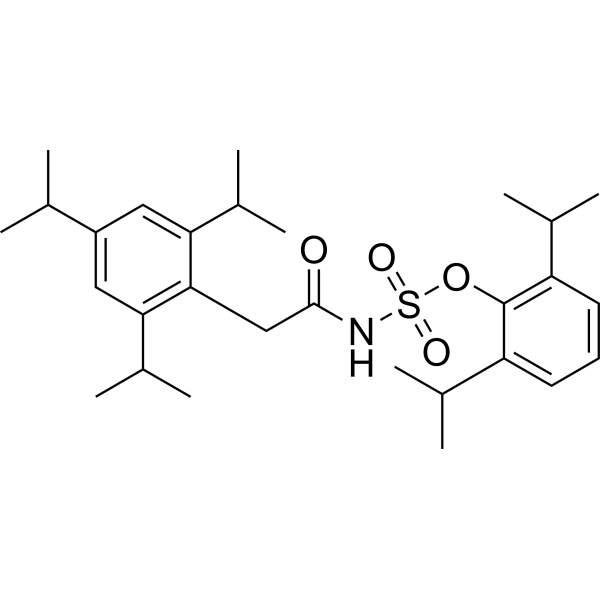
HY-13215
AvasimibeACAT/SOAT Inhibitor -
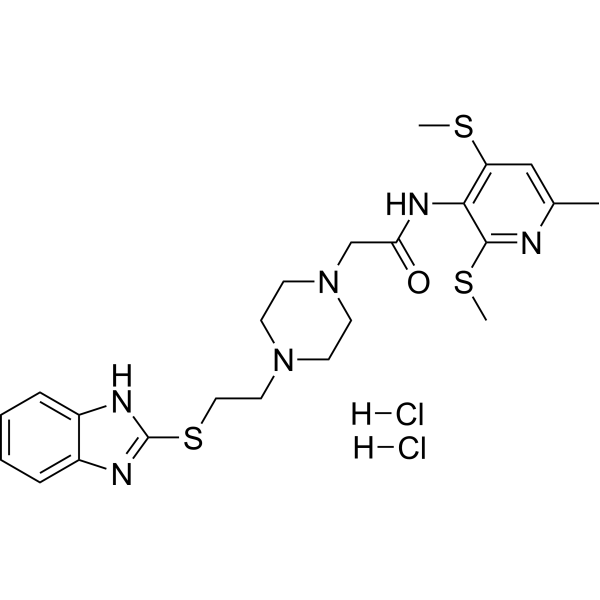
HY-100400A
K-604 dihydrochlorideACAT1 Inhibitor -
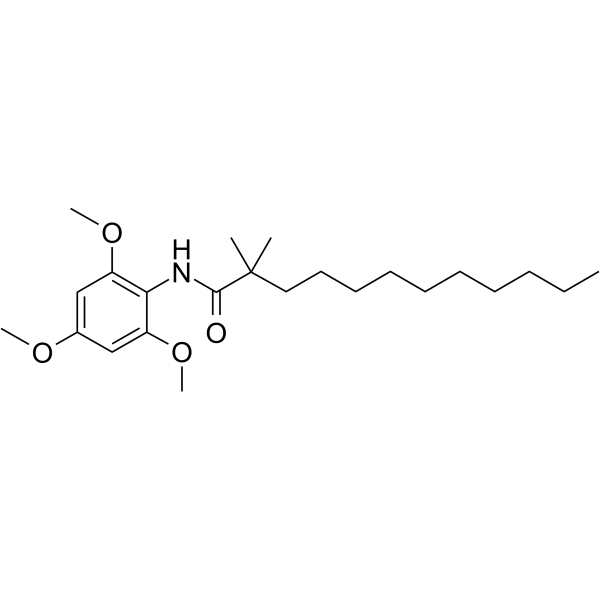
HY-107572
PD 128042ACAT/LPAT Inhibitor -
HY-101576
RP 70676ACAT Inhibitor -
HY-107396
YM-750ACAT Inhibitor -
HY-16437
RP-64477ACAT Inhibitor -
HY-B0015
PaclitaxelAntitumor Agent -
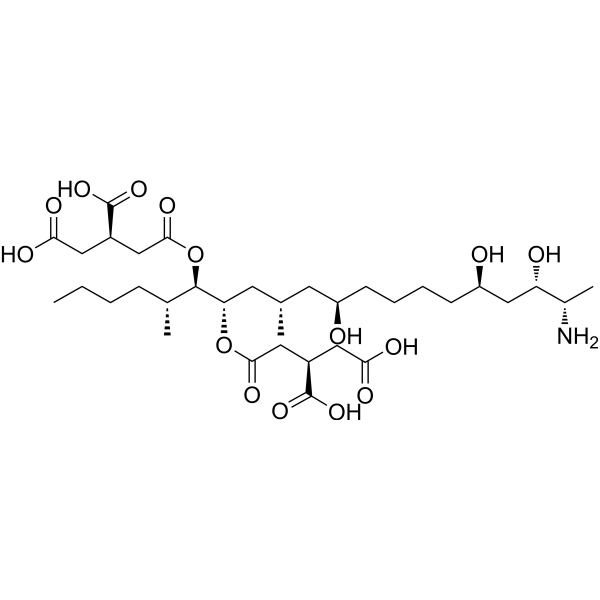
HY-N6719
Fumonisin B1Sphingosine N-acyltransferase Inhibitor -
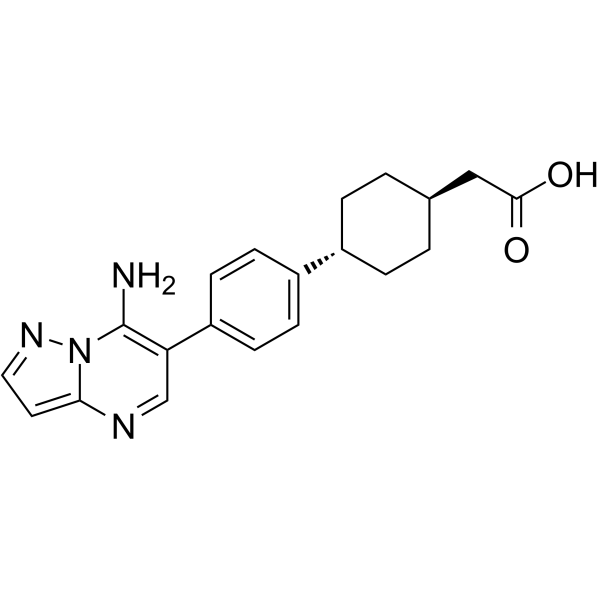
HY-15197
ABT-046DGAT-1 Inhibitor -
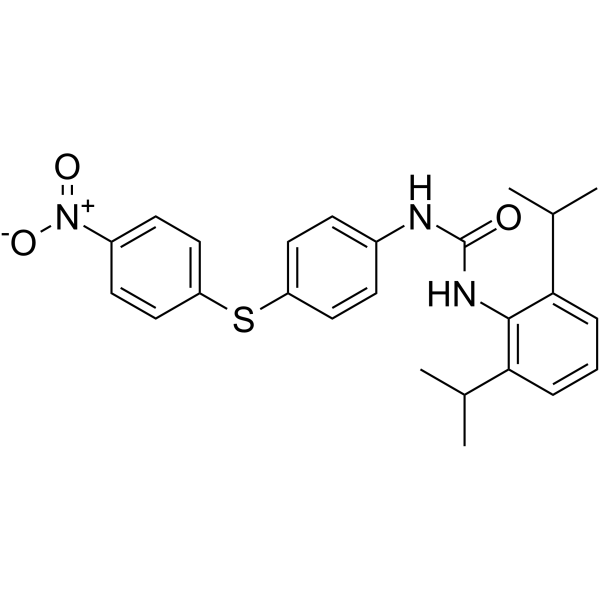
HY-107571
VULM 1457Acyl-CoA Inhibitor -

HY-100399AR
Nevanimibe hydrochloride (Standard)ACAT1 Inhibitor -
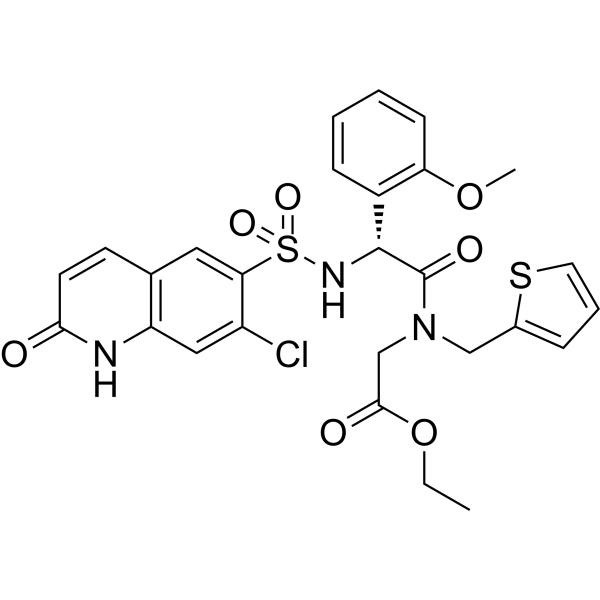
HY-114361
OSMI-4OGT Inhibitor
Publications Citing Use of MedChemExpress (MCE) Nevanimibe hydrochloride
More

Biological Activity
Description
IC50 & Target
[1]|
ACAT1 9 nM (EC50) |
ACAT2 368 nM (EC50) |
In Vitro
Coincubation of Nevanimibe hydrochloride (PD-132301 hydrochloride; ATR101 hydrochloride; 3 nM-30 μM) and Cholesterol markedly increases toxicity in a dose-dependent manner, where 3 nM Nevanimibe in the presence of 60 μg/mL Cholesterol reduces survival by 60% after 24 hours. All doses of Nevanimibe (3 nM-30 μM) induces cytoxicity in the presence of Cholesterol, whereas treatment with Cholesterol in the absence of Nevanimibe has no effect on cell viability[1].
MedChemExpress (MCE) has not independently confirmed the accuracy of these methods. They are for reference only.
-
Cell Line:The H295R and HAC clone 15 (HAC15) human ACC cell lines
-
Concentration:3 nM-30 μM
-
Incubation Time:24 hours
-
Result:3 nM-3 μM exhibited no toxicity, whereas 30 μM treatment reduced survival by approximately 40% within 24 hours.
Clinical Trial
| NCT Number | Sponsor | Condition | Start Date |
Phase

|
|---|---|---|---|---|
| NCT01329991 | Plexxikon| | 2011-05 | PHASE1 |


Chemical Information
-
CAS No. 133825-81-7
-
Appearance Solid
-
Molecular Weight 458.08
-
Formula C27H40ClN3O
-
Color White to off-white
-
SMILES
O=C(NCC1(C2=CC=C(N(C)C)C=C2)CCCC1)NC3=C(C(C)C)C=CC=C3C(C)C.[H]Cl
-
Synonyms
PD-132301 hydrochloride; ATR101 hydrochloride
-
Shipping
Room temperature in continental US; may vary elsewhere.
-
Storage
4°C, sealed storage, away from moisture
* In solvent : -80°C, 6 months; -20°C, 1 month (sealed storage, away from moisture)


Publications (5)
-
Journal Impact Factor
-
Most Recent
-
Cell Rep
β-hydroxybutyrate reduces reinstatement of cocaine conditioned place preference through hippocampal CaMKII-α β-hydroxybutyrylation. [Abstract]2022 Nov 29;41(9):111724. PMID: 36450263 -
-
Aquat Toxicol
Is acyl-CoA cholesterol acyltransferase 2 the enzyme responsible for the esterification of okadaic acid in bivalves?. [Abstract]2026 Jun:295:107814. PMID: 41935504 -
Structure
2021 Dec 2;29(12):1410-1418.e4. PMID: 34520735 -
Mol Cell Endocrinol
The impact of acyl-CoA:cholesterol transferase (ACAT) inhibitors on biophysical membrane properties depends on membrane lipid composition. [Abstract]2024 Dec 1:594:112385. PMID: 39406287


Solvent & Solubility
In Vitro:
DMSO : 41.67 mg/mL (90.97 mM; Need ultrasonic; Hygroscopic DMSO has a significant impact on the solubility of product, please use newly opened DMSO)
H2O : < 0.1 mg/mL (insoluble)
Please refer to the solubility information to select the appropriate solvent. Once prepared, please aliquot and store the solution to prevent product inactivation from repeated freeze-thaw cycles.
Storage method and period of stock solution: -80°C, 6 months; -20°C, 1 month (sealed storage, away from moisture). When stored at -80°C, please use it within 6 months. When stored at -20°C, please use it within 1 month.
Please refer to the solubility information to select the appropriate solvent. Once prepared, please aliquot and store the solution to prevent product inactivation from repeated freeze-thaw cycles.
Storage method and period of stock solution: -80°C, 6 months; -20°C, 1 month (sealed storage, away from moisture). When stored at -80°C, please use it within 6 months. When stored at -20°C, please use it within 1 month.
Concentration (start) × Volume (start) = Concentration (final) × Volume (final)
In Vivo:
Select the appropriate dissolution method based on your experimental animal and administration route.
- For the following dissolution methods, please ensure to first prepare a clear stock solution using an In Vitro approach and then sequentially add co-solvents:
- To ensure reliable experimental results, the clarified stock solution can be appropriately stored based on storage conditions. As for the working solution for In Vivo experiments, it is recommended to prepare freshly and use it on the same day.
- The percentages shown for the solvents indicate their volumetric ratio in the final prepared solution. If precipitation or phase separation occurs during preparation, heat and/or sonication can be used to aid dissolution.
Add each solvent one by one: 10% DMSO 40% PEG300 5% Tween-80 45% Saline
Solubility: ≥ 2.08 mg/mL (4.54 mM); Clear solution
This protocol yields a clear solution of ≥ 2.08 mg/mL (saturation unknown).
Taking 1 mL working solution as an example, add 100 μL DMSO stock solution (20.8 mg/mL) to 400 μL PEG300, and mix evenly; then add 50 μL Tween-80 and mix evenly; then add 450 μL Saline to adjust the volume to 1 mL.
Preparation of Saline: Dissolve 0.9 g sodium chloride in ddH₂O and dilute to 100 mL to obtain a clear Saline solution.
Add each solvent one by one: 10% DMSO 90% (20% SBE-β-CD in Saline)
Solubility: ≥ 2.08 mg/mL (4.54 mM); Clear solution
This protocol yields a clear solution of ≥ 2.08 mg/mL (saturation unknown).
Taking 1 mL working solution as an example, add 100 μL DMSO stock solution (20.8 mg/mL) to 900 μL 20% SBE-β-CD in Saline, and mix evenly.
Preparation of 20% SBE-β-CD in Saline (4°C, storage for one week): 2 g SBE-β-CD powder is dissolved in 10 mL Saline, completely dissolve until clear.
In Vivo Dissolution Calculator
Please enter the basic information of animal experiments:
-
-
-
-
Recommended: Prepare an additional quantity of animals to account for potential losses during experiments.
Please enter your animal formula composition:
-
%DMSO +
Recommended: Keep the proportion of DMSO in working solution below 2% if your animal is weak.
-
%+
-
+%Tween-80 + +
-
%Saline +
The co-solvents required include: DMSO, . All of co-solvents are available by MedChemExpress (MCE). , Tween 80. All of co-solvents are available by MedChemExpress (MCE).
Working solution concentration: 0.22 mg/mL
Method for preparing stock solution: mg drug dissolved in μL DMSO. Stock solution concentration: mg/mL. * In solvent : -80°C, 6 months; -20°C, 1 month (sealed storage, away from moisture)
1. Take μL DMSO stock solution;
2. Add μL .
μL , mix evenly;
3. Then add μL Tween 80, mix evenly;
4. Then add μL
Please ensure that the stock solution in the first step is dissolved to a clear state, and add co-solvents in sequence. You can use ultrasonic heating (ultrasonic cleaner, recommended frequency 20-40 kHz), vortexing, etc. to assist dissolution.


Purity & Documentation
-
Data Sheet (278 KB)
-
SDS (252 KB)
- English - EN (252 KB)
- Français - FR (252 KB)
- Deutsch - DE (252 KB)
- Norwegian - NO (252 KB)
- Español - ES (252 KB)
- Swedish - SV (252 KB)
- Italian - IT (252 KB)
- Korean - KR (252 KB)
- Portuguese - PT (252 KB)
-
Handling Instructions (2659 KB)
References


Complete Stock Solution Preparation Table
Please refer to the solubility information to select the appropriate solvent. Once prepared, please aliquot and store the solution to prevent product inactivation from repeated freeze-thaw cycles.
Storage method and period of stock solution: -80°C, 6 months; -20°C, 1 month (sealed storage, away from moisture). When stored at -80°C, please use it within 6 months. When stored at -20°C, please use it within 1 month.
| Optional Solvent | Concentration Solvent Mass | 1 mg | 5 mg | 10 mg | 25 mg |
|---|---|---|---|---|---|
| DMSO | 1 mM | 2.1830 mL | 10.9151 mL | 21.8302 mL | 54.5756 mL |
| 5 mM | 0.4366 mL | 2.1830 mL | 4.3660 mL | 10.9151 mL | |
| 10 mM | 0.2183 mL | 1.0915 mL | 2.1830 mL | 5.4576 mL | |
| 15 mM | 0.1455 mL | 0.7277 mL | 1.4553 mL | 3.6384 mL | |
| 20 mM | 0.1092 mL | 0.5458 mL | 1.0915 mL | 2.7288 mL | |
| 25 mM | 0.0873 mL | 0.4366 mL | 0.8732 mL | 2.1830 mL | |
| 30 mM | 0.0728 mL | 0.3638 mL | 0.7277 mL | 1.8192 mL | |
| 40 mM | 0.0546 mL | 0.2729 mL | 0.5458 mL | 1.3644 mL | |
| 50 mM | 0.0437 mL | 0.2183 mL | 0.4366 mL | 1.0915 mL | |
| 60 mM | 0.0364 mL | 0.1819 mL | 0.3638 mL | 0.9096 mL | |
| 80 mM | 0.0273 mL | 0.1364 mL | 0.2729 mL | 0.6822 mL |


Nevanimibe hydrochloride Related Classifications
HY-100399A Related Classifications
 Powered by Bioz