



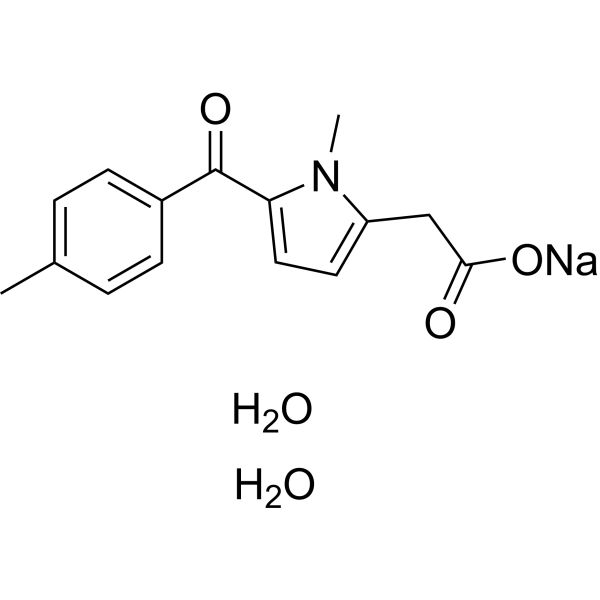
Tolmetin sodium dihydrate
Based on 1 publication(s) in Google Scholar
Tolmetin sodium dihydrate is an orally active and potent COX inhibitor with IC50s of 0.35 μM and 0.82 μM human COX-1 and COX-2, respectively. Tolmetin sodium dihydrate is a non-steroidal anti-inflammatory drug (NSAID).
For research use only. We do not sell to patients.
- Purity: 99.94%
- CAS No.: 64490-92-2
- Formula: C15H18NNaO5
- Molecular Weight:315.30
-
Storage:
4°C, sealed storage, away from moisture
* In solvent : -80°C, 6 months; -20°C, 1 month (sealed storage, away from moisture)

To place orders, for customer services and technical support, please contact: MedChemExpress USA
Tel: 609-228-6898 E-mail: [email protected] [email protected]


-
 Biological Activity
-
Chemical Information
-
Solvent & Solubility
- Protocol
- Purity & Documentation
- References
-
 Help & FAQs


Publications Citing Use of MedChemExpress (MCE) Tolmetin sodium dihydrate
More

Biological Activity
Description
IC50 & Target
[1]|
Human COX-1 0.35 μM (IC50) |
Human COX-2 0.82 μM (IC50) |
In Vitro
Tolmetin sodium dihydrate (0.25 mM) does not attenuate lipid peroxidation in rat brain homogenate. Tolmetin (0.25, 0.5, 0.75, 1 mM) shows radical scavenging properties but without superoxide anion generation in rat brain homogenat[3].
Tolmetin sodium dihydrate (0.001-100 μM) shows anticancer activity againts HT-29 colon cancer cell line in a dose-dependent manner[4].
Tolmetin sodium dihydrate (0-100 μM) shows no effect on osteoblast growth[5].
MedChemExpress (MCE) has not independently confirmed the accuracy of these methods. They are for reference only.
In Vivo
Tolmetin sodium dihydrate (5 mg/kg twice a day for 5 days) pre-treatment considerably attenuates quinolinic acid (QA)-induced neurotoxicity[3].
MedChemExpress (MCE) has not independently confirmed the accuracy of these methods. They are for reference only.


Chemical Information
-
CAS No. 64490-92-2
-
Appearance Solid
-
Molecular Weight 315.30
-
Formula C15H18NNaO5
-
Color Off-white to yellow
-
SMILES
O=C(O[Na])CC1=CC=C(C(C2=CC=C(C)C=C2)=O)N1C.O.O
-
Shipping
Room temperature in continental US; may vary elsewhere.
-
Storage
4°C, sealed storage, away from moisture
* In solvent : -80°C, 6 months; -20°C, 1 month (sealed storage, away from moisture)


Publications (1)
-
Journal Impact Factor
-
Most Recent


Solvent & Solubility
In Vitro:
H2O : ≥ 100 mg/mL (317.16 mM)
DMSO : 12.5 mg/mL (39.64 mM; Need ultrasonic; Hygroscopic DMSO has a significant impact on the solubility of product, please use newly opened DMSO)
* "≥" means soluble, but saturation unknown.
Please refer to the solubility information to select the appropriate solvent. Once prepared, please aliquot and store the solution to prevent product inactivation from repeated freeze-thaw cycles.
Storage method and period of stock solution: -80°C, 6 months; -20°C, 1 month (sealed storage, away from moisture). When stored at -80°C, please use it within 6 months. When stored at -20°C, please use it within 1 month.
* Note: If you choose water as the stock solution, please dilute it to the working solution, then filter and sterilize it with a 0.22 μm filter before use.
Please refer to the solubility information to select the appropriate solvent. Once prepared, please aliquot and store the solution to prevent product inactivation from repeated freeze-thaw cycles.
Storage method and period of stock solution: -80°C, 6 months; -20°C, 1 month (sealed storage, away from moisture). When stored at -80°C, please use it within 6 months. When stored at -20°C, please use it within 1 month.
* Note: If you choose water as the stock solution, please dilute it to the working solution, then filter and sterilize it with a 0.22 μm filter before use.
Concentration (start) × Volume (start) = Concentration (final) × Volume (final)
In Vivo:
Select the appropriate dissolution method based on your experimental animal and administration route.
- For the following dissolution methods, please ensure to first prepare a clear stock solution using an In Vitro approach and then sequentially add co-solvents:
- To ensure reliable experimental results, the clarified stock solution can be appropriately stored based on storage conditions. As for the working solution for In Vivo experiments, it is recommended to prepare freshly and use it on the same day.
- The percentages shown for the solvents indicate their volumetric ratio in the final prepared solution. If precipitation or phase separation occurs during preparation, heat and/or sonication can be used to aid dissolution.
Add each solvent one by one: 10% DMSO 40% PEG300 5% Tween-80 45% Saline
Solubility: ≥ 1.25 mg/mL (3.96 mM); Clear solution
This protocol yields a clear solution of ≥ 1.25 mg/mL (saturation unknown).
Taking 1 mL working solution as an example, add 100 μL DMSO stock solution (12.5 mg/mL) to 400 μL PEG300, and mix evenly; then add 50 μL Tween-80 and mix evenly; then add 450 μL Saline to adjust the volume to 1 mL.
Preparation of Saline: Dissolve 0.9 g sodium chloride in ddH₂O and dilute to 100 mL to obtain a clear Saline solution.
Add each solvent one by one: 10% DMSO 90% (20% SBE-β-CD in Saline)
Solubility: ≥ 1.25 mg/mL (3.96 mM); Clear solution
This protocol yields a clear solution of ≥ 1.25 mg/mL (saturation unknown).
Taking 1 mL working solution as an example, add 100 μL DMSO stock solution (12.5 mg/mL) to 900 μL 20% SBE-β-CD in Saline, and mix evenly.
Preparation of 20% SBE-β-CD in Saline (4°C, storage for one week): 2 g SBE-β-CD powder is dissolved in 10 mL Saline, completely dissolve until clear.
For the following dissolution methods, please prepare the working solution directly:
It is recommended to prepare fresh solutions and use them promptly within a short period of time.
The percentages shown for the solvents indicate their volumetric ratio in the final prepared solution. If precipitation or phase separation occurs during preparation, heat and/or sonication can be used to aid dissolution.
Add each solvent one by one: PBS
Solubility: 25 mg/mL (79.29 mM); Clear solution; Need ultrasonic
In Vivo Dissolution Calculator
Please enter the basic information of animal experiments:
-
-
-
-
Recommended: Prepare an additional quantity of animals to account for potential losses during experiments.
Working solution concentration: 0.22 mg/mL
This product has good water solubility, please refer to the measured solubility data in water/PBS/Saline for details.

Protocol
Animal Administration[1]
Rats[1]
After 2 weeks of acclimatization, rats are randomized to different groups and given the non-selective COX inhibitors, amtolmetin guacyl (AMG) (50 and 150 mg/kg) and Tolmetin (30 and 100 mg/kg) as well as the selective COX-2 inhibitor, celecoxib (CXIB; 20 and 60 mg/kg). The compounds are suspended in 1% carboxymethylcellulose (CMC) immediately before use and administered by gavage in a 10-mL/kg volume. Control groups receive CMC in the same volume. Rats from each group are divided into 3 subgroups, consisting each of at least 10 animals. Subgroups are dosed either with a single dose (acute treatment group) or twice daily for 3 and 14 days (chronic treatment groups). To ensure that all groups are dosed for the same period of time, those receiving less than 14 days of NSAIDs are given CMC until they are due to start the assigned treatment. Rats are killed by cervical dislocation 4 h after the last administration. Stomachs are immediately removed, opened along the lesser curvature and gently rinsed[1].
MedChemExpress (MCE) has not independently confirmed the accuracy of these methods. They are for reference only.


Purity & Documentation
-
Data Sheet (280 KB)
-
SDS (418 KB)
- English - EN (418 KB)
- Français - FR (418 KB)
- Deutsch - DE (418 KB)
- Norwegian - NO (418 KB)
- Español - ES (418 KB)
- Swedish - SV (418 KB)
- Italian - IT (418 KB)
- Korean - KR (418 KB)
- Portuguese - PT (418 KB)
-
Handling Instructions (2659 KB)
References
[1]. T D Warner, et al. Nonsteroid drug selectivities for cyclo-oxygenase-1 rather than cyclo-oxygenase-2 are associated with human gastrointestinal toxicity: a full in vitro analysis. Proc Natl Acad Sci U S A. 1999 Jun 22;96(13):7563-8. [Content Brief]
[2]. Morini G, et al. Morphological features of rat gastric mucosa after acute and chronic treatment with amtolmetin guacyl: comparison with non-selective and COX-2-selective NSAIDs. Digestion. 2003;68(2-3):124-32. Epub 2003 Nov 7. [Content Brief]
[3]. Dairam A, et al. Non-steroidal anti-inflammatory agents, tolmetin and sulindac, attenuate oxidative stress in rat brain homogenate and reduce quinolinic acid-induced neurodegeneration in rat hippocampal neurons. Metab Brain Dis. 2006 Sep;21(2-3):221-33. [Content Brief]
[5]. Etcheverry SB, et al. Three new vanadyl(IV) complexes with non-steroidal anti-inflammatory drugs (Ibuprofen, Naproxen and Tolmetin). Bioactivity on osteoblast-like cells in culture. J Inorg Biochem. 2002 Jan 1;88(1):94-100. [Content Brief]


Complete Stock Solution Preparation Table
Please refer to the solubility information to select the appropriate solvent. Once prepared, please aliquot and store the solution to prevent product inactivation from repeated freeze-thaw cycles.
Storage method and period of stock solution: -80°C, 6 months; -20°C, 1 month (sealed storage, away from moisture). When stored at -80°C, please use it within 6 months. When stored at -20°C, please use it within 1 month.
| Optional Solvent | Concentration Solvent Mass | 1 mg | 5 mg | 10 mg | 25 mg |
|---|---|---|---|---|---|
| DMSO / H2O | 1 mM | 3.1716 mL | 15.8579 mL | 31.7158 mL | 79.2896 mL |
| 5 mM | 0.6343 mL | 3.1716 mL | 6.3432 mL | 15.8579 mL | |
| 10 mM | 0.3172 mL | 1.5858 mL | 3.1716 mL | 7.9290 mL | |
| 15 mM | 0.2114 mL | 1.0572 mL | 2.1144 mL | 5.2860 mL | |
| 20 mM | 0.1586 mL | 0.7929 mL | 1.5858 mL | 3.9645 mL | |
| 25 mM | 0.1269 mL | 0.6343 mL | 1.2686 mL | 3.1716 mL | |
| 30 mM | 0.1057 mL | 0.5286 mL | 1.0572 mL | 2.6430 mL | |
| H2O | 40 mM | 0.0793 mL | 0.3964 mL | 0.7929 mL | 1.9822 mL |
| 50 mM | 0.0634 mL | 0.3172 mL | 0.6343 mL | 1.5858 mL | |
| 60 mM | 0.0529 mL | 0.2643 mL | 0.5286 mL | 1.3215 mL | |
| 80 mM | 0.0396 mL | 0.1982 mL | 0.3964 mL | 0.9911 mL | |
| 100 mM | 0.0317 mL | 0.1586 mL | 0.3172 mL | 0.7929 mL |
* Note: If you choose water as the stock solution, please dilute it to the working solution, then filter and sterilize it with a 0.22 μm filter before use.


Tolmetin sodium dihydrate Related Classifications
HY-B1489 Related Classifications
 Powered by Bioz