



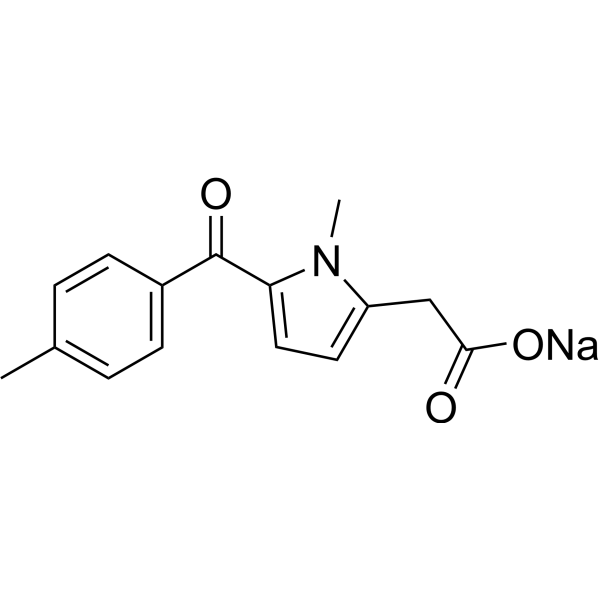
Tolmetin sodium
Based on 1 publication(s) in Google Scholar
Tolmetin sodium is an orally active and potent COX inhibitor with IC50s of 0.35 μM and 0.82 μM human COX-1 and COX-2, respectively. Tolmetin sodium is a non-steroidal anti-inflammatory drug (NSAID).
For research use only. We do not sell to patients.
- CAS No.: 35711-34-3
- Formula: C15H14NNaO3
- Molecular Weight:279.27
-
Storage:
Please store the product under the recommended conditions in the Certificate of Analysis.

To place orders, for customer services and technical support, please contact: MedChemExpress USA
Tel: 609-228-6898 E-mail: [email protected] [email protected]


-
 Biological Activity
-
Chemical Information
- Protocols
- Purity & Documentation
- References
-
 Help & FAQs


Publications Citing Use of MedChemExpress (MCE) Tolmetin sodium
More

Biological Activity
Description
IC50 & Target
[1]|
Human COX-1 0.35 μM (IC50) |
Human COX-2 0.82 μM (IC50) |
In Vitro
Tolmetin sodium (0.25 mM) does not attenuate lipid peroxidation in rat brain homogenate. Tolmetin (0.25, 0.5, 0.75, 1 mM) shows radical scavenging properties but without superoxide anion generation in rat brain homogenat[3].
Tolmetin sodium (0.001-100 μM) shows anticancer activity againts HT-29 colon cancer cell line in a dose-dependent manner[4].
Tolmetin sodium (0-100 μM) shows no effect on osteoblast growth[5].
MedChemExpress (MCE) has not independently confirmed the accuracy of these methods. They are for reference only.
In Vivo
Tolmetin sodium (5 mg/kg twice a day for 5 days) pre-treatment considerably attenuates quinolinic acid (QA)-induced neurotoxicity[3].
MedChemExpress (MCE) has not independently confirmed the accuracy of these methods. They are for reference only.


Chemical Information
-
CAS No. 35711-34-3
-
Molecular Weight 279.27
-
Formula C15H14NNaO3
-
SMILES
O=C(CC1=CC=C(N1C)C(C2=CC=C(C)C=C2)=O)O[Na]
-
Shipping
Room temperature in continental US; may vary elsewhere.
-
Storage
Please store the product under the recommended conditions in the Certificate of Analysis.


Publications (1)
-
Journal Impact Factor
-
Most Recent


Purity & Documentation
References
[1]. T D Warner, et al. Nonsteroid drug selectivities for cyclo-oxygenase-1 rather than cyclo-oxygenase-2 are associated with human gastrointestinal toxicity: a full in vitro analysis. Proc Natl Acad Sci U S A. 1999 Jun 22;96(13):7563-8. [Content Brief]
[2]. Etcheverry SB, et al. Three new vanadyl(IV) complexes with non-steroidal anti-inflammatory drugs (Ibuprofen, Naproxen and Tolmetin). Bioactivity on osteoblast-like cells in culture. J Inorg Biochem. 2002 Jan 1;88(1):94-100. [Content Brief]

Calculators
Concentration (start) × Volume (start) = Concentration (final) × Volume (final)


Tolmetin sodium Related Classifications
HY-B1799A Related Classifications
 Powered by Bioz