



Zomepirac sodium salt

Based on 1 Customer Validation
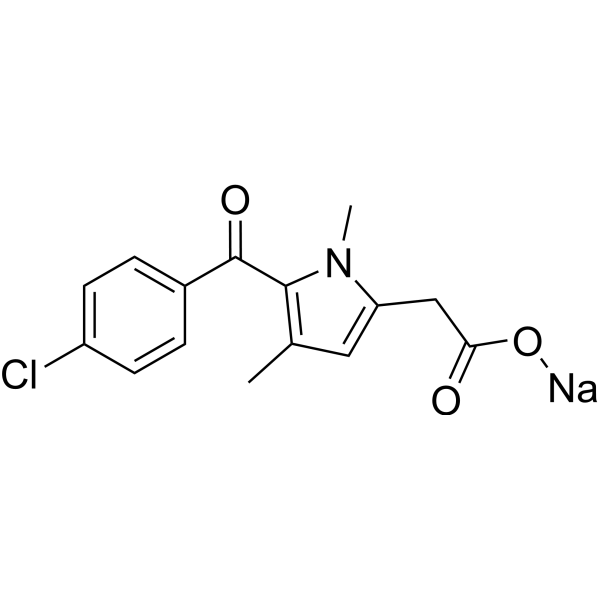
Zomepirac sodium salt (McN-2783-21-98) is an orally active prostaglandin synthetase inhibitor. Zomepirac sodium salt blocks prostaglandin synthesis and inhibits Collagen (HY-P72147)- or Epinephrine (HY-B0447)-induced platelet aggregation. Zomepirac sodium salt can be used for the research of postoperative pain and osteoarthritis.
For research use only. We do not sell to patients.
- Purity : 99.67%
- CAS No.: 64092-48-4
- Formula: C15H13ClNNaO3
- Molecular Weight:313.71
-
Storage:
4°C, sealed storage, away from moisture
* In solvent : -80°C, 6 months; -20°C, 1 month (sealed storage, away from moisture)

To place orders, for customer services and technical support, please contact: MedChemExpress USA
Tel: 609-228-6898 E-mail: [email protected] [email protected]


-
 Biological Activity
-
Chemical Information
-
Solvent & Solubility
- Purity & Documentation
- References
-
 Help & FAQs





Biological Activity
Description
In Vitro
Zomepirac sodium salt potently inhibits prostaglandin synthesis in homogenised bovine seminal vesicles[3].
Zomepirac sodium salt potently inhibits Collagen (HY-NP003)-induced aggregation of human platelets in vitro[3].
Zomepirac (0.1-10 μg/mL) sodium salt is 98.5% bound to human plasma albumin in vitro[3].
MedChemExpress (MCE) has not independently confirmed the accuracy of these methods. They are for reference only.
In Vivo
Zomepirac (5 mg/kg; p.o.; 3 times daily; 3 days) sodium salt shows no physical dependence liability in the mouse Naloxone (HY-17417A) challenge jumping test[3].
Zomepirac (p.o.) sodium salt exhibits potent acute anti-inflammatory activity in the Carrageenan (HY-125474)-induced paw oedema test in rats, with an oral ED50 of 0.15 mg/kg[3].
Zomepirac (p.o.) sodium salt exhibits anti-inflammatory activity in the acute adjuvant-induced arthritis test in rats, with an oral ED50 of 3.9 mg/kg[3].
Zomepirac (p.o.) sodium salt exhibits analgesic activity in the chronic adjuvant-induced arthritis test in rats, with an oral ED50 of 16.6 mg/kg[3].
Zomepirac (p.o.) sodium salt has ulcerogenic activity in Rattus norvegicus rats, with an oral median ulcerogenic dose (UD50) of 13.9 mg/kg[3].
Zomepirac (0.3-3 mg/kg; i.v.) sodium salt reduces cerebrospinal fluid prostaglandin E2 concentrations by ~96% in conscious cats, with effects lasting up to 5 days[3].
Zomepirac (2-6 mg/kg; i.v.) sodium salt substantially reduces spinothalamic tract cell responses to nociceptive stimuli in anaesthetised rhesus monkeys[3].
Zomepirac (20 mg/kg; i.v.) sodium salt has minimal impact on renal haemodynamics and function in anaesthetised rhesus monkeys[3].
Zomepirac (10-40 mg/kg; p.o.; daily; 12 months) sodium salt causes interstitial nephritis in monkeys[3].
Zomepirac (p.o.; daily; 24 months) sodium salt increases the incidence of adrenal tumours and hyperplasia in rats[3].
Zomepirac (p.o.; daily; 18 months) sodium salt does not cause carcinogenicity in mice[3].
MedChemExpress (MCE) has not independently confirmed the accuracy of these methods. They are for reference only.
-
Animal Model:Mice (Naloxone challenge jumping model)[3]
-
Dosage:5 mg/kg
-
Administration:p.o.; 3 times daily; 3 days
-
Result:Showed no jumping after naloxone challenge, whereas morphine-pretreated mice showed significant jumping behavior.
-
Animal Model:Cats[3]
-
Dosage:0.3 mg/kg; 3 mg/kg
-
Administration:i.v.
-
Result:Reduced cerebrospinal fluid immunoreactive prostaglandin E2 concentrations by approximately 96%.
Concentrations remained depressed for up to 5 days and returned to control values within 7 days.
-
Animal Model:Monkeys[3]
-
Dosage:2 mg/kg; 6 mg/kg
-
Administration:i.v.
-
Result:Produced a substantial reduction in spinothalamic tract cell responses to mechanical, thermal, and algesic chemical stimuli.
-
Animal Model:Monkeys[3]
-
Dosage:20 mg/kg
-
Administration:i.v.
-
Result:Had little effect on renal blood flow, and no effect on inulin clearance or urinary excretion of sodium and potassium.
-
Animal Model:Monkeys[3]
-
Dosage:10 mg/kg; 40 mg/kg
-
Administration:p.o.; daily for 12 months
-
Result:Caused multifocal nephritis characterised by interstitial scarring at 40 mg/kg daily; caused milder interstitial nephritis and oedema at 10 mg/kg daily.


Chemical Information
-
CAS No. 64092-48-4
-
Appearance Powder
-
Molecular Weight 313.71
-
Formula C15H13ClNNaO3
-
Color Light yellow to yellow
-
SMILES
O=C(O[Na])CC1=CC(C)=C(C(C2=CC=C(Cl)C=C2)=O)N1C
-
Synonyms
McN-2783-21-98
-
Shipping
Room temperature in continental US; may vary elsewhere.
-
Storage
4°C, sealed storage, away from moisture
* In solvent : -80°C, 6 months; -20°C, 1 month (sealed storage, away from moisture)


Solvent & Solubility
In Vitro:
DMSO : 100 mg/mL (318.77 mM; Need ultrasonic; Hygroscopic DMSO has a significant impact on the solubility of product, please use newly opened DMSO)
H2O : 5 mg/mL (15.94 mM; Need ultrasonic)
Please refer to the solubility information to select the appropriate solvent. Once prepared, please aliquot and store the solution to prevent product inactivation from repeated freeze-thaw cycles.
Storage method and period of stock solution: -80°C, 6 months; -20°C, 1 month (sealed storage, away from moisture). When stored at -80°C, please use it within 6 months. When stored at -20°C, please use it within 1 month.
* Note: If you choose water as the stock solution, please dilute it to the working solution, then filter and sterilize it with a 0.22 μm filter before use.
Please refer to the solubility information to select the appropriate solvent. Once prepared, please aliquot and store the solution to prevent product inactivation from repeated freeze-thaw cycles.
Storage method and period of stock solution: -80°C, 6 months; -20°C, 1 month (sealed storage, away from moisture). When stored at -80°C, please use it within 6 months. When stored at -20°C, please use it within 1 month.
* Note: If you choose water as the stock solution, please dilute it to the working solution, then filter and sterilize it with a 0.22 μm filter before use.
Concentration (start) × Volume (start) = Concentration (final) × Volume (final)
In Vivo:
Select the appropriate dissolution method based on your experimental animal and administration route.
- For the following dissolution methods, please ensure to first prepare a clear stock solution using an In Vitro approach and then sequentially add co-solvents:
- To ensure reliable experimental results, the clarified stock solution can be appropriately stored based on storage conditions. As for the working solution for In Vivo experiments, it is recommended to prepare freshly and use it on the same day.
- The percentages shown for the solvents indicate their volumetric ratio in the final prepared solution. If precipitation or phase separation occurs during preparation, heat and/or sonication can be used to aid dissolution.
Add each solvent one by one: 10% DMSO 90% (20% SBE-β-CD in Saline)
Solubility: ≥ 2.5 mg/mL (7.97 mM); Clear solution
This protocol yields a clear solution of ≥ 2.5 mg/mL (saturation unknown).
Taking 1 mL working solution as an example, add 100 μL DMSO stock solution (25.0 mg/mL) to 900 μL 20% SBE-β-CD in Saline, and mix evenly.
Preparation of 20% SBE-β-CD in Saline (4°C, storage for one week): 2 g SBE-β-CD powder is dissolved in 10 mL Saline, completely dissolve until clear.
Add each solvent one by one: 10% DMSO 40% PEG300 5% Tween-80 45% Saline
Solubility: ≥ 2.08 mg/mL (6.63 mM); Clear solution
This protocol yields a clear solution of ≥ 2.08 mg/mL (saturation unknown).
Taking 1 mL working solution as an example, add 100 μL DMSO stock solution (20.8 mg/mL) to 400 μL PEG300, and mix evenly; then add 50 μL Tween-80 and mix evenly; then add 450 μL Saline to adjust the volume to 1 mL.
Preparation of Saline: Dissolve 0.9 g sodium chloride in ddH₂O and dilute to 100 mL to obtain a clear Saline solution.
For the following dissolution methods, please prepare the working solution directly:
It is recommended to prepare fresh solutions and use them promptly within a short period of time.
The percentages shown for the solvents indicate their volumetric ratio in the final prepared solution. If precipitation or phase separation occurs during preparation, heat and/or sonication can be used to aid dissolution.
Add each solvent one by one: PBS
Solubility: 8.33 mg/mL (26.55 mM); Clear solution; Need ultrasonic
In Vivo Dissolution Calculator
Please enter the basic information of animal experiments:
-
-
-
-
Recommended: Prepare an additional quantity of animals to account for potential losses during experiments.
Please enter your animal formula composition:
-
%DMSO +
Recommended: Keep the proportion of DMSO in working solution below 2% if your animal is weak.
-
%+
-
+%Tween-80 + +
-
%Saline +
The co-solvents required include: DMSO, . All of co-solvents are available by MedChemExpress (MCE). , Tween 80. All of co-solvents are available by MedChemExpress (MCE).
Working solution concentration: 0.22 mg/mL
Method for preparing stock solution: mg drug dissolved in μL DMSO. Stock solution concentration: mg/mL. * In solvent : -80°C, 6 months; -20°C, 1 month (sealed storage, away from moisture)
1. Take μL DMSO stock solution;
2. Add μL .
μL , mix evenly;
3. Then add μL Tween 80, mix evenly;
4. Then add μL
Please ensure that the stock solution in the first step is dissolved to a clear state, and add co-solvents in sequence. You can use ultrasonic heating (ultrasonic cleaner, recommended frequency 20-40 kHz), vortexing, etc. to assist dissolution.


Purity & Documentation
-
Data Sheet (278 KB)
-
SDS (480 KB)
- English - EN (480 KB)
- Français - FR (480 KB)
- Deutsch - DE (480 KB)
- Norwegian - NO (480 KB)
- Español - ES (480 KB)
- Swedish - SV (480 KB)
- Italian - IT (480 KB)
- Korean - KR (480 KB)
- Portuguese - PT (480 KB)
-
Handling Instructions (2659 KB)
References
[1]. Lewis JR. Zomepirac sodium. A new nonaddicting analgesic. JAMA. 1981 Jul 24-31;246(4):377-9. [Content Brief]
[2]. Smith PC, et al. Irreversible binding of zomepirac to plasma protein in vitro and in vivo. J Clin Invest. 1986;77(3):934-939. [Content Brief]
[3]. Morley PA, et al. Zomepirac: a review of its pharmacological properties and analgesic efficacy. Drugs. 1982;23(4):250-275. [Content Brief]
[4]. Strom BL, et al. The effect of indication on hypersensitivity reactions associated with zomepirac sodium and other nonsteroidal antiinflammatory drugs. Arthritis Rheum. 1987;30(10):1142-1148. [Content Brief]


Complete Stock Solution Preparation Table
Please refer to the solubility information to select the appropriate solvent. Once prepared, please aliquot and store the solution to prevent product inactivation from repeated freeze-thaw cycles.
Storage method and period of stock solution: -80°C, 6 months; -20°C, 1 month (sealed storage, away from moisture). When stored at -80°C, please use it within 6 months. When stored at -20°C, please use it within 1 month.
| Optional Solvent | Concentration Solvent Mass | 1 mg | 5 mg | 10 mg | 25 mg |
|---|---|---|---|---|---|
| H2O / DMSO | 1 mM | 3.1877 mL | 15.9383 mL | 31.8766 mL | 79.6914 mL |
| 5 mM | 0.6375 mL | 3.1877 mL | 6.3753 mL | 15.9383 mL | |
| 10 mM | 0.3188 mL | 1.5938 mL | 3.1877 mL | 7.9691 mL | |
| 15 mM | 0.2125 mL | 1.0626 mL | 2.1251 mL | 5.3128 mL | |
| DMSO | 20 mM | 0.1594 mL | 0.7969 mL | 1.5938 mL | 3.9846 mL |
| 25 mM | 0.1275 mL | 0.6375 mL | 1.2751 mL | 3.1877 mL | |
| 30 mM | 0.1063 mL | 0.5313 mL | 1.0626 mL | 2.6564 mL | |
| 40 mM | 0.0797 mL | 0.3985 mL | 0.7969 mL | 1.9923 mL | |
| 50 mM | 0.0638 mL | 0.3188 mL | 0.6375 mL | 1.5938 mL | |
| 60 mM | 0.0531 mL | 0.2656 mL | 0.5313 mL | 1.3282 mL | |
| 80 mM | 0.0398 mL | 0.1992 mL | 0.3985 mL | 0.9961 mL | |
| 100 mM | 0.0319 mL | 0.1594 mL | 0.3188 mL | 0.7969 mL |
* Note: If you choose water as the stock solution, please dilute it to the working solution, then filter and sterilize it with a 0.22 μm filter before use.


Zomepirac sodium salt Related Classifications
HY-B0890 Related Classifications
 Powered by Bioz