



Anti-Mouse CTLA-4 Antibody (9D9)
Based on 3 publication(s) in Google Scholar
Anti-Mouse CTLA-4 Antibody (9D9) is an anti-mouse CTLA-4 IgG2b monoclonal antibody. Anti-Mouse CTLA-4 Antibody (9D9) can bind to CTLA-4 and block its binding to B7. Anti-Mouse CTLA-4 Antibody (9D9) enhances T cell function by increasing the ratio of CD8+ T cells to regulatory T cells (Tregs). Anti-Mouse CTLA-4 Antibody (9D9) can be used for research on cancer such as colon cancer and melanoma.
For research use only. We do not sell to patients.
- Purity : 98.91%
- Molecular Weight:147.57 kDa
-
Storage:
Please store the product under the recommended conditions in the Certificate of Analysis.

To place orders, for customer services and technical support, please contact: MedChemExpress USA
Tel: 609-228-6898 E-mail: [email protected] [email protected]


-
 Biological Activity
-
Chemical Information
- Purity & Documentation
- References
-
 Help & FAQs


-

HY-P99144
Anti-Mouse PD-1 Antibody (RMP1-14) -

HY-P990679
Rat IgG2a kappa, Isotype Control -
HY-P99982
Mouse IgG2b kappa, Isotype Control -
HY-P99145
Anti-Mouse PD-L1/B7-H1 Antibody (10F.9G2) -
HY-P990145
Anti-Mouse VISTA Antibody (13F3) -
HY-P990821
Anti-Mouse TIM-3 Antibody (RMT3-23) -
HY-P99141
Anti-Mouse LAG-3 Antibody (C9B7W) -
HY-P990155
Anti-Mouse TIGIT Antibody (1G9)
Publications Citing Use of MedChemExpress (MCE) Anti-Mouse CTLA-4 Antibody (9D9)
More Customer Validation & Images

-
In Vivo Efficacy Study

-
IHC

-
WB

-
ELISA

-
In Vivo Efficacy Study


Biological Activity
Description
Isotype
Mouse IgG2b kappa
Recommend Isotype Controls
Species Reactivity
Mouse
IC50 & Target
CTLA-4
In Vitro
Anti-Mouse CTLA-4 Antibody (9D9) (0.1-1000 nM, 2 h) has high binding strength with CTLA-4WT (KD = 15.4 nM) and CTLA-4del36 (KD = 69.6 nM) in HEK293-F cells[1].
Anti-Mouse CTLA-4 Antibody (9D9) (0.01-1000 nM, 1 h) significantly blocks the binding of B7 to CTLA-4 in HEK293-F cells (IC50 = 23.5 nM for ELISA, IC50 = 24.4 nM for cell surface)[1].
MedChemExpress (MCE) has not independently confirmed the accuracy of these methods. They are for reference only.
In Vivo
Anti-Mouse CTLA-4 Antibody (9D9) (100 μg/dose, i.p., on day 3, 6 and 9) has significant anti-tumor activity and prolongs survival in male C57BL/6 mice bearing B16-F10 tumors[2].
MedChemExpress (MCE) has not independently confirmed the accuracy of these methods. They are for reference only.
-
Animal Model:1 M MC38 cells injected female C57BL/6 mice (6-8 weeks)[1]
-
Dosage:200 μg
-
Administration:Intraperitoneal injection (i.p.) or intratumoral injection (i.t.), on day 7, 10 and 14
-
Result:Achieved a cure rate of 47 % (i.t.) or 33 % (i.p.).
Exhausted intratumoral Tregs and activates lymph node T cells.
-
Animal Model:2.5×10⁴ B16-F10 cells injected male C57BL/6 mice (6 weeks)[2]
-
Dosage:100 μg/dose, combined with MGN1703
-
Administration:Intraperitoneal injection (i.p.), on day 3, 6 and 9
-
Result:Cured 50% of mice and prolongs survival time.
Gene ID
Accession
Conjugated
Unconjugated
Reconsititution
The product can be reconstituted/diluted with sterile PBS or saline.
Application
in vivo CTLA-4 neutralization; Western blot; in vivo intra-tumoral regulatory T cell depletion
Verified Bioactivity
-
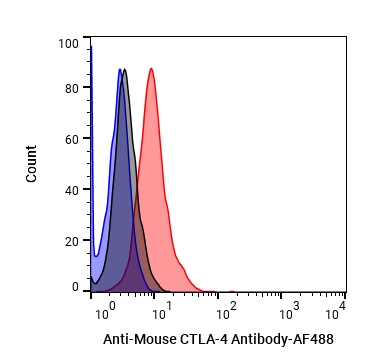 Flow Cytometry analysis of Raji cells labelling CTLA4 (red) with Anti-Mouse CTLA-4 Antibody (HY-P99132). Cells were fixed with 4% paraformaldehyde and permeabilised with 90% methanol. Then cells were stained with the primary antibody at 1/200 dilution for an hour at 4℃. Goat Anti-Mouse IgG H&L (AF488) (HY-P8005) was used as the secondary antibody at 1/1,000 dilution for 30 minutes at 4℃. Mouse IgG2b kappa (HY-P99982, blue) was used as the isotype control, cells without incubation with primary antibody were used as the unlabeled control (black).
 -
 Immobilized CTLA-4 Protein, Mouse (HEK293, His, HY-P71991) can bind Anti-Mouse CTLA-4 Antibody (9D9). The EC50 for this effect is 1.979 ng/mL.


Chemical Information
-
Appearance Liquid
-
Molecular Weight 147.57 kDa
-
Color Colorless to light yellow
-
SMILES
[Anti-Mouse CTLA-4 Antibody (9D9)]
-
Shipping
Shipping with dry ice.
-
Formulation
Please refer to the lot-specific COA for specific buffer information.
-
Storage
Please store the product under the recommended conditions in the Certificate of Analysis.


Publications (3)
-
Journal Impact Factor
-
Most Recent
-
Cancer Commun (Lond)
Radiotherapy-resistant prostate cancer cells escape immune checkpoint blockade through the senescence-related ataxia telangiectasia and Rad3-related protein. [Abstract]2025 Mar;45(3):218-244. PMID: 39698847
Anti-Mouse CTLA-4 Antibody (9D9) purchased from MedChemExpress. Usage Cited in: Cancer Commun (Lond). 2025 Mar;45(3):218-244. [Abstract]
Anti-Mouse CTLA-4 Antibody (9D9) (200 μg; IP; on days 7, 10, and 13) showed RT-resistant tumors implanted in WT mice exhibited slow growth and did not respond to treatment with anti-Ctla-4 antibodies, in contrast to the control tumors, which were sensitive to this antibody treatment. The survival data revealed that the RT-resistant group had slightly prolonged survival but didn’t sensitive to immunotherapy.
-
Nat Commun
NIR-IIb fluorescence ratiometric imaging of tumor-associated neutrophils for immunotherapy efficacy monitoring and strategy optimization. [Abstract]2025 Dec 5;16(1):10880. PMID: 41350535 -
Cancer Sci
UBE2C-Mediated CD147-CTLA-4 Axis Promotes T Cell Exhaustion and Immunosuppressive Microenvironment in Bladder Cancer. [Abstract]2026 May 27. PMID: 42203671
Anti-Mouse CTLA-4 Antibody (9D9) purchased from MedChemExpress. Usage Cited in: Cancer Sci. 2026 May 27. [Abstract]
Anti-Mouse CTLA-4 Antibody (9D9) (200 μg; peritumoral injection; at d7, d10, and d13) decreased the tumor weight C57BL/6 mouse BCa model.
Anti-Mouse CTLA-4 Antibody (9D9) purchased from MedChemExpress. Usage Cited in: Cancer Sci. 2026 May 27. [Abstract]
Anti-Mouse CTLA-4 Antibody (9D9) (200 μg; peritumoral injection; at d7, d10, and d13) decreased the protein expression of UBE2C and CTLA-4 in tumor tissues of C57BL/6 mouse BCa model.
Anti-Mouse CTLA-4 Antibody (9D9) purchased from MedChemExpress. Usage Cited in: Cancer Sci. 2026 May 27. [Abstract]
Anti-Mouse CTLA-4 Antibody (9D9) (200 μg; peritumoral injection; at d7, d10, and d13) decreased the protein expression of UBE2C and CTLA-4,LAG-3, PD-1 in tumor tissues of C57BL/6 mouse BCa model.
Anti-Mouse CTLA-4 Antibody (9D9) purchased from MedChemExpress. Usage Cited in: Cancer Sci. 2026 May 27. [Abstract]
Anti-Mouse CTLA-4 Antibody (9D9) (200 μg; peritumoral injection; at d7, d10, and d13) increased IFN-γ and TNF-α expression and decreased TGF-β in the blood of the C57BL/6 mouse BCa model.


Purity & Documentation
-
Data Sheet (262 KB)
-
SDS (251 KB)
- English - EN (251 KB)
- Français - FR (251 KB)
- Deutsch - DE (251 KB)
- Norwegian - NO (251 KB)
- Español - ES (251 KB)
- Swedish - SV (251 KB)
- Italian - IT (251 KB)
- Korean - KR (251 KB)
- Portuguese - PT (251 KB)
-
Inhibitory Antibodies User Guide (603 KB)
References
[1]. Lax BM, et al. Both intratumoral regulatory T cell depletion and CTLA-4 antagonism are required for maximum efficacy of anti-CTLA-4 antibodies. Proc Natl Acad Sci U S A. 2023 Aug;120(31):e2300895120. [Content Brief]
[2]. Reilley MJ, et al. TLR9 activation cooperates with T cell checkpoint blockade to regress poorly immunogenic melanoma. J Immunother Cancer. 2019 Nov 26;7(1):323. [Content Brief]

Calculators
Concentration (start) × Volume (start) = Concentration (final) × Volume (final)


Anti-Mouse CTLA-4 Antibody (9D9) Related Classifications
HY-P99132 Related Classifications
 Powered by Bioz