



Antimalarial agent 25
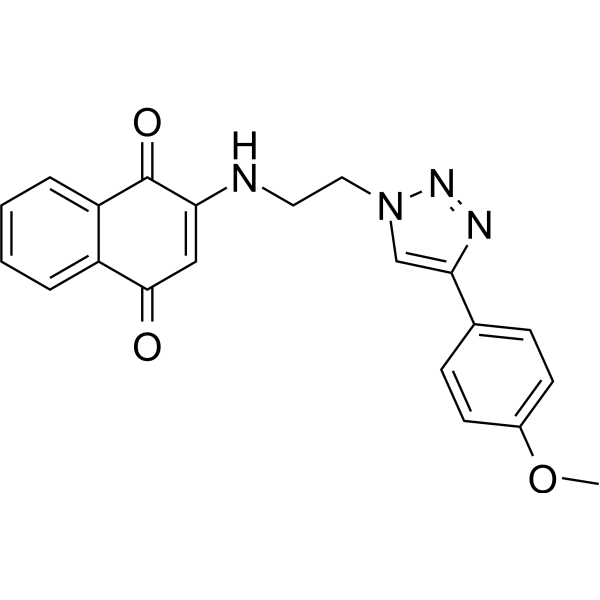
Antimalarial agent 25 is an orally active 1,4-naphthoquinones derivative with antimalarial activity. Antimalarial agent 25 shows cytotoxicity against P. falciparum. Antimalarial agent 25 inhibits P. burghei induced parasitemia in vivo.
Nos produits utilisent uniquement pour la recherche. Nous ne vendons pas aux patients.
- CAS No.: 2944456-41-9
- Formule: C21H18N4O3
- Masse moléculaire:374.39
-
Stockage:
Please store the product under the recommended conditions in the Certificate of Analysis.

To place orders, for customer services and technical support, please contact: MedChemExpress USA
Tel: 609-228-6898 E-mail: [email protected] [email protected]


-
 Activité biologique
-
Chemical Information
- Protocole
- Pureté et documentation
- Références
-
 Help & FAQs


Voir tous les produits spécifiques à Isoform Parasite
More

Activité biologique
Description
Cellular Effect
|
Cell Line

|
Type | Value | Description | References |
|---|---|---|---|---|
| HepG2 | CC50 |
289.2 μM
Compound: 8
|
Cytotoxicity against human HepG2 cells incubated for 24 hrs by MTT assay
Cytotoxicity against human HepG2 cells incubated for 24 hrs by MTT assay
|
[PMID: 37130472] |
| Vero | CC50 |
400.6 μM
Compound: 8
|
Cytotoxicity against African green monkey Vero cells incubated for 24 hrs by MTT assay
Cytotoxicity against African green monkey Vero cells incubated for 24 hrs by MTT assay
|
[PMID: 37130472] |
In Vitro
Antimalarial agent 25 (compound 8) inhibits P. falciparum with IC50 of 4.2 μM, while shows CC50 on mammalian cells with CC50s of 289.2 μM (HepG2), and 400.6 μM (Vero), respectively[1].
Antimalarial agent 25 (compound 8) (15.62-1000 μM; 2 h) shows hemolytic activity below 40% at concentrations from 15.6 to 250 μM in uninfected human erythrocytes[1].
Antimalarial agent 25 (compound 8) (30-0.411 μg/mL; 48 h) causes morphological changes such as complete cytoplasmic degradation and loss of membrane integrity in the W2 strain of P. falciparum[1].
MedChemExpress (MCE) has not independently confirmed the accuracy of these methods. They are for reference only. Further protocols information, click here.
-
Cell Line:W2 strain of P. falciparum (CQ-resistant)
-
Concentration:30 - 0.411 μg/mL
-
Incubation Time:48 h
-
Result:Presented completely degraded cytoplasm with loss of membrane integrity, dense cytoplasm with some possible undefined organelles in degenerating stage, and a possible deteriorated food vacuole.
In Vivo
MedChemExpress (MCE) has not independently confirmed the accuracy of these methods. They are for reference only.
-
Animal Model:Mice infected with Plasmodium berghei ANKA[1]
-
Dosage:30 mg/kg
-
Administration:Oral administration; for 4 consecutive days
-
Result:Partly reduced P. berghei infection.
Parasitemia decreased by 33% on the seventh day (post-treatment).


Chemical Information
-
CAS No. 2944456-41-9
-
Masse moléculaire 374.39
-
Formule C21H18N4O3
-
SMILES
COC1=CC=C(C=C1)C2=CN(N=N2)CCNC3=CC(C4=CC=CC=C4C3=O)=O
-
Livraison
Room temperature in continental US; may vary elsewhere.
-
Stockage
Please store the product under the recommended conditions in the Certificate of Analysis.

Protocole
-
Cell Cytotoxicity Assay
Cytotoxicity assays are usually based on the assessment of cell membrane damage, which can also be indirectly detected by measuring cell viability. Detection methods include MTT assay, CKK-8 assay, LDH assay and ATP assay, etc.
-
Mammalian live/dead viability and cytotoxicity staining
Live/dead viability and cytotoxicity staining assays are based on the simultaneous detection of intracellular esterase activity in metabolically active (viable) cells and membrane integrity loss in non-viable cells. In commonly used dual-staining approaches, membrane-permeant fluorogenic substrates are converted by intracellular esterases into fluorescent products in live cells, while impermeant DNA-binding dyes selectively enter cells with compromised plasma membranes and label nucleic acids in dead or dying cells, enabling discrimination between viable and non-viable populations by fluorescence microscopy or flow cytometry.
-
Cell Viability Determination by MTT Colorimetric Assay
The following protocol uses the MTT colorimetric assay as a classic literature-established method for assessing cell viability/metabolic activity in cultured mammalian cells. MTT[3-(4,5-dimethylthiazol-2-yl)-2,5-diphenyltetrazolium bromide] is reduced by metabolically active cells to a colored formazan product; the amount of formazan is quantified spectrophotometrically and provides an indirect measure of metabolically active viable cells. Importantly, MTT reduction reflects cellular oxidoreductase/metabolic activity rather than an absolute direct count of living cells, so changes in cellular metabolism can alter the signal independently of cell number.


Pureté et documentation
Références

Calculators
Concentration (start) × Volume (start) = Concentration (final) × Volume (final)


Antimalarial agent 25 Related Classifications
HY-149938 Related Classifications
 Powered by Bioz