



Pyocyanin (Standard)
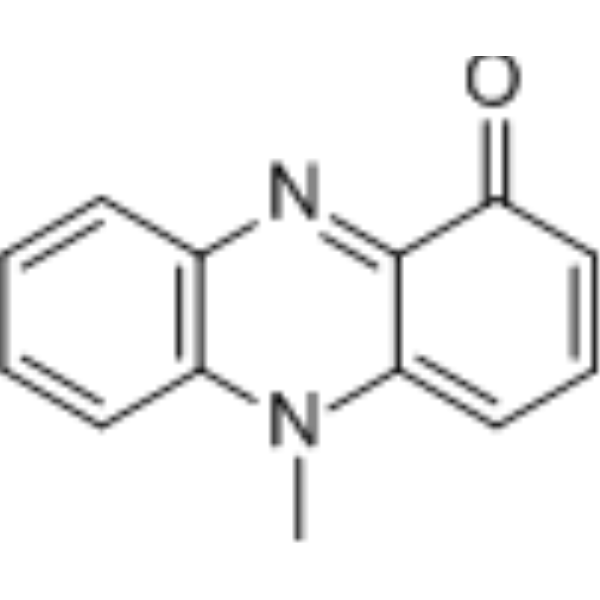
Pyocyanin (Standard) is the analytical standard of Pyocyanin. This product is intended for research and analytical applications. Pyocyanin (Pyocyanine) is a toxic, quorum sensing (QS) controlled metabolite produced by Pseudomonas aeruginosa. Pyocyanin is a REDOX active compound that promotes the production of reactive oxygen species (ROS). Pyocyanin has antibacterial and anti-inflammatory activity[1][2][3][4].
Nos produits utilisent uniquement pour la recherche. Nous ne vendons pas aux patients.
- CAS No.: 85-66-5
- Formule: C13H10N2O
- Masse moléculaire:210.23
-
Stockage:
Please store the product under the recommended conditions in the Certificate of Analysis.


To place orders, for customer services and technical support, please contact: MedChemExpress USA
Tel: 609-228-6898 E-mail: [email protected] [email protected]


-
 Product Information
-
Chemical Information
- Pureté et documentation
-
 Help & FAQs




Product Information
The compound is the grade of analytical standard, which is the reference standard supplied assay. It is commonly used in qualitative, quantitative and methodological research experiments in HPLC, GC and MS.


Chemical Information
-
CAS No. 85-66-5
-
Masse moléculaire 210.23
-
Formule C13H10N2O
-
SMILES
O=C1C=CC=C2N(C)C3=C(N=C21)C=CC=C3
-
Synonyms
Pyocyanine (Standard); Sanazin (Standard); Sanasin (Standard)
-
Initial Source
-
Livraison
Room temperature in continental US; may vary elsewhere.
-
Stockage
Please store the product under the recommended conditions in the Certificate of Analysis.


Pureté et documentation
Références
[1]. Paulina Castañeda-Tamez, et al. Pyocyanin Restricts Social Cheating in Pseudomonas aeruginosa. Front Microbiol. 2018 Jun 27;9:1348. [Content Brief]
[2]. Marreiro de Sales-Neto J, et al. Anti-inflammatory potential of pyocyanin in LPS-stimulated murine macrophages. Immunopharmacol Immunotoxicol. 2019 Feb;41(1):102-108. [Content Brief]
[3]. Kamer AMA, et al. Antibacterial, antibiofilm, and anti-quorum sensing activities of pyocyanin against methicillin-resistant Staphylococcus aureus: in vitro and in vivo study. BMC Microbiol. 2023 Apr 24;23(1):116. [Content Brief]
[4]. Arora D, et al. Pyocyanin induces systemic oxidative stress, inflammation and behavioral changes in vivo. Toxicol Mech Methods. 2018 Jul;28(6):410-414. [Content Brief]

Calculators
Concentration (start) × Volume (start) = Concentration (final) × Volume (final)


Pyocyanin (Standard) Related Classifications
HY-111278R Related Classifications
 Powered by Bioz