



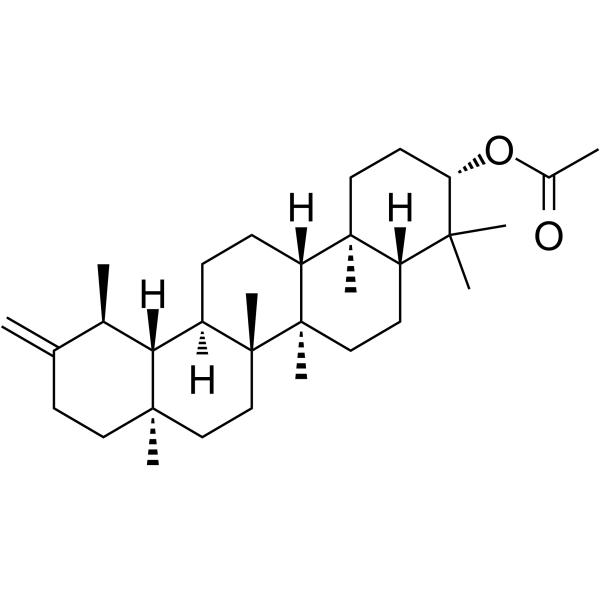
Taraxasteryl acetate

Based on 1 Customer Validation
Taraxasteryl acetate is isolated from P. sagittalis,and has a broad spectrum of anti-inflammatory activity. Taraxasterol acetate promotes RNF31 degradation by activating autophagy. Taraxasteryl acetate relieves dextran, zymosan and arachidonic acid induced rat hind-paw edema. Taraxasteryl acetate can be used for the topical inflammation treatment[1][2].
Nos produits utilisent uniquement pour la recherche. Nous ne vendons pas aux patients.
- Pureté: 98.74%
- CAS No.: 6426-43-3
- Formule: C32H52O2
- Masse moléculaire:468.75
-
Stockage:
4°C, protect from light
* In solvent : -80°C, 6 months; -20°C, 1 month (protect from light)

To place orders, for customer services and technical support, please contact: MedChemExpress USA
Tel: 609-228-6898 E-mail: [email protected] [email protected]


-
 Activité biologique
-
Chemical Information
-
Solvant et solubilité
- Pureté et documentation
- Références
-
 Help & FAQs



Voir tous les produits spécifiques à Isoform Parasite
More

Activité biologique


Chemical Information
-
CAS No. 6426-43-3
-
Appearance Solid
-
Masse moléculaire 468.75
-
Formule C32H52O2
-
Color White to off-white
-
SMILES
C[C@]12[C@]3([C@@](CC[C@]1([H])[C@@]4([C@@](C(C)([C@@H](OC(C)=O)CC4)C)([H])CC2)C)([H])[C@]([C@@H]5C)([H])[C@](C)(CCC5=C)CC3)C
-
Structure Classification
-
Initial Source
-
Livraison
Room temperature in continental US; may vary elsewhere.
-
Stockage
4°C, protect from light
* In solvent : -80°C, 6 months; -20°C, 1 month (protect from light)


Solvant et solubilité
DMSO : < 1 mg/mL (insoluble or slightly soluble)
H2O : < 0.1 mg/mL (insoluble)


Pureté et documentation
-
Fiche technique (269 KB)
-
SDS (252 KB)
- English - EN (252 KB)
- Français - FR (252 KB)
- Deutsch - DE (252 KB)
- Norwegian - NO (252 KB)
- Español - ES (252 KB)
- Swedish - SV (252 KB)
- Italian - IT (252 KB)
- Korean - KR (252 KB)
- Portuguese - PT (252 KB)
-
Instruction de manipulation (2659 KB)
Références
[1]. Pérez-García F, et al. Activity of taraxasteryl acetate on inflammation and heat shock protein synthesis.Phytomedicine. 2005 Apr;12(4):278-84. [Content Brief]
[2]. Chao-Tao Tang, et al. Taraxasterol acetate targets RNF31 to inhibit RNF31/p53 axis-driven cell proliferation in colorectal cancer. Cell Death Discov. 2021 Apr 6;7(1):66. [Content Brief]

Calculators
Concentration (start) × Volume (start) = Concentration (final) × Volume (final)


Taraxasteryl acetate Related Classifications
HY-N2478 Related Classifications
 Powered by Bioz