



Pirenzepine
Based on 5 publication(s) in Google Scholar
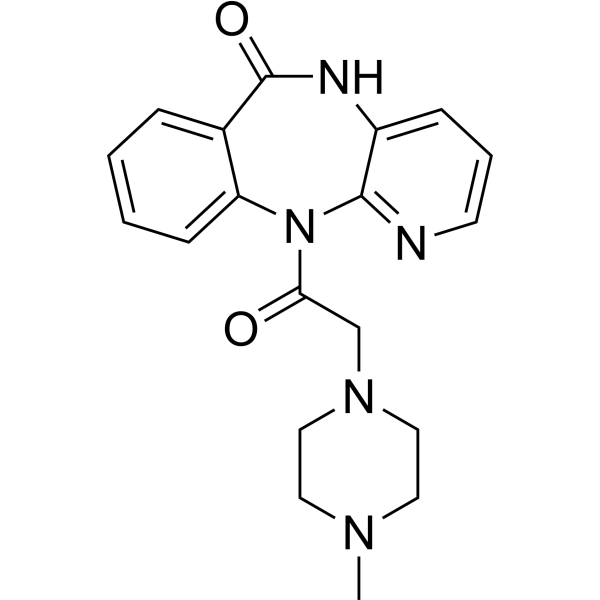
Pirenzepine (LS 519 free base) is a selective M1 mAChR (muscarinic acetylcholine receptor) antagonist, with poor penetration of the blood-brain barrier. Pirenzepine reduces gastric acid secretion and reduces muscle spasm, can be used in peptic ulcers research. Pirenzepine shows anti-proliferative activity to cancer cells.
Nur für Forschungszwecke. Wir verkaufen nicht an Patienten.
- Reinheit: 99.13%
- CAS. Nr.: 28797-61-7
- Formel: C19H21N5O2
- Molecular Weight:351.40
-
Speicherung:Powder -20°C, 3 years , 4°C, 2 years ; In solvent -80°C, 6 months , -20°C, 1 month

To place orders, for customer services and technical support, please contact: MedChemExpress USA
Tel: 609-228-6898 E-mail: [email protected] [email protected]


-
 Biologische Aktivität
-
Chemical Information
-
Lösungsmittel & Löslichkeit
- Reinheit & Dokumentation
- Verweise
-
 Help & FAQs
-

GPCR/G Protein Compound Library
HY-L006
-
Neuronal Signaling Compound Library
HY-L013
-
FDA-Approved Drug Library
HY-L022
-
Anti-Cancer Compound Library
HY-L025
-
Drug Repurposing Compound Library
HY-L035
-
Neurotransmitter Receptor Compound Library
HY-L062
-
FDA Approved & Pharmacopeial Drug Library
HY-L066
-
Anti-Lung Cancer Compound Library
HY-L075
-
Anti-Parkinson's Disease Compound Library
HY-L085
-
Neurodegenerative Disease-related Compound Library
HY-L086
-
FDA-Approved Anticancer Drug Library
HY-L122
-
Human Metabolite Library
HY-L123
-
Heterocyclic Compound Library
HY-L138
-
Off-patent Drug Library
HY-L141
-
Membrane Protein-targeted Compound Library
HY-L149
-
Membrane Receptor-targeted Compound Library
HY-L150
-
Highly Selective Inhibitors Library
HY-L158
-
Bioactive Compound Library Max
HY-L181
-
MCE Bioactive Compound Library
HY-L001V
-
Drug Repurposing Compound Library Plus
HY-L035P
-
FDA-Approved Drug Library Plus
HY-L022P
-
FDA-Approved Drug Library Mini
HY-L022M
-
Bioactive Compound Library
HY-L001
-
Anti-Gastric Cancer Compound Library
HY-L184
-
High-Throughput Bioactive Compound Library
HY-L205
-
Mass Spectrometry Human Metabolite Library
HY-L215
-
Chinese Baijiu Compound Library
HY-L241
-
Lactylation Compound Library
HY-L249


Publications Citing Use of MedChemExpress (MCE) Pirenzepine
More

Biologische Aktivität
|
Cell Line

|
Type | Value | Description | References |
|---|---|---|---|---|
| CHO | IC50 |
119 nM
Compound: pirenzepine
|
Compound was tested for its binding affinity against M1 human recombinant muscarinic receptor in CHO cells.
Compound was tested for its binding affinity against M1 human recombinant muscarinic receptor in CHO cells.
|
[PMID: 10522693] |
| CHO | IC50 |
2.1 x 10⁻⁸ M
Compound: Pirenzepine
|
Displacement of [3H]pirenzepine from human recombinant muscarinic M1 receptor expressed in CHO cells
Displacement of [3H]pirenzepine from human recombinant muscarinic M1 receptor expressed in CHO cells
|
[PMID: 26988801] |
| CHO | IC50 |
2.1 x 10⁻⁸ M
Compound: Pirenzepine
|
Displacement of [3H]pirenzepine from human recombinant M1 receptor expressed in CHO cells measured after 60 mins by scintillation counting method
Displacement of [3H]pirenzepine from human recombinant M1 receptor expressed in CHO cells measured after 60 mins by scintillation counting method
|
[PMID: 27876250] |
| CHO | IC50 |
246.8 nM
Compound: pirenzepine
|
Displacement of [3H]NMS binding to human Muscarinic acetylcholine receptor M4 using membranes from transfected CHO cells
Displacement of [3H]NMS binding to human Muscarinic acetylcholine receptor M4 using membranes from transfected CHO cells
|
[PMID: 9986705] |
| CHO | IC50 |
28.2 nM
Compound: pirenzepine
|
Displacement of [3H]NMS binding to human Muscarinic acetylcholine receptor M1 using membranes from transfected CHO cells
Displacement of [3H]NMS binding to human Muscarinic acetylcholine receptor M1 using membranes from transfected CHO cells
|
[PMID: 9986705] |
| CHO | IC50 |
340.6 nM
Compound: pirenzepine
|
Displacement of [3H]NMS binding to human Muscarinic acetylcholine receptor M5 using membranes from transfected CHO cells
Displacement of [3H]NMS binding to human Muscarinic acetylcholine receptor M5 using membranes from transfected CHO cells
|
[PMID: 9986705] |
| CHO | IC50 |
955.6 nM
Compound: pirenzepine
|
Displacement of [3H]-NMS binding to human Muscarinic acetylcholine receptor M3 using membranes from transfected CHO cells
Displacement of [3H]-NMS binding to human Muscarinic acetylcholine receptor M3 using membranes from transfected CHO cells
|
[PMID: 9986705] |
| CHO | IC50 |
968.2 nM
Compound: pirenzepine
|
Displacement of [3H]NMS binding to human Muscarinic acetylcholine receptor M2 using membranes from transfected CHO cells
Displacement of [3H]NMS binding to human Muscarinic acetylcholine receptor M2 using membranes from transfected CHO cells
|
[PMID: 9986705] |
Pirenzepine (100-140 μg/mL; 24 h) inhibits PC-3 cell proliferation activity[2].
Pirenzepine (110 μg/mL; 24 h) inhibits prostate and lung cancer cell migration[2].
Pirenzepine (100-130 μg/mL; 0-24 h) inhibits the expression of GLI1 in PC-3 cells[2].
MedChemExpress (MCE) has not independently confirmed the accuracy of these methods. They are for reference only.
-
Cell Line:PC-3 cells
-
Concentration:100-140 μg/mL
-
Incubation Time:24 hours
-
Result:Inhibited PC-3 cell proliferation in a concentration-dependent manner.
-
Cell Line:PC-3 and A549 cells
-
Concentration:110 μg/mL
-
Incubation Time:24 hours
-
Result:Inhibited the migration of PC-3 and A549 cell lines (P=0.014).
-
Cell Line:PC-3 cells
-
Concentration:110 μg/mL
-
Incubation Time:0-24 hours
-
Result:Inhibited the expression of GLI1 and PTCH1.
-
Cell Line:PC-3 cell
-
Concentration:100-130 μg/mL
-
Incubation Time:24 hours
-
Result:Suppressed GLI1 mRNA expression in PC-3 cells.
Increased PTCH1 mRNA level but not reach statistical significance.
Showed no SHH mRNA expression level change.
MedChemExpress (MCE) has not independently confirmed the accuracy of these methods. They are for reference only.
-
Animal Model:Male C57BL/6 mice with experimental endotoxemia[3]
-
Dosage:0.3 mg/kg
-
Administration:Intraperitoneal injection; 0.3 mg/kg; once
-
Result:Improved survival rate of LPS-induced septic shock.
Relieved LPS-induced pulmonary and hepatic injury.
Reduced the expression of SOCS3 at mRNA level.


Chemical Information
-
CAS. Nr. 28797-61-7
-
Appearance Solid
-
Molecular Weight 351.40
-
Formel C19H21N5O2
-
Color Light yellow to yellow
-
SMILES
O=C1NC2=CC=CN=C2N(C(CN3CCN(C)CC3)=O)C4=CC=CC=C14
-
Synonyms
LS 519 free base; Pirenzepin; Gastrozepin
-
Versand
Room temperature in continental US; may vary elsewhere.
-
Speicherung
Powder -20°C 3 years 4°C 2 years In solvent -80°C 6 months -20°C 1 month


Publications (5)
-
Journal Impact Factor
-
Most Recent
-
Cell Rep
2025 Apr 16;44(5):115572. PMID: 40249703 -
Eur J Med Res
Pirenzepine exhibits anti-prostate cancer activity and enhances checkpoint inhibitor-based immunotherapy by targeting STING. [Abstract]2025 Dec 23;30(1):1250. PMID: 41430631 -
Ther Adv Med Oncol
Repurposing of ivacaftor shows potential to treat ROR1 expressing high-grade serous ovarian cancer. [Abstract]2026 Jan 2:18:17588359251409010. PMID: 41487693 -
Mol Cell Endocrinol
Vagotomy suppresses food intake by increasing GLP-1 secretion via the M3 AChR-AMPKα pathway in mice. [Abstract]2025 Jan 21:599:112464. PMID: 39848433 -


Lösungsmittel & Löslichkeit
DMSO : 100 mg/mL (284.58 mM; ultrasonic and warming and heat to 60°C; Hygroscopic DMSO has a significant impact on the solubility of product, please use newly opened DMSO)
Please refer to the solubility information to select the appropriate solvent. Once prepared, please aliquot and store the solution to prevent product inactivation from repeated freeze-thaw cycles.
Storage method and period of stock solution: -80°C, 6 months; -20°C, 1 month. When stored at -80°C, please use it within 6 months. When stored at -20°C, please use it within 1 month.
Please refer to the solubility information to select the appropriate solvent. Once prepared, please aliquot and store the solution to prevent product inactivation from repeated freeze-thaw cycles.
Storage method and period of stock solution: -80°C, 6 months; -20°C, 1 month. When stored at -80°C, please use it within 6 months. When stored at -20°C, please use it within 1 month.
Konzentration (Stammlösung) × Volumen (Stammlösung) = Konzentration (Ziellösung) × Volumen (Ziellösung)
Select the appropriate dissolution method based on your experimental animal and administration route.
- For the following dissolution methods, please ensure to first prepare a clear stock solution using an In Vitro approach and then sequentially add co-solvents:
- To ensure reliable experimental results, the clarified stock solution can be appropriately stored based on storage conditions. As for the working solution for In Vivo experiments, it is recommended to prepare freshly and use it on the same day.
- The percentages shown for the solvents indicate their volumetric ratio in the final prepared solution. If precipitation or phase separation occurs during preparation, heat and/or sonication can be used to aid dissolution.
Add each solvent one by one: 10% DMSO 40% PEG300 5% Tween-80 45% Saline
Solubility: ≥ 5 mg/mL (14.23 mM); Clear solution
This protocol yields a clear solution of ≥ 5 mg/mL (saturation unknown).
Taking 1 mL working solution as an example, add 100 μL DMSO stock solution (50.0 mg/mL) to 400 μL PEG300, and mix evenly; then add 50 μL Tween-80 and mix evenly; then add 450 μL Saline to adjust the volume to 1 mL.
Preparation of Saline: Dissolve 0.9 g sodium chloride in ddH₂O and dilute to 100 mL to obtain a clear Saline solution.
Add each solvent one by one: 10% DMSO 90% (20% SBE-β-CD in Saline)
Solubility: ≥ 5 mg/mL (14.23 mM); Clear solution
This protocol yields a clear solution of ≥ 5 mg/mL (saturation unknown).
Taking 1 mL working solution as an example, add 100 μL DMSO stock solution (50.0 mg/mL) to 900 μL 20% SBE-β-CD in Saline, and mix evenly.
Preparation of 20% SBE-β-CD in Saline (4°C, storage for one week): 2 g SBE-β-CD powder is dissolved in 10 mL Saline, completely dissolve until clear.
Please enter the basic information of animal experiments:
-
-
-
-
Recommended: Prepare an additional quantity of animals to account for potential losses during experiments.
Please enter your animal formula composition:
-
%DMSO +
Recommended: Keep the proportion of DMSO in working solution below 2% if your animal is weak.
-
%+
-
+%Tween-80 + +
-
%Saline +
The co-solvents required include: DMSO, . All of co-solvents are available by MedChemExpress (MCE). , Tween 80. All of co-solvents are available by MedChemExpress (MCE).
Working solution concentration: 0.22 mg/mL
Method for preparing stock solution: mg drug dissolved in μL DMSO. Stock solution concentration: mg/mL.
1. Take μL DMSO stock solution;
2. Add μL .
μL , mix evenly;
3. Then add μL Tween 80, mix evenly;
4. Then add μL
Please ensure that the stock solution in the first step is dissolved to a clear state, and add co-solvents in sequence. You can use ultrasonic heating (ultrasonic cleaner, recommended frequency 20-40 kHz), vortexing, etc. to assist dissolution.


Reinheit & Dokumentation
-
Data Sheet (282 KB)
-
SDS (393 KB)
- English - EN (393 KB)
- Français - FR (393 KB)
- Deutsch - DE (393 KB)
- Norwegian - NO (393 KB)
- Español - ES (393 KB)
- Swedish - SV (393 KB)
- Italian - IT (393 KB)
- Korean - KR (393 KB)
- Portuguese - PT (393 KB)
-
Handling Instructions (2659 KB)
Verweise
[1]. Carmine AA, et al. Pirenzepine. A review of its pharmacodynamic and pharmacokinetic properties and therapeutic efficacy in peptic ulcer disease and other allied diseases. Drugs. 1985 Aug;30(2):85-126. [Content Brief]
[2]. Yin QQ, et al. Muscarinic acetylcholine receptor M1 mediates prostate cancer cell migration and invasion through hedgehog signaling. Asian J Androl. 2018 Nov-Dec;20(6):608-614. [Content Brief]
[3]. Yabuki Y, et al. The T-type calcium channel enhancer SAK3 inhibits neuronal death following transient brain ischemia via nicotinic acetylcholine receptor stimulation. Neurochem Int. 2017 Sep;108:272-281. [Content Brief]


Complete Stock Solution Preparation Table
Please refer to the solubility information to select the appropriate solvent. Once prepared, please aliquot and store the solution to prevent product inactivation from repeated freeze-thaw cycles.
Storage method and period of stock solution: -80°C, 6 months; -20°C, 1 month. When stored at -80°C, please use it within 6 months. When stored at -20°C, please use it within 1 month.
| Optional Solvent | Concentration Solvent Mass | 1 mg | 5 mg | 10 mg | 25 mg |
|---|---|---|---|---|---|
| DMSO | 1 mM | 2.8458 mL | 14.2288 mL | 28.4576 mL | 71.1440 mL |
| 5 mM | 0.5692 mL | 2.8458 mL | 5.6915 mL | 14.2288 mL | |
| 10 mM | 0.2846 mL | 1.4229 mL | 2.8458 mL | 7.1144 mL | |
| 15 mM | 0.1897 mL | 0.9486 mL | 1.8972 mL | 4.7429 mL | |
| 20 mM | 0.1423 mL | 0.7114 mL | 1.4229 mL | 3.5572 mL | |
| 25 mM | 0.1138 mL | 0.5692 mL | 1.1383 mL | 2.8458 mL | |
| 30 mM | 0.0949 mL | 0.4743 mL | 0.9486 mL | 2.3715 mL | |
| 40 mM | 0.0711 mL | 0.3557 mL | 0.7114 mL | 1.7786 mL | |
| 50 mM | 0.0569 mL | 0.2846 mL | 0.5692 mL | 1.4229 mL | |
| 60 mM | 0.0474 mL | 0.2371 mL | 0.4743 mL | 1.1857 mL | |
| 80 mM | 0.0356 mL | 0.1779 mL | 0.3557 mL | 0.8893 mL | |
| 100 mM | 0.0285 mL | 0.1423 mL | 0.2846 mL | 0.7114 mL |


Pirenzepine Related Classifications
HY-17037A Related Classifications
 Powered by Bioz