



Deoxyartemisinin
Based on 1 publication(s) in Google Scholar
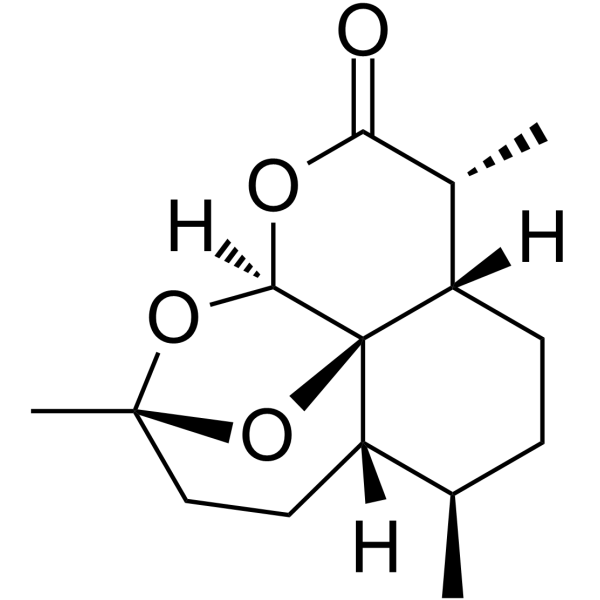
Deoxyartemisinin (2-Deoxyartemisinin) is an orally active anti-inflammatory and analgesic agent. Deoxyartemisinin selectively reduces the level of the pro-inflammatory cytokine TNF-α. Deoxyartemisinin alleviates neuropathic pain, inflammatory pain, and croton oil-induced ear edema.\nDeoxyartemisinin exerts an analgesic effect against thermal stimulation. Deoxyartemisinin has anti-ulcer activity. Deoxyartemisinin can be used in research related to inflammatory diseases, pain, and gastric ulcers.
For research use only. We do not sell to patients.
- Purity : 98.76%
- CAS No.: 72826-63-2
- Formula: C15H22O4
- Molecular Weight:266.33
-
Storage:Powder -20°C, 3 years ; In solvent -80°C, 6 months , -20°C, 1 month

To place orders, for customer services and technical support, please contact: MedChemExpress USA
Tel: 609-228-6898 E-mail: [email protected] [email protected]


-
 Biological Activity
-
Chemical Information
- Protocols
- Purity & Documentation
- References
-
 Help & FAQs


-
HY-119979
Cardanol monoenePhenolic Compound -
HY-N0551
WedelolactoneCaspase-11 And 5-Lox Inhibitor -
HY-B0223S2
Albendazole-d7Stable Isotope -

HY-W702646
Hydroxymethyl tolperisone hydrochloride -

HY-156054
N-Hydroxy riluzoleRiluzole Metabolite -

HY-134290A
8-Chloro-ATP tetrasodiumTopoisomerase II Inhibitor -

HY-34590
3-Amino-2,6-piperidinedioneSynthetic Intermediate -

HY-127059
Clindamycin Sulfoxide -
HY-B0094S
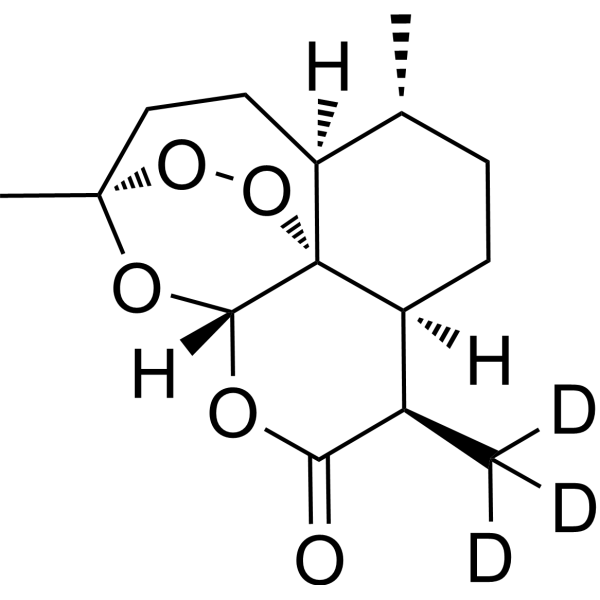
Artemisinin-d3Stable Isotope -

HY-N12230
Penicolinate BPicolinic Acid Derivative -
HY-N8258
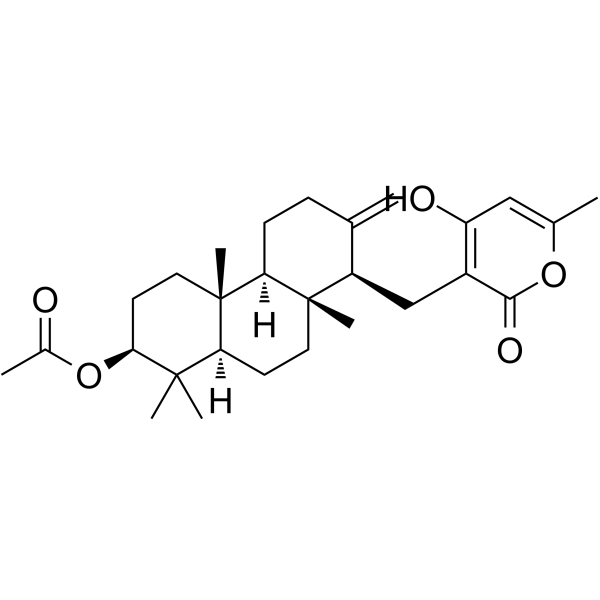
Aszonapyrone AAntifungal Agent -

HY-N0551R
Wedelolactone (Standard)Caspase-11 And 5-Lox Inhibitor
Publications Citing Use of MedChemExpress (MCE) Deoxyartemisinin
More

Biological Activity
Description
Cellular Effect
|
Cell Line

|
Type | Value | Description | References |
|---|---|---|---|---|
| HCT-116 | IC50 |
>50 μM
Compound: DART
|
Antiproliferative activity against human HCT-116 cells assessed as inhibition of cell growth by Cell-titer Glo luminescent assay
Antiproliferative activity against human HCT-116 cells assessed as inhibition of cell growth by Cell-titer Glo luminescent assay
|
[PMID: 38287228] |
| HUVEC | IC50 |
>50 μM
Compound: 12
|
Inhibitory activity against human umbilical vein endothelial cells (HUVEC) was assayed using MTT colorimetric proliferation assay
Inhibitory activity against human umbilical vein endothelial cells (HUVEC) was assayed using MTT colorimetric proliferation assay
|
[PMID: 14552753] |
Parmacokinetics
In Vivo
Deoxyartemisinin (100 mg/kg; i.p.; single administration) reduces croton oil-induced ear swelling by 33.64% and selectively decreases TNF-α levels by 37.37% in male Swiss mice[1].
Deoxyartemisinin (50-200 mg/kg; p.o.; single administration) dose-dependently reduces the gastric ulcer injury index in ethanol-induced male Wistar rats, with an ED50 of 87.5 mg/kg[1].
MedChemExpress (MCE) has not independently confirmed the accuracy of these methods. They are for reference only.
-
Animal Model:Swiss mice (male, 25-35 g)[1]
-
Dosage:10 mg/kg; 30 mg/kg; 100 mg/kg
-
Administration:i.p.; single dose
-
Result:Reduced neurogenic pain by 0% and inflammatory pain by 1.69% (10 mg/kg).
Reduced neurogenic pain by 9.26% and inflammatory pain by 0% (30 mg/kg).
Reduced neurogenic pain by 56.55% and inflammatory pain by 45.43% (100 mg/kg).
Exerted a dose-dependent antinociceptive effect in the tail flick test
-
Animal Model:Swiss mice (male, 25-35 g)[1]
-
Dosage:100 mg/kg
-
Administration:i.p.; single dose
-
Result:Reduced croton oil-induced ear edema by 33.64% compared to vehicle group.
Selectively reduced tumor necrosis factor alpha (TNF-α) levels by 37.37%, with no significant reduction in interleukin-1beta (IL-1β) or interleukin-6 (IL-6) levels.
-
Animal Model:Wistar rats (male, 200-300 g)[1]
-
Dosage:50 mg/kg; 100 mg/kg; 200 mg/kg
-
Administration:p.o.; single dose
-
Result:Reduced ulcerative lesion index by 49.7% (50 mg/kg).
Reduced ulcerative lesion index by 74% (100 mg/kg).
Reduced ulcerative lesion index by 76.5% (200 mg/kg).
Had an effective dose 50 (ED50) of 87.5 mg/kg.


Chemical Information
-
CAS No. 72826-63-2
-
Appearance Solid
-
Molecular Weight 266.33
-
Formula C15H22O4
-
Color White to off-white
-
SMILES
C[C@@H]1[C@@](CC[C@H]2C)([H])[C@@]([C@@]2([H])CC3)(O4)[C@@](OC1=O)([H])O[C@@]34C
-
Synonyms
2-Deoxyartemisinin
-
Initial Source
Nocardia cwallina
-
Shipping
Room temperature in continental US; may vary elsewhere.
-
Storage
Powder -20°C 3 years In solvent -80°C 6 months -20°C 1 month


Publications (1)
-
Journal Impact Factor
-
Most Recent
-
Structure
2025 May 27:S0969-2126(25)00186-8. PMID: 40480224

Protocols
-
TPA/Croton Oil Ear Edema and Dermatitis
The TPA (12-O-tetradecanoylphorbol-13-acetate) and croton oil-induced mouse ear edema model is a well-established acute cutaneous inflammation system used to evaluate topical anti-inflammatory activity by measuring edema formation, neutrophil infiltration, vascular permeability, and cytokine-mediated skin responses in vivo. The inflammatory response is triggered by topical application of phorbol esters (TPA) or croton oil constituents, leading to rapid activation of protein kinase C signaling, leukocyte recruitment, and increased vascular permeability, which can be quantified by ear thickness, weight, dye extravasation, and biochemical markers such as myeloperoxidase (MPO) activity and pro-inflammatory mediators in ear tissue homogenates. This model is widely used for screening anti-inflammatory agents, where reductions in edema and inflammatory biomarkers reflect suppression of acute dermal inflammation and immune cell infiltration. Histological evaluation typically confirms epidermal
-
Formalin-Induced Paw Inflammation/Nociceptive Inflammation
The formalin-induced paw inflammation/nociceptive test is a chemical persistent pain model in rodents in which subcutaneous injection of formalin into the hind paw produces spontaneous nocifensive behaviors such as flinching and licking. The response is classically biphasic, consisting of an early acute phase (Phase I) reflecting direct activation of peripheral nociceptors (particularly C-fiber afferents), followed by a later prolonged phase (Phase II) associated with central sensitization in the spinal dorsal horn driven by sustained afferent input and inflammatory signaling. This model is widely used to evaluate analgesic and anti-inflammatory interventions because it captures both peripheral nociception and central sensitization processes within a single assay system.
-
Research Protocol for Inflammation-related Diseases
The NLRP3 inflammasome is a cytosolic innate immune signaling platform that integrates priming signals and danger-signal activation to promote caspase-1 activation, maturation of IL-1β and IL-18, and gasdermin D-mediated pyroptotic cell death. The core experimental logic is to determine whether inflammatory disease phenotypes are driven by increased NLRP3 expression, ASC-containing inflammasome assembly, caspase-1 cleavage, GSDMD cleavage, and extracellular release of IL-1β/IL-18 rather than by nonspecific cell injury alone. The pathway is strongly linked to inflammation-related disease phenotypes because monosodium urate crystals activate NALP3/NLRP3 inflammasome signaling in gout-like crystal inflammation, cholesterol crystals activate NLRP3 inflammasomes in atherogenesis models, and DSS-induced intestinal inflammation has been reported to involve NLRP3 inflammasome activity. However, experimental colitis studies also show context-dependent protective effects of NLRP3 inflammasome co


Purity & Documentation
-
Data Sheet (280 KB)
-
SDS (396 KB)
- English - EN (396 KB)
- Français - FR (396 KB)
- Deutsch - DE (396 KB)
- Norwegian - NO (396 KB)
- Español - ES (396 KB)
- Swedish - SV (396 KB)
- Italian - IT (396 KB)
- Korean - KR (396 KB)
- Portuguese - PT (396 KB)
-
Handling Instructions (2659 KB)
References
[1]. Favero FF, et al. Artemisinin and deoxyartemisinin isolated from Artemisia annua L. promote distinct antinociceptive and anti-inflammatory effects in an animal model. Biomed Pharmacother. 2024;178:117299. [Content Brief]
[2]. Fu C, et al. Oral Bioavailability Comparison of Artemisinin, Deoxyartemisinin, and 10-Deoxoartemisinin Based on Computer Simulations and Pharmacokinetics in Rats. ACS Omega. 2020;6(1):889-899. Published 2020 Dec 28. [Content Brief]

Calculators
Concentration (start) × Volume (start) = Concentration (final) × Volume (final)


Deoxyartemisinin Related Classifications
HY-W013331 Related Classifications
 Powered by Bioz