


1. Apoptosis Cell Cycle/DNA Damage Metabolic Enzyme/Protease
  2. Apoptosis DNA/RNA Synthesis Mitochondrial Metabolism
  3. Ganoderic acid T

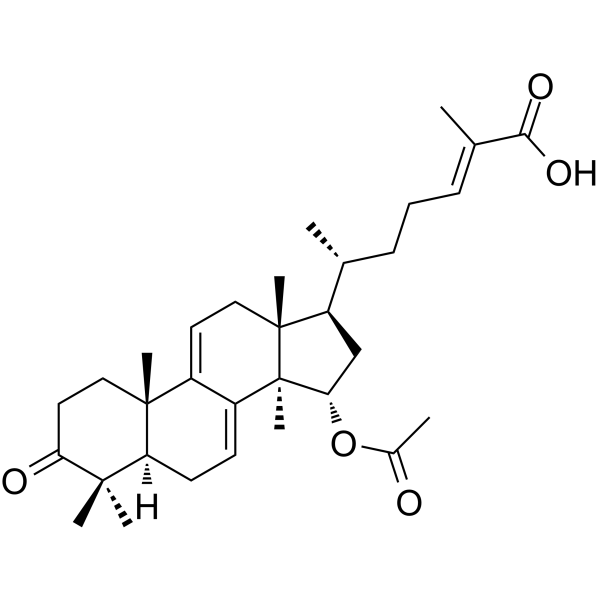
Ganoderic acid T is a lanostane triterpenoid. Ganoderic acid T is isolated from Ganoderma lucidum mycelia. Ganoderic acid T induces Mitochondria-mediated Apoptosis and inhibits DNA synthesis. Ganoderic acid T exhibits anticancer activity against cervical cancer, liver cancer and lung cancer.

For research use only. We do not sell to patients.

Ganoderic acid T

Ganoderic acid T Chemical Structure

CAS No. : 103992-91-2

Size Stock
50 mg   Get quote  
100 mg   Get quote  
250 mg   Get quote  

* Please select Quantity before adding items.

This product is a controlled substance and not for sale in your territory.

Top Publications Citing Use of Products

View All DNA/RNA Synthesis Isoform Specific Products:

  • Biological Activity

  • Purity & Documentation

  • References

  • Customer Review

Description

Ganoderic acid T is a lanostane triterpenoid. Ganoderic acid T is isolated from Ganoderma lucidum mycelia. Ganoderic acid T induces Mitochondria-mediated Apoptosis and inhibits DNA synthesis. Ganoderic acid T exhibits anticancer activity against cervical cancer, liver cancer and lung cancer[1][2][3][4].

Cellular Effect
Cell Line Type Value Description References
Vero IC50
28 μM
Compound: 37
Cytotoxicity against African green monkey Vero cells by green fluorescent protein microplate assay
[PMID: 26716912]
In Vitro

Ganoderic acid T (6-50 μg/mL; 24 h) inhibits the proliferation of cancer cell lines (95-D, SMMC7721, KB-A-1, KB-3-1, HeLa) and normal cell lines (HLF, L-02) in a dose-dependent manner, with the strongest inhibitory activity against 95-D cells (IC50 = 27.9 μg/mL)[1].
Ganoderic acid T (2-10 μg/mL; 12 days) dose-dependently inhibits colony formation of 95-D cells, with an EC50 of 3.34 μg/mL[1].
Ganoderic acid T (50 μg/mL; 4-8 h) induces time-dependent apoptosis in 95-D cells[1].
Ganoderic acid T (25-50 μg/mL; 24 h) induces G1 cell cycle arrest in 95-D cells in a dose-dependent manner, with 76% of cells arrested at the G1 phase after treatment with 50 μg/mL for 24 h[1].
Ganoderic acid T (0-40 μM; 24 h) potently inhibits the viability of cervical cancer HeLa cells, liver cancer HepG2 cells, and lung cancer 95-D cells (with an IC50 of 11.0 μM in HeLa cells), and exhibits significantly lower cytotoxicity toward non-tumorigenic MCF-10A cells[3].
Ganoderic acid T (5-40 μM; 24 h) inhibits DNA synthesis in cervical cancer HeLa cells in a dose-dependent manner[3].
Ganoderic acid T (5-20 μM; 24 h) dose-dependently arrests cervical cancer HeLa cells at the G1 phase and increases the sub-G1 apoptotic cell population, with 55.30% of cells in the G1 phase and 17.33% in the sub-G1 phase, while exerting only minimal effects on non-tumorigenic MCF-10A cells[3].
Ganoderic acid T (5-20 μM; 24 h) induces apoptosis in cervical cancer HeLa cells in a dose-dependent manner, while it causes only minimal apoptosis in non-tumorigenic MCF-10A cells[3].

MedChemExpress (MCE) has not independently confirmed the accuracy of these methods. They are for reference only.

Cell Proliferation Assay[1]

Cell Line: human highly metastatic lung tumor cell line 95-D, human liver tumor cell line SMMC7721, human epidermal cancer cell lines KB-A-1 and KB-3-1, human cervixal cancer cell line HeLa, human normal cell lines HLF (lung) and L-02 (liver)
Concentration: 6-50 μg/mL; 10-50 μg/mL (95-D-specific analysis)
Incubation Time: 24 h
Result: Reduced proliferation of multiple cancer cell lines in a dose-dependent manner, with higher cytotoxicity to 95-D cells than to normal cell lines.
Suppressed 95-D cell viability by 70% at 50 μg/mL after 24 h, with an IC50 of 27.9 μg/mL.

Apoptosis Analysis[1]

Cell Line: human highly metastatic lung tumor cell line 95-D
Concentration: 50 μg/mL
Incubation Time: 4 h, 8 h
Result: Induced apoptosis in 95-D cells in a time-dependent manner.
Increased total apoptotic cell percentage (early + late apoptosis) to 36.5% after 4 h of treatment with 50 μg/mL.
Resulted in apoptosis in ~50% of the cells after 8 h of treatment with 50 μg/mL.

Cell Cycle Analysis[1]

Cell Line: human highly metastatic lung tumor cell line 95-D
Concentration: 25-50 μg/mL
Incubation Time: 24 h
Result: Induced G1 phase cell cycle arrest in 95-D cells in a dose-dependent manner.
Increased the percentage of cells in G1 phase from 48% (control) to 76% at 50 μg/mL for 24 h.
Decreased the percentage of cells in S phase from 37% (control) to 13% at 50 μg/mL for 24 h.

Cell Cycle Analysis[3]

Cell Line: human cervical cancer HeLa cells, non-tumorous human breast epithelial MCF-10A cells
Concentration: 5 μM, 10 μM, 20 μM
Incubation Time: 24 h
Result: Caused dose-dependent accumulation in the G1 phase in HeLa cells: 44.54% at 5 μM, 46.47% at 10 μM, and 55.30% at 20 μM (compared to 42.53% in control).
Induced a dose-dependent increase in the sub-G1 apoptotic population in HeLa cells: 1.52% at 5 μM, 7.47% at 10 μM, and 17.33% at 20 μM (compared to 0.34% in control).
Caused only minimal changes in MCF-10A cells treated with 20 μM: the G1 phase increased slightly to 72.00% (compared to 66.20% in control), and the sub-G1 population only increased to 1.05% (compared to 0.66% in control).

Apoptosis Analysis[3]

Cell Line: human cervical cancer HeLa cells, non-tumorous human breast epithelial MCF-10A cells
Concentration: 5 μM, 10 μM, 20 μM
Incubation Time: 24 h
Result: Caused a dose-dependent increase in total apoptotic cells (early + late) in HeLa cells: 5.25% at 5 μM, 7.75% at 10 μM, and 11.12% at 20 μM (compared to 0.24% in control).
Increased early apoptotic cells to 3.69% and late apoptotic cells to 7.43% at 20 μM (compared to 99.77% viable cells in control).
Caused only minimal apoptosis in MCF-10A cells treated with 20 μM: total apoptotic cells increased slightly to 2.60%, with viable cells remaining at 97.20%.
In Vivo

Ganoderic acid T (12.5-25 mg/kg; i.p.; once daily; for 12 consecutive days) inhibits the growth of lung cancer xenografts in athymic mice[1].

MedChemExpress (MCE) has not independently confirmed the accuracy of these methods. They are for reference only.

Animal Model: BALB/c nude (4-week-old male, athymic, specific-pathogen-free, implanted with human highly metastatic lung cancer 95-D cells via two-step xenograft)[1]
Dosage: 12.5 mg/kg; 25 mg/kg
Administration: i.p.; daily; 12 days
Result: Achieved a tumor growth inhibition ratio of ~30% at 12.5 mg/kg.
Achieved a tumor growth inhibition ratio of ~60% at 25 mg/kg.
Molecular Weight

612.79

Formula

C36H52O8

CAS No.
SMILES

C[C@]12C3=CC[C@](C(C)([C@@H](CC4)OC(C)=O)C)([H])[C@@]4(C)C3=CC[C@@]1([C@@](C[C@@H]2OC(C)=O)([H])[C@H](C)[C@@H](OC(C)=O)C/C=C(C)/C(O)=O)C

Structure Classification
Initial Source

cultured mycelia of G. lucidum.

Shipping

Room temperature in continental US; may vary elsewhere.

Storage

Please store the product under the recommended conditions in the Certificate of Analysis.

Purity & Documentation
References
  • No file chosen (Maximum size is: 1024 Kb)
  • If you have published this work, please enter the PubMed ID.
  • Your name will appear on the site.
  • Molarity Calculator

  • Dilution Calculator

The molarity calculator equation

Mass (g) = Concentration (mol/L) × Volume (L) × Molecular Weight (g/mol)

Mass   Concentration   Volume   Molecular Weight *
= × ×

The dilution calculator equation

Concentration (start) × Volume (start) = Concentration (final) × Volume (final)

This equation is commonly abbreviated as: C1V1 = C2V2

Concentration (start) × Volume (start) = Concentration (final) × Volume (final)
× = ×
C1   V1   C2   V2
Help & FAQs
  • Do most proteins show cross-species activity?

    Species cross-reactivity must be investigated individually for each product. Many human cytokines will produce a nice response in mouse cell lines, and many mouse proteins will show activity on human cells. Other proteins may have a lower specific activity when used in the opposite species.

Your Recently Viewed Products:

Inquiry Online

Your information is safe with us. * Required Fields.

Product Name


Requested Quantity *

Applicant Name *


Salutation

Email Address *


Phone Number *

Department


Organization Name *

City

State

Country or Region *


Remarks

Bulk Inquiry

Inquiry Information

Product Name:
Ganoderic acid T
Cat. No.:
HY-N11591
Quantity:
MCE Japan Authorized Agent:

