



USP7-IN-1
Based on 6 publication(s) in Google Scholar
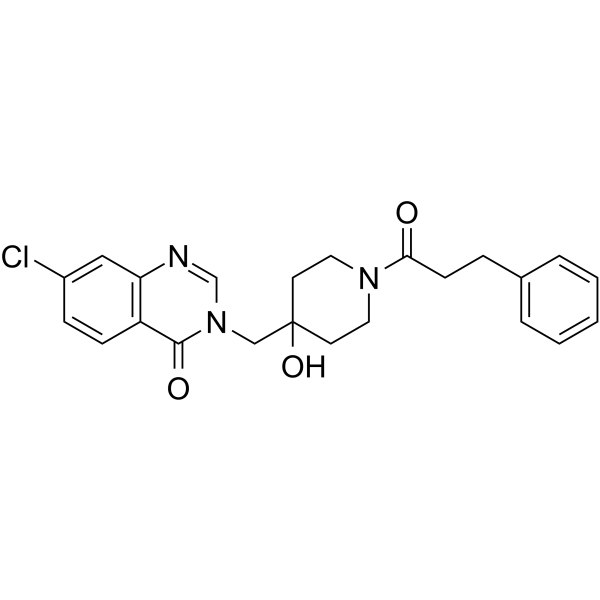
USP7-IN-1 is a selective and reversible inhibitor of ubiquitin-specific protease 7 (USP7), with an IC50 of 77 μM, and can be used for the research of cancer.
Para uso exclusivo en investigación. No vendemos a pacientes.
- Pureza: 99.18%
- No. CAS: 1381291-36-6
- Fòrmula: C23H24ClN3O3
- Peso molecular:425.91
-
Almacenamiento:Powder -20°C, 3 years , 4°C, 2 years ; In solvent -80°C, 2 years , -20°C, 1 year


-
 Actividad biológica
-
Chemical Information
-
Solvente y solubilidad
- Protocolo
- Pureza y Documentación
- Referencias
-
 Help & FAQs
-

Cell Cycle/DNA Damage Compound Library
HY-L004
-
Anti-Cancer Compound Library
HY-L025
-
Anti-Aging Compound Library
HY-L034
-
Ubiquitination Compound Library
HY-L050
-
Metabolic Enzyme Compound Library
HY-L146
-
Protease Inhibitor Library
HY-L147
-
Highly Selective Inhibitors Library
HY-L158
-
Bioactive Compound Library Max
HY-L181
-
MCE Bioactive Compound Library
HY-L001V
-
Bioactive Compound Library
HY-L001
-
High-Throughput Bioactive Compound Library
HY-L205
-
Posttranslational Modification Library
HY-L226


Publications Citing Use of MedChemExpress (MCE) USP7-IN-1
More- Nat Commun. 2019 Jan 24;10(1):411. [Abstract]
- Cell Death Dis. 2025 Dec 24. [Abstract]
- Cell Rep. 2024 Aug 5;43(8):114584. [Abstract]
- J Med Chem. 2022 Oct 27;65(20):13645-13659. [Abstract]
- Arch Pharm (Weinheim). 2023 Jul;356(7):e2200661. [Abstract]
- Anim Cells Syst. 2024 May 11;28(1):237-250. [Abstract]
 Customer Validation & Images

-
WB


Actividad biológica
IC50: 77 μM (USP7)[1]
USP7-IN-1 (Example 2) is a selective and reversible inhibitor of USP7, with an IC50 of 77 μM, and shows no inhibition of USP8, USP5, Uch-L1, Uch-L3 or caspase 3. USP7-IN-1 inhibits the proliferation of HCT116 cells, with a GI50 of 67 μM[1].
MedChemExpress (MCE) has not independently confirmed the accuracy of these methods. They are for reference only.


Chemical Information
-
No. CAS 1381291-36-6
-
Appearance Solid
-
Peso molecular 425.91
-
Fòrmula C23H24ClN3O3
-
Color White to off-white
-
SMILES
O=C1N(CC2(O)CCN(C(CCC3=CC=CC=C3)=O)CC2)C=NC4=C1C=CC(Cl)=C4
-
Envío
Room temperature in continental US; may vary elsewhere.
-
Almacenamiento
Powder -20°C 3 years 4°C 2 years In solvent -80°C 2 years -20°C 1 year


Publications (6)
-
Journal Impact Factor
-
Most Recent
-
Nat Commun
Usp7 regulates Hippo pathway through deubiquitinating the transcriptional coactivator Yorkie. [Abstract]2019 Jan 24;10(1):411. PMID: 30679505
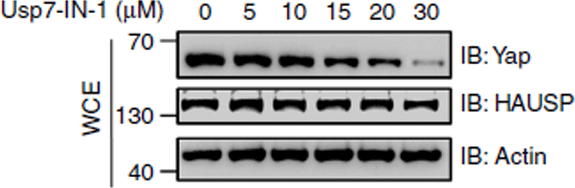
USP7-IN-1 purchased from MedChemExpress. Usage Cited in: Nat Commun. 2019 Jan 24;10(1):411. [Abstract]
Immunoblot analysis of lysates from Huh7 cells treated with Usp7-IN-1 at indicated concentrations for 24 h.
-
Cell Death Dis
SPOP and HAUSP bidirectionally regulate LZTS2 ubiquitination to modulate the Wnt pathway. [Abstract]2025 Dec 24. PMID: 41436424 -
Cell Rep
Oxidative stress reprograms the transcriptional coactivator Yki to suppress cell proliferation. [Abstract]2024 Aug 5;43(8):114584. PMID: 39106181 -
J Med Chem
Discovery of Potent OTUB1/USP8 Dual Inhibitors Targeting Proteostasis in Non-Small-Cell Lung Cancer. [Abstract]2022 Oct 27;65(20):13645-13659. PMID: 36221183 -
Arch Pharm (Weinheim)
2023 Jul;356(7):e2200661. PMID: 37196427 -
Anim Cells Syst
Blocking SLC7A11 attenuates the proliferation of esophageal squamous cell carcinoma cells. [Abstract]2024 May 11;28(1):237-250. PMID: 38741950


Solvente y solubilidad
DMSO : 100 mg/mL (234.79 mM; Need ultrasonic; Hygroscopic DMSO has a significant impact on the solubility of product, please use newly opened DMSO)
Please refer to the solubility information to select the appropriate solvent. Once prepared, please aliquot and store the solution to prevent product inactivation from repeated freeze-thaw cycles.
Storage method and period of stock solution: -80°C, 2 years; -20°C, 1 year. When stored at -80°C, please use it within 2 years. When stored at -20°C, please use it within 1 year.
Please refer to the solubility information to select the appropriate solvent. Once prepared, please aliquot and store the solution to prevent product inactivation from repeated freeze-thaw cycles.
Storage method and period of stock solution: -80°C, 2 years; -20°C, 1 year. When stored at -80°C, please use it within 2 years. When stored at -20°C, please use it within 1 year.
Concentration (start) × Volume (start) = Concentration (final) × Volume (final)
Select the appropriate dissolution method based on your experimental animal and administration route.
- For the following dissolution methods, please ensure to first prepare a clear stock solution using an In Vitro approach and then sequentially add co-solvents:
- To ensure reliable experimental results, the clarified stock solution can be appropriately stored based on storage conditions. As for the working solution for In Vivo experiments, it is recommended to prepare freshly and use it on the same day.
- The percentages shown for the solvents indicate their volumetric ratio in the final prepared solution. If precipitation or phase separation occurs during preparation, heat and/or sonication can be used to aid dissolution.
Add each solvent one by one: 10% DMSO 40% PEG300 5% Tween-80 45% Saline
Solubility: ≥ 2.5 mg/mL (5.87 mM); Clear solution
This protocol yields a clear solution of ≥ 2.5 mg/mL (saturation unknown).
Taking 1 mL working solution as an example, add 100 μL DMSO stock solution (25.0 mg/mL) to 400 μL PEG300, and mix evenly; then add 50 μL Tween-80 and mix evenly; then add 450 μL Saline to adjust the volume to 1 mL.
Preparation of Saline: Dissolve 0.9 g sodium chloride in ddH₂O and dilute to 100 mL to obtain a clear Saline solution.
Add each solvent one by one: 10% DMSO 90% (20% SBE-β-CD in Saline)
Solubility: ≥ 2.5 mg/mL (5.87 mM); Clear solution
This protocol yields a clear solution of ≥ 2.5 mg/mL (saturation unknown).
Taking 1 mL working solution as an example, add 100 μL DMSO stock solution (25.0 mg/mL) to 900 μL 20% SBE-β-CD in Saline, and mix evenly.
Preparation of 20% SBE-β-CD in Saline (4°C, storage for one week): 2 g SBE-β-CD powder is dissolved in 10 mL Saline, completely dissolve until clear.
Please enter the basic information of animal experiments:
-
-
-
-
Recommended: Prepare an additional quantity of animals to account for potential losses during experiments.
Please enter your animal formula composition:
-
%DMSO +
Recommended: Keep the proportion of DMSO in working solution below 2% if your animal is weak.
-
%+
-
+%Tween-80 + +
-
%Saline +
The co-solvents required include: DMSO, . All of co-solvents are available by MedChemExpress (MCE). , Tween 80. All of co-solvents are available by MedChemExpress (MCE).
Working solution concentration: 0.22 mg/mL
Method for preparing stock solution: mg drug dissolved in μL DMSO. Stock solution concentration: mg/mL.
1. Take μL DMSO stock solution;
2. Add μL .
μL , mix evenly;
3. Then add μL Tween 80, mix evenly;
4. Then add μL
Please ensure that the stock solution in the first step is dissolved to a clear state, and add co-solvents in sequence. You can use ultrasonic heating (ultrasonic cleaner, recommended frequency 20-40 kHz), vortexing, etc. to assist dissolution.

Protocolo
USP7 is diluted in USP buffer (50 mM Tris HCl; 0.5 mM EDTA (Ethylenediaminetetraacetic acid); 5 mM DTT; 0.01 % Triton X-100; Bovine Serum Albumin 0.05 mg/mL pH7.6). Compounds stocks (10 mM) are stored at -20°C in DMSO. Compounds (including USP7-IN-1) are tested at different concentrations: from 200 μM to 91 nM. Reactions are performed as duplicates in Black 384 well plates (10 μL final reaction volume). The substrate concentration for USP7 is 300 nM Ub-AMC. The concentrations of the enzyme (USP7) in specificity assays is 100 pM. The concentrations are determined in order to perform specificity assays under initial velocities at fixed substrate concentration. Compounds are pre-incubated with enzymes for 30 minutes at 25°C. Reactions are initiated by addition of substrate to the plates containing the enzymes (+/- compounds) diluted in assay buffer. Reactions are incubated for 60 minutes at 37°C. Reactions are stopped by adding acetic acid (100 mM final). Readings are performed on a Pherastar Fluorescent Reader. λ Emission 380 nm; λ Excitation = 460 nm. Data (mean values +/- standard deviation) are analyzed as % of control (no compound) and plotted as percentage versus the Log of the compound concentration using GraphPad. Data are fitted to a sigmoidal model (variable slope)[1].
MedChemExpress (MCE) has not independently confirmed the accuracy of these methods. They are for reference only.
HCT116 colon cancer cells are maintained in Mc Coy's 5A medium containing 10% FBS, 3 mM glutamine and 1 % penicillin/streptomycin. Cells are incubated at 37°C in a humidified atmosphere containing 5% CO2. Cell viability is assayed using the MTS technique in 96-well culture plates. MTS (3-(4,5-dimethyl-thiazol-2-yl)-5-(3-carboxy- methoxyphenyl)-2-(4-sulfophenyl)-2H-tetra-zolium) is a MTT-derived tetrazolium that is reduced in metabolically active cells into a soluble, cell-permeant formazan. The amount of formazan, detected by its absorbance at 492 nm is proportional to the number of living, metabolically active cells. 103 HCT116 cells are seeded per well. 24 hours later, the medium is changed and the cells treated in triplicate with the concentrations of each compound from 100 μM to 50 nM. The compounds (including USP7-IN-1) are diluted in 100% DMSO, whose final concentration on cells is kept at 0.5%. Cells are incubated with the compounds for 72 hours, and their viability then assayed by the addition of MTS for 2 hours. Absorbance at 492 nm is measured directly from the 96-well culture plates. GI50 (Growth Inhibition 50) concentrations for each compound are calculated using a sigmoidal variable slope fit. Values represent mean of three independent experiments[1].
MedChemExpress (MCE) has not independently confirmed the accuracy of these methods. They are for reference only.


Pureza y Documentación
-
Ficha de datos (274 KB)
-
SDS (251 KB)
- English - EN (251 KB)
- Français - FR (251 KB)
- Deutsch - DE (251 KB)
- Norwegian - NO (251 KB)
- Español - ES (251 KB)
- Swedish - SV (251 KB)
- Italian - IT (251 KB)
- Portuguese - PT (251 KB)
-
Instrucciones de manejo (2659 KB)
Referencias


Complete Stock Solution Preparation Table
Please refer to the solubility information to select the appropriate solvent. Once prepared, please aliquot and store the solution to prevent product inactivation from repeated freeze-thaw cycles.
Storage method and period of stock solution: -80°C, 2 years; -20°C, 1 year. When stored at -80°C, please use it within 2 years. When stored at -20°C, please use it within 1 year.
| Optional Solvent | Concentration Solvent Mass | 1 mg | 5 mg | 10 mg | 25 mg |
|---|---|---|---|---|---|
| DMSO | 1 mM | 2.3479 mL | 11.7396 mL | 23.4791 mL | 58.6978 mL |
| 5 mM | 0.4696 mL | 2.3479 mL | 4.6958 mL | 11.7396 mL | |
| 10 mM | 0.2348 mL | 1.1740 mL | 2.3479 mL | 5.8698 mL | |
| 15 mM | 0.1565 mL | 0.7826 mL | 1.5653 mL | 3.9132 mL | |
| 20 mM | 0.1174 mL | 0.5870 mL | 1.1740 mL | 2.9349 mL | |
| 25 mM | 0.0939 mL | 0.4696 mL | 0.9392 mL | 2.3479 mL | |
| 30 mM | 0.0783 mL | 0.3913 mL | 0.7826 mL | 1.9566 mL | |
| 40 mM | 0.0587 mL | 0.2935 mL | 0.5870 mL | 1.4674 mL | |
| 50 mM | 0.0470 mL | 0.2348 mL | 0.4696 mL | 1.1740 mL | |
| 60 mM | 0.0391 mL | 0.1957 mL | 0.3913 mL | 0.9783 mL | |
| 80 mM | 0.0293 mL | 0.1467 mL | 0.2935 mL | 0.7337 mL | |
| 100 mM | 0.0235 mL | 0.1174 mL | 0.2348 mL | 0.5870 mL |


 Powered by Bioz