



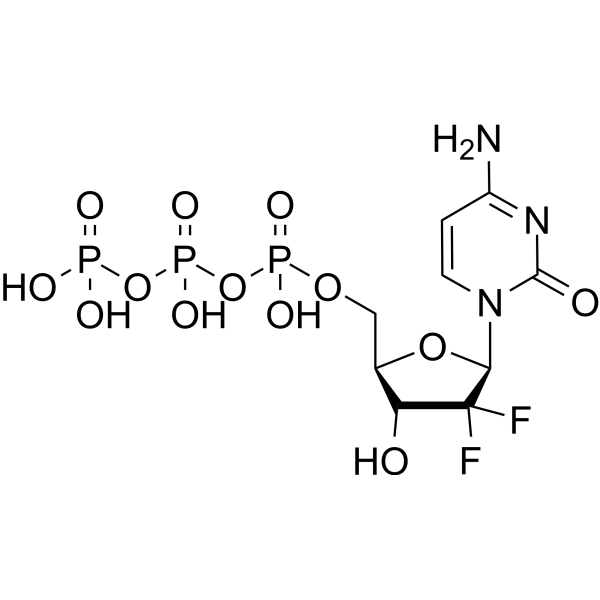
Gemcitabine triphosphate
Gemcitabine triphosphate (dFdCTP) is the active metabolite of Gemcitabine (HY-17026). The mechanism of Gemcitabine triphosphate cell-killing is its competition with cytidine triphosphate during DNA replication, which results in the inhibition of chain elongation. Gemcitabine triphosphate shows a Ki of 11.2 μM against DNA polymerase α and 14.4 μM against DNA polymerase ε. Gemcitabine triphosphate partially inhibits dCMP deaminase and acts as a substrate for DNA synthesis to incorporate into cellular DNA and RNA. Gemcitabine triphosphate disrupts DNA and RNA synthesis, arrests cell cycle in G0/G1 and S phases, triggers apoptosis, reduces tumor cell proliferation. Gemcitabine triphosphate can be used for the research of pancreatic cancer and non-small cell lung cancer.
연구목적의 판매만을 진행합니다. 환자를 대상으로 한 판매는 하지 않습니다.
- CAS No.: 110988-86-8
- 화학식: C9H14F2N3O13P3
- 분자량:503.14
-
보관:
Please store the product under the recommended conditions in the Certificate of Analysis.

To place orders, for customer services and technical support, please contact: MedChemExpress USA
Tel: 609-228-6898 E-mail: [email protected] [email protected]


-
 Biological Activity
-
Chemical Information
- Protocol
- 순도&문서
- References
-
 Help & FAQs


All DNA/RNA Synthesis Isoforms
More

Biological Activity
제품 설명
IC50 & Target
|
DNA Polymerase |
In Vitro
Gemcitabine triphosphate inhibits replicative DNA polymerases α and ε with Ki values of 11.2 μM and 14.4 μM, respectively[1].
Gemcitabine triphosphate (0.01-10 μM; short-term incubation) accumulates to 0.01-10 μM in human colon carcinoma cells, with radiation enhancement ratios plateauing at 1.0 μM Gemcitabine (precursor)[1].
Gemcitabine triphosphate (0.1-10 μM; 48 h) reduces cell viability in H460 human NSCLC cells and BxPC-3 human pancreatic cancer cells in a dose-dependent manner[3].
Gemcitabine triphosphate (1.8 μM; 24 h) arrests the cell cycle in the S phase in H460 human NSCLC cells and BxPC-3 human pancreatic cancer cells[3].
Gemcitabine triphosphate (1.8 μM; 48 h) induce caspase-3/7 activation in H460 human NSCLC cells and BxPC-3 human pancreatic cancer cells[3].
MedChemExpress (MCE) has not independently confirmed the accuracy of these methods. They are for reference only.
-
Cell Line:H460 and BxPC-3 cells
-
Concentration:0.1 μM, 0.2 μM, 0.5 μM, 1 μM, 2 μM, 5 μM, 10 μM
-
Incubation Time:48 h
-
Result:Reduced cell viability in a dose-dependent manner.
-
Cell Line:H460 and BxPC-3 cells
-
Concentration:1.8 μM
-
Incubation Time:24 h
-
Result:Increased the percentage of cells in the S phase in both H460 and BxPC-3 cells, indicating S-phase arrest.
Parmacokinetics
| Species | Dose | Route | AUC | MRT | Vss |
|---|---|---|---|---|---|
| Mice[3] | 7.5 μmol/Kg | i.v. | 14.89 h | 0.83 h | 5.58 |
In Vivo
Lipid/calcium/phosphate (LCP) nanoparticles loaded with Gemcitabine triphosphate (7.5 μmol/kg; i.v.; every other day for 4 days, followed by daily administration for 3 days) exert potent anti-tumor efficacy in H460 non-small cell lung cancer and BxPC-3 pancreatic cancer xenograft models via caspase-dependent apoptosis, proliferation inhibition and tumor growth arrest[3].
MedChemExpress (MCE) has not independently confirmed the accuracy of these methods. They are for reference only.
- Annexin V plus membrane-impermeant dye apoptosis staining
- BrdU Incorporation Assay
- Somatic Cell Culture
- CFSE Dye Dilution Proliferation Assay
- Dye-dilution cell tracking and proliferation staining
- Protocol for Cell Cycle
- CCK-8/WST-8 Cell Proliferation Assay
- Cell Counting-Based Growth Curve Assay
- Colony Formation (Clonogenic) Assay
- Cell Viability Determination by MTT Colorimetric Assay
- EdU Incorporation Assay (Click Chemistry-Based DNA Synthesis Measurement)
- Detection of Apoptosis
- TUNEL staining for apoptotic DNA fragmentation
- Ki-67 Immunostaining Proliferation Assay
- PCNA Immunodetection Proliferation Assay
- Flow cytometric DNA-content cell-cycle staining
- Protocol for Cell Counting and Cell Density Analysis
- Apoptosis Solutions
- MTT Cell Proliferation Assay


Chemical Information
-
CAS No. 110988-86-8
-
분자량 503.14
-
화학식 C9H14F2N3O13P3
-
SMILES
NC(C=CN1[C@H]2C(F)(F)[C@H](O)[C@@H](COP(OP(OP(O)(O)=O)(O)=O)(O)=O)O2)=NC1=O
-
Synonyms
dFdCTP
-
Structure Classification
-
Initial Source
-
선적
Room temperature in continental US; may vary elsewhere.
-
보관
Please store the product under the recommended conditions in the Certificate of Analysis.


순도&문서
References
[1]. Shewach DS, et al. Gemcitabine and radiosensitization in human tumor cells. Invest New Drugs. 1996;14(3):257-263. [Content Brief]
[2]. Matsumoto T, et al. A Liposomal Gemcitabine, FF-10832, Improves Plasma Stability, Tumor Targeting, and Antitumor Efficacy of Gemcitabine in Pancreatic Cancer Xenograft Models. Pharm Res. 2021;38(6):1093-1106. [Content Brief]
[3]. Zhang Y, et al. Systemic delivery of gemcitabine triphosphate via LCP nanoparticles for NSCLC and pancreatic cancer therapy. Biomaterials. 2013;34(13):3447-3458. [Content Brief]
[4]. Rizzuto I, et al. Pharmacological factors affecting accumulation of gemcitabine's active metabolite, gemcitabine triphosphate. Pharmacogenomics. 2017;18(9):911-925. [Content Brief]

Calculators
Concentration (start) × Volume (start) = Concentration (final) × Volume (final)


Gemcitabine triphosphate Related Classifications
HY-17026A Related Classifications
 Powered by Bioz