



Gypsogenin

Based on 1 Customer Validation
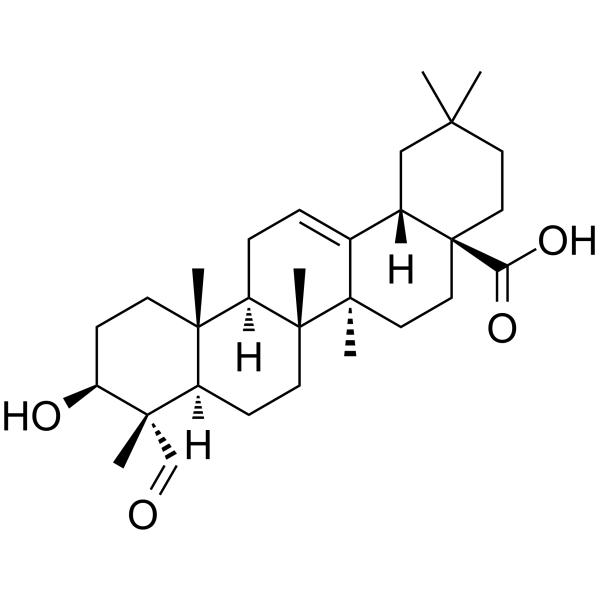
Gypsogenin is a selective mixed-type BChE inhibitor (Ki=19.99 μM) that also exhibits significant cytotoxicity against various human cancer cell lines. Gypsogenin inhibits tumor growth by inducing cell cycle arrest and triggering apoptosis. Gypsogenin displays antibacterial activity against bacteria such as Bacillus subtilis and Bacillus thuringiensis, and often serves as a key parent nucleus for the synthesis of anticancer compounds. Gypsogenin is widely used in research on Alzheimer's disease and various cancers including colon cancer, melanoma, and leukemia.
For research use only. We do not sell to patients.
- Purity : 99.51%
- CAS No.: 639-14-5
- Formula: C30H46O4
- Molecular Weight:470.68
-
Storage:
4°C, protect from light
* In solvent : -80°C, 6 months; -20°C, 1 month (protect from light)

To place orders, for customer services and technical support, please contact: MedChemExpress USA
Tel: 609-228-6898 E-mail: [email protected] [email protected]


-
 Biological Activity
-
Chemical Information
-
Solvent & Solubility
- Protocols
- Purity & Documentation
- References
-
 Help & FAQs




Biological Activity
Description
IC50 & Target
|
BChE 19.99 μM (Ki) |
Cellular Effect
|
Cell Line

|
Type | Value | Description | References |
|---|---|---|---|---|
| Caco-2 | IC50 |
16.67 μM
Compound: 1, gypsogenin
|
Antiproliferative activity against human Caco2 cells after 24 and 72 hrs by MTT assay
Antiproliferative activity against human Caco2 cells after 24 and 72 hrs by MTT assay
|
[PMID: 24941130] |
| HeLa | IC50 |
22.48 μM
Compound: 1, gypsogenin
|
Antiproliferative activity against human HeLa cells after 24 and 72 hrs by MTT assay
Antiproliferative activity against human HeLa cells after 24 and 72 hrs by MTT assay
|
[PMID: 24941130] |
| HL-60 | IC50 |
10.4 μM
Compound: 1, gypsogenin
|
Antiproliferative activity against human HL60 cells after 24 and 72 hrs by MTT assay
Antiproliferative activity against human HL60 cells after 24 and 72 hrs by MTT assay
|
[PMID: 24941130] |
| HT-29 | IC50 |
11.9 μM
Compound: 1, gypsogenin
|
Antiproliferative activity against human HT-29 cells after 24 and 72 hrs by MTT assay
Antiproliferative activity against human HT-29 cells after 24 and 72 hrs by MTT assay
|
[PMID: 24941130] |
| MCF7 | IC50 |
9.02 μM
Compound: 1, gypsogenin
|
Antiproliferative activity against human MCF7 cells after 24 and 72 hrs by MTT assay
Antiproliferative activity against human MCF7 cells after 24 and 72 hrs by MTT assay
|
[PMID: 24941130] |
| RAW264.7 | ED50 |
36.6 μM
Compound: IVL-9
|
Cytotoxicity against mouse RAW264.7 cells assessed as induction of cell killing incubated for 24 hrs by alamar blue dye based fluorescence analysis
Cytotoxicity against mouse RAW264.7 cells assessed as induction of cell killing incubated for 24 hrs by alamar blue dye based fluorescence analysis
|
[PMID: 33479679] |
| SAOS-2 | IC50 |
7.85 μM
Compound: 1, gypsogenin
|
Antiproliferative activity against human Saos2 cells after 24 and 72 hrs by MTT assay
Antiproliferative activity against human Saos2 cells after 24 and 72 hrs by MTT assay
|
[PMID: 24941130] |
In Vitro
Gypsogenin exhibits moderate cytotoxicity against 518A2, A2780, MCF-7, A549, and HeLa human cancer cell lines, with IC50 values ranging from 9.9 to 21.3 μM, and no significant activity against HT-29 cells (IC50 >30 μM)[1].
Gypsogenin (1000 μg/mL; 24 h) shows moderate antimicrobial activity against Bacillus cereus ATCC 11778, Bacillus subtilis ATCC 6633, and Bacillus thrungiensis, with 13 mm inhibition zones for all three strains[2].
Gypsogenin (0.5-40 μM; 72 h) exhibits antiproliferative activity against human cancer cell lines, with the strongest activity against Saos-2 (IC50=7.85 μM) and MCF-7 (IC50=9.02 μM) cells[2].
Gypsogenin (20 μM; 48 h) triggers apoptotic cell death (20-36% apoptosis) with low necrosis rates in HL-60, HT-29, Caco-2, Saos-2, MCF-7, and HeLa human cancer cell lines when treated at 20 μM for 48 h[2].
Gypsogenin (0.01-100 μM; 48 h) inhibits viability of A549, LOVO, SKOV3, and HepG2 human cancer cells with IC50 values ranging from 15.90 μM (LOVO) to 22.18 μM (HepG2) after 48 h of treatment[3].
MedChemExpress (MCE) has not independently confirmed the accuracy of these methods. They are for reference only.
-
Cell Line:Human cancer cell lines (HL-60 acute promyelocytic leukemia, Saos-2 osteosarcoma, MCF-7 breast cancer, HT-29 colorectal adenocarcinoma, Caco-2 colorectal adenocarcinoma, HeLa cervical cancer)
-
Concentration:0.5, 10, 20, 40 μM
-
Incubation Time:72 h
-
Result:Demonstrated antiproliferative activity with IC50 values of 10.40 μM (HL-60), 11.90 μM (HT-29), 16.67 μM (Caco-2), 7.85 μM (Saos-2), 9.02 μM (MCF-7), and 22.48 μM (HeLa).
Showed IC50 values less than 10 μM for Saos-2 and MCF-7 cell lines.
-
Cell Line:Human cancer cell lines (HL-60, HT-29, Caco-2, Saos-2, MCF-7, HeLa)
-
Concentration:20 μM
-
Incubation Time:48 h
-
Result:Induced apoptotic cell death with ratios (apoptosis/necrosis) of 33%/4% (HL-60), 21%/2% (HT-29), 20% /0% (Caco-2), 36%/2% (Saos-2), 30%/4% (MCF-7), and 29%/0% (HeLa).
Maintained consistently low necrosis rates across all cell lines.
-
Cell Line:A549, LOVO, SKOV3, HepG2
-
Concentration:0.01-100 μM
-
Incubation Time:48 h
-
Result:Exhibited cytotoxicity with an IC50 of 19.60 μM in A549 cells.
Exhibited cytotoxicity with an IC50 of 15.90 μM in LOVO cells.
Exhibited cytotoxicity with an IC50 of 20.67 μM in SKOV3 cells.
Exhibited cytotoxicity with an IC50 of 22.18 μM in HepG2 cells.
- Research Protocol for Infectious Diseases
- Mammalian live/dead viability and cytotoxicity staining
- Annexin V plus membrane-impermeant dye apoptosis staining
- BrdU Incorporation Assay
- Patient-Derived Orthotopic Xenograft (PDOX)
- Protocol for Cell Cycle
- Bacterial live/dead nucleic-acid viability staining
- Cell Viability Determination by MTT Colorimetric Assay
- Alzheimer’s Disease Modeling
- Detection of Apoptosis
- TUNEL staining for apoptotic DNA fragmentation
- Cell Cytotoxicity Assay
- Flow cytometric DNA-content cell-cycle staining
- Patient-Derived Xenograft (PDX)
- Apoptosis Solutions
- Subcutaneous Cell-Line-Derived Xenograft
- Orthotopic Cell-Line Xenograft


Chemical Information
-
CAS No. 639-14-5
-
Appearance Solid
-
Molecular Weight 470.68
-
Formula C30H46O4
-
Color White to off-white
-
SMILES
C[C@]1([C@H](CC[C@@]2([C@]3(CC=C4[C@@]5(CC(C)(CC[C@@]5(CC[C@]4([C@@]3(CC[C@@]12[H])C)C)C(O)=O)C)[H])[H])C)O)C=O
-
Structure Classification
-
Initial Source
-
Shipping
Room temperature in continental US; may vary elsewhere.
-
Storage
4°C, protect from light
* In solvent : -80°C, 6 months; -20°C, 1 month (protect from light)


Solvent & Solubility
In Vitro:
DMSO : 25 mg/mL (53.11 mM; Need ultrasonic; Hygroscopic DMSO has a significant impact on the solubility of product, please use newly opened DMSO)
Please refer to the solubility information to select the appropriate solvent. Once prepared, please aliquot and store the solution to prevent product inactivation from repeated freeze-thaw cycles.
Storage method and period of stock solution: -80°C, 6 months; -20°C, 1 month (protect from light). When stored at -80°C, please use it within 6 months. When stored at -20°C, please use it within 1 month.
Please refer to the solubility information to select the appropriate solvent. Once prepared, please aliquot and store the solution to prevent product inactivation from repeated freeze-thaw cycles.
Storage method and period of stock solution: -80°C, 6 months; -20°C, 1 month (protect from light). When stored at -80°C, please use it within 6 months. When stored at -20°C, please use it within 1 month.
Concentration (start) × Volume (start) = Concentration (final) × Volume (final)


Purity & Documentation
-
Data Sheet (281 KB)
-
SDS (392 KB)
- English - EN (392 KB)
- Français - FR (392 KB)
- Deutsch - DE (392 KB)
- Norwegian - NO (392 KB)
- Español - ES (392 KB)
- Swedish - SV (392 KB)
- Italian - IT (392 KB)
- Korean - KR (392 KB)
- Portuguese - PT (392 KB)
-
Handling Instructions (2659 KB)
References
[1]. Heller L, et al. Gypsogenin derivatives: an unexpected class of inhibitors of cholinesterases. Arch Pharm (Weinheim). 2014;347(10):707-716. [Content Brief]
[2]. Emirdağ-Öztürk S, et al. Synthesis, antimicrobial and cytotoxic activities, and structure-activity relationships of gypsogenin derivatives against human cancer cells. Eur J Med Chem. 2014;82:565-573. [Content Brief]
[3]. Zhang H, et al. Synthesis of gypsogenin derivatives with capabilities to arrest cell cycle and induce apoptosis in human cancer cells. R Soc Open Sci. 2018 Jan 24;5(1):171510. [Content Brief]


Complete Stock Solution Preparation Table
Please refer to the solubility information to select the appropriate solvent. Once prepared, please aliquot and store the solution to prevent product inactivation from repeated freeze-thaw cycles.
Storage method and period of stock solution: -80°C, 6 months; -20°C, 1 month (protect from light). When stored at -80°C, please use it within 6 months. When stored at -20°C, please use it within 1 month.
| Optional Solvent | Concentration Solvent Mass | 1 mg | 5 mg | 10 mg | 25 mg |
|---|---|---|---|---|---|
| DMSO | 1 mM | 2.1246 mL | 10.6229 mL | 21.2459 mL | 53.1146 mL |
| 5 mM | 0.4249 mL | 2.1246 mL | 4.2492 mL | 10.6229 mL | |
| 10 mM | 0.2125 mL | 1.0623 mL | 2.1246 mL | 5.3115 mL | |
| 15 mM | 0.1416 mL | 0.7082 mL | 1.4164 mL | 3.5410 mL | |
| 20 mM | 0.1062 mL | 0.5311 mL | 1.0623 mL | 2.6557 mL | |
| 25 mM | 0.0850 mL | 0.4249 mL | 0.8498 mL | 2.1246 mL | |
| 30 mM | 0.0708 mL | 0.3541 mL | 0.7082 mL | 1.7705 mL | |
| 40 mM | 0.0531 mL | 0.2656 mL | 0.5311 mL | 1.3279 mL | |
| 50 mM | 0.0425 mL | 0.2125 mL | 0.4249 mL | 1.0623 mL |


Gypsogenin Related Classifications
HY-121382 Related Classifications
 Powered by Bioz
Keywords
- Gypsogenin
- 639-14-5
- Cholinesterase (ChE)
- Apoptosis
- Necroptosis
- equine butyrylcholinesterase
- human colon carcinoma
- Bacillus subtilis
- apoptotic cell death
- Bacillus thuringiensis
- Bacillus cereus
- human cancer cell lines
- Alzheimer’s disease
- butyrylcholinesterase
- equus-derived butyrylcholinesterase
- Inhibitor
- inhibitor
- inhibit