



Atropine methyl bromide

Based on 1 Customer Validation
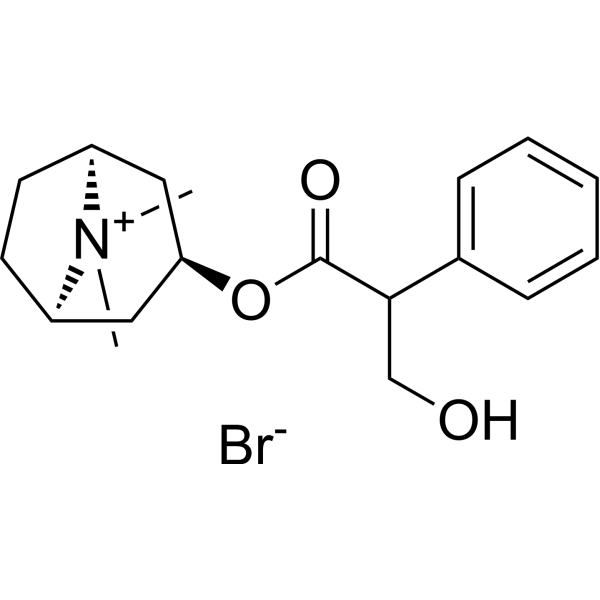
Atropine methyl bromide (Methylatropine bromide), an antagonist of muscarinic acetylcholine receptors (mAChR), is a quaternary ammonium salt of atropine and an active molecule used for pupil dilation during ophthalmic examinations. Due to its high polarity, it is used to relieve pyloric spasm in infants. It is less likely than atropine to cross the central nervous system.
For research use only. We do not sell to patients.
- Purity: 99.84%
- CAS No.: 2870-71-5
- Formula: C18H26BrNO3
- Molecular Weight:384.31
-
Storage:
4°C, sealed storage, away from moisture
* In solvent : -80°C, 6 months; -20°C, 1 month (sealed storage, away from moisture)

To place orders, for customer services and technical support, please contact: MedChemExpress USA
Tel: 609-228-6898 E-mail: [email protected] [email protected]


-
 Biological Activity
-
Chemical Information
-
Solvent & Solubility
- Purity & Documentation
- References
-
 Help & FAQs
-

GPCR/G Protein Compound Library
HY-L006
-
Neuronal Signaling Compound Library
HY-L013
-
FDA-Approved Drug Library
HY-L022
-
Drug Repurposing Compound Library
HY-L035
-
NMPA-Approved Drug Library
HY-L053
-
Neurotransmitter Receptor Compound Library
HY-L062
-
FDA Approved & Pharmacopeial Drug Library
HY-L066
-
Anti-Parkinson's Disease Compound Library
HY-L085
-
Neurodegenerative Disease-related Compound Library
HY-L086
-
Off-patent Drug Library
HY-L141
-
Membrane Protein-targeted Compound Library
HY-L149
-
Membrane Receptor-targeted Compound Library
HY-L150
-
Bioactive Compound Library Max
HY-L181
-
MCE Bioactive Compound Library
HY-L001V
-
Drug Repurposing Compound Library Plus
HY-L035P
-
FDA-Approved Drug Library Plus
HY-L022P
-
FDA-Approved Drug Library Mini
HY-L022M
-
Bioactive Compound Library
HY-L001
-
High-Throughput Bioactive Compound Library
HY-L205
-
Lactylation Compound Library
HY-L249




Biological Activity
Atropine methyl bromide (15-20 mg/kg; i.p.; single injection prior to behavioral run; 50 μg/rat; hippocampal; single injection prior to behavioral run) produces significant impairments in complex operant conditioning task performance in rats when administered directly into the hippocampus at 50 μg/rat (unilateral or bilateral), but only produces a single significant behavioral change at the highest tested intraperitoneal dose of 20 mg/kg[2].
MedChemExpress (MCE) has not independently confirmed the accuracy of these methods. They are for reference only.
-
Animal Model:Hartley (male, adult, 250-300 g, sarin toxicity model)[1]
-
Dosage:2.5 mg/kg
-
Administration:nasal; 40 pulses over 1 min
-
Result:Achieved 100% survival.
Decreased development of muscular tremors, with animals appearing close to normal after 24 hours recovery.
Normalized acute decrease in blood oxygen saturation and heart rate.
Resulted in body weight loss similar to saline controls, with no significant difference in accessory lung lobe or tracheal wet/dry edema ratios compared to controls.
Significantly reduced inhibition of blood acetylcholinesterase (AChE) and butyrylcholinesterase (BChE) activities compared to untreated sarin-exposed animals.
Brought total bronchoalveolar lavage fluid (BALF) protein levels similar to saline controls, and returned surfactant levels to normal.
Resulted in BALF alkaline phosphatase levels slightly lower than saline controls.
Maintained BALC dead cell counts similar to saline controls, and total BAL cell counts comparable to animals exposed to a lower, non-lethal sarin dose.
Significantly decreased blood monocytes, and significantly increased blood eosinophils compared to saline controls.
Significantly decreased BALC neutrophils and leukocytes, and increased BALC lymphocytes compared to animals exposed to 677.4 mg/m3 sarin.


Chemical Information
-
CAS No. 2870-71-5
-
Appearance Solid
-
Molecular Weight 384.31
-
Formula C18H26BrNO3
-
Color White to off-white
-
SMILES
C[N+]1([C@H]2C[C@H](OC(C(C3=CC=CC=C3)CO)=O)C[C@@H]1CC2)C.[Br-]
-
Synonyms
Methylatropine bromide
-
Shipping
Room temperature in continental US; may vary elsewhere.
-
Storage
4°C, sealed storage, away from moisture
* In solvent : -80°C, 6 months; -20°C, 1 month (sealed storage, away from moisture)


Solvent & Solubility
DMSO : 125 mg/mL (325.26 mM; Need ultrasonic; Hygroscopic DMSO has a significant impact on the solubility of product, please use newly opened DMSO)
Please refer to the solubility information to select the appropriate solvent. Once prepared, please aliquot and store the solution to prevent product inactivation from repeated freeze-thaw cycles.
Storage method and period of stock solution: -80°C, 6 months; -20°C, 1 month (sealed storage, away from moisture). When stored at -80°C, please use it within 6 months. When stored at -20°C, please use it within 1 month.
Please refer to the solubility information to select the appropriate solvent. Once prepared, please aliquot and store the solution to prevent product inactivation from repeated freeze-thaw cycles.
Storage method and period of stock solution: -80°C, 6 months; -20°C, 1 month (sealed storage, away from moisture). When stored at -80°C, please use it within 6 months. When stored at -20°C, please use it within 1 month.
Concentration (start) × Volume (start) = Concentration (final) × Volume (final)
Select the appropriate dissolution method based on your experimental animal and administration route.
- For the following dissolution methods, please ensure to first prepare a clear stock solution using an In Vitro approach and then sequentially add co-solvents:
- To ensure reliable experimental results, the clarified stock solution can be appropriately stored based on storage conditions. As for the working solution for In Vivo experiments, it is recommended to prepare freshly and use it on the same day.
- The percentages shown for the solvents indicate their volumetric ratio in the final prepared solution. If precipitation or phase separation occurs during preparation, heat and/or sonication can be used to aid dissolution.
Add each solvent one by one: 10% DMSO 40% PEG300 5% Tween-80 45% Saline
Solubility: ≥ 2.5 mg/mL (6.51 mM); Clear solution
This protocol yields a clear solution of ≥ 2.5 mg/mL (saturation unknown).
Taking 1 mL working solution as an example, add 100 μL DMSO stock solution (25.0 mg/mL) to 400 μL PEG300, and mix evenly; then add 50 μL Tween-80 and mix evenly; then add 450 μL Saline to adjust the volume to 1 mL.
Preparation of Saline: Dissolve 0.9 g sodium chloride in ddH₂O and dilute to 100 mL to obtain a clear Saline solution.
Add each solvent one by one: 10% DMSO 90% (20% SBE-β-CD in Saline)
Solubility: ≥ 2.5 mg/mL (6.51 mM); Clear solution
This protocol yields a clear solution of ≥ 2.5 mg/mL (saturation unknown).
Taking 1 mL working solution as an example, add 100 μL DMSO stock solution (25.0 mg/mL) to 900 μL 20% SBE-β-CD in Saline, and mix evenly.
Preparation of 20% SBE-β-CD in Saline (4°C, storage for one week): 2 g SBE-β-CD powder is dissolved in 10 mL Saline, completely dissolve until clear.
Please enter the basic information of animal experiments:
-
-
-
-
Recommended: Prepare an additional quantity of animals to account for potential losses during experiments.
Please enter your animal formula composition:
-
%DMSO +
Recommended: Keep the proportion of DMSO in working solution below 2% if your animal is weak.
-
%+
-
+%Tween-80 + +
-
%Saline +
The co-solvents required include: DMSO, . All of co-solvents are available by MedChemExpress (MCE). , Tween 80. All of co-solvents are available by MedChemExpress (MCE).
Working solution concentration: 0.22 mg/mL
Method for preparing stock solution: mg drug dissolved in μL DMSO. Stock solution concentration: mg/mL. * In solvent : -80°C, 6 months; -20°C, 1 month (sealed storage, away from moisture)
1. Take μL DMSO stock solution;
2. Add μL .
μL , mix evenly;
3. Then add μL Tween 80, mix evenly;
4. Then add μL
Please ensure that the stock solution in the first step is dissolved to a clear state, and add co-solvents in sequence. You can use ultrasonic heating (ultrasonic cleaner, recommended frequency 20-40 kHz), vortexing, etc. to assist dissolution.


Purity & Documentation
-
Data Sheet (277 KB)
-
SDS (393 KB)
- English - EN (393 KB)
- Français - FR (393 KB)
- Deutsch - DE (393 KB)
- Norwegian - NO (393 KB)
- Español - ES (393 KB)
- Swedish - SV (393 KB)
- Italian - IT (393 KB)
- Korean - KR (393 KB)
- Portuguese - PT (393 KB)
-
Handling Instructions (2659 KB)
References
[1]. Che MM, et al. Post-exposure treatment with nasal atropine methyl bromide protects against microinstillation inhalation exposure to sarin in guinea pigs. Toxicol Appl Pharmacol. 2009;239(3):251-257. [Content Brief]
[2]. Khavari KA, et al. Atropine and atropine methyl bromide effects on behavior of rats. Int J Neuropharmacol. 1967 Jul;6(4):301-6. [Content Brief]


Complete Stock Solution Preparation Table
Please refer to the solubility information to select the appropriate solvent. Once prepared, please aliquot and store the solution to prevent product inactivation from repeated freeze-thaw cycles.
Storage method and period of stock solution: -80°C, 6 months; -20°C, 1 month (sealed storage, away from moisture). When stored at -80°C, please use it within 6 months. When stored at -20°C, please use it within 1 month.
| Optional Solvent | Concentration Solvent Mass | 1 mg | 5 mg | 10 mg | 25 mg |
|---|---|---|---|---|---|
| DMSO | 1 mM | 2.6021 mL | 13.0103 mL | 26.0207 mL | 65.0517 mL |
| 5 mM | 0.5204 mL | 2.6021 mL | 5.2041 mL | 13.0103 mL | |
| 10 mM | 0.2602 mL | 1.3010 mL | 2.6021 mL | 6.5052 mL | |
| 15 mM | 0.1735 mL | 0.8674 mL | 1.7347 mL | 4.3368 mL | |
| 20 mM | 0.1301 mL | 0.6505 mL | 1.3010 mL | 3.2526 mL | |
| 25 mM | 0.1041 mL | 0.5204 mL | 1.0408 mL | 2.6021 mL | |
| 30 mM | 0.0867 mL | 0.4337 mL | 0.8674 mL | 2.1684 mL | |
| 40 mM | 0.0651 mL | 0.3253 mL | 0.6505 mL | 1.6263 mL | |
| 50 mM | 0.0520 mL | 0.2602 mL | 0.5204 mL | 1.3010 mL | |
| 60 mM | 0.0434 mL | 0.2168 mL | 0.4337 mL | 1.0842 mL | |
| 80 mM | 0.0325 mL | 0.1626 mL | 0.3253 mL | 0.8131 mL | |
| 100 mM | 0.0260 mL | 0.1301 mL | 0.2602 mL | 0.6505 mL |


Atropine methyl bromide Related Classifications
HY-112076 Related Classifications
 Powered by Bioz