



JR14a
Based on 11 publication(s) in Google Scholar
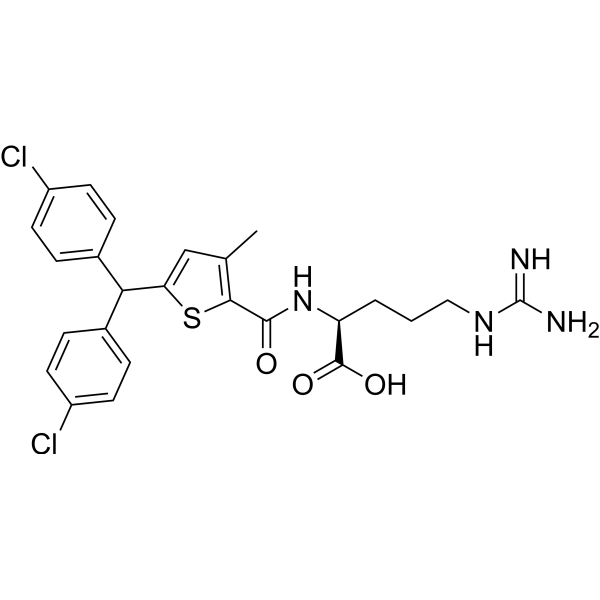
JR14a is a potent thiophene antagonist of human complement C3a receptor. JR14a shows selectivity for the human C3a receptor over C5a receptor. JR14a can suppress C3aR-mediated inflammation.
Nur für Forschungszwecke. Wir verkaufen nicht an Patienten.
- Reinheit : 99.77%
- CAS. Nr.: 2411440-41-8
- Formel: C25H26Cl2N4O3S
- Molecular Weight:533.47
-
Speicherung:Powder -20°C, 3 years , 4°C, 2 years ; In solvent -80°C, 2 years , -20°C, 1 year

To place orders, for customer services and technical support, please contact: MedChemExpress USA
Tel: 609-228-6898 E-mail: [email protected] [email protected]


-
 Biologische Aktivität
-
Chemical Information
-
Lösungsmittel & Löslichkeit
- Protokoll
- Reinheit & Dokumentation
- Verweise
-
 Help & FAQs


-
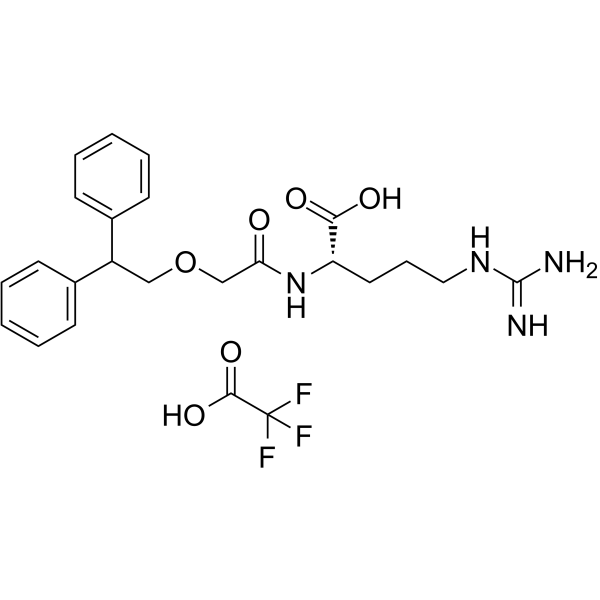
HY-101502A
SB290157 trifluoroacetateC3aR Antagonist -
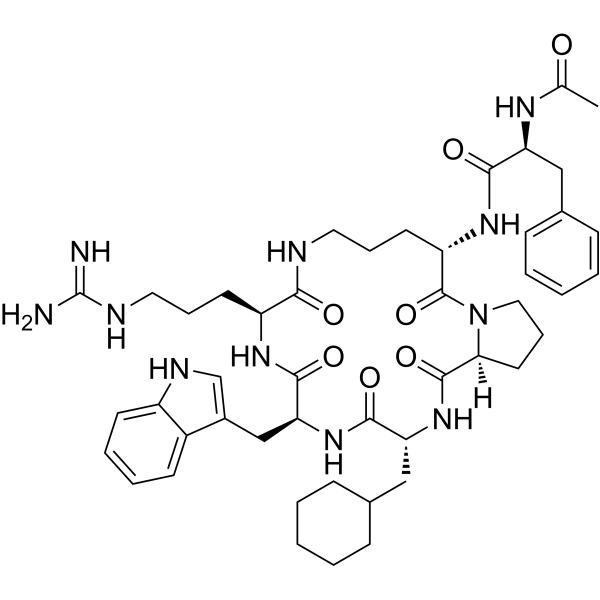
HY-106178
PMX-53C5a Receptor Antagonist -

HY-101502AR
SB290157 trifluoroacetate (Standard)C3aR Antagonist -
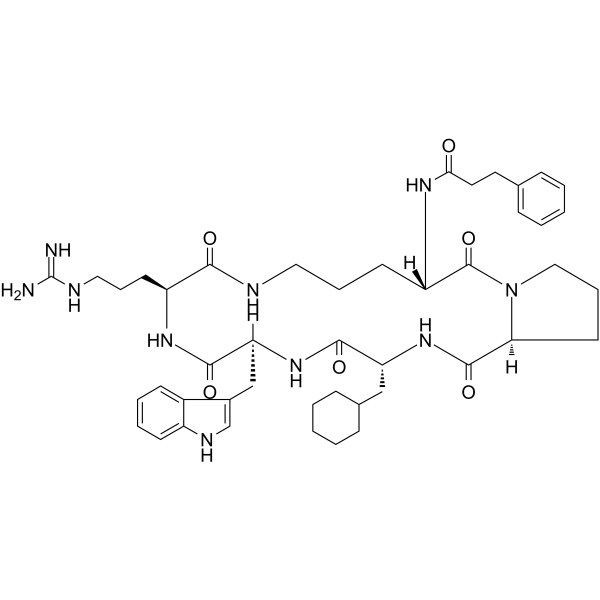
HY-110136
PMX 205Complement System Antagonist -
HY-Y0320
Dimethyl sulfoxide, meets analytical specification of Ch.P.Aprotic Solvent -
HY-16926
CK-666Arp2/3 Complex Inhibitor -
HY-P1345A
TLQP-21 TFAC3aR1 Agonist -

HY-P7863
Complement C3a Protein, Mouse -
HY-P7862
Complement C3a Protein, Human -
HY-P702819
Complement C3 Protein, Human (HEK293, His) -
HY-127105
IptacopanFactor B Inhibitor -
HY-17627
AvacopanC5aR Inhibitor
Publications Citing Use of MedChemExpress (MCE) JR14a
More- Nat Commun. 2026 Aug 25.
- Neuron. 2025 Oct 24:S0896-6273(25)00751-2. [Abstract]
- Arthritis Rheumatol. 2025 Jul 14. [Abstract]
- J Orthop Translat. 2026 Aug 3:60:101187.
- J Am Soc Nephrol. 2022 Sep;33(9):1742-1756. [Abstract]
- Basic Res Cardiol. 2026 Jun;121(3):481-502. [Abstract]
- EMBO J. 2025 Apr 7. [Abstract]
- J Neurochem. 2025 Jun;169(6):e70129. [Abstract]
- Brain Res Bull. 2024 Jul:213:110986. [Abstract]
- J Biol Chem. 2025 May;301(5):108500. [Abstract]
- bioRxiv. 2025 May 29:2025.05.26.656101. [Abstract]
 Customer Validation & Images

-
Cell Proliferation/Viability Assay
-
Cell Imaging/Staining
-
Flow Cytometry
-
IF
-
RT-PCR


Biologische Aktivität
Beschreibung
IC50 & Target
human complement C3a receptor[1]
Cellular Effect
|
Cell Line

|
Type | Value | Description | References |
|---|---|---|---|---|
| LAD2 | IC50 |
8 nM
Compound: 14a; JR14a
|
Antagonist at C3a receptor in human LAD2 cells assessed as inhibition of C3a-induced beta-hexosaminidase release preincubated for 30 mins followed by C3a addition
Antagonist at C3a receptor in human LAD2 cells assessed as inhibition of C3a-induced beta-hexosaminidase release preincubated for 30 mins followed by C3a addition
|
[PMID: 31910011] |
In Vitro
JR14a (0.1 nM-100 μM) inhibits C3a-induced intracellular Ca2+ release in human monocyte-derived macrophages, with an IC50 of 10 nM[1].
JR14a (0.1 nM-100 μM) is metabolically stable to exposure over 1 h to rat liver microsomes[1].
JR14a (0.1 nM-100 μM) inhibits C3a-induced β-hexosaminidase secretion in human LAD2 mast cells, with an IC50 of 8 nM[1].
MedChemExpress (MCE) has not independently confirmed the accuracy of these methods. They are for reference only.
In Vivo
JR14a (1 mg/kg; i.v.) exhibits elimination half-life (191 min), clearance (4.4 mL/min/kg) and AUC (3795 ng h/mL) in rats[1].
JR14a (10 mg/kg; p.o.) exhibits Cmax (88 ng/mL), Tmax (300 min) and AUC (478 ng h/mL) in rats[1].
MedChemExpress (MCE) has not independently confirmed the accuracy of these methods. They are for reference only.
-
Animal Model:Male Wister rats (8 weeks, 250-300 g) were injected with BR103[1]
-
Dosage:10 mg/kg
-
Administration:P.o. 2 h prior to agonist challenge
-
Result:Inhibited C3aR-mediated inflammation.
-
Animal Model:Male Wister rats (8 weeks, 250-300 g)[1]
-
Dosage:1 mg/kg for i.v.; 10 mg/kg for oral (Pharmacokinetic Analysis)
-
Administration:Intravenous administration and oral administration
-
Result:I.v.: t1/2=191 min, clearance=4.4 mL/min/kg, AUC=3795 ng•h/mL.
P.o.: Cmax=88 ng/mL, Tmax=300 min, AUC=478 ng•h/mL.


Chemical Information
-
CAS. Nr. 2411440-41-8
-
Appearance Solid
-
Molecular Weight 533.47
-
Formel C25H26Cl2N4O3S
-
Color White to light yellow
-
SMILES
O=C(C(SC(C(C(C=C1)=CC=C1Cl)C(C=C2)=CC=C2Cl)=C3)=C3C)N[C@H](C(O)=O)CCCNC(N)=N
-
Versand
Room temperature in continental US; may vary elsewhere.
-
Speicherung
Powder -20°C 3 years 4°C 2 years In solvent -80°C 2 years -20°C 1 year


Publications (11)
-
Journal Impact Factor
-
Most Recent
-
-
Neuron
BST2 expression at astrocyte borders promotes microglial recruitment via the C3/C3aR signaling. [Abstract]2025 Oct 24:S0896-6273(25)00751-2. PMID: 41138733 -
Arthritis Rheumatol
C3a-C3aR1-mediated interactions between fibroblast-like synoviocytes and macrophages promote the progression of rheumatoid arthritis. [Abstract]2025 Jul 14. PMID: 40654154 -
-
J Am Soc Nephrol
Complement C3a and C3a Receptor Activation Mediates Podocyte Injuries in the Mechanism of Primary Membranous Nephropathy. [Abstract]2022 Sep;33(9):1742-1756. PMID: 35777783
JR14a purchased from MedChemExpress. Usage Cited in: J Am Soc Nephrol. 2022 Sep;33(9):1742-1756. [Abstract]
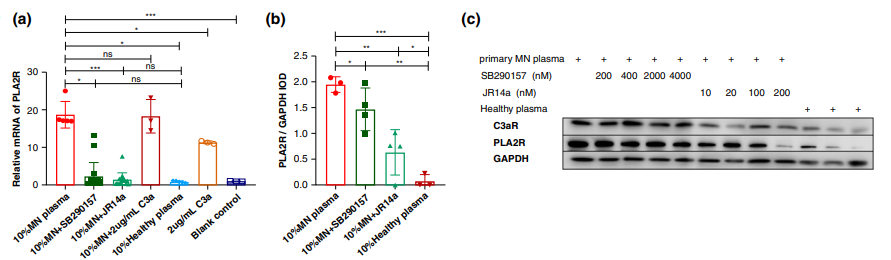
Human podocytes were exposed to medium containing 10% MN plasma (with C3a 1966.76259.0 ng/ml), 10% MN plasma 1 C3aR antagonist SB290157, 10% MN plasma 1 C3aR antagonist JR14a, 10% MN plasma 1 human C3a (2 mg/ml), 10% healthy plasma, C3a, or blank control. The expression of PLA2R was significantly elevated after exposure to MN plasma, and blocked by C3aR antagonists JR14a (10, 20, 100, 200 nM).
JR14a purchased from MedChemExpress. Usage Cited in: J Am Soc Nephrol. 2022 Sep;33(9):1742-1756. [Abstract]
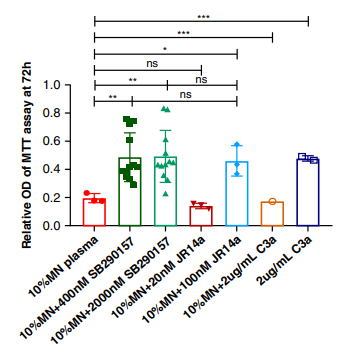
JR14a (20 nM; 72 h) arrested MN plasma induced a decrease in the viability of podocytes.
JR14a purchased from MedChemExpress. Usage Cited in: J Am Soc Nephrol. 2022 Sep;33(9):1742-1756. [Abstract]
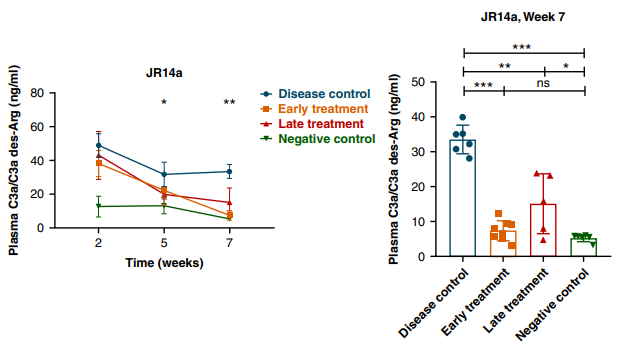
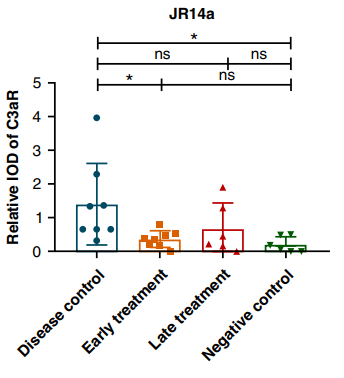
JR14a (10 mg/kg; po; daily for 7 weeks) in Sprague-Dawley rats with Heymann nephritis (early-treatment group from day 0 ; the late-treatment group from day 21) alleviated plasma level of C3a.
JR14a purchased from MedChemExpress. Usage Cited in: J Am Soc Nephrol. 2022 Sep;33(9):1742-1756. [Abstract]
JR14a (10 mg/kg; po; daily for 7 weeks) in Sprague-Dawley rats with Heymann nephritis (early-treatment group from day 0 ; the late-treatment group from day 21) alleviated glomerular expression of C3aR.
-
Basic Res Cardiol
Activation of the C3a-C3aReceptor-axis is associated with endothelial dysfunction and glycocalyx damage in ST-elevation myocardial infarction. [Abstract]2026 Jun;121(3):481-502. PMID: 42047759 -
EMBO J
Structural insights into small-molecule agonist recognition and activation of complement receptor C3aR. [Abstract]2025 Apr 7. PMID: 40195498 -
J Neurochem
Complement C3a and C5a Receptors Are Presented in Mouse Sciatic and Human Sural Nerves and Selectively Modulate the Neuronal Function of Large-Caliber Fibers in Mice. [Abstract]2025 Jun;169(6):e70129. PMID: 40539483 -
Brain Res Bull
JR14a: A novel antagonist of C3aR attenuates neuroinflammation in cerebral ischemia-reperfusion injury. [Abstract]2024 Jul:213:110986. PMID: 38810789 -
J Biol Chem
Knockdown of C3aR alleviates age-related bone loss via activation of YAP1/β-catenin signaling. [Abstract]2025 May;301(5):108500. PMID: 40216253
JR14a purchased from MedChemExpress. Usage Cited in: J Biol Chem. 2025 May;301(5):108500. [Abstract]
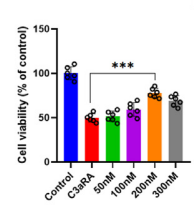
JR14a (C3aRA; 50, 100, 200, 300 nM; 48 h) shows 200 nM C3aRA on top of 100 mM D-gal intervention, the cell viability was significantly restored to a relatively desirable level, indicating that C3aRA has a protective effect against D-gal-induced cell damage at this concentration in MC3T3-E1 cells.
JR14a purchased from MedChemExpress. Usage Cited in: J Biol Chem. 2025 May;301(5):108500. [Abstract]
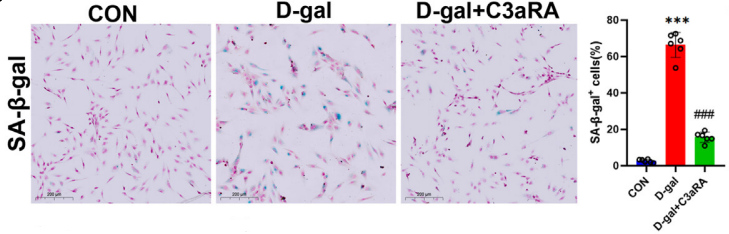
A-b-gal staining and quantitative analysis. MC3T3-E1 cells were cultured in media supplemented with D-gal (100 mM) or D-gal + C3aRA (JR14a, a novel antagonist of C3aR, 200 nM) for 48 h.
JR14a purchased from MedChemExpress. Usage Cited in: J Biol Chem. 2025 May;301(5):108500. [Abstract]
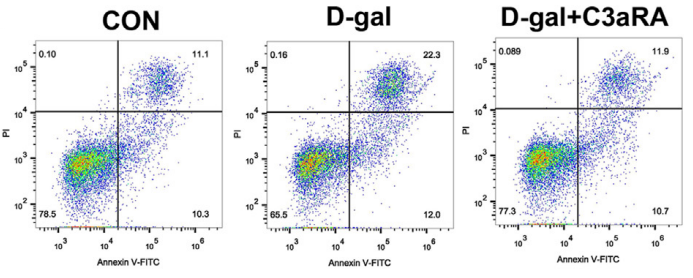
MC3T3-E1 cells were cultured in media supplemented with D-gal (100 mM) or D-gal + C3aRA (JR14a, a novel antagonist of C3aR, 200 nM) for 48 h. Flow cytometry analysis of apoptosis in the different groups.
JR14a purchased from MedChemExpress. Usage Cited in: J Biol Chem. 2025 May;301(5):108500. [Abstract]
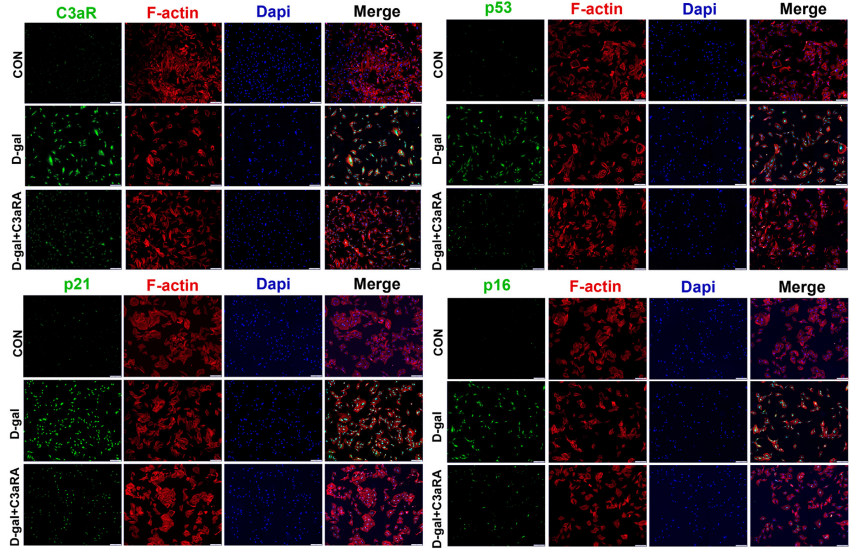
MC3T3-E1 cells were cultured in media supplemented with D-gal (100 mM) or D-gal + C3aRA (JR14a, a novel antagonist of C3aR, 200 nM) for 48 h. Representative immunofluorescence images of C3aR, p53, p21, and p16 expression.
-
bioRxiv
Molecular fingerprints of a convergent mechanism orchestrating diverse ligand recognition and species-specific pharmacology at the complement anaphylatoxin receptors. [Abstract]2025 May 29:2025.05.26.656101. PMID: 40501890


Lösungsmittel & Löslichkeit
In Vitro:
DMSO : 50 mg/mL (93.73 mM; ultrasonic and warming and heat to 60°C; Hygroscopic DMSO has a significant impact on the solubility of product, please use newly opened DMSO)
Please refer to the solubility information to select the appropriate solvent. Once prepared, please aliquot and store the solution to prevent product inactivation from repeated freeze-thaw cycles.
Storage method and period of stock solution: -80°C, 2 years; -20°C, 1 year. When stored at -80°C, please use it within 2 years. When stored at -20°C, please use it within 1 year.
Please refer to the solubility information to select the appropriate solvent. Once prepared, please aliquot and store the solution to prevent product inactivation from repeated freeze-thaw cycles.
Storage method and period of stock solution: -80°C, 2 years; -20°C, 1 year. When stored at -80°C, please use it within 2 years. When stored at -20°C, please use it within 1 year.
Konzentration (Stammlösung) × Volumen (Stammlösung) = Konzentration (Ziellösung) × Volumen (Ziellösung)
In Vivo:
Select the appropriate dissolution method based on your experimental animal and administration route.
- For the following dissolution methods, please ensure to first prepare a clear stock solution using an In Vitro approach and then sequentially add co-solvents:
- To ensure reliable experimental results, the clarified stock solution can be appropriately stored based on storage conditions. As for the working solution for In Vivo experiments, it is recommended to prepare freshly and use it on the same day.
- The percentages shown for the solvents indicate their volumetric ratio in the final prepared solution. If precipitation or phase separation occurs during preparation, heat and/or sonication can be used to aid dissolution.
Add each solvent one by one: 10% DMSO 40% PEG300 5% Tween-80 45% Saline
Solubility: ≥ 2.5 mg/mL (4.69 mM); Clear solution
This protocol yields a clear solution of ≥ 2.5 mg/mL (saturation unknown).
Taking 1 mL working solution as an example, add 100 μL DMSO stock solution (25.0 mg/mL) to 400 μL PEG300, and mix evenly; then add 50 μL Tween-80 and mix evenly; then add 450 μL Saline to adjust the volume to 1 mL.
Preparation of Saline: Dissolve 0.9 g sodium chloride in ddH₂O and dilute to 100 mL to obtain a clear Saline solution.
Add each solvent one by one: 10% DMSO 90% (20% SBE-β-CD in Saline)
Solubility: ≥ 2.5 mg/mL (4.69 mM); Clear solution
This protocol yields a clear solution of ≥ 2.5 mg/mL (saturation unknown).
Taking 1 mL working solution as an example, add 100 μL DMSO stock solution (25.0 mg/mL) to 900 μL 20% SBE-β-CD in Saline, and mix evenly.
Preparation of 20% SBE-β-CD in Saline (4°C, storage for one week): 2 g SBE-β-CD powder is dissolved in 10 mL Saline, completely dissolve until clear.
For the following dissolution methods, please prepare the working solution directly:
It is recommended to prepare fresh solutions and use them promptly within a short period of time.
The percentages shown for the solvents indicate their volumetric ratio in the final prepared solution. If precipitation or phase separation occurs during preparation, heat and/or sonication can be used to aid dissolution.
Add each solvent one by one: 50% PEG300 50% Saline
Solubility: 5 mg/mL (9.37 mM); Suspended solution; Need ultrasonic
In Vivo Dissolution Calculator
Please enter the basic information of animal experiments:
-
-
-
-
Recommended: Prepare an additional quantity of animals to account for potential losses during experiments.
Please enter your animal formula composition:
-
%DMSO +
Recommended: Keep the proportion of DMSO in working solution below 2% if your animal is weak.
-
%+
-
+%Tween-80 + +
-
%Saline +
The co-solvents required include: DMSO, . All of co-solvents are available by MedChemExpress (MCE). , Tween 80. All of co-solvents are available by MedChemExpress (MCE).
Working solution concentration: 0.22 mg/mL
Method for preparing stock solution: mg drug dissolved in μL DMSO. Stock solution concentration: mg/mL.
1. Take μL DMSO stock solution;
2. Add μL .
μL , mix evenly;
3. Then add μL Tween 80, mix evenly;
4. Then add μL
Please ensure that the stock solution in the first step is dissolved to a clear state, and add co-solvents in sequence. You can use ultrasonic heating (ultrasonic cleaner, recommended frequency 20-40 kHz), vortexing, etc. to assist dissolution.


Reinheit & Dokumentation
-
Data Sheet (276 KB)
-
SDS (393 KB)
- English - EN (393 KB)
- Français - FR (393 KB)
- Deutsch - DE (393 KB)
- Norwegian - NO (393 KB)
- Español - ES (393 KB)
- Swedish - SV (393 KB)
- Italian - IT (393 KB)
- Korean - KR (393 KB)
- Portuguese - PT (393 KB)
-
Handling Instructions (2659 KB)
Verweise


Complete Stock Solution Preparation Table
Please refer to the solubility information to select the appropriate solvent. Once prepared, please aliquot and store the solution to prevent product inactivation from repeated freeze-thaw cycles.
Storage method and period of stock solution: -80°C, 2 years; -20°C, 1 year. When stored at -80°C, please use it within 2 years. When stored at -20°C, please use it within 1 year.
| Optional Solvent | Concentration Solvent Mass | 1 mg | 5 mg | 10 mg | 25 mg |
|---|---|---|---|---|---|
| DMSO | 1 mM | 1.8745 mL | 9.3726 mL | 18.7452 mL | 46.8630 mL |
| 5 mM | 0.3749 mL | 1.8745 mL | 3.7490 mL | 9.3726 mL | |
| 10 mM | 0.1875 mL | 0.9373 mL | 1.8745 mL | 4.6863 mL | |
| 15 mM | 0.1250 mL | 0.6248 mL | 1.2497 mL | 3.1242 mL | |
| 20 mM | 0.0937 mL | 0.4686 mL | 0.9373 mL | 2.3431 mL | |
| 25 mM | 0.0750 mL | 0.3749 mL | 0.7498 mL | 1.8745 mL | |
| 30 mM | 0.0625 mL | 0.3124 mL | 0.6248 mL | 1.5621 mL | |
| 40 mM | 0.0469 mL | 0.2343 mL | 0.4686 mL | 1.1716 mL | |
| 50 mM | 0.0375 mL | 0.1875 mL | 0.3749 mL | 0.9373 mL | |
| 60 mM | 0.0312 mL | 0.1562 mL | 0.3124 mL | 0.7810 mL | |
| 80 mM | 0.0234 mL | 0.1172 mL | 0.2343 mL | 0.5858 mL |


JR14a Related Classifications
HY-138161 Related Classifications
 Powered by Bioz