



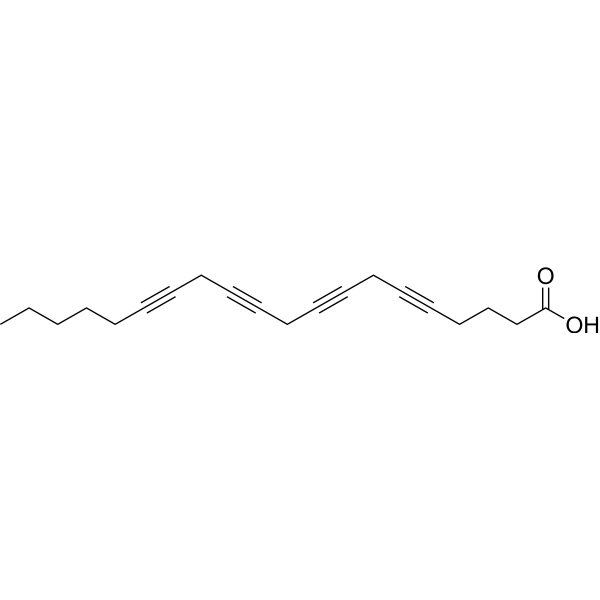
Eicosatetraynoic acid

Based on 1 Customer Validation
Eicosatetraynoic acid (ETYA) is a non-metabolizable analog of Arachidonic acid (HY-109590) and also an inhibitor of the lipoxygenase (LOX)/cyclooxygenase (COX) pathway (ID50 = 8 μM and 4 μM). Eicosatetraynoic acid acts as a suicide substrate to inhibit the production of inflammatory mediators such as leukotrienes and prostaglandins. Eicosatetraynoic acid acts directly on cell membranes and membrane proteins to exert a wide range of effects, including blocking potassium channels, increasing cell membrane fluidity, elevating intracellular calcium levels, inhibiting DNA synthesis in tumor cells, inducing differentiation of certain cells, and specifically inhibiting the assembly and replication of orthopoxviruses. Eicosatetraynoic acid alleviates acute lung injury induced by chemicals such as phosgene.
For research use only. We do not sell to patients.
- Purity: 99.9%
- CAS No.: 1191-85-1
- Formula: C20H24O2
- Molecular Weight:296.40
-
Storage:Powder -20°C, 3 years
* The compound is unstable in solutions, freshly prepared is recommended.


-
 Biological Activity
-
Chemical Information
-
Solvent & Solubility
- Purity & Documentation
- References
-
 Help & FAQs



All DNA/RNA Synthesis Isoforms
More

Biological Activity
|
COX 8 μM (ID50) |
Eicosatetraynoic acid dose-dependently reduces MDA production in cultured human umbilical vein endothelial cells co-incubated with low-density lipoprotein[1].
Eicosatetraynoic acid (40 μM; 4-72 h) reversibly inhibits DNA synthesis and blocks the proliferation of PC3, U937 and A172 cells without inducing significant cytotoxicity[2].
Eicosatetraynoic acid (40 μM; 3-7 d) induces partial monocyte-like differentiation in U937 cells, and induces partial glial-like differentiation in A172 cells after 72 h of incubation; in addition, the differentiation of U937 cells progresses gradually over 5 to 7 days[2].
Incubation with eicosatetraynoic acid (40 μM; 72 h) for 72 h induces cell type-specific ultrastructural changes, including severe oxidative stress-related mitochondrial damage in PC3 cells, milder damage in A172 cells, and immature monocyte morphology in U937 cells[2].
Eicosatetraynoic acid (40 μM) rapidly regulates multiple signal transduction pathways in PC3 and U937 cells, including increasing membrane fluidity and intracellular Ca2+ levels, inhibiting O2 uptake, reversibly blocking DNA synthesis, downregulating c-myc, inhibiting eicosanoid synthesis, and altering the localization of protein kinase C[2].
Eicosatetraynoic acid non-selectively inhibits 12-lipoxygenase (ID50 = 4 μM) and fatty acid cyclooxygenase (ID50 = 8 μM) in washed human platelets[3].
Eicosatetraynoic acid (79-316 μM) specifically and effectively blocks the replication of orthopoxviruses (vaccinia, vaccinia vaccine, and ectromelia viruses)[4].
MedChemExpress (MCE) has not independently confirmed the accuracy of these methods. They are for reference only.
-
Cell Line:PC3 prostate, U937 monoblastoid, A172 glioblastoma cells
-
Concentration:40 μM
-
Incubation Time:4 h, 72 h (DNA synthesis and cell number measurements); 4 h, 72 h (viability assays)
-
Result:Inhibited DNA synthesis in all three cell lines.
Reduced PC3 cell proliferation over 72 h, with control cells increasing from 1.3 million to 3.1 million while treated cells remained at 0.99 million, and maintained >95% viability.
Showed reversible inhibition of DNA synthesis at 4 h and 72 h, with no induced change in Cr51 release from prelabelled PC3 and U937 cells, and kept PC3/A172 cells attached to substrates.
-
Cell Line:U937 monoblastoid, A172 glioblastoma cells
-
Concentration:40 μM
-
Incubation Time:72 h; 5 to 7 days (extended U937 cell cultures)
-
Result:Induced reduced nuclear-to-cytoplasmic ratio, increased cytoplasm, irregular plasma membranes, increased nonspecific acid phosphatase activity, latex bead ingestion, and increased expression of the monocyte-associated surface epitope leu M3 (cd14) in U937 cells.
Caused spindle-shaped morphology, increased glial fibrillary acidic protein (GFAP) expression, and prominent bundles of 8 nm glial filaments in A172 cells.
Produced a progressive increase in differentiated cell functions in U937 cells during extended 5 to 7 day culture.
Eicosatetraynoic acid (300 μM; topical administration) significantly reduces pock formation on the chorioallantoic membranes of chicken embryos infected with the vaccinia virus CPV-BR.D1[4].
MedChemExpress (MCE) has not independently confirmed the accuracy of these methods. They are for reference only.
-
Animal Model:Hartley (male, 600-700 g, phosgene-induced acute lung injury)[1]
-
Dosage:100 µM (i.p. post-exposure); 50 µM (perfusate, every 40 mins starting 60 mins post-exposure)
-
Administration:i.p.; single dose (5 mins post-phosgene exposure); perfusate; every 40 minutes (starting 60 mins post-exposure initiation)
-
Result:Prevented phosgene-induced acute lung injury in male Hartley guinea pigs by maintaining lung GSH levels, reducing pulmonary edema, and increasing the GSH/TBARS protection ratio to 12.
-
Animal Model:12-day-old chick embryo[4]
-
Dosage:300 μM
-
Administration:topical (alongside virus infection)
-
Result:Severely reduced the number of pocks detected on chorioallantoic membranes.


Chemical Information
-
CAS No. 1191-85-1
-
Appearance Solid
-
Molecular Weight 296.40
-
Formula C20H24O2
-
Color Light yellow to brown
-
SMILES
CCCCCC#CCC#CCC#CCC#CCCCC(O)=O
-
Synonyms
ETYA
-
Shipping
Room temperature in continental US; may vary elsewhere.
-
Storage
Powder -20°C 3 years * The compound is unstable in solutions, freshly prepared is recommended.


Solvent & Solubility
DMSO : 2 mg/mL (6.75 mM; Need ultrasonic; Hygroscopic DMSO has a significant impact on the solubility of product, please use newly opened DMSO)
Ethanol : < 1 mg/mL (insoluble)
Please refer to the solubility information to select the appropriate solvent. The compound is unstable in solutions, freshly prepared is recommended.
Please refer to the solubility information to select the appropriate solvent. The compound is unstable in solutions, freshly prepared is recommended.
Concentration (start) × Volume (start) = Concentration (final) × Volume (final)


Purity & Documentation
-
Data Sheet (275 KB)
-
SDS (254 KB)
- English - EN (254 KB)
- Français - FR (254 KB)
- Deutsch - DE (254 KB)
- Norwegian - NO (254 KB)
- Español - ES (254 KB)
- Swedish - SV (254 KB)
- Italian - IT (254 KB)
- Korean - KR (254 KB)
- Portuguese - PT (254 KB)
-
Handling Instructions (2659 KB)
References
[1]. Sciuto AM, et al. Posttreatment with ETYA protects against phosgene-induced lung injury by amplifying the glutathione to lipid peroxidation ratio. Inhal Toxicol. 2000;12(4):347-356. [Content Brief]
[2]. Anderson KM, et al. ETYA, a pleotropic membrane-active arachidonic acid analogue affects multiple signal transduction pathways in cultured transformed mammalian cells. Clin Biochem. 1992;25(1):1-9. [Content Brief]
[3].
Hammarström S. Selective inhibition of platelet n-8 lipoxygenase by 5,8,11-eicosatriynoic acid. Biochim Biophys Acta. 1977 Jun 22;487(3):517-9.
[Content Brief]
[4]. Palumbo GJ, et al. Inhibitors of the lipoxygenase pathway specifically block orthopoxvirus replication. Virology. 1991;180(1):457-463. [Content Brief]
[5]. Kehl SJ, et al. Eicosatetraynoic acid (ETYA), a non-metabolizable analogue of arachidonic acid, blocks the fast-inactivating potassium current of rat pituitary melanotrophs. Can J Physiol Pharmacol. 2001;79(4):338-345. [Content Brief]


Complete Stock Solution Preparation Table
Please refer to the solubility information to select the appropriate solvent. The compound is unstable in solutions, freshly prepared is recommended.
| Optional Solvent | Concentration Solvent Mass | 1 mg | 5 mg | 10 mg | 25 mg |
|---|---|---|---|---|---|
| DMSO | 1 mM | 3.3738 mL | 16.8691 mL | 33.7382 mL | 84.3455 mL |
| 5 mM | 0.6748 mL | 3.3738 mL | 6.7476 mL | 16.8691 mL |


Eicosatetraynoic acid Related Classifications
Cat. No.: HY-124108
 Powered by Bioz
- Eicosatetraynoic acid
- 1191-85-1
- ETYA
- COX
- Lipoxygenase
- Orthopoxvirus
- Potassium Channel
- DNA/RNA Synthesis
- Drug Derivative
- lipoxygenase/cyclooxygenase pathway
- prostate cancer
- prostaglandin
- arachidonic acid
- histiocytic lymphoma
- BS-C-1 African green monkey kidney cells
- PC3 cells
- leukotriene
- glioblastoma
- orthopoxvirus
- Inhibitor
- inhibitor
- inhibit