



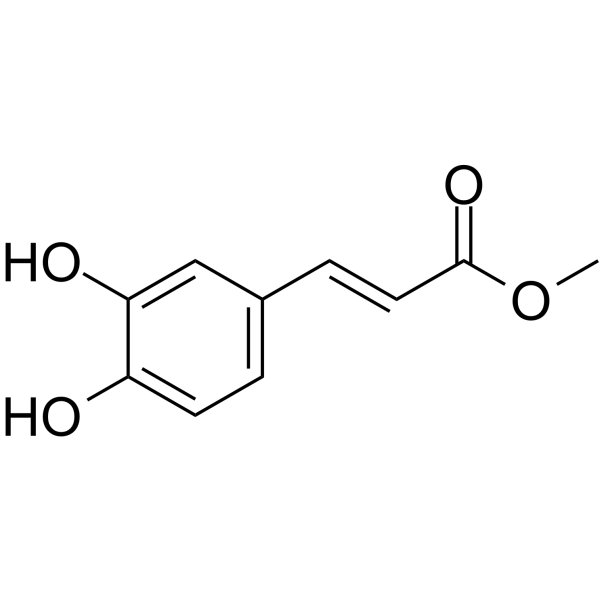
Methyl caffeate

Based on 1 Customer Validation
Methyl caffeate is a phenylpropanoid, antibacterial agent, and Apoptosis-inducing agent. Methyl caffeate can be isolated from the flowers of peach Prunus persica (L.). Methyl caffeate upregulates the expression of pro-apoptotic proteins Bid, Bax and p53, and downregulates the expression of anti-apoptotic protein BCL-2. Methyl caffeate downregulates SASP factors. Methyl caffeate enhances glucose-stimulated insulin secretion. Methyl caffeate inhibits the growth of Gram-positive bacteria, Gram-negative bacteria, fungi, and Mycobacterium tuberculosis strains. Methyl caffeate can be used in studies related to breast cancer, type 2 diabetes, and tuberculosis.
연구목적의 판매만을 진행합니다. 환자를 대상으로 한 판매는 하지 않습니다.
- Purity : 99.89%
- CAS No.: 3843-74-1
- 화학식: C10H10O4
- 분자량:194.18
-
보관:Powder -20°C, 3 years , 4°C, 2 years ; In solvent -80°C, 6 months , -20°C, 1 month

To place orders, for customer services and technical support, please contact: MedChemExpress USA
Tel: 609-228-6898 E-mail: [email protected] [email protected]


-
 Biological Activity
-
Chemical Information
-
용액&용해도
- Protocol
- 순도&문서
- References
-
 Help & FAQs




Biological Activity
제품 설명
IC50 & Target
[1]|
Bax |
Bcl-2 |
Cellular Effect
|
Cell Line

|
Type | Value | Description | References |
|---|---|---|---|---|
| A-431 | IC50 |
1.79 μg/mL
Compound: 4a
|
Inhibitory concentration required against A 431 human epidermoid carcinoma cell line
Inhibitory concentration required against A 431 human epidermoid carcinoma cell line
|
[PMID: 11354370] |
| A549 | IC50 |
7.54 μM
Compound: 2a
|
Cytotoxicity against human A549 cells after 72 hrs by alamar blue assay
Cytotoxicity against human A549 cells after 72 hrs by alamar blue assay
|
[PMID: 22954735] |
| B16 | IC50 |
2.96 μg/mL
Compound: 4a
|
Inhibitory concentration against B16 murine melanoma cell line
Inhibitory concentration against B16 murine melanoma cell line
|
[PMID: 11354370] |
| BeWo | IC50 |
17.27 μM
Compound: I-1
|
Antitumor activity against human Bewo cells assessed as inhibition of cell growth by MTT assay
Antitumor activity against human Bewo cells assessed as inhibition of cell growth by MTT assay
|
[PMID: 25160837] |
| Calu-1 | IC50 |
5.5 μM
Compound: 2a
|
Cytotoxicity against human Calu1 cells after 72 hrs by alamar blue assay
Cytotoxicity against human Calu1 cells after 72 hrs by alamar blue assay
|
[PMID: 22954735] |
| HCT-116 | IC50 |
3.01 μg/mL
Compound: 4a
|
Inhibitory concentration against HCT 116 human colon cancer cell line
Inhibitory concentration against HCT 116 human colon cancer cell line
|
[PMID: 11354370] |
| HeLa | IC50 |
3.77 μM
Compound: 2a
|
Cytotoxicity against human HeLa cells after 72 hrs by alamar blue assay
Cytotoxicity against human HeLa cells after 72 hrs by alamar blue assay
|
[PMID: 22954735] |
| HeLa | IC50 |
52.53 μM
Compound: I-1
|
Antitumor activity against human HeLa cells assessed as inhibition of cell growth by MTT assay
Antitumor activity against human HeLa cells assessed as inhibition of cell growth by MTT assay
|
[PMID: 25160837] |
| HepG2 | IC50 |
81.55 μM
Compound: I-1
|
Antitumor activity against human HepG2 cells assessed as inhibition of cell growth by MTT assay
Antitumor activity against human HepG2 cells assessed as inhibition of cell growth by MTT assay
|
[PMID: 25160837] |
| HL-60 | IC50 |
7.5 μM
Compound: 4
|
Cytotoxicity against human HL60 cells after 72 hrs by MTT assay
Cytotoxicity against human HL60 cells after 72 hrs by MTT assay
|
[PMID: 15387667] |
| HL-60 | IC50 |
12.32 μM
Compound: I-1
|
Antitumor activity against human HL60 cells assessed as inhibition of cell growth by MTT assay
Antitumor activity against human HL60 cells assessed as inhibition of cell growth by MTT assay
|
[PMID: 25160837] |
| HOP-62 | IC50 |
3.86 μM
Compound: 2a
|
Cytotoxicity against human HOP62 cells after 72 hrs by alamar blue assay
Cytotoxicity against human HOP62 cells after 72 hrs by alamar blue assay
|
[PMID: 22954735] |
| HT-1080 | IC50 |
11.1 μM
Compound: 4
|
Cytotoxicity against human HT1080 cells after 72 hrs by MTT assay
Cytotoxicity against human HT1080 cells after 72 hrs by MTT assay
|
[PMID: 15387667] |
| KB | IC50 |
>200 μM
Compound: 1d
|
Antitumor activity against KB cells by MTT assay
Antitumor activity against KB cells by MTT assay
|
[PMID: 17387015] |
| LNCaP | IC50 |
>100 μM
Compound: 3
|
Cytotoxicity against human LNCAP cells assessed as reduction in cell viability after 24 hrs by WST-1 assay
Cytotoxicity against human LNCAP cells assessed as reduction in cell viability after 24 hrs by WST-1 assay
|
[PMID: 24080105] |
| LoVo | IC50 |
>40 μM
Compound: 4
|
Cytotoxicity against human doxorubicin-resistant LoVo cells after 72 hrs by MTT assay
Cytotoxicity against human doxorubicin-resistant LoVo cells after 72 hrs by MTT assay
|
[PMID: 15387667] |
| LoVo | IC50 |
5.8 μM
Compound: 4
|
Cytotoxicity against human LoVo cells after 72 hrs by MTT assay
Cytotoxicity against human LoVo cells after 72 hrs by MTT assay
|
[PMID: 15387667] |
| LOX IMVI | IC50 |
21.8 μM
Compound: 2a
|
Cytotoxicity against human LOXIMVI cells after 72 hrs by alamar blue assay
Cytotoxicity against human LOXIMVI cells after 72 hrs by alamar blue assay
|
[PMID: 22954735] |
| M14 | IC50 |
8.86 μM
Compound: 2a
|
Cytotoxicity against human M14 cells after 72 hrs by alamar blue assay
Cytotoxicity against human M14 cells after 72 hrs by alamar blue assay
|
[PMID: 22954735] |
| NCI-H1299 | IC50 |
3.53 μM
Compound: 2a
|
Cytotoxicity against human NCI-H1299 cells after 72 hrs by alamar blue assay
Cytotoxicity against human NCI-H1299 cells after 72 hrs by alamar blue assay
|
[PMID: 22954735] |
| NCI-H157 | IC50 |
6.25 μM
Compound: 2a
|
Cytotoxicity against human NCI-H157 cells after 72 hrs by alamar blue assay
Cytotoxicity against human NCI-H157 cells after 72 hrs by alamar blue assay
|
[PMID: 22954735] |
| NCI-H1792 | IC50 |
6.09 μM
Compound: 2a
|
Cytotoxicity against human NCI-H1792 cells after 72 hrs by alamar blue assay
Cytotoxicity against human NCI-H1792 cells after 72 hrs by alamar blue assay
|
[PMID: 22954735] |
| NCI-H460 | IC50 |
14.8 μM
Compound: 2a
|
Cytotoxicity against human H460 cells after 72 hrs by alamar blue assay
Cytotoxicity against human H460 cells after 72 hrs by alamar blue assay
|
[PMID: 22954735] |
| Oocyte | IC50 |
388 μM
Compound: Caf-COOMe, methyl caffeate
|
Antagonist activity at Gloeobacter violaceus ligand-gated ion channel expressed in Xenopus oocytes assessed as inhibition of MES buffer pH 5.5 -induced currents after 30 secs by voltage clamp technique
Antagonist activity at Gloeobacter violaceus ligand-gated ion channel expressed in Xenopus oocytes assessed as inhibition of MES buffer pH 5.5 -induced currents after 30 secs by voltage clamp technique
|
[PMID: 23682762] |
| RAW264.7 | EC50 |
3.199 μM
Compound: 2, methyl caffeate
|
Inhibition of LPS-induced nitric oxide production in mouse RAW264.7 cells assessed as nitrite accumulation administered 1 hr before LPS challenge and measured after 24 hrs by Griess reagent assay
Inhibition of LPS-induced nitric oxide production in mouse RAW264.7 cells assessed as nitrite accumulation administered 1 hr before LPS challenge and measured after 24 hrs by Griess reagent assay
|
[PMID: 18667320] |
| RAW264.7 | EC50 |
367.5 μM
Compound: 2, methyl caffeate
|
Cytotoxicity against mouse RAW264.7 cells assessed as cell survival after 24 hrs by MTT assay
Cytotoxicity against mouse RAW264.7 cells assessed as cell survival after 24 hrs by MTT assay
|
[PMID: 18667320] |
| RAW264.7 | IC50 |
>0.3 mM
Compound: 31
|
Antiinflammatory activity in mouse RAW264.7 cells assessed as inhibition of LPS-induced nitric oxide production after 24 hrs
Antiinflammatory activity in mouse RAW264.7 cells assessed as inhibition of LPS-induced nitric oxide production after 24 hrs
|
[PMID: 18986199] |
| RAW264.7 | IC50 |
>0.3 μM/mL
Compound: 31
|
Antiinflammatory activity in mouse RAW264.7 cells assessed as inhibition of LPS-induced nitric oxide production after 24 hrs
Antiinflammatory activity in mouse RAW264.7 cells assessed as inhibition of LPS-induced nitric oxide production after 24 hrs
|
[PMID: 18986199] |
| RAW264.7 | IC50 |
3.9 μM
Compound: 29
|
Antiinflammatory activity against LPS-stimulated mouse RAW264.7 cells assessed as decrease in PGE2 production preincubated for 1 hr followed by LPS stimulation and measured after 24 hrs by ELISA
Antiinflammatory activity against LPS-stimulated mouse RAW264.7 cells assessed as decrease in PGE2 production preincubated for 1 hr followed by LPS stimulation and measured after 24 hrs by ELISA
|
[PMID: 31747281] |
| SGC-7901 | IC50 |
>100 μM
Compound: I-1
|
Antitumor activity against human SGC7901 cells assessed as inhibition of cell growth by MTT assay
Antitumor activity against human SGC7901 cells assessed as inhibition of cell growth by MTT assay
|
[PMID: 25160837] |
| SiHa | IC50 |
60.26 μM
Compound: I-1
|
Antitumor activity against human SiHa cells assessed as inhibition of cell growth by MTT assay
Antitumor activity against human SiHa cells assessed as inhibition of cell growth by MTT assay
|
[PMID: 25160837] |
In Vitro
Methyl caffeate (0.08-24.6 μM; 12-72 h) potently inhibits the viability of MCF-7 cells, with an IC50 of 0.62 μM at 24 h; it shows weak cytotoxicity against A549, COLO320 and HepG-2 cells, and exhibits no toxicity to Vero cells even at concentrations as high as 24.6 μM[1].
Methyl caffeate (1.23-2.46 μM; 24 h) induces dose-dependent DNA fragmentation in MCF-7 cells following 24 h of treatment at doses of 1.23 μM and 2.46 μM[1].
Methyl caffeate (1.23-2.46 μM; 24 h) regulates the expression of apoptosis-related proteins in MCF-7 cells[1].
Methyl caffeate (5-10 μM; 30 min preincubation, 1 h glucose stimulation) enhances glucose-stimulated insulin secretion in INS-1 rat insulinoma pancreatic β cells, with glucose stimulation indices of 4.01 at 5 μM and 5.34 at 10 μM[2].
Methyl caffeate (2-20 μM; 24 h) suppresses specific SASP factors (IL-6, IL-1α, CXCL1, MCP-2) in a concentration-dependent manner in bleomycin-induced senescent BJ foreskin fibroblasts[3].
Using the disk diffusion method, methyl caffeate (24 h for bacteria, 48 h for fungi) produces inhibition zones of varying sizes (0-22 mm) against tested Gram-positive bacteria, Gram-negative bacteria, and fungal strains, with the largest inhibition zone diameters observed against *Proteus vulgaris* MTCC 1771 and *Aspergillus flavus*[4].
Methyl caffeate (1.56-500 μg/mL; 24 h (bacteria), 48-72 h (fungi)) inhibits the growth of tested bacteria and fungi in vitro, with MIC values ranging from 25 μg/mL (against *Klebsiella pneumoniae* (ESBL-3971)) to 500 μg/mL (against some bacterial and fungal strains)[4].
MedChemExpress (MCE) has not independently confirmed the accuracy of these methods. They are for reference only.
-
Cell Line:human MCF-7, A549, COLO320, HepG-2, and Vero cells
-
Concentration:0.08-2.46 μM; up to 24.6 μM (Vero cells, 24 h)
-
Incubation Time:12 h, 24 h, 48 h, 72 h
-
Result:Induced 67.4% cell death in MCF-7 cells at 2.46 μM and an IC50 of 0.62 μM at 24 h.
Exhibited similar cytotoxicity against MCF-7 cells across 24 h, 48 h, and 72 h incubations with concentration-dependent activity (P < 0.05).
Showed weaker cytotoxicity against A549, COLO320, and HepG-2 cells at 24 h.
Caused no toxicity against Vero cells up to 24.6 μM.
-
Cell Line:human MCF-7 cells
-
Concentration:1.23-2.46 μM
-
Incubation Time:24 h
-
Result:Downregulated anti-apoptotic Bcl-2 protein and upregulated pro-apoptotic Bid and Bax proteins in a dose-dependent manner.
Upregulated cytochrome c levels.
Significantly increased p53, cleaved caspase-3, and cleaved PARP protein levels in a dose-dependent manner, while pro-caspase-3 and full-length PARP levels decreased.
- Research Protocol for Infectious Diseases
- RNA extraction experimental
- Detection of Apoptosis
- TUNEL staining for apoptotic DNA fragmentation
- Annexin V plus membrane-impermeant dye apoptosis staining
- Research Protocol for Endocrine Diseases
- Human Islet Cell Culture
- Apoptosis Solutions
- Gram Staining of Tissue Sections
- Breast Cancer Modeling
- Research Protocol for Metabolic Diseases


Chemical Information
-
CAS No. 3843-74-1
-
Appearance Solid
-
분자량 194.18
-
화학식 C10H10O4
-
Color White to off-white
-
SMILES
O=C(OC)/C=C/C1=CC=C(O)C(O)=C1
-
Structure Classification
-
Initial Source
-
선적
Room temperature in continental US; may vary elsewhere.
-
보관
Powder -20°C 3 years 4°C 2 years In solvent -80°C 6 months -20°C 1 month


용액&용해도
In Vitro:
DMSO : 33.33 mg/mL (171.64 mM; ultrasonic and warming and heat to 60°C; Hygroscopic DMSO has a significant impact on the solubility of product, please use newly opened DMSO)
Please refer to the solubility information to select the appropriate solvent. Once prepared, please aliquot and store the solution to prevent product inactivation from repeated freeze-thaw cycles.
Storage method and period of stock solution: -80°C, 6 months; -20°C, 1 month. When stored at -80°C, please use it within 6 months. When stored at -20°C, please use it within 1 month.
Please refer to the solubility information to select the appropriate solvent. Once prepared, please aliquot and store the solution to prevent product inactivation from repeated freeze-thaw cycles.
Storage method and period of stock solution: -80°C, 6 months; -20°C, 1 month. When stored at -80°C, please use it within 6 months. When stored at -20°C, please use it within 1 month.
Concentration (start) × Volume (start) = Concentration (final) × Volume (final)
In Vivo:
Select the appropriate dissolution method based on your experimental animal and administration route.
- For the following dissolution methods, please ensure to first prepare a clear stock solution using an In Vitro approach and then sequentially add co-solvents:
- To ensure reliable experimental results, the clarified stock solution can be appropriately stored based on storage conditions. As for the working solution for In Vivo experiments, it is recommended to prepare freshly and use it on the same day.
- The percentages shown for the solvents indicate their volumetric ratio in the final prepared solution. If precipitation or phase separation occurs during preparation, heat and/or sonication can be used to aid dissolution.
Add each solvent one by one: 10% DMSO 40% PEG300 5% Tween-80 45% Saline
Solubility: ≥ 2.5 mg/mL (12.87 mM); Clear solution
This protocol yields a clear solution of ≥ 2.5 mg/mL (saturation unknown).
Taking 1 mL working solution as an example, add 100 μL DMSO stock solution (25.0 mg/mL) to 400 μL PEG300, and mix evenly; then add 50 μL Tween-80 and mix evenly; then add 450 μL Saline to adjust the volume to 1 mL.
Preparation of Saline: Dissolve 0.9 g sodium chloride in ddH₂O and dilute to 100 mL to obtain a clear Saline solution.
Add each solvent one by one: 10% DMSO 90% (20% SBE-β-CD in Saline)
Solubility: ≥ 2.5 mg/mL (12.87 mM); Clear solution
This protocol yields a clear solution of ≥ 2.5 mg/mL (saturation unknown).
Taking 1 mL working solution as an example, add 100 μL DMSO stock solution (25.0 mg/mL) to 900 μL 20% SBE-β-CD in Saline, and mix evenly.
Preparation of 20% SBE-β-CD in Saline (4°C, storage for one week): 2 g SBE-β-CD powder is dissolved in 10 mL Saline, completely dissolve until clear.
In Vivo Dissolution Calculator
Please enter the basic information of animal experiments:
-
-
-
-
Recommended: Prepare an additional quantity of animals to account for potential losses during experiments.
Please enter your animal formula composition:
-
%DMSO +
Recommended: Keep the proportion of DMSO in working solution below 2% if your animal is weak.
-
%+
-
+%Tween-80 + +
-
%Saline +
The co-solvents required include: DMSO, . All of co-solvents are available by MedChemExpress (MCE). , Tween 80. All of co-solvents are available by MedChemExpress (MCE).
Working solution concentration: 0.22 mg/mL
Method for preparing stock solution: mg drug dissolved in μL DMSO. Stock solution concentration: mg/mL.
1. Take μL DMSO stock solution;
2. Add μL .
μL , mix evenly;
3. Then add μL Tween 80, mix evenly;
4. Then add μL
Please ensure that the stock solution in the first step is dissolved to a clear state, and add co-solvents in sequence. You can use ultrasonic heating (ultrasonic cleaner, recommended frequency 20-40 kHz), vortexing, etc. to assist dissolution.


순도&문서
-
Data Sheet (277 KB)
-
SDS (393 KB)
- English - EN (393 KB)
- Français - FR (393 KB)
- Deutsch - DE (393 KB)
- Norwegian - NO (393 KB)
- Español - ES (393 KB)
- Swedish - SV (393 KB)
- Italian - IT (393 KB)
- Korean - KR (393 KB)
- Portuguese - PT (393 KB)
-
Handling Instructions (2659 KB)
References
[1]. Balachandran C, et al. In vitro anticancer activity of methyl caffeate isolated from Solanum torvum Swartz. fruit. Chem Biol Interact. 2015;242:81-90. [Content Brief]
[2]. Lee D, et al. Methyl Caffeate Isolated from the Flowers of Prunus persica (L.) Batsch Enhances Glucose-Stimulated Insulin Secretion. Biomolecules. 2021 Feb 14;11(2):279. [Content Brief]
[3]. Lim H, et al. Methyl caffeate and some plant constituents inhibit age-related inflammation: effects on senescence-associated secretory phenotype (SASP) formation. Arch Pharm Res. 2017;40(4):524-535. [Content Brief]
[4]. Balachandran C, et al. Antimicrobial and Antimycobacterial Activities of Methyl Caffeate Isolated from Solanum torvum Swartz. Fruit. Indian J Microbiol. 2012;52(4):676-681. [Content Brief]


Complete Stock Solution Preparation Table
Please refer to the solubility information to select the appropriate solvent. Once prepared, please aliquot and store the solution to prevent product inactivation from repeated freeze-thaw cycles.
Storage method and period of stock solution: -80°C, 6 months; -20°C, 1 month. When stored at -80°C, please use it within 6 months. When stored at -20°C, please use it within 1 month.
| Optional Solvent | Concentration Solvent Mass | 1 mg | 5 mg | 10 mg | 25 mg |
|---|---|---|---|---|---|
| DMSO | 1 mM | 5.1499 mL | 25.7493 mL | 51.4986 mL | 128.7465 mL |
| 5 mM | 1.0300 mL | 5.1499 mL | 10.2997 mL | 25.7493 mL | |
| 10 mM | 0.5150 mL | 2.5749 mL | 5.1499 mL | 12.8747 mL | |
| 15 mM | 0.3433 mL | 1.7166 mL | 3.4332 mL | 8.5831 mL | |
| 20 mM | 0.2575 mL | 1.2875 mL | 2.5749 mL | 6.4373 mL | |
| 25 mM | 0.2060 mL | 1.0300 mL | 2.0599 mL | 5.1499 mL | |
| 30 mM | 0.1717 mL | 0.8583 mL | 1.7166 mL | 4.2916 mL | |
| 40 mM | 0.1287 mL | 0.6437 mL | 1.2875 mL | 3.2187 mL | |
| 50 mM | 0.1030 mL | 0.5150 mL | 1.0300 mL | 2.5749 mL | |
| 60 mM | 0.0858 mL | 0.4292 mL | 0.8583 mL | 2.1458 mL | |
| 80 mM | 0.0644 mL | 0.3219 mL | 0.6437 mL | 1.6093 mL | |
| 100 mM | 0.0515 mL | 0.2575 mL | 0.5150 mL | 1.2875 mL |


Methyl caffeate Related Classifications
HY-N6005 Related Classifications
 Powered by Bioz