



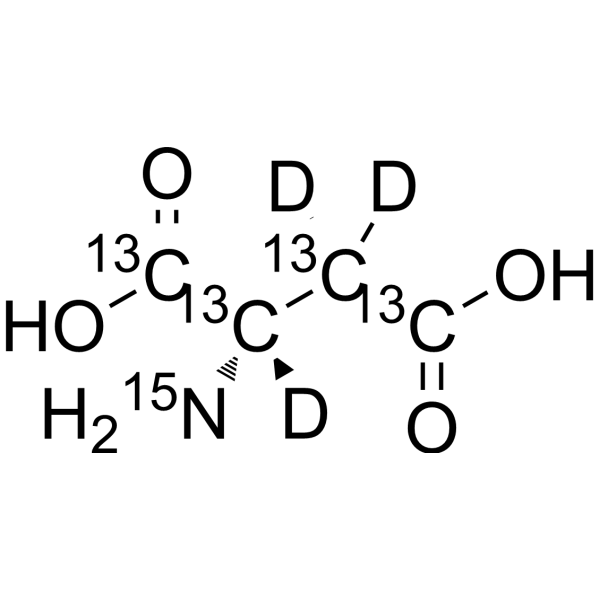
L-Aspartic acid-13C4,15N,d3
L-Aspartic acid-13C4,15N,d3 is the 15N, deuterated, 13C-labeled L-Aspartic acid (HY-N0666). L-Aspartic acid is a NMDA receptor agonist and acidic amino acid. L-Aspartic acid has no independent analgesic activity. L-Aspartic acid can antagonize the analgesic effects of D-Aspartic acid and Morphine. L-Aspartic acid regulates polymorph transformation, crystal growth/aggregation and nucleation processes of calcium carbonate, and can serve as a biomineralization template. L-Aspartic acid promotes burst firing of central neurons. L-Aspartic acid can be used in studies related to cerebral ischemia and epilepsy.
For research use only. We do not sell to patients.
- CAS No.: 1217475-13-2
- Formula: 13C4H4D3 15NO4
- Molecular Weight:141.09
-
Storage:Powder -20°C, 3 years , 4°C, 2 years ; In solvent -80°C, 6 months , -20°C, 1 month

To place orders, for customer services and technical support, please contact: MedChemExpress USA
Tel: 609-228-6898 E-mail: [email protected] [email protected]


-
 Biological Activity
-
Chemical Information
- Purity & Documentation
- References
-
 Help & FAQs


All iGluR Isoforms
More

Biological Activity
Description
IC50 & Target
|
NMDA Receptor |
Application
1. This compound can be used as a tracer
2. This compound can be used as an internal standard for quantitative analysis by NMR, GC-MS, or LC-MS.


Chemical Information
-
CAS No. 1217475-13-2
-
Unlabeled CAS 56-84-8
-
Appearance Solid
-
Molecular Weight 141.09
-
Formula 13C4H4D3 15NO4
-
Color White to off-white
-
SMILES
O[13C]([13C]([2H])([2H])[13C@@]([15NH2])([2H])[13C](O)=O)=O
-
Shipping
Room temperature in continental US; may vary elsewhere.
-
Storage
Powder -20°C 3 years 4°C 2 years In solvent -80°C 6 months -20°C 1 month


Purity & Documentation
-
Data Sheet (274 KB)
-
SDS (254 KB)
- English - EN (254 KB)
- Français - FR (254 KB)
- Deutsch - DE (254 KB)
- Norwegian - NO (254 KB)
- Español - ES (254 KB)
- Swedish - SV (254 KB)
- Italian - IT (254 KB)
- Korean - KR (254 KB)
- Portuguese - PT (254 KB)
-
Handling Instructions (2659 KB)
References
[1]. Onat F, et al. Antinociceptive effect of D-aspartic acid in mice. Pharmacology, biochemistry, and behavior. 1995 Aug;51(4):715-9. [Content Brief]
[2]. Hosoya K, et al. Blood-brain barrier produces significant efflux of L-aspartic acid but not D-aspartic acid: in vivo evidence using the brain efflux index method. Journal of neurochemistry. 1999 Sep;73(3):1206-11. [Content Brief]
[3]. Tong H, et al. Control over the crystal phase, shape, size and aggregation of calcium carbonate via a L-aspartic acid inducing process. Biomaterials. 2004 Aug;25(17):3923-9. [Content Brief]
[4]. MacDonald JF, et al. L-Aspartic acid induces a region of negative slope conductance in the current-voltage relationship of cultured spinal cord neurons. Brain research. 1982 Apr 08;237(1):248-53. [Content Brief]

Calculators
Concentration (start) × Volume (start) = Concentration (final) × Volume (final)


L-Aspartic acid-13C4,15N,d3 Related Classifications
HY-N0666S5 Related Classifications
 Powered by Bioz