



Licoisoflavone B

Based on 1 Customer Validation
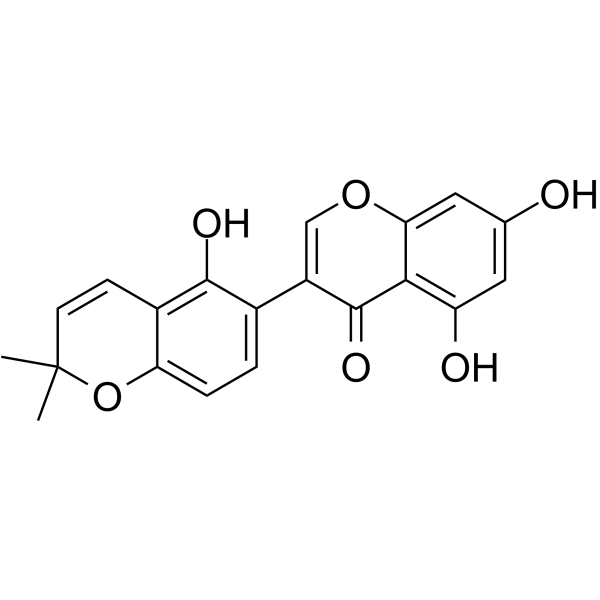
Licoisoflavone B is an orally active flavonoid found in licorice. Licoisoflavone B alleviates psoriasis via SCD1-targeted lipid metabolism reprogramming and suppression of Th17/IL-17-mediated inflammation. Licoisoflavone B inhiibits superoxide anion generation and superoxide anion-induced lipid peroxidation. Licoisoflavone B binds tightly to Lassa virus nucleoprotein and can be used as a nucleoprotein antagonist of Lassa virus. Licoisoflavone B exhibits anti-mutagenic activity
against carcinogenic mutagen, by preventing DNA damage. Licoisoflavone B can be used for the research of psoriasis, Lassa fever, inflammation and cancer.
For research use only. We do not sell to patients.
- Purity : 99.46%
- CAS No.: 66056-30-2
- Formula: C20H16O6
- Molecular Weight:352.34
-
Storage:
4°C, protect from light
* In solvent : -80°C, 6 months; -20°C, 1 month (protect from light)

To place orders, for customer services and technical support, please contact: MedChemExpress USA
Tel: 609-228-6898 E-mail: [email protected] [email protected]


-
 Biological Activity
-
Chemical Information
-
Solvent & Solubility
- Protocols
- Purity & Documentation
- References
-
 Help & FAQs




Biological Activity
Description
against carcinogenic mutagen, by preventing DNA damage. Licoisoflavone B can be used for the research of psoriasis, Lassa fever, inflammation and cancer[1][2][3][4].
In Vitro
Licoisoflavone B binds directly to purified SCD1 protein with a Kd of 7.1 μM[1].
Licoisoflavone B (0-15 μM; 24 h) exhibits no cytotoxicity toward HaCaT keratinocytes at concentrations ≤12 μM[1].
Licoisoflavone B (9 μM; 24 h) attenuates IL-17-induced SCD1 upregulation and lipid droplet accumulation in HaCaT keratinocytes[1].
Licoisoflavone B (9 μM; 24 h) suppresses IL-17-driven hyperproliferation of HaCaT keratinocytes[1].
Licoisoflavone B (100 μM; 10 min) inhibits superoxide anion-induced lipid peroxidation in a cell-free lecithin-based assay with an IC50 of 2.7 μM, and exhibits a 92.5% inhibitory ratio at 100 μM[2].
Licoisoflavone B (100 μM; 20 min) inhibits superoxide anion generation in a cell-free xanthine-xanthine oxidase assay with an IC50 of 31.2 μM and exhibits a 58.3% inhibitory ratio at 100 μM[2].
Licoisoflavone B binds tightly to Lassa virus nucleoprotein (PDB ID: 3MX5) with a binding affinity of -10.1 kcal/mol[3].
MedChemExpress (MCE) has not independently confirmed the accuracy of these methods. They are for reference only.
-
Cell Line:HaCaT keratinocytes
-
Concentration:0, 1, 3, 6, 9, 12, 15 μM
-
Incubation Time:24 h
-
Result:Showed no detectable cytotoxicity at concentrations ≤9 μM after 24 h of treatment.
Maintained cell viability near baseline levels at concentrations ≤9 μM.
Caused a significant reduction in cell viability at 15 μM.
In Vivo
Licoisoflavone B (40-160 mg/kg; p.o.; daily; 6 days) is well-tolerated in healthy male C57BL/6 mice at doses up to 160 mg/kg administered orally daily for 6 days, with no detected hepatic or renal toxicity[1].
MedChemExpress (MCE) has not independently confirmed the accuracy of these methods. They are for reference only.
-
Animal Model:C57BL/6 (male, 6-8 weeks old, Imiquimod-induced psoriasis-like model)[1]
-
Dosage:40 mg/kg; 80 mg/kg; 160 mg/kg
-
Administration:p.o.; daily; 6 days
-
Result:Reduced Psoriasis Area and Severity Index (PASI) cumulative scores, erythema scores, thickness scores, and scaling scores compared to untreated imiquimod-exposed mice.
Decreased epidermal thickness and splenic weight index in Imiquimod-induced mice.
Reduced splenic Th17 cell proportions.
Markedly decreased skin tissue mRNA expression of IL-17 and RORγt.
Significantly reduced protein expression of keratinocyte hyperproliferation markers KRT17, Ki67, and SCD1 in skin lesions.


Chemical Information
-
CAS No. 66056-30-2
-
Appearance Solid
-
Molecular Weight 352.34
-
Formula C20H16O6
-
Color White to yellow
-
SMILES
OC1=C(C=CC(C)(C)O2)C2=CC=C1C3=COC4=CC(O)=CC(O)=C4C3=O
-
Structure Classification
-
Initial Source
-
Shipping
Room temperature in continental US; may vary elsewhere.
-
Storage
4°C, protect from light
* In solvent : -80°C, 6 months; -20°C, 1 month (protect from light)


Solvent & Solubility
In Vitro:
DMSO : 50 mg/mL (141.91 mM; Need ultrasonic; Hygroscopic DMSO has a significant impact on the solubility of product, please use newly opened DMSO)
Please refer to the solubility information to select the appropriate solvent. Once prepared, please aliquot and store the solution to prevent product inactivation from repeated freeze-thaw cycles.
Storage method and period of stock solution: -80°C, 6 months; -20°C, 1 month (protect from light). When stored at -80°C, please use it within 6 months. When stored at -20°C, please use it within 1 month.
Please refer to the solubility information to select the appropriate solvent. Once prepared, please aliquot and store the solution to prevent product inactivation from repeated freeze-thaw cycles.
Storage method and period of stock solution: -80°C, 6 months; -20°C, 1 month (protect from light). When stored at -80°C, please use it within 6 months. When stored at -20°C, please use it within 1 month.
Concentration (start) × Volume (start) = Concentration (final) × Volume (final)
In Vivo:
Select the appropriate dissolution method based on your experimental animal and administration route.
- For the following dissolution methods, please ensure to first prepare a clear stock solution using an In Vitro approach and then sequentially add co-solvents:
- To ensure reliable experimental results, the clarified stock solution can be appropriately stored based on storage conditions. As for the working solution for In Vivo experiments, it is recommended to prepare freshly and use it on the same day.
- The percentages shown for the solvents indicate their volumetric ratio in the final prepared solution. If precipitation or phase separation occurs during preparation, heat and/or sonication can be used to aid dissolution.
Add each solvent one by one: 10% DMSO 40% PEG300 5% Tween-80 45% Saline
Solubility: ≥ 1.25 mg/mL (3.55 mM); Clear solution
This protocol yields a clear solution of ≥ 1.25 mg/mL (saturation unknown).
Taking 1 mL working solution as an example, add 100 μL DMSO stock solution (12.5 mg/mL) to 400 μL PEG300, and mix evenly; then add 50 μL Tween-80 and mix evenly; then add 450 μL Saline to adjust the volume to 1 mL.
Preparation of Saline: Dissolve 0.9 g sodium chloride in ddH₂O and dilute to 100 mL to obtain a clear Saline solution.
Add each solvent one by one: 10% DMSO 90% (20% SBE-β-CD in Saline)
Solubility: 1.25 mg/mL (3.55 mM); Suspended solution; Need ultrasonic
This protocol yields a suspended solution of 1.25 mg/mL. Suspended solution can be used for oral and intraperitoneal injection.
Taking 1 mL working solution as an example, add 100 μL DMSO stock solution (12.5 mg/mL) to 900 μL 20% SBE-β-CD in Saline, and mix evenly.
Preparation of 20% SBE-β-CD in Saline (4°C, storage for one week): 2 g SBE-β-CD powder is dissolved in 10 mL Saline, completely dissolve until clear.
In Vivo Dissolution Calculator
Please enter the basic information of animal experiments:
-
-
-
-
Recommended: Prepare an additional quantity of animals to account for potential losses during experiments.
Please enter your animal formula composition:
-
%DMSO +
Recommended: Keep the proportion of DMSO in working solution below 2% if your animal is weak.
-
%+
-
+%Tween-80 + +
-
%Saline +
The co-solvents required include: DMSO, . All of co-solvents are available by MedChemExpress (MCE). , Tween 80. All of co-solvents are available by MedChemExpress (MCE).
Working solution concentration: 0.22 mg/mL
Method for preparing stock solution: mg drug dissolved in μL DMSO. Stock solution concentration: mg/mL. * In solvent : -80°C, 6 months; -20°C, 1 month (protect from light)
1. Take μL DMSO stock solution;
2. Add μL .
μL , mix evenly;
3. Then add μL Tween 80, mix evenly;
4. Then add μL
Please ensure that the stock solution in the first step is dissolved to a clear state, and add co-solvents in sequence. You can use ultrasonic heating (ultrasonic cleaner, recommended frequency 20-40 kHz), vortexing, etc. to assist dissolution.


Purity & Documentation
-
Data Sheet (278 KB)
-
SDS (394 KB)
- English - EN (394 KB)
- Français - FR (394 KB)
- Deutsch - DE (394 KB)
- Norwegian - NO (394 KB)
- Español - ES (394 KB)
- Swedish - SV (394 KB)
- Italian - IT (394 KB)
- Korean - KR (394 KB)
- Portuguese - PT (394 KB)
-
Handling Instructions (2659 KB)
References
[1]. Liu Y, et al. Licoisoflavone B alleviates psoriasis via SCD1-targeted lipid metabolism reprogramming and suppression of Th17/IL-17-mediated inflammation. Front Pharmacol. 2026;17:1754729. Published 2026 Feb 16. [Content Brief]
[3]. Faisal Ahmed S, et al. Licoisoflavone B and glabridin from Glycyrrhiza glabra as potent nucleoprotein antagonists of Lassa virus: insights from molecular docking, dynamics simulation, PCA, and DFT studies. J Genet Eng Biotechnol. 2025;23(3):100544. [Content Brief]


Complete Stock Solution Preparation Table
Please refer to the solubility information to select the appropriate solvent. Once prepared, please aliquot and store the solution to prevent product inactivation from repeated freeze-thaw cycles.
Storage method and period of stock solution: -80°C, 6 months; -20°C, 1 month (protect from light). When stored at -80°C, please use it within 6 months. When stored at -20°C, please use it within 1 month.
| Optional Solvent | Concentration Solvent Mass | 1 mg | 5 mg | 10 mg | 25 mg |
|---|---|---|---|---|---|
| DMSO | 1 mM | 2.8382 mL | 14.1908 mL | 28.3817 mL | 70.9542 mL |
| 5 mM | 0.5676 mL | 2.8382 mL | 5.6763 mL | 14.1908 mL | |
| 10 mM | 0.2838 mL | 1.4191 mL | 2.8382 mL | 7.0954 mL | |
| 15 mM | 0.1892 mL | 0.9461 mL | 1.8921 mL | 4.7303 mL | |
| 20 mM | 0.1419 mL | 0.7095 mL | 1.4191 mL | 3.5477 mL | |
| 25 mM | 0.1135 mL | 0.5676 mL | 1.1353 mL | 2.8382 mL | |
| 30 mM | 0.0946 mL | 0.4730 mL | 0.9461 mL | 2.3651 mL | |
| 40 mM | 0.0710 mL | 0.3548 mL | 0.7095 mL | 1.7739 mL | |
| 50 mM | 0.0568 mL | 0.2838 mL | 0.5676 mL | 1.4191 mL | |
| 60 mM | 0.0473 mL | 0.2365 mL | 0.4730 mL | 1.1826 mL | |
| 80 mM | 0.0355 mL | 0.1774 mL | 0.3548 mL | 0.8869 mL | |
| 100 mM | 0.0284 mL | 0.1419 mL | 0.2838 mL | 0.7095 mL |


Licoisoflavone B Related Classifications
HY-N3388 Related Classifications
 Powered by Bioz