



Madecassoside (Standard)
Based on 1 publication(s) in Google Scholar
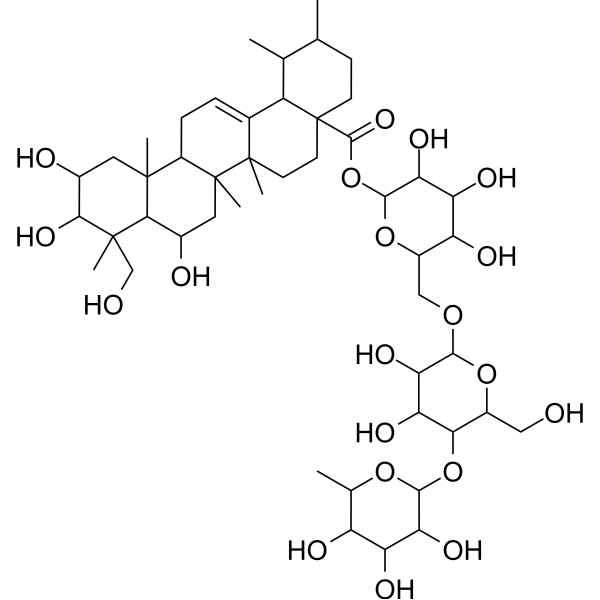
Madecassoside (Standard) is the analytical standard of Madecassoside. This product is intended for research and analytical applications. Madecassoside is a pentacyclic triterpene isolated from Centella asiatica and has anti-inflammatory properties. Antioxidant and anti-aging effects. Madecassoside is a pentacyclic triterpene isolated from Centella asiatica. Madecassoside is orally active and has inhibitory properties against inflammation, oxidation, apoptosis and autophagy. Madecassosid inhibits activities of p38 MAPK and NF-kB, exhibits an anti-apopototic property, activates Nrf2 expression to reduce the neurotoxicity[10]. Madecassoside can be used in endocrine diseases, cardiovascular diseases, skin diseases and other diseases.
For research use only. We do not sell to patients.
- Purity : 99.09%
- CAS No.: 34540-22-2
- Formula: C₄₈H₇₈O₂₀
- Molecular Weight:975.12
-
Storage:
Please store the product under the recommended conditions in the Certificate of Analysis.


To place orders, for customer services and technical support, please contact: MedChemExpress USA
Tel: 609-228-6898 E-mail: [email protected] [email protected]


-
 Product Information
-
Chemical Information
- Purity & Documentation
-
 Help & FAQs



Publications Citing Use of MedChemExpress (MCE) Madecassoside (Standard)
More

Product Information
Information
Application
The compound is the grade of analytical standard, which is the reference standard supplied assay. It is commonly used in qualitative, quantitative and methodological research experiments in HPLC, GC and MS.


Chemical Information
-
CAS No. 34540-22-2
-
Appearance Solid
-
Molecular Weight 975.12
-
Formula C₄₈H₇₈O₂₀
-
Color White to off-white
-
SMILES
O=C(C1(CCC(C)C2C)C2C3=CCC4C(C)(CC(O)C5C4(CC(O)C(O)C5(C)CO)C)C3(C)CC1)OC(C(C(O)C6O)O)OC6COC(C(C(O)C7OC(OC(C)C(O)C8O)C8O)O)OC7CO
-
Synonyms
Asiaticoside A (Standard)
-
Structure Classification
-
Shipping
Room temperature in continental US; may vary elsewhere.
-
Storage
Please store the product under the recommended conditions in the Certificate of Analysis.


Publications (1)
-
Journal Impact Factor
-
Most Recent


Purity & Documentation
-
SDS (394 KB)
- English - EN (394 KB)
- Français - FR (394 KB)
- Deutsch - DE (394 KB)
- Norwegian - NO (394 KB)
- Español - ES (394 KB)
- Swedish - SV (394 KB)
- Italian - IT (394 KB)
- Korean - KR (394 KB)
- Portuguese - PT (394 KB)
-
Handling Instructions (2659 KB)
References
[1]. Zexin Li et al. Madecassoside suppresses proliferation and invasiveness of HGF-induced human hepatocellular carcinoma cells via PKC-cMET-ERK1/2-COX-2-PGE2 pathway. Int Immunopharmacol. 2016 Apr;33:24-32. [Content Brief]
[2]. Xia Y et al. Madecassoside ameliorates bleomycin-induced pulmonary fibrosis in mice through promoting the generation of hepatocyte growth factor via PPAR-γ in colon. Br J Pharmacol. 2016 Apr;173(7):1219-35 [Content Brief]
[3]. Su Z et al. Protective effects of madecassoside against Doxorubicin induced nephrotoxicity in vivo and in vitro. Sci Rep. 2015 Dec 14 [Content Brief]
[4]. Anukunwithaya, et al., Pharmacokinetics of a Standardized Extract of Centella asiatica ECa 233 in Rats. Planta Med. 2017 May;83(8):710-717. [Content Brief]
[5]. Bian D, et al., Madecassoside, a triterpenoid saponin isolated from Centella asiatica herbs, protects endothelial cells against oxidative stress. J Biochem Mol Toxicol. 2012 Oct;26(10):399-406. [Content Brief]
[6]. Luo Y, et al., Neuroprotective effects of madecassoside against focal cerebral ischemia reperfusion injury in rats. Brain Res. 2014 May 27;1565:37-47. [Content Brief]
[7]. Ling Y, et al., Protective effect of madecassoside on H2O2-induced oxidative stress and autophagy activation in human melanocytes. Oncotarget. 2017 May 7;8(31):51066-51075. [Content Brief]
[8]. Elhassen SAM, et al., Effect of madecassoside and catalpol in amelioration of insulin sensitivity in pancreatic (INS-1E) β-cell line. Nat Prod Res. 2021 Nov;35(22):4627-4631. [Content Brief]
[9]. Du B, et a;., Madecassoside prevents Aβ(25-35)-induced inflammatory responses and autophagy in neuronal cells through the class III PI3K/Beclin-1/Bcl-2 pathway. Int Immunopharmacol. 2014 May;20(1):221-8. [Content Brief]
[10]. Liu S, et al., Madecassoside ameliorates lipopolysaccharide-induced neurotoxicity in rats by activating the Nrf2-HO-1 pathway. Neurosci Lett. 2019 Sep 14;709:134386. [Content Brief]
[11]. Lu GX, et al., Madecassoside ameliorates bleomycin-induced pulmonary fibrosis in mice by downregulating collagen deposition. Phytother Res. 2014 Aug;28(8):1224-31. [Content Brief]

Calculators
Concentration (start) × Volume (start) = Concentration (final) × Volume (final)


Madecassoside (Standard) Related Classifications
HY-N0568R Related Classifications
 Powered by Bioz