



Oglufanide

Based on 1 Customer Validation
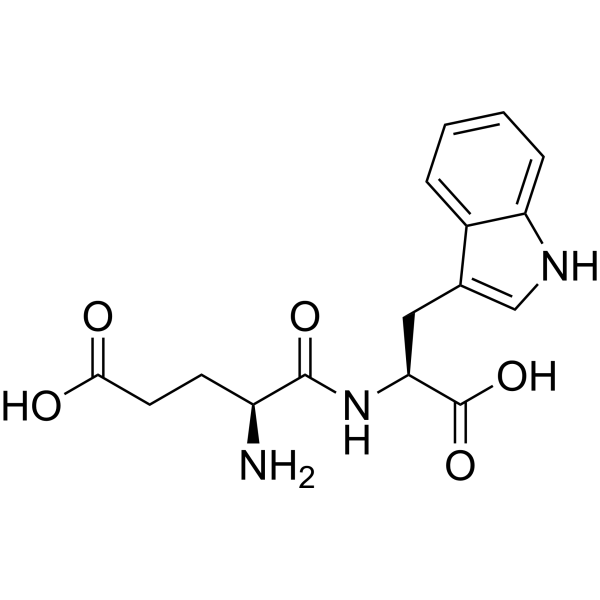
Oglufanide (H-Glu-Trp-OH) is a dipeptide immunomodulator isolated from calf thymus. Oglufanide inhibits vascular endothelial growth factor (VEGF). Oglufanide can stimulate the immune response to hepatitic C virus (HCV) and intracellular bacterial infections. Oglufanide shows antitumor and anti-angiogenesis activities.
For research use only. We do not sell to patients.
- Purity: 98.93%
- CAS No.: 38101-59-6
- Formula: C16H19N3O5
- Molecular Weight:333.34
-
Storage:
Sealed storage, away from moisture.
Powder -80°C, 2 years , -20°C, 1 year* In solvent : -80°C, 6 months; -20°C, 1 month (sealed storage, away from moisture)

To place orders, for customer services and technical support, please contact: MedChemExpress USA
Tel: 609-228-6898 E-mail: [email protected] [email protected]


-
 Biological Activity
-
Chemical Information
-
Solvent & Solubility
- Purity & Documentation
- References
-
 Help & FAQs





Biological Activity
|
VEGFR |
HCV |
Human Endogenous Metabolite |
Oglufanide (IM862) (1-1000 μg/mL) exhibits dose dependent inhibition of angiogenesis in the chorioallantoic membrane assay with complete inhibition of β-FGF and VEGF-induced angiogenesis[3].
?
Oglufanide (L-glu-L-trp) (0-1000 μg/mL; 5 days) has no effect on the viability of either the tumor cell lines or HUVECs[4].
MedChemExpress (MCE) has not independently confirmed the accuracy of these methods. They are for reference only.
MedChemExpress (MCE) has not independently confirmed the accuracy of these methods. They are for reference only.
-
Animal Model:C57BL/6 immune competent mice, Lewis lung carcinoma (LLC) xenograft; Balb/C athymic mice, M21 human melanoma xenograft[4]
-
Dosage:1, 10, 50 and 100 mg/kg/day
-
Administration:Subcutaneous injection, 10 days
-
Result:Resulted in a dose-dependent inhibition of LLC tumor growth in syngeneic immune competent mice and showed a dose-dependent decrease in tumor volumes of xenografts in Balb/C athymic mice implanted with M21 human melanoma cells.
| NCT Number | Sponsor | Condition | Start Date |
Phase

|
|---|---|---|---|---|
| NCT01329991 | Plexxikon| | 2011-05 | PHASE1 |


Chemical Information
-
CAS No. 38101-59-6
-
Appearance Solid
-
Molecular Weight 333.34
-
Formula C16H19N3O5
-
Color White to off-white
-
SMILES
O=C(O)[C@H](CC1=CNC2=CC=CC=C12)NC([C@H](CCC(O)=O)N)=O
-
Synonyms
H-Glu-Trp-OH; L-Glutamyl-L-tryptophan
-
Structure Classification
-
Initial Source
-
Shipping
Room temperature in continental US; may vary elsewhere.
-
Storage
Sealed storage, away from moisture
Powder -80°C 2 years -20°C 1 year * In solvent : -80°C, 6 months; -20°C, 1 month (sealed storage, away from moisture)


Solvent & Solubility
DMSO : 15.5 mg/mL (46.50 mM; Need ultrasonic and warming; Hygroscopic DMSO has a significant impact on the solubility of product, please use newly opened DMSO)
Please refer to the solubility information to select the appropriate solvent. Once prepared, please aliquot and store the solution to prevent product inactivation from repeated freeze-thaw cycles.
Storage method and period of stock solution: -80°C, 6 months; -20°C, 1 month (sealed storage, away from moisture). When stored at -80°C, please use it within 6 months. When stored at -20°C, please use it within 1 month.
Please refer to the solubility information to select the appropriate solvent. Once prepared, please aliquot and store the solution to prevent product inactivation from repeated freeze-thaw cycles.
Storage method and period of stock solution: -80°C, 6 months; -20°C, 1 month (sealed storage, away from moisture). When stored at -80°C, please use it within 6 months. When stored at -20°C, please use it within 1 month.
Concentration (start) × Volume (start) = Concentration (final) × Volume (final)
Select the appropriate dissolution method based on your experimental animal and administration route.
- For the following dissolution methods, please ensure to first prepare a clear stock solution using an In Vitro approach and then sequentially add co-solvents:
- To ensure reliable experimental results, the clarified stock solution can be appropriately stored based on storage conditions. As for the working solution for In Vivo experiments, it is recommended to prepare freshly and use it on the same day.
- The percentages shown for the solvents indicate their volumetric ratio in the final prepared solution. If precipitation or phase separation occurs during preparation, heat and/or sonication can be used to aid dissolution.
Add each solvent one by one: 10% DMSO 40% PEG300 5% Tween-80 45% Saline
Solubility: ≥ 2.5 mg/mL (7.50 mM); Clear solution
This protocol yields a clear solution of ≥ 2.5 mg/mL (saturation unknown).
Taking 1 mL working solution as an example, add 100 μL DMSO stock solution (25.0 mg/mL) to 400 μL PEG300, and mix evenly; then add 50 μL Tween-80 and mix evenly; then add 450 μL Saline to adjust the volume to 1 mL.
Preparation of Saline: Dissolve 0.9 g sodium chloride in ddH₂O and dilute to 100 mL to obtain a clear Saline solution.
Add each solvent one by one: 10% DMSO 90% (20% SBE-β-CD in Saline)
Solubility: ≥ 2.5 mg/mL (7.50 mM); Clear solution
This protocol yields a clear solution of ≥ 2.5 mg/mL (saturation unknown).
Taking 1 mL working solution as an example, add 100 μL DMSO stock solution (25.0 mg/mL) to 900 μL 20% SBE-β-CD in Saline, and mix evenly.
Preparation of 20% SBE-β-CD in Saline (4°C, storage for one week): 2 g SBE-β-CD powder is dissolved in 10 mL Saline, completely dissolve until clear.
Please enter the basic information of animal experiments:
-
-
-
-
Recommended: Prepare an additional quantity of animals to account for potential losses during experiments.
Please enter your animal formula composition:
-
%DMSO +
Recommended: Keep the proportion of DMSO in working solution below 2% if your animal is weak.
-
%+
-
+%Tween-80 + +
-
%Saline +
The co-solvents required include: DMSO, . All of co-solvents are available by MedChemExpress (MCE). , Tween 80. All of co-solvents are available by MedChemExpress (MCE).
Working solution concentration: 0.22 mg/mL
Method for preparing stock solution: mg drug dissolved in μL DMSO. Stock solution concentration: mg/mL. * In solvent : -80°C, 6 months; -20°C, 1 month (sealed storage, away from moisture)
1. Take μL DMSO stock solution;
2. Add μL .
μL , mix evenly;
3. Then add μL Tween 80, mix evenly;
4. Then add μL
Please ensure that the stock solution in the first step is dissolved to a clear state, and add co-solvents in sequence. You can use ultrasonic heating (ultrasonic cleaner, recommended frequency 20-40 kHz), vortexing, etc. to assist dissolution.


Purity & Documentation
-
Data Sheet (277 KB)
-
SDS (393 KB)
- English - EN (393 KB)
- Français - FR (393 KB)
- Deutsch - DE (393 KB)
- Norwegian - NO (393 KB)
- Español - ES (393 KB)
- Swedish - SV (393 KB)
- Italian - IT (393 KB)
- Korean - KR (393 KB)
- Portuguese - PT (393 KB)
-
Handling Instructions (2659 KB)
References
[1]. Bayes M, et al. Gateways to clinical trials. Methods Find Exp Clin Pharmacol. 2005 Jul-Aug;27(6):411-61. [Content Brief]
[2]. Nagendra Kumar Kaushik, et al. Biomedical importance of indoles. Molecules. 2013 Jun 6;18(6):6620-62. [Content Brief]
[3]. Noy A, et al. Angiogenesis inhibitor IM862 is ineffective against AIDS-Kaposi's sarcoma in a phase III trial, but demonstrates sustained, potent effect of highly active antiretroviral therapy: from the AIDS Malignancy Consortium and IM862 Study Team. J Clin Oncol. 2005 Feb 10;23(5):990-8. [Content Brief]
[4]. Smith DL, et al. Natural killer cell cytolytic activity is necessary for in vivo antitumor activity of the dipeptide L-glutamyl-L-tryptophan. Int J Cancer. 2003 Sep 10;106(4):528-533. [Content Brief]


Complete Stock Solution Preparation Table
Please refer to the solubility information to select the appropriate solvent. Once prepared, please aliquot and store the solution to prevent product inactivation from repeated freeze-thaw cycles.
Storage method and period of stock solution: -80°C, 6 months; -20°C, 1 month (sealed storage, away from moisture). When stored at -80°C, please use it within 6 months. When stored at -20°C, please use it within 1 month.
| Optional Solvent | Concentration Solvent Mass | 1 mg | 5 mg | 10 mg | 25 mg |
|---|---|---|---|---|---|
| DMSO | 1 mM | 2.9999 mL | 14.9997 mL | 29.9994 mL | 74.9985 mL |
| 5 mM | 0.6000 mL | 2.9999 mL | 5.9999 mL | 14.9997 mL | |
| 10 mM | 0.3000 mL | 1.5000 mL | 2.9999 mL | 7.4999 mL | |
| 15 mM | 0.2000 mL | 1.0000 mL | 2.0000 mL | 4.9999 mL | |
| 20 mM | 0.1500 mL | 0.7500 mL | 1.5000 mL | 3.7499 mL | |
| 25 mM | 0.1200 mL | 0.6000 mL | 1.2000 mL | 2.9999 mL | |
| 30 mM | 0.1000 mL | 0.5000 mL | 1.0000 mL | 2.5000 mL | |
| 40 mM | 0.0750 mL | 0.3750 mL | 0.7500 mL | 1.8750 mL |


Oglufanide Related Classifications
HY-13718 Related Classifications
 Powered by Bioz