



Orange I

Based on 1 Customer Validation
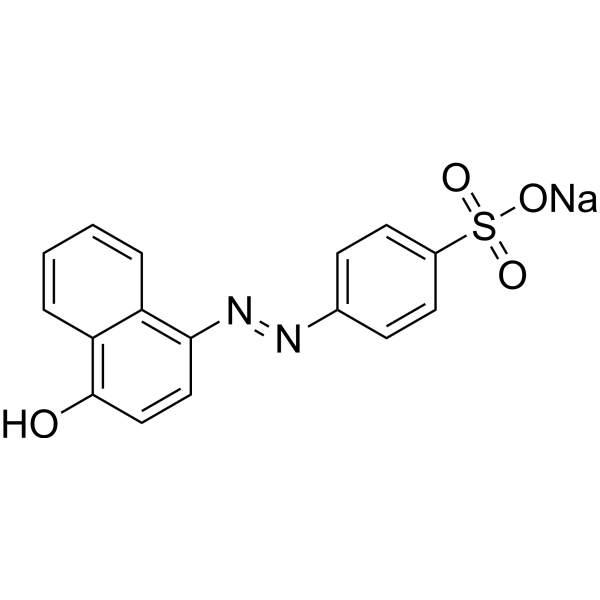
Orange I (α-Naphthol Orange) is an anionic azo dye that can form a complex with Methylene blue (HY-14536) and cause fluorescence quenching. The equilibrium constant of the complex of Orange I and Methylene blue is 79900 mol-1·dm3. Orange I can change the absorption spectrum of itself and Methylene blue.
For research use only. We do not sell to patients.
- Purity : 92.97%
- CAS No.: 523-44-4
- Formula: C16H11N2NaO4S
- Molecular Weight:350.32
-
Storage:
4°C, protect from light
* In solvent : -80°C, 6 months; -20°C, 1 month (protect from light)

To place orders, for customer services and technical support, please contact: MedChemExpress USA
Tel: 609-228-6898 E-mail: [email protected] [email protected]


-
 Biological Activity
-
Chemical Information
-
Solvent & Solubility
- Purity & Documentation
- References
-
 Help & FAQs


-
HY-D0213
Sudan Black BFat-soluble Diazo Dye -
HY-W040226
Indigo carmine -
HY-N1442
Acid orange 7Azo Dye -
HY-D0932
Sudan IVDisazo Dye -

HY-D0932R
Sudan IV (Standard)Standard of Sudan IV -

HY-N1442R
Acid orange 7 (Standard)Azo Dye -
HY-Y0700
Calconcarboxylic acid -
HY-D0928
Sudan IIBiochemical Reagent -

HY-W040226R
Indigo carmine (Standard) -
HY-129721
Acid Red 26Biochemical Assay Reagent -

HY-D0928R
Sudan II (Standard)Biochemical Reagent -
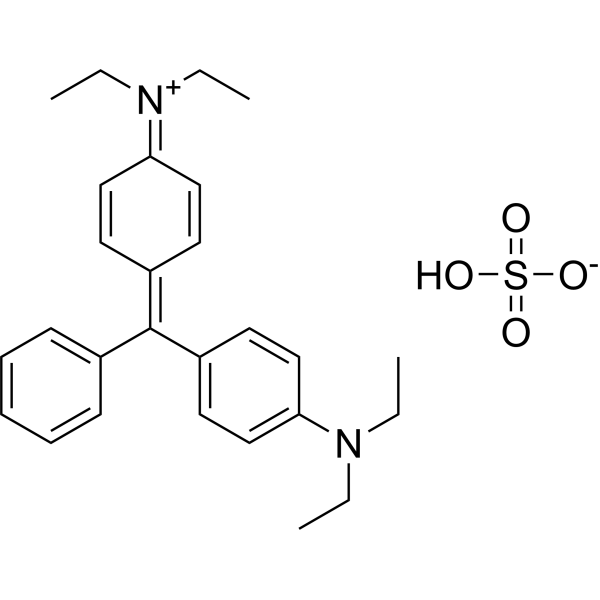
HY-D0008
Brilliant greenCationic Dye


Biological Activity
Description
In Vitro
Guideline (The following are our recommended procedures. This guideline is for informational purposes only and should be modified according to your specific needs.)
1. Solution Preparation
Stock Solution: Accurately weigh an appropriate amount of Orange I powder and dissolve it in deionized water or a suitable buffer (such as acetate-sodium acetate buffer at pH 4.9) to prepare a stock solution. Use sonication to assist dissolution and ensure complete dissolution.
Working Solution: Dilute the stock solution with the same buffer or solvent according to the final concentration required for the experiment. Common working concentrations range from 1-100 μM, depending on the properties of the stained material and the experimental purpose.
2. Staining/Treatment Procedure (Taking the study of its interaction with cationic substances, such as methylene blue (MB) (HY-14536), as an example)
Sample Preparation: Prepare the sample to be treated. 3. Staining/Reaction: Solution Complexation Experiment: Add the prepared Orange I working solution dropwise or in a gradient to a cuvette containing MB solution, and mix well.
Material Adsorption Experiment: Immerse a certain amount of material in a known volume and concentration of Orange I working solution, and shake or stir at a certain temperature.
4. Incubation: Incubate the reaction system at a constant temperature (e.g., 25°C) for a sufficient time (usually 15-60 minutes) to ensure that the reaction or adsorption equilibrium is reached.
5. Detection/Analysis: Spectroscopy: Use a UV-Vis spectrophotometer to scan the absorption spectrum in the range of 300-700 nm. The characteristic absorption peak of Orange I is usually around ~480-490 nm (the specific position is affected by pH and environment). After complexation with MB, the absorption peak of MB red-shifts and changes in intensity. When reacting with surfactants, the intensity and position of its absorption peak change regularly with concentration.
Visual/Colorimetric Method: Observe the color change of the solution. Free Orange I is orange-yellow; the color may deepen or change after binding with cationic substances.
Adsorption Capacity Determination: For material adsorption experiments, after incubation, separate the material by centrifugation or filtration, measure the absorbance of the supernatant, and calculate the concentration of the remaining Orange I in the solution using a standard curve, thereby calculating the adsorption capacity.
MedChemExpress (MCE) has not independently confirmed the accuracy of these methods. They are for reference only.


Chemical Information
-
CAS No. 523-44-4
-
Appearance Solid
-
Molecular Weight 350.32
-
Formula C16H11N2NaO4S
-
Color Brown to reddish brown
-
SMILES
O=S(C1=CC=C(N=NC2=C3C=CC=CC3=C(O)C=C2)C=C1)(O[Na])=O
-
Synonyms
α-Naphthol Orange
-
Shipping
Room temperature in continental US; may vary elsewhere.
-
Storage
4°C, protect from light
* In solvent : -80°C, 6 months; -20°C, 1 month (protect from light)


Solvent & Solubility
In Vitro:
DMSO : 125 mg/mL (356.82 mM; Need ultrasonic; Hygroscopic DMSO has a significant impact on the solubility of product, please use newly opened DMSO)
Please refer to the solubility information to select the appropriate solvent. Once prepared, please aliquot and store the solution to prevent product inactivation from repeated freeze-thaw cycles.
Storage method and period of stock solution: -80°C, 6 months; -20°C, 1 month (protect from light). When stored at -80°C, please use it within 6 months. When stored at -20°C, please use it within 1 month.
Please refer to the solubility information to select the appropriate solvent. Once prepared, please aliquot and store the solution to prevent product inactivation from repeated freeze-thaw cycles.
Storage method and period of stock solution: -80°C, 6 months; -20°C, 1 month (protect from light). When stored at -80°C, please use it within 6 months. When stored at -20°C, please use it within 1 month.
Concentration (start) × Volume (start) = Concentration (final) × Volume (final)


Purity & Documentation
-
Data Sheet (274 KB)
-
SDS (252 KB)
- English - EN (252 KB)
- Français - FR (252 KB)
- Deutsch - DE (252 KB)
- Norwegian - NO (252 KB)
- Español - ES (252 KB)
- Swedish - SV (252 KB)
- Italian - IT (252 KB)
- Korean - KR (252 KB)
- Portuguese - PT (252 KB)
-
Handling Instructions (2659 KB)
References


Complete Stock Solution Preparation Table
Please refer to the solubility information to select the appropriate solvent. Once prepared, please aliquot and store the solution to prevent product inactivation from repeated freeze-thaw cycles.
Storage method and period of stock solution: -80°C, 6 months; -20°C, 1 month (protect from light). When stored at -80°C, please use it within 6 months. When stored at -20°C, please use it within 1 month.
| Optional Solvent | Concentration Solvent Mass | 1 mg | 5 mg | 10 mg | 25 mg |
|---|---|---|---|---|---|
| DMSO | 1 mM | 2.8545 mL | 14.2727 mL | 28.5453 mL | 71.3633 mL |
| 5 mM | 0.5709 mL | 2.8545 mL | 5.7091 mL | 14.2727 mL | |
| 10 mM | 0.2855 mL | 1.4273 mL | 2.8545 mL | 7.1363 mL | |
| 15 mM | 0.1903 mL | 0.9515 mL | 1.9030 mL | 4.7576 mL | |
| 20 mM | 0.1427 mL | 0.7136 mL | 1.4273 mL | 3.5682 mL | |
| 25 mM | 0.1142 mL | 0.5709 mL | 1.1418 mL | 2.8545 mL | |
| 30 mM | 0.0952 mL | 0.4758 mL | 0.9515 mL | 2.3788 mL | |
| 40 mM | 0.0714 mL | 0.3568 mL | 0.7136 mL | 1.7841 mL | |
| 50 mM | 0.0571 mL | 0.2855 mL | 0.5709 mL | 1.4273 mL | |
| 60 mM | 0.0476 mL | 0.2379 mL | 0.4758 mL | 1.1894 mL | |
| 80 mM | 0.0357 mL | 0.1784 mL | 0.3568 mL | 0.8920 mL | |
| 100 mM | 0.0285 mL | 0.1427 mL | 0.2855 mL | 0.7136 mL |


Orange I Related Classifications
HY-D0929 Related Classifications
 Powered by Bioz