



3,6-Diaminoacridine
Based on 3 publication(s) in Google Scholar
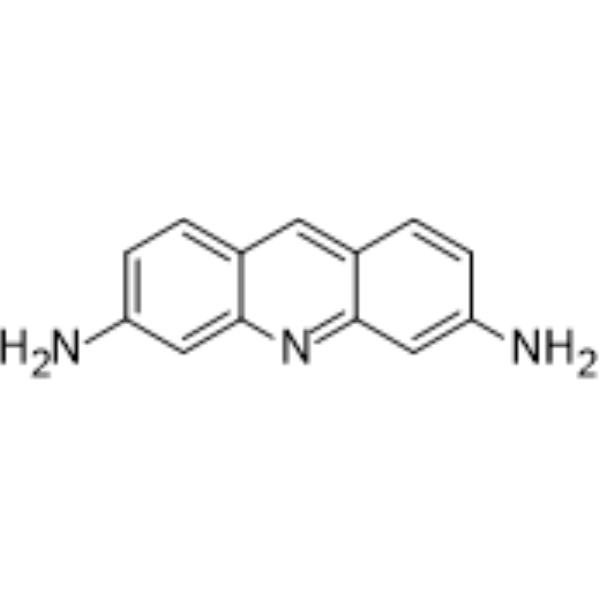
3,6-Diaminoacridine is a versatile acridine compound. 3,6-Diaminoacridine exerts antibacterial activity by intercalating into bacterial DNA, interfering with replication and transcription, and inducing bacterial lysis. 3,6-Diaminoacridine is an acridine dye and also a DNA intercalator.
Para uso exclusivo en investigación. No vendemos a pacientes.
- Pureza : 98.58%
- No. CAS: 92-62-6
- Fòrmula: C13H11N3
- Peso molecular:209.25
-
Almacenamiento:
4°C, protect from light
* In solvent : -80°C, 6 months; -20°C, 1 month (protect from light)

To place orders, for customer services and technical support, please contact: MedChemExpress USA
Tel: 609-228-6898 E-mail: [email protected] [email protected]


-
 Actividad biológica
-
Chemical Information
-
Solvente y solubilidad
- Protocolo
- Pureza y Documentación
- Referencias
-
 Help & FAQs


Publications Citing Use of MedChemExpress (MCE) 3,6-Diaminoacridine
MoreVer todos los productos específicos de isoformas DNA/RNA Synthesis
More

Actividad biológica
Descripciòn
Cellular Effect
|
Cell Line

|
Type | Value | Description | References |
|---|---|---|---|---|
| A2780 | IC50 |
0.47 μM
Compound: Acridine-3,6-diamine
|
Concentration required to inhibit the cell growth by 50 % after 96 hr A2780 leukemic cells.
Concentration required to inhibit the cell growth by 50 % after 96 hr A2780 leukemic cells.
|
[PMID: 7658436] |
| A2780 | IC50 |
0.47 μM
Compound: Proflavine
|
Cytotoxic potency required to inhibit A2780 cell growth by 50% after cell drug contact for 96 hrs
Cytotoxic potency required to inhibit A2780 cell growth by 50% after cell drug contact for 96 hrs
|
[PMID: 9371240] |
| A2780 | IC50 |
0.47 μM
Compound: Proflavine
|
Compound was evaluated for cytotoxicity against A2780 cell lines.
Compound was evaluated for cytotoxicity against A2780 cell lines.
|
10.1016/0960-894X(96)00130-8 |
| A549 | CC50 |
3.1 μM
Compound: 23
|
Cytotoxicity against human A549 cells expressing ACE2 assessed as cell viability
Cytotoxicity against human A549 cells expressing ACE2 assessed as cell viability
|
[PMID: 35620927] |
| CHO | IC50 |
0.52 μM
Compound: 1
|
Phototoxicity in transformed CHO cells after 24 hrs of UV irradiation by WST1 assay
Phototoxicity in transformed CHO cells after 24 hrs of UV irradiation by WST1 assay
|
[PMID: 19217190] |
| CHO | IC50 |
1.1 μM
Compound: 1
|
Phototoxicity in transformed CHO cells after 24 hrs incubation in dark by WST1 assay
Phototoxicity in transformed CHO cells after 24 hrs incubation in dark by WST1 assay
|
[PMID: 19217190] |
| Keratinocyte | IC50 |
>50 μM
Compound: 1
|
Phototoxicity in normal human keratinocytes after 24 hrs incubation in dark by WST1 assay
Phototoxicity in normal human keratinocytes after 24 hrs incubation in dark by WST1 assay
|
[PMID: 19217190] |
| Keratinocyte | IC50 |
>50 μM
Compound: 1
|
Phototoxicity in normal human keratinocytes after 24 hrs of UV irradiation by WST1 assay
Phototoxicity in normal human keratinocytes after 24 hrs of UV irradiation by WST1 assay
|
[PMID: 19217190] |
| L1210 | IC50 |
2.7 μM
Compound: Acridine-3,6-diamine
|
Concentration required to inhibit the cell growth by 50 % after 48 hr in L1210 leukemic cells.
Concentration required to inhibit the cell growth by 50 % after 48 hr in L1210 leukemic cells.
|
[PMID: 7658436] |
| L1210 | IC50 |
2.7 μM
Compound: Proflavine
|
Cytotoxic potency required to inhibit L1210 cell growth by 50% after cell drug contact for 48 hrs
Cytotoxic potency required to inhibit L1210 cell growth by 50% after cell drug contact for 48 hrs
|
[PMID: 9371240] |
| SK-MEL-2 | IC50 |
1.6 μM
Compound: Proflavine
|
Cytotoxicity against human SK-MEL-2 cells expressing NRAS mutant assessed as cell growth inhibition incubated for 48 hrs by MTT assay
Cytotoxicity against human SK-MEL-2 cells expressing NRAS mutant assessed as cell growth inhibition incubated for 48 hrs by MTT assay
|
[PMID: 36961300] |
| SK-MEL-2 | IC50 |
5.31 μM
Compound: Proflavine
|
Cytotoxicity against human SK-MEL-2 cells assessed as cell growth inhibition incubated for 24 hrs by MTT assay
Cytotoxicity against human SK-MEL-2 cells assessed as cell growth inhibition incubated for 24 hrs by MTT assay
|
[PMID: 36961300] |
| THP-1 | IC50 |
2.21 μM
Compound: proflavine
|
Cytotoxicity against human THP1 cells
Cytotoxicity against human THP1 cells
|
[PMID: 17418916] |
| Vero | CC50 |
3.4 μM
Compound: 23
|
Cytotoxicity against African green monkey Vero cells assessed as cell viability
Cytotoxicity against African green monkey Vero cells assessed as cell viability
|
[PMID: 35620927] |
In Vitro
3,6-Diaminoacridine induces cytotoxicity in transformed Chinese hamster ovary cells, with an IC50 of 1.1 μM[3].
MedChemExpress (MCE) has not independently confirmed the accuracy of these methods. They are for reference only.


Chemical Information
-
No. CAS 92-62-6
-
Appearance Solid
-
Peso molecular 209.25
-
Fòrmula C13H11N3
-
Color Light yellow to yellow
-
SMILES
NC1=CC2=NC3=CC(N)=CC=C3C=C2C=C1
-
Envío
Room temperature in continental US; may vary elsewhere.
-
Almacenamiento
4°C, protect from light
* In solvent : -80°C, 6 months; -20°C, 1 month (protect from light)


Publications (3)
-
Journal Impact Factor
-
Most Recent


Solvente y solubilidad
In Vitro:
DMSO : 125 mg/mL (597.37 mM; Need ultrasonic; Hygroscopic DMSO has a significant impact on the solubility of product, please use newly opened DMSO)
Please refer to the solubility information to select the appropriate solvent. Once prepared, please aliquot and store the solution to prevent product inactivation from repeated freeze-thaw cycles.
Storage method and period of stock solution: -80°C, 6 months; -20°C, 1 month (protect from light). When stored at -80°C, please use it within 6 months. When stored at -20°C, please use it within 1 month.
Please refer to the solubility information to select the appropriate solvent. Once prepared, please aliquot and store the solution to prevent product inactivation from repeated freeze-thaw cycles.
Storage method and period of stock solution: -80°C, 6 months; -20°C, 1 month (protect from light). When stored at -80°C, please use it within 6 months. When stored at -20°C, please use it within 1 month.
Concentration (start) × Volume (start) = Concentration (final) × Volume (final)


Pureza y Documentación
-
Ficha de datos (271 KB)
-
SDS (394 KB)
- English - EN (394 KB)
- Français - FR (394 KB)
- Deutsch - DE (394 KB)
- Norwegian - NO (394 KB)
- Español - ES (394 KB)
- Swedish - SV (394 KB)
- Italian - IT (394 KB)
- Korean - KR (394 KB)
- Portuguese - PT (394 KB)
-
Instrucciones de manejo (2659 KB)
Referencias
[1]. Kubota Y, et al. Fluorescence decay studies of the DNA-3,6-diaminoacridine complexes. Biophys Chem. 1984;19(1):25-37. [Content Brief]
[2]. Gamage SA, et al. Synthesis and in vitro evaluation of 9-anilino-3,6-diaminoacridines active against a multidrug-resistant strain of the malaria parasite Plasmodium falciparum. J Med Chem. 1994;37(10):1486-1494. [Content Brief]
[3]. Sabolova D, et al. Proflavine/acriflavine derivatives with versatile biological activities. J Appl Toxicol. 2020;40(1):64-71. [Content Brief]


Complete Stock Solution Preparation Table
Please refer to the solubility information to select the appropriate solvent. Once prepared, please aliquot and store the solution to prevent product inactivation from repeated freeze-thaw cycles.
Storage method and period of stock solution: -80°C, 6 months; -20°C, 1 month (protect from light). When stored at -80°C, please use it within 6 months. When stored at -20°C, please use it within 1 month.
| Optional Solvent | Concentration Solvent Mass | 1 mg | 5 mg | 10 mg | 25 mg |
|---|---|---|---|---|---|
| DMSO | 1 mM | 4.7790 mL | 23.8949 mL | 47.7897 mL | 119.4743 mL |
| 5 mM | 0.9558 mL | 4.7790 mL | 9.5579 mL | 23.8949 mL | |
| 10 mM | 0.4779 mL | 2.3895 mL | 4.7790 mL | 11.9474 mL | |
| 15 mM | 0.3186 mL | 1.5930 mL | 3.1860 mL | 7.9650 mL | |
| 20 mM | 0.2389 mL | 1.1947 mL | 2.3895 mL | 5.9737 mL | |
| 25 mM | 0.1912 mL | 0.9558 mL | 1.9116 mL | 4.7790 mL | |
| 30 mM | 0.1593 mL | 0.7965 mL | 1.5930 mL | 3.9825 mL | |
| 40 mM | 0.1195 mL | 0.5974 mL | 1.1947 mL | 2.9869 mL | |
| 50 mM | 0.0956 mL | 0.4779 mL | 0.9558 mL | 2.3895 mL | |
| 60 mM | 0.0796 mL | 0.3982 mL | 0.7965 mL | 1.9912 mL | |
| 80 mM | 0.0597 mL | 0.2987 mL | 0.5974 mL | 1.4934 mL | |
| 100 mM | 0.0478 mL | 0.2389 mL | 0.4779 mL | 1.1947 mL |


3,6-Diaminoacridine Related Classifications
HY-B1741 Related Classifications
 Powered by Bioz