



LAMTOR1 Protein, Human (His)

Based on 1 Customer Validation
The LAMTOR1 protein is an important component of the Ragulator complex and plays dual roles in amino acid sensing and mTORC1 activation. It acts as a guanine nucleotide exchange factor (GEF) for Rag GTPases and mediates their recruitment to the lysosomal membrane. LAMTOR1 Protein, Human (His) is the recombinant human-derived LAMTOR1 protein, expressed by E. coli , with N-His labeled tag.
- Species: Human
- Source: E. coli
-
Storage:Stored at -20°C for 2 years from date of receipt. After reconstitution, it is stable at 4°C for 1 week or -20°C for longer (with carrier protein). It is recommended to freeze aliquots at -20°C or -80°C for extended storage.


To place orders, for customer services and technical support, please contact: MedChemExpress USA
Tel: 609-228-6898 E-mail: [email protected] [email protected]


-
 Biological Activity
-
Technical Parameters
-
Product Properties
- Documentation
- Help & FAQs




Biological Activity
Description
The LAMTOR1 protein is an important component of the Ragulator complex and plays dual roles in amino acid sensing and mTORC1 activation. It acts as a guanine nucleotide exchange factor (GEF) for Rag GTPases and mediates their recruitment to the lysosomal membrane. LAMTOR1 Protein, Human (His) is the recombinant human-derived LAMTOR1 protein, expressed by E. coli , with N-His labeled tag.
Background
LAMTOR1 stands as a crucial component within the Ragulator complex, a multifaceted assembly involved in amino acid sensing and the activation of mTORC1, a signaling nexus orchestrating cell growth in response to diverse stimuli, including growth factors, energy levels, and amino acids. Serving a dual role for the small GTPases Rag, the Ragulator acts as both a guanine nucleotide exchange factor (GEF) activating Rag GTPases and a mediator for their recruitment to the lysosome membrane. In this intricate interplay, activated Ragulator and Rag GTPases synergistically act as a scaffold, orchestrating the recruitment and activation of mTORC1 at lysosomes. LAMTOR1, pivotal to this mechanism, directly anchors the Ragulator complex to the lysosomal membrane, assuming a critical role in holding together other subunits of the Ragulator complex. Additionally, LAMTOR1's interaction with Rag GTPases plays a central role in the recruitment of the mTORC1 complex to lysosomes. Beyond its role in mTOR signaling, LAMTOR1 demonstrates its versatility by participating in processes such as the control of embryonic stem cell differentiation, regulation of late endosomes/lysosomes biogenesis, and potential involvement in cholesterol homeostasis and RHOA activation. As part of the Ragulator complex and various interacting networks, LAMTOR1 emerges as a key orchestrator in cellular responses to diverse stimuli, contributing to the regulation of essential cellular processes.
MCE Validation Data
-
Purity - SDS-PAGE
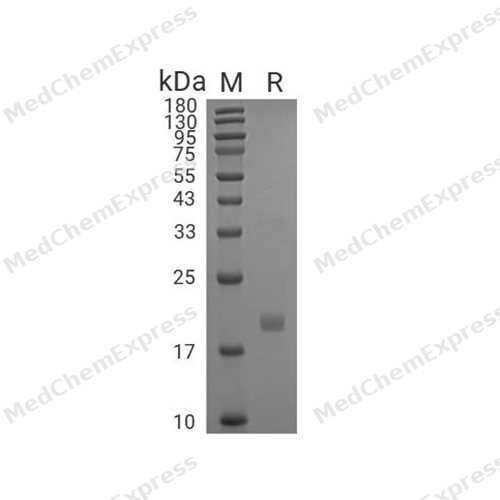
Purity - SDS-PAGE


Technical Parameters
-
Species Human
-
Source E. coli
-
Tag N-6*His
-
Accession
Q6IAA8 (G2-P161)
-
Molecular Construction
-
N-term
-
6*His
-
LAMTOR1 (G2-P161)
Accession # Q6IAA8 -
C-term
-
-
Protein Length
Full Length
-
Synonyms
LAMTOR1; P18; Prev. C11orf59; P27Kip1-Releasing Factor From RhoA; P27RF-Rho; Lipid Raft Adaptor Protein P18; Late Endosomal/Lysosomal Adaptor And MAPK And MTOR Activator 1; FLJ20625; Protein Associated With DRMs And Endosomes; Chromosome 11 Open Reading F
-
AA Sequence
GCCYSSENEDSDQDREERKLLLDPSSPPTKALNGAEPNYHSLPSARTDEQALLSSILAKTASNIIDVSAADSQGMEQHEYMDRARQYSTRLAVLSSSLTHWKKLPPLPSLTSQPHQVLASEPIPFSDLQQVSRIAAYAYSALSQIRVDAKEELVVQFGIP
-
Molecular Weight
Approximately 20-24 kDa, based on SDS-PAGE under reducing conditions, may be due to relative charge.
-
Purity
≥ 90%, as determined by reducing SDS-PAGE.


Product Properties
Lyophilized powder
1.Lyophilized from a 0.22 μm filtered solution of PBS, 6% trehalose, pH 7.4.
2.Lyophilized from a 0.22 μm filtered solution of 10 mM Tris-HCl, 1 mM EDTA, 6% Trehalose, pH 8.0.
3.Lyophilized from a 0.22 μm filtered solution of PBS, pH 7.4, 8% trehalose, 8% mannitol and 0.02% Tween 80.
Please refer to the lot-specific COA for specific buffer information.
Note: For SPR assay, please replace the buffer. Primary amine components (e.g., Tris, imidazole) can affect protein-coupled chips.
<1 EU/μg, determined by LAL method.
It is not recommended to reconstitute to a concentration less than 100 μg/mL in ddH2O.
Stored at -20°C for 2 years from date of receipt. After reconstitution, it is stable at 4°C for 1 week or -20°C for longer (with carrier protein). It is recommended to freeze aliquots at -20°C or -80°C for extended storage.
Room temperature in continental US; may vary elsewhere.


Documentation
-
Data Sheet (236 KB)
-
SDS (254 KB)
- English - EN (254 KB)
- Français - FR (254 KB)
- Deutsch - DE (254 KB)
- Norwegian - NO (254 KB)
- Español - ES (254 KB)
- Swedish - SV (254 KB)
- Italian - IT (254 KB)
- Korean - KR (254 KB)
- Portuguese - PT (254 KB)
-
Handling Instructions (2659 KB)

Calculators
Concentration (start) × Volume (start) = Concentration (final) × Volume (final)


 Powered by Bioz

