



VEGF165 Protein, Human (HEK293)
Based on 19 publication(s) in Google Scholar
VEGF165 Protein, Human is a Vascular Endothelial Growth Factor A (VEGF-A) isoform. VEGF165 Protein is the growth factor that affects the angiogenesis, vasculogenesis and endothelial cell growth. VEGF165 Protein can binds to the FLT1/VEGFR1 and KDR/VEGFR2 receptors, heparan sulfate and heparin, and affects the motor neuron signaling pathway. VEGF165 Protein, Human (HEK293) is a human-derived VEGF165 Protein that can be expressed by HEK293.
- Species: Human
- Source: HEK293
-
Storage:Stored at -20°C for 2 years from date of receipt. After reconstitution, it is stable at 4°C for 1 week or -20°C for longer (with carrier protein). It is recommended to freeze aliquots at -20°C or -80°C for extended storage.


To place orders, for customer services and technical support, please contact: MedChemExpress USA
Tel: 609-228-6898 E-mail: [email protected] [email protected]


-
 Biological Activity
-
Technical Parameters
-
Product Properties
- Documentation
- References
- Help & FAQs


-

HY-P7007
BMP-4 Protein, Human -
HY-P7004
FGF basic/bFGF Protein, Human (146a.a) -
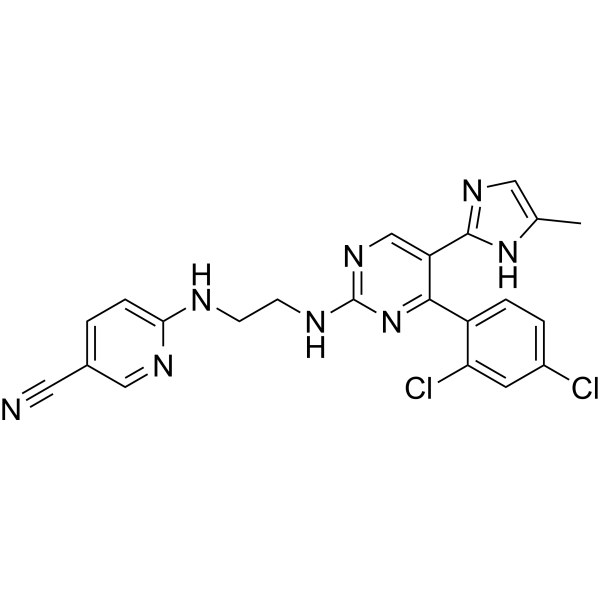
HY-10182
Laduviglusib -
HY-P7109
EGF Protein, Human -
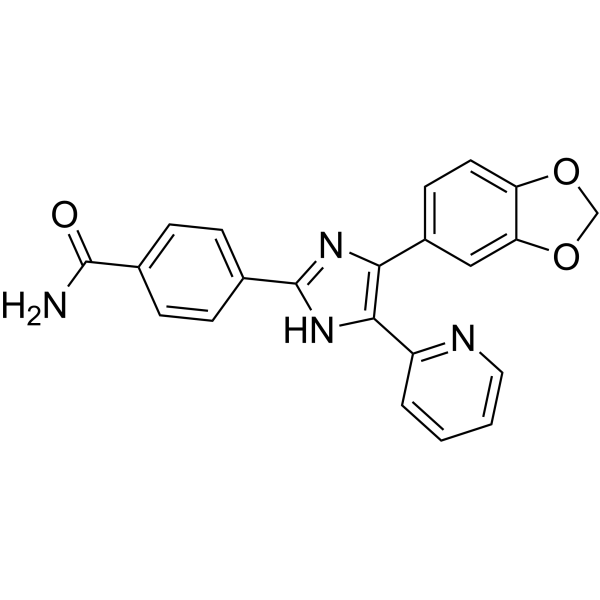
HY-10431
SB-431542 -
HY-P70781
SCF Protein, Human -
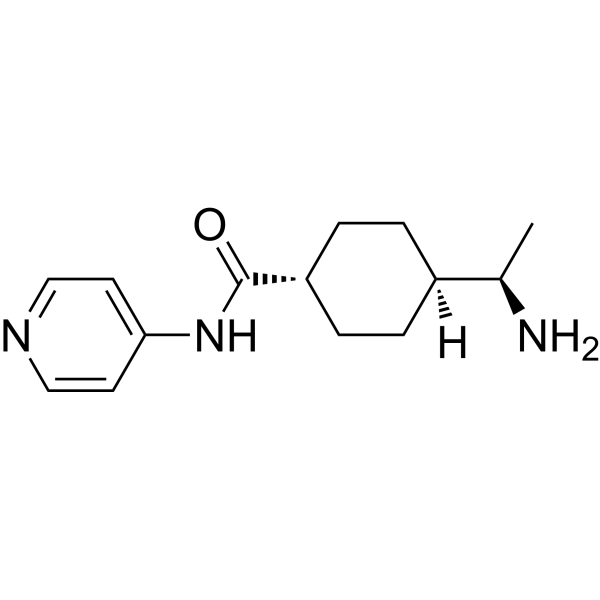
HY-10071
Y-27632 -
HY-P70311
Activin A Protein, Human/Mouse/Rat (HEK293) -
HY-P7331
FGF basic/bFGF Protein, Human (154a.a) -
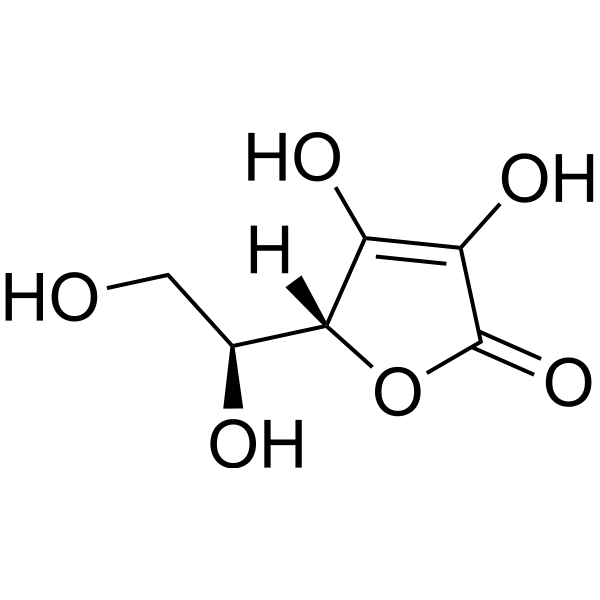
HY-B0166
L-Ascorbic acid -
HY-10583
Y-27632 dihydrochloride -
HY-15371
Forskolin


Biological Activity
Description
VEGF165 Protein, Human is a Vascular Endothelial Growth Factor A (VEGF-A) isoform. VEGF165 Protein is the growth factor that affects the angiogenesis, vasculogenesis and endothelial cell growth. VEGF165 Protein can binds to the FLT1/VEGFR1 and KDR/VEGFR2 receptors, heparan sulfate and heparin, and affects the motor neuron signaling pathway. VEGF165 Protein, Human (HEK293) is a human-derived VEGF165 Protein that can be expressed by HEK293.
Background
Vascular Endothelial Growth Factor (VEGF) has multiple isoforms, created by alternative splicing or proteolytic cleavage, and characterized by different receptor-binding and matrix-binding properties. These isoforms are known to give rise to a spectrum of angiogenesis patterns marked by differences in branching, which has functional implications for tissues. VEGF-A is a key member of the VEGF family of cytokines, along with VEGF-B, -C, -D, and PlGF. VEGF-A mediates angiogenesis, the expansion of an existing vascular bed by sprouting of new blood vessels. The vegfa gene is translated into a number of splice isoforms, the most notable in humans being VEGF121, VEGF165, and VEGF189[1].
In Vitro
VEGF165 Protein, Human (50 ng/mL, 12-48 h) promotes the proliferation, migration, invasion and tube formation of HUVECs[2].
Verified Bioactivity
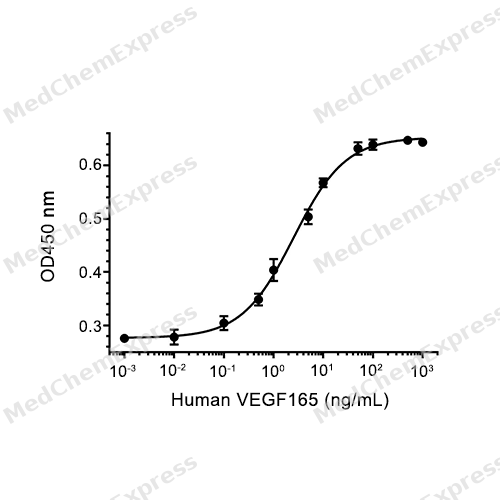
Measured in a cell proliferation assay using HUVEC human umbilical vein endothelial cells. The ED50 this effect is <15 ng/mL.
MCE Validation Data
-
Purity - SDS-PAGE
Purity - SDS-PAGE
-
Bioactivity - Cell-Based Assay
Bioactivity - Cell-Based Assay


Publications (19)
-
Journal Impact Factor
-
Most Recent
-
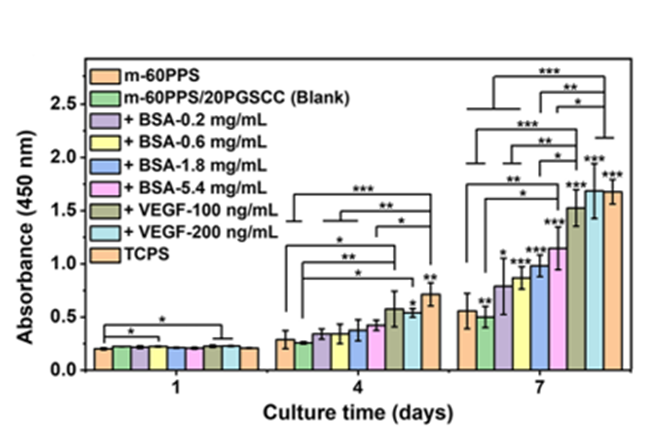
VEGF165 Protein, Human (HEK293) purchased from MedChemExpress. Usage Cited in: Adv Fiber Mater. 2025 Oct 20.
Proliferation results of HUVECs on PGSCC/PLLA films chemically grafted with various concentrations of BSA (0.2, 0.6, 1.8, or 5.4 mg/mL) or VEGFA (100 or 200 ng/mL, 24 h) (n = 3).
-
Bone Res
Sorafenib inhibits ossification of the posterior longitudinal ligament by blocking LOXL2-mediated vascularization. [Abstract]2024 Apr 10;12(1):24. PMID: 38594260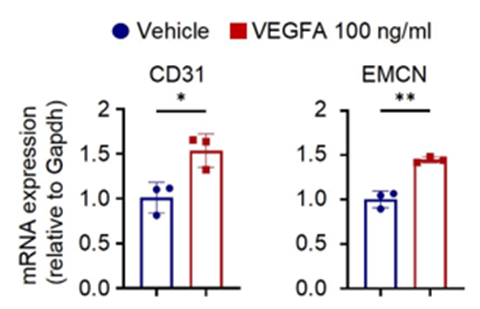
VEGF165 Protein, Human (HEK293) purchased from MedChemExpress. Usage Cited in: Bone Res. 2024 Apr 10;12(1):24. [Abstract]
Quantitative PCR (qPCR) results illustrating gene expression levels of CD31 and EMCN, normalized to housekeeping gene GAPDH, in ligament cells treated with PBS (Vehicle) or 100 ng/ml VEGFA. Values indicate means ± s.d., n = 3. *P < 0.05, **P < 0.01 by Student's t-test.
-
-
-
Anal Chem
Triblock PolyA-Mediated Protein Biosensor Based on a Size-Matching Proximity Hybridization Analysis. [Abstract]2024 Apr 30;96(17):6692-6699. PMID: 38632948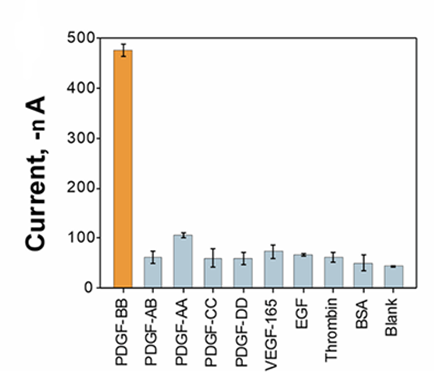
VEGF165 Protein, Human (HEK293) purchased from MedChemExpress. Usage Cited in: Anal Chem. 2024 Apr 30;96(17):6692-6699. [Abstract]
Specificity investigation of the polyA-mediated PHA. The concentration of VEGF-165 was 5 μg/mL. Error bars represent the SDs (n = 3).
-
Life Sci
SNX17 knockdown improves post-ischemic angiogenesis via blocking lysosomal dependent VEGFR degradation. [Abstract]2025 Sep 15:377:123739. PMID: 40412610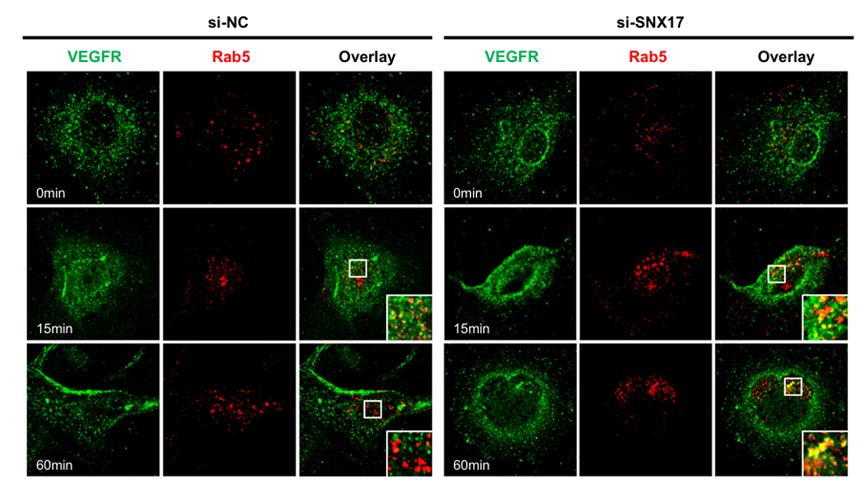
VEGF165 Protein, Human (HEK293) purchased from MedChemExpress. Usage Cited in: Life Sci. 2025 Sep 15:377:123739. [Abstract]
Representative images of immunofluorescence staining of VEGFR-Rab5 colocalization 15 or 60 min after stimulation with VEGF (100 ng/mL).
-
ACS Biomater Sci Eng
Low-Temperature Three-Dimensional Bioprinted Dual-Factor rhBMP-2/VEGF-165 Biomimetic Scaffolds for Synergistic Bone-Vascularization Repair in Large Segmental Bone Defect. [Abstract]2025 Dec 8;11(12):7357-7367. PMID: 41171637 -
Colloids Surf B Biointerfaces
Long-term suppression of retinal degeneration with anti-VEGF agents-loaded hollow mesoporous silica nanoparticles. [Abstract]2026 Jun:262:115527. PMID: 41655333 -
Int Immunopharmacol
Ginsenoside Rg3 synergizes with near-infrared photothermal therapy to suppress prostate cancer progression by inhibiting RAS signaling and enhancing ARL11-mediated macrophage reprogramming. [Abstract]2026 Apr 15:175:116417. PMID: 41734586 -
Int J Mol Sci
The Reduction of PSMB4 in T24 and J82 Bladder Cancer Cells Inhibits the Angiogenesis and Migration of Endothelial Cells. [Abstract]2024 May 20;25(10):5559. PMID: 38791597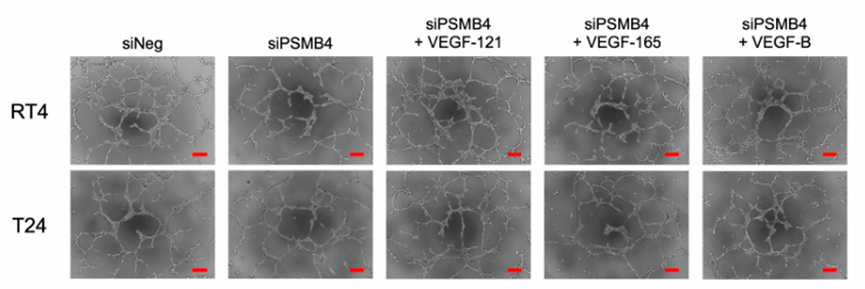
VEGF165 Protein, Human (HEK293) purchased from MedChemExpress. Usage Cited in: Int J Mol Sci. 2024 May 20;25(10):5559. [Abstract]
The conditioned media from RT4 (n=7) and T24 (n=11) cells transfected with siPSMB4 were collected. The angiogenesis factors of VEFG-121, VEGF-165, and VEGF-B (2 µg/mL) were added into the condition media. Tube formation was observed after 6 h.
-
Cancer Sci
NOL7 Inhibits Ovarian Cancer Progression and Suppresses Angiogenesis by Stabilizing GADD45A to Deactivate STAT3. [Abstract]2026 May;117(5):1303-1321. PMID: 41812272 -
Materials
Surface Modification and Pore Size Regulation of MSN as Function Aflibercept Carrier for Anti-Vascular Migration. [Abstract]2025 Sep 19;18(18):4384. PMID: 41010227 -
J Cancer
Nudifloside, a Secoiridoid Glucoside Derived from Callicarpa nudiflora, Inhibits Endothelial-to-Mesenchymal Transition and Angiogenesis in Endothelial Cells by Suppressing Ezrin Phosphorylation. [Abstract]2024 Mar 11;15(9):2448-2459. PMID: 38577590 -
Microvasc Res
CM082, a novel VEGF receptor tyrosine kinase inhibitor, can inhibit angiogenesis in vitro and in vivo. [Abstract]2021 Jul:136:104146. PMID: 33610563 -
Dig Dis Sci
SERPINE1-Driven MAPK Activation Enhances Cuproptosis Resistance and Angiogenic Potential in Colorectal Cancer. [Abstract]2026 Feb 9. PMID: 41661494 -
Anal Cell Pathol
Sunitinib Reduced the Migration of Ectopic Endometrial Cells via p-VEGFR-PI3K-AKT-YBX1-Snail Signaling Pathway. [Abstract]2022 Jun 30:2022:6042518. PMID: 35837295 -
J Ocul Pharmacol Ther
Exploring the Efficacy of AZD6738 in Corneal Neovascularization: Autophagy Enhancement and Angiogenesis Inhibition. [Abstract]2025 Jun 27. PMID: 40576624 -
-


Technical Parameters
-
Species Human
-
Source HEK293
-
Tag Tag Free
-
Accession
P15692-4 (A27-R191)
-
Molecular Construction
-
N-term
-
VEGF165 (A27-R191)
Accession # P15692-4 -
C-term
-
-
Protein Length
Full Length of Isoform-4
-
Synonyms
VEGFA; Vascular Endothelial Growth Factor A; VEGF; VPF; Vascular Permeability Factor; Vascular Endothelial Growth Factor A, Long Form; VEGF-A; L-VEGF; Vascular Endothelial Growth Factor A121; Vascular Endothelial Growth Factor A165; Vascular Endothelial G
-
AA Sequence
APMAEGGGQNHHEVVKFMDVYQRSYCHPIETLVDIFQEYPDEIEYIFKPSCVPLMRCGGCCNDEGLECVPTEESNITMQIMRIKPHQGQHIGEMSFLQHNKCECRPKKDRARQENPCGPCSERRKHLFVQDPQTCKCSCKNTDSRCKARQLELNERTCRCDKPRR
-
Predicted Molecular Mass
19.2 kDa
-
Molecular Weight
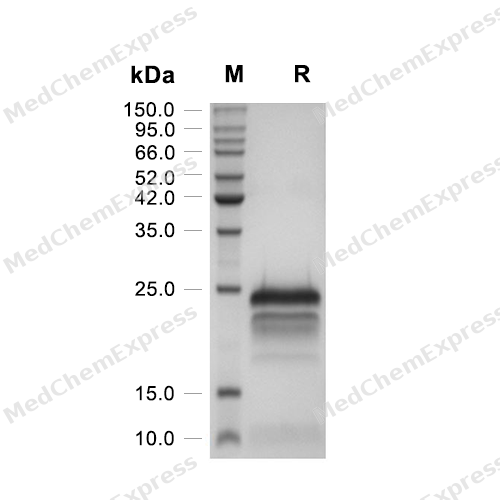
Approximately 18-24 kDa, based on SDS-PAGE under reducing conditions, due to the glycosylation.
-
Glycosylation
Yes
-
Purity
≥ 95%, as determined by reducing SDS-PAGE.


Product Properties
Lyophilized powder
1.Lyophilized from a 0.22 μm filtered solution of PBS.
2.Lyophilized from a 0.22 μm filtered solution of 50 mM Tris-HCl, 300 mM NaCl, pH 7.4.
3.Lyophilized from a 0.22 μm filtered solution of PBS, pH 7.4, 5% trehalose, 5% mannitol, 0.01% Tween 80.
4.Lyophilized from a 0.22 μm filtered solution of PBS, pH 7.4, 8% trehalose.
5.Lyophilized from a 0.22 μm filtered solution of 20 mM Tris, 150 mM NaCl, pH 8, 5% trehalose, 5% mannitol, 0.01% Tween 80.
Please refer to the lot-specific COA for specific buffer information.
Note: For SPR assay, please replace the buffer. Primary amine components (e.g., Tris, imidazole) can affect protein-coupled chips.
<1 EU/μg, determined by LAL method.
It is not recommended to reconstitute to a concentration less than 100 μg/mL in ddH2O. For long term storage it is recommended to add a carrier protein (0.1% BSA, 5% HSA, 10% FBS or 5% Trehalose).
Stored at -20°C for 2 years from date of receipt. After reconstitution, it is stable at 4°C for 1 week or -20°C for longer (with carrier protein). It is recommended to freeze aliquots at -20°C or -80°C for extended storage.
Room temperature in continental US; may vary elsewhere.


Documentation
-
Data Sheet (263 KB)
-
SDS (252 KB)
- English - EN (252 KB)
- Français - FR (252 KB)
- Deutsch - DE (252 KB)
- Norwegian - NO (252 KB)
- Español - ES (252 KB)
- Swedish - SV (252 KB)
- Italian - IT (252 KB)
- Korean - KR (252 KB)
- Portuguese - PT (252 KB)
-
Handling Instructions (2659 KB)


References
[1]. Vempati P, et al. Extracellular regulation of VEGF: isoforms, proteolysis, and vascular patterning. Cytokine Growth Factor Rev. 2014 Feb;25(1):1-19. [Content Brief]
[2]. Dan H, et al., CM082, a novel VEGF receptor tyrosine kinase inhibitor, can inhibit angiogenesis in vitro and in vivo. Microvasc Res. 2021 Jul;136:104146. [Content Brief]

Calculators
Concentration (start) × Volume (start) = Concentration (final) × Volume (final)


 Powered by Bioz

