



Rivoglitazone

Based on 1 Customer Validation
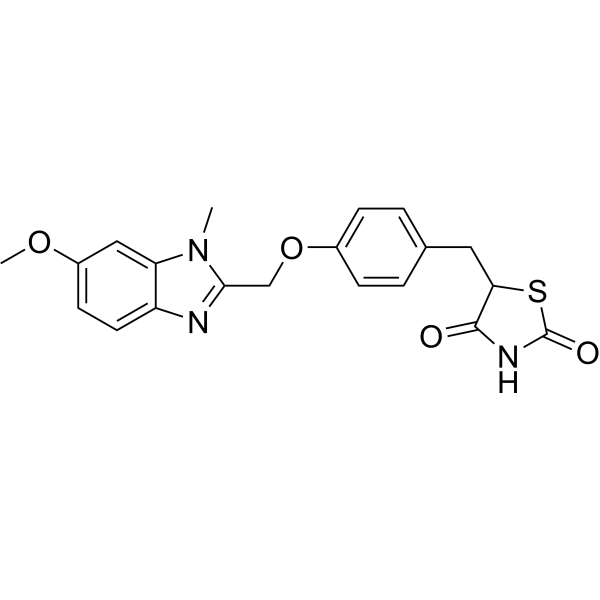
Rivoglitazone (R-106056) is an orally active, selective PPARγ agonist with an EC50 of 0.22 μM for hPPARγ. Rivoglitazone regulates fatty acid storage and uptake, glucose homeostasis, and cardiac glucose/fatty acid metabolism. Rivoglitazone reduces levels of hyperglycemia, hyperinsulinemia, and hypertriglyceridemia, decreases hepatic glucose production, and accelerates plasma triglyceride clearance. Rivoglitazone induces a reduction in glycated hemoglobin A1C, while causing peripheral edema and weight gain. Rivoglitazone can be used in research related to type 2 diabetes.
For research use only. We do not sell to patients.
- Purity : 98.59%
- CAS No.: 185428-18-6
- Formula: C20H19N3O4S
- Molecular Weight:397.45
-
Storage:Powder -20°C, 3 years , 4°C, 2 years ; In solvent -80°C, 6 months , -20°C, 1 month

To place orders, for customer services and technical support, please contact: MedChemExpress USA
Tel: 609-228-6898 E-mail: [email protected] [email protected]


-
 Biological Activity
-
Chemical Information
-
Solvent & Solubility
- Protocols
- Purity & Documentation
- References
-
 Help & FAQs




Biological Activity
Description
IC50 & Target
[3]|
PPARγ 0.22 μM (EC50) |
In Vitro
Rivoglitazone exhibits higher potency in activating PPAR-γ compared with Pioglitazone (HY-13956) and Rosiglitazone (HY-17386), with 16.4-fold and 3.6-fold increases, respectively[1].
Rivoglitazone (0.001-10 μM; 24 h) potently and selectively activates hPPARγ in HT-1080 cells with an EC50 of 0.22 μM, while it exhibits only extremely weak activity against hPPARα and no activity against hPPARδ[3].
MedChemExpress (MCE) has not independently confirmed the accuracy of these methods. They are for reference only. Further protocols information, click here.
Parmacokinetics
| Species | Dose | Route | AUC0-t | AUC0-inf | CLtotal | Vss | T1/2 |
|---|---|---|---|---|---|---|---|
| Rat[4] | 0.1, 0.5 mg/kg | i.v. | 4.53 (0.1 mg/kg) μg·h/mL | 4.67 (0.1 mg/kg) μg·h/mL | 0.329 (0.1 mg/kg) mL/min/kg | 0.125 (0.1 mg/kg) L/kg | 4.55 (0.1 mg/kg) h |
In Vivo
Rivoglitazone (0.03-1 mg/kg; p.o.; daily; 14 days) exerts potent dose-dependent glucose-lowering (ED50 0.47 mg/kg) and adiponectin-increasing effects in male db/db mice[3].
Rivoglitazone (0.1 mg/kg; p.o.; daily; 7-8 days) improves whole-body insulin resistance, as shown by a 40% increase in steady-state GIR, and lowers plasma TG primarily by accelerating TG elimination in male ZF rats[3].
Rivoglitazone (0.0986-1 mg/kg; i.v., saphenous vein; p.o., nasal tubing) exhibits low clearance, low volume of distribution, high oral bioavailability (≥76.1%), and dose-proportional exposure in male cynomolgus monkeys, with O-demethylation as the main metabolic pathway and balanced excretion in urine and feces[4].
MedChemExpress (MCE) has not independently confirmed the accuracy of these methods. They are for reference only.
-
Animal Model:BKS.Cg-it +Lepr^db/+Lepr^db/Jcl (male, 8 weeks old)[3]
-
Dosage:0.03 mg/kg; 0.1 mg/kg; 0.3 mg/kg; 1 mg/kg
-
Administration:p.o.; daily; 14 days
-
Result:Decreased plasma glucose levels in a dose-dependent manner, with an ED50 of 0.47 mg/kg compared to pioglitazone (70 mg/kg).
Strikingly increased plasma adiponectin levels in a dose-dependent manner, reaching 40 μg/mL at 1 mg/kg.
-
Animal Model:Crlj:ZUC-Leprfa (male, 9 weeks old)[3]
-
Dosage:0.1 mg/kg
-
Administration:p.o.; daily; 7-8 days
-
Result:Significantly increased the steady-state glucose infusion rate (GIR) to 36.6 mg·kg-1·min-1 (vs. control 26.0 mg·kg-1·min-1) and decreased steady-state plasma insulin to 28.5 ng/mL (vs. control 31.7 ng/mL).
Reduced basal plasma TG to 227 mg/dL, decreased the area under the TG curve (AUCTG) after lipid load to 939 h·mg/dL, and increased the TG elimination rate constant to 0.0689 min-1, with no effect on TG production rate.


Chemical Information
-
CAS No. 185428-18-6
-
Appearance Solid
-
Molecular Weight 397.45
-
Formula C20H19N3O4S
-
Color White to off-white
-
SMILES
O=C(N1)SC(CC2=CC=C(OCC3=NC4=CC=C(OC)C=C4N3C)C=C2)C1=O
-
Synonyms
R-106056
-
Shipping
Room temperature in continental US; may vary elsewhere.
-
Storage
Powder -20°C 3 years 4°C 2 years In solvent -80°C 6 months -20°C 1 month


Solvent & Solubility
In Vitro:
DMSO : 10 mg/mL (25.16 mM; ultrasonic and warming and heat to 80°C; Hygroscopic DMSO has a significant impact on the solubility of product, please use newly opened DMSO)
Please refer to the solubility information to select the appropriate solvent. Once prepared, please aliquot and store the solution to prevent product inactivation from repeated freeze-thaw cycles.
Storage method and period of stock solution: -80°C, 6 months; -20°C, 1 month. When stored at -80°C, please use it within 6 months. When stored at -20°C, please use it within 1 month.
Please refer to the solubility information to select the appropriate solvent. Once prepared, please aliquot and store the solution to prevent product inactivation from repeated freeze-thaw cycles.
Storage method and period of stock solution: -80°C, 6 months; -20°C, 1 month. When stored at -80°C, please use it within 6 months. When stored at -20°C, please use it within 1 month.
Concentration (start) × Volume (start) = Concentration (final) × Volume (final)

Protocols
-
Protocol for Pharmacokinetic Study
Pharmacokinetic studies quantify how an organism handles a drug over time through absorption, distribution, metabolism, and excretion, and the core experimental readout is the concentration-time profile of parent drug and, when relevant, metabolites in biological matrices such as plasma, whole blood, urine, bile, or tissue. Pharmacokinetic analysis links dose, route, exposure, clearance, half-life, distribution, bioavailability, and systemic exposure to drug efficacy and toxicity hypotheses rather than measuring a signaling pathway directly. The literature links pharmacokinetics to drug-development phenotypes by showing that drug metabolism and pharmacokinetics influence compound progression, exposure-response interpretation, safety margins, dosing strategy, and failure risk during discovery and development. DMPK science contributes to compound optimization by integrating physicochemical properties, in vitro metabolism, transporter behavior, in vivo exposure, and pharmacodynamic contex
-
Research Protocol for Metabolic Diseases
AMP-activated protein kinase, AMPK, is a conserved cellular energy sensor that responds to reduced cellular energy status and coordinates metabolism by increasing ATP-generating catabolic pathways while suppressing ATP-consuming anabolic processes. In metabolic disease research, the AMPK pathway is experimentally relevant because it regulates hepatic lipid synthesis, fatty acid oxidation, glucose production, skeletal-muscle glucose disposal, mTORC1-linked biosynthesis, autophagy, mitochondrial homeostasis, and whole-body energy balance. The central pathway logic is that energy stress, metformin, exercise-like stimulation, or direct AMPK activators increase AMPKα Thr172 phosphorylation and downstream substrate phosphorylation, including ACC and RAPTOR. Phosphorylation of ACC suppresses lipogenesis and supports fatty acid oxidation, whereas phosphorylation of RAPTOR suppresses mTORC1 signaling and links cellular energy status to growth and protein synthesis control. The pathway is linked


Purity & Documentation
-
Data Sheet (275 KB)
-
SDS (251 KB)
- English - EN (251 KB)
- Français - FR (251 KB)
- Deutsch - DE (251 KB)
- Norwegian - NO (251 KB)
- Español - ES (251 KB)
- Swedish - SV (251 KB)
- Italian - IT (251 KB)
- Korean - KR (251 KB)
- Portuguese - PT (251 KB)
-
Handling Instructions (2659 KB)
References
[1]. Koffarnus RL, et al. Rivoglitazone: a new thiazolidinedione for the treatment of type 2 diabetes mellitus. Ann Pharmacother. 2013;47(6):877-885. [Content Brief]
[2]. Pfanzagl B, et al. The Transient Receptor Potential Vanilloid 4 Agonist RN-1747 Inhibits the Calcium Response to Histamine. Pharmacology. 2019;104(3-4):166-172. [Content Brief]
[3]. Kanda S, et al. Potent antidiabetic effects of rivoglitazone, a novel peroxisome proliferator-activated receptor-gamma agonist, in obese diabetic rodent models. J Pharmacol Sci. 2009;111(2):155-166. [Content Brief]
[4]. Uchiyama M, et al. Pharmacokinetics, metabolism, and disposition of rivoglitazone, a novel peroxisome proliferator-activated receptor γ agonist, in rats and monkeys. Drug Metab Dispos. 2011;39(4):653-666. [Content Brief]


Complete Stock Solution Preparation Table
Please refer to the solubility information to select the appropriate solvent. Once prepared, please aliquot and store the solution to prevent product inactivation from repeated freeze-thaw cycles.
Storage method and period of stock solution: -80°C, 6 months; -20°C, 1 month. When stored at -80°C, please use it within 6 months. When stored at -20°C, please use it within 1 month.
| Optional Solvent | Concentration Solvent Mass | 1 mg | 5 mg | 10 mg | 25 mg |
|---|---|---|---|---|---|
| DMSO | 1 mM | 2.5160 mL | 12.5802 mL | 25.1604 mL | 62.9010 mL |
| 5 mM | 0.5032 mL | 2.5160 mL | 5.0321 mL | 12.5802 mL | |
| 10 mM | 0.2516 mL | 1.2580 mL | 2.5160 mL | 6.2901 mL | |
| 15 mM | 0.1677 mL | 0.8387 mL | 1.6774 mL | 4.1934 mL | |
| 20 mM | 0.1258 mL | 0.6290 mL | 1.2580 mL | 3.1450 mL | |
| 25 mM | 0.1006 mL | 0.5032 mL | 1.0064 mL | 2.5160 mL |


Rivoglitazone Related Classifications
HY-106181 Related Classifications
 Powered by Bioz