



RKER-216
RKER-216 is a human monoclonal IgG antibody inhibitor targeting ALK2 with a KD of 58.7 pM. RKER-216 reduces hepcidin transcription in Hep3B.RKER-216 competes with BMP ligands for binding to the extracellular domain of ALK2, thereby inhibiting BMP-SMAD signal. RKER-216 mobilizes tissue iron effectively in inflammatory conditions. RKER-216 improves microcytic anemia in a dose-dependent manner by inhibiting SMAD signaling to reduce hepcidin and promote iron absorption and utilization in vivo. RKER-216 can be used for research on anemia of inflammation.
For research use only. We do not sell to patients.
-
Storage:
Please store the product under the recommended conditions in the Certificate of Analysis.


To place orders, for customer services and technical support, please contact: MedChemExpress USA
Tel: 609-228-6898 E-mail: [email protected] [email protected]


-
 Biological Activity
-
Chemical Information
- Protocols
- Purity & Documentation
- References
-
 Help & FAQs




Biological Activity
Description
Species Reactivity
Human
IC50 & Target
[1]|
ACVR1 58.7 pM (Kd) |
In Vitro
RKER-216 (0.02-1 μg/mL, 6 h) binds to ALK2 with a KD of 58.7 pM, but does not bind to ALK3 at a concentration 10-fold higher than those necessary to bind ALK2[1].
RKER-216 achieves potential interactions between ALK2 with a robust peptide coverage of 92.2% in ACVR1 knockout in HepG2 and Huh7 cells[1].
RKER-216 (0.02-30 μg/mL,6 h) inhibits alk2-mediated hepcidin transcription in Hep3B cells (0.02-1 μg/mL), HepG2 (ACVR1 knockout (KO)) (1-30 μg/mL) and Huh7 cell (ACVR1 knockout (KO)) (1-30 μg/mL) [1].
MedChemExpress (MCE) has not independently confirmed the accuracy of these methods. They are for reference only.
-
Cell Line:Hep3B, HepG2 (ACVR1 knockout (KO)), and Huh7 cell (ACVR1 knockout (KO)) cell lines
-
Concentration:0.02, 0.2 and 1 μg/mL and 0, 1, 10 and 30 μg/mL
-
Incubation Time:6 h
-
Result:Resulted HAMP mRNA a dose dependent decrease (0.02, 0.2 and 1 μg/mL) in Hep3B cells.
Exhibited the greatest suppression in BMP6-stimulated hepcidin expression, followed by BMP2/6 and BMP2 in Hep3B cells at 0-1 μg/mL.
Did not decreased HAMP mRNA at 1-30 μg/mL in HepG2 (ACVR1 knockout (KO)) and Huh7 (ACVR1 knockout (KO)) cell lines.
In Vivo
RKER-216 (compound m216) (1-3 mg/kg, s.c., once, persisted for 6, 24 or 96 h) inhibited SMAD signaling to lower serum hepcidin, allowing more iron absorption to increase TSAT in TMPRSS6 KO mice[2].
RKER-216 (1 mg/kg, s.c., twice daily for 9 days) regulates iron metabolism through a unique mechanism that differs from intravenous iron in TMPRSS6 KO mice[2].
RKER-216 (1-3 mg/kg, s.c., twice daily for 3 weeks) g a dose proportional mitigation in improving microcytic anemia in TMPRSS6 KO mice[2].
MedChemExpress (MCE) has not independently confirmed the accuracy of these methods. They are for reference only.
-
Animal Model:B6N male mice (7 weeks)[1]
-
Dosage:3 mg/kg
-
Administration:s.c. once followed by LPS (1 mg/kg, i.p.)
-
Result:Induced Liver Il6 mRNA and decreased serum IL-6.
Resulted a greater fold-change ((11.7-fold for Hamp mRNA and 3.2-fold for serum hepcidin).
Inhibited SMAD1/5/9 phosphorylation regardless of inflammatory status.
Failed to impair LPS-mediated STAT3 phosphorylation, and the same LPS-induced effect was seen in isotype control groups in immunoblot analyses.
-
Animal Model:TMPRSS6 KO mice (8-11 weeks) [2]
-
Dosage:1 or 3 mg/kg
-
Administration:s.c., once, persisted for 6, 24 or 96 h
-
Result:Decreased liver smAD1/5/9 phosphorylation, hepcidin (Hamp) mRNA, and serum hepcidin levels dosed with 1 or 3 mg/kg for 6 h.
Decreased serum hepcidin by 88% and increased TSAT by 4-fold at 1 or 3 mg/kg for 24 h.
Had sustained effects by 96 h at 3 mg/kg.
Gene ID
Accession
Conjugated
Unconjugated
Reconsititution
The product can be reconstituted/diluted with sterile PBS or saline.
Format
-
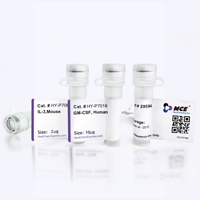
Product Image
Application
ELISA, FACS, Functional assay


Chemical Information
-
Formulation
Please refer to the lot-specific COA for specific buffer information.
-
Storage
Please store the product under the recommended conditions in the Certificate of Analysis.


Purity & Documentation
References

Calculators
Concentration (start) × Volume (start) = Concentration (final) × Volume (final)


RKER-216 Related Classifications
HY-P991855 Related Classifications
 Powered by Bioz