
8 Results for "

20:4 PA

" in MedChemExpress (MCE) Product Catalog:
Products (8)

8 Results for "20:4 PA" in MCE Product Catalog:

Cat. No.: HY-P9932
CAS No.: 1351337-07-9
Synonyms: ETI 204

Target:  

Bacterial

Research Areas:  

Infection Cardiovascular Disease

Obiltoxaximab (ETI 204) is the second and potent anti-protective antigen (PA) monoclonal antibody with immunogenicity. Obiltoxaximab plays a central role in anthrax toxin assembly and target cell intoxication, promoting survival, and inhibiting bacterial spread to the periphery in animal models. Obiltoxaximab can be used in the research of inhalational anthrax, bacteremia and toxemia .
loading...
    loading...
Cat. No.: HY-145486
CAS No.: 799268-65-8
Synonyms: 20:4 Lyso PA
Target:  

Liposome

Research Areas:  

Neurological Disease

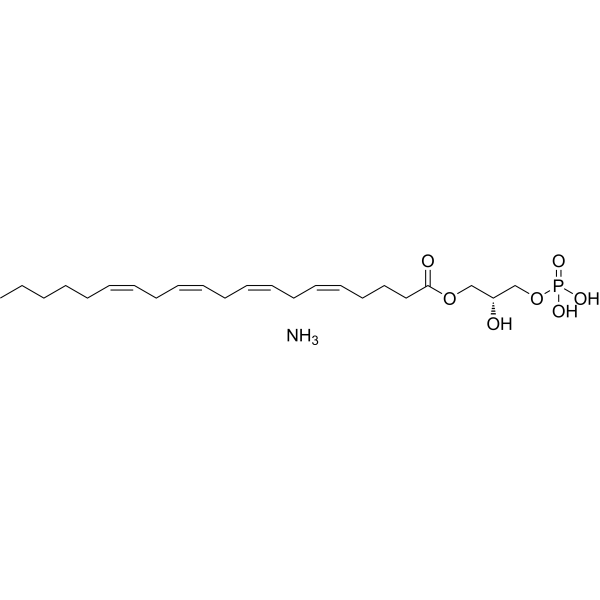
1-Arachidonoyl-sn-glycerol 3-phosphate ammonium (20:4 Lyso PA) is a phospholipid and an LPA derived from arachidonic acid. The concentration of 1-Arachidonoyl-sn-glycerol 3-phosphate ammonium in plasma is significantly correlated with the age of onset of cocaine use and the duration of abstinence. 1-Arachidonoyl-sn-glycerol 3-phosphate ammonium can be used in the research of biomarkers for cocaine use disorder (CUD) .
loading...
    loading...
20:4 PA sodium
0 Images
5,8,11,14-Eicosatetraenoic acid, (1R)-1-[(phosphonooxy)methyl]-1,2-ethanediyl ester, monosodium salt, (5Z,5′Z,8Z,8′Z,11Z,11′Z,14Z,14′Z)-
Cat. No.: HY-W783251
CAS No.: 474943-33-4
20:4 PA (sodium) is a phosphatidic acid.
loading...
    loading...
Cat. No.: HY-171906A
Synonyms: 1-Arachidonoyl-sn-glycerol 3-phosphate sodium; 1-Arachidonoyl LPA sodium; LPA (20:4) sodium
Target:  

LPL Receptor

Research Areas:  

Cancer

1-Arachidonoyl-2-hydroxy-sn-glycero-3-PA (sodium) (1-Arachidonoyl-sn-glycerol 3-phosphate (sodium)) is a phospholipid with arachifonic acid at the sn-1 position. 1-Arachidonoyl-2-hydroxy-sn-glycero-3-PA (sodium) binds to the LPA2/EDG4 receptor (EC50 of 10 nM). 1-Arachidonoyl-2-hydroxy-sn-glycero-3-PA (sodium) can be found in rat brain as 37% of the arachidoinic acid-containing lysophosphatidic acid species. 1-Arachidonoyl-2-hydroxy-sn-glycero-3-PA (sodium) is the precursor to 1-arachidonoyl glycerol. 1-Arachidonoyl-2-hydroxy-sn-glycero-3-PA (sodium) can prevent TNF-α and IL-6 secretion in wild type LPS-stimulated dendritic cells. 1-Arachidonoyl-2-hydroxy-sn-glycero-3-PA (sodium) reduces differentiation of HT-29 colon carcinoma cells into goblet cells when sodium butyrate is present .
loading...
    loading...
Cat. No.: HY-171906
CAS No.: 65446-08-4
Synonyms: 1-Arachidonoyl-sn-glycerol 3-phosphate; 1-Arachidonoyl LPA; LPA (20:4)
Target:  

LPL Receptor

Research Areas:  

Inflammation/Immunology

1-Arachidonoyl-2-hydroxy-sn-glycero-3-PA is a phospholipid containing arachidonic acid at the sn-1 position. It is a precursor to 1-arachidonoyl glycerol (1-Monoarachidin; HY-130567) . 1-Arachidonoyl-2-hydroxy-sn-glycero-3-PA binds to the LPA2/EDG4 receptor with an EC50 value of approximately 10 nM . It prevents TNF-α and IL-6 secretion in wild-type but not Lpa2-/- dendritic cells stimulated by LPS . It also decreases differentiation of HT-29 human colon carcinoma cells to goblet cells in the presence of sodium butyrate .
loading...
    loading...
18:0-20:4 PA sodium
0 Images
5,8,11,14-Eicosatetraenoic acid, (1R)-1-[[(1-oxooctadecyl)oxy]methyl]-2-(phosphonooxy)ethyl ester, sodium salt (1:1), (5Z,8Z,11Z,14Z)-
Cat. No.: HY-147068
CAS No.: 322647-61-0
Synonyms: PA(18:0/20:4(5Z,8Z,11Z,14Z)) sodium
18:0-20:4 PA sodium is a phosphatidic acid.
loading...
    loading...
16:0-20:4 PA sodium
0 Images
5,8,11,14-Eicosatetraenoic acid, (1R)-1-[[(1-oxohexadecyl)oxy]methyl]-2-(phosphonooxy)ethyl ester, sodium salt (1:1), (5Z,8Z,11Z,14Z)-
Cat. No.: HY-W783252
CAS No.: 322647-60-9
Synonyms: 1-PAlmitoyl-2-arachidonoyl-sn-glycero-3-phosphate sodium
16:0-20:4 PA (sodium) is a phosphatidic acid.
loading...
    loading...
Cat. No.: HY-L204
565 compounds

Lactic acid metabolism is one of the key metabolic pathways within living organisms. It plays a crucial role not only in cellular energy conversion but is also closely related to a variety of physiological and pathological processes. The production and clearance of lactic acid are important indicators of cellular metabolic balance, and its abnormal regulation may lead to conditions such as lactic acidosis, muscle fatigue, and hereditary metabolic diseases. Moreover, lactic acid is closely related to the malignancy of tumors and is considered a biomarker for malignant tumors and poor prognosis. Lactic acid can serve as a metabolic substrate to support the metabolic needs of tumor cells under hypoxic conditions, and it can also cause acidification of the tumor microenvironment, suppress immune cell function to promote immune evasion, and induce drug resistance in tumor cells. Currently, targeting lactic acid-lactylation and its related metabolic pathways has become a new research avenue for cancer treatment. In-depth exploration of the molecular mechanisms of lactic acid metabolism can help in screening lead compounds that regulate the lactic acid metabolism.

MCE contains 565 small molecule compounds targeting enzymes involved in lactic acid metabolism. This library is of significant value for researching the role of lactate metabolism in the mechanisms of diseases.

