1. Search Result
Search Result
Results for "

Azide-PEG2000-azide

" in MedChemExpress (MCE) Product Catalog:

20

Inhibitors & Agonists

8

Biochemical Assay Reagents

8

Peptides

1

Isotope-Labeled Compounds

9

Click Chemistry

2

Oligonucleotides

Cat. No. Product Name Target Research Areas Chemical Structure
  • HY-W440832

    Liposome Infection
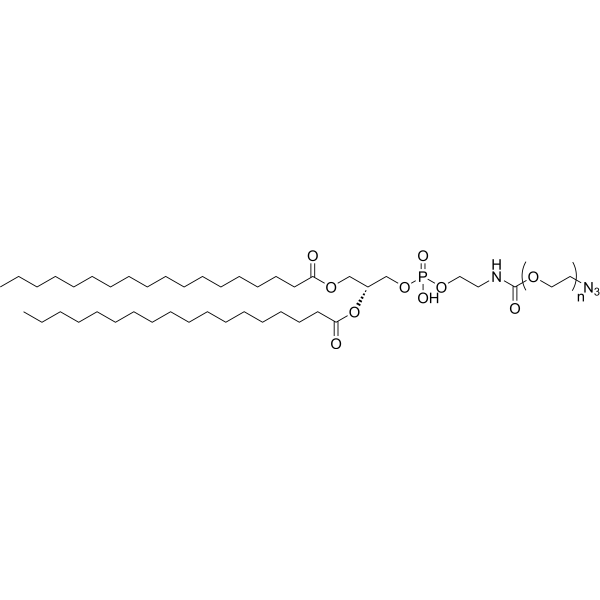
    DSPE-PEG2000-azide is an azide containing lipid that can be used to form micelles as nanoparticles for drug delivery . DSPE-PEG2000-azide is a click chemistry reagent, it contains an Azide group and can undergo copper-catalyzed azide-alkyne cycloaddition reaction (CuAAc) with molecules containing Alkyne groups. It can also undergo strain-promoted alkyne-azide cycloaddition (SPAAC) reactions with molecules containing DBCO or BCN groups.
    DSPE-PEG2000-azide
  • HY-P10303

    Cyclo[RGDfK(azide)]

    Biochemical Assay Reagents Others
    Cyclo[Arg-Gly-Asp-D-Phe-Lys(Azide)] is the derivative of Cyclo(-RGDfK) (HY-P0023). Cyclo[Arg-Gly-Asp-D-Phe-Lys(Azide)] is a click chemistry reagent containing an azide group. Click chemistry has great potential for use in binding between nucleic acids, lipids, proteins, and other molecules, and has been used in many research fields because of its beneficial characteristics, including high yield, high specificity, and simplicity .
    Cyclo[Arg-Gly-Asp-D-Phe-Lys(Azide)]
  • HY-P10392AF

    Wnt β-catenin Cancer
    fStAx-35R TFA is the hydrocarbon-stapled peptide. fStAx-35R TFA inhibits Wnt/β-catenin signaling pathway by disrupting the β-catenin-TCF interaction. fStAx-35R TFA can be used in cancer research .
    fStAx-35R TFA
  • HY-140664

    PROTAC Linkers Cancer
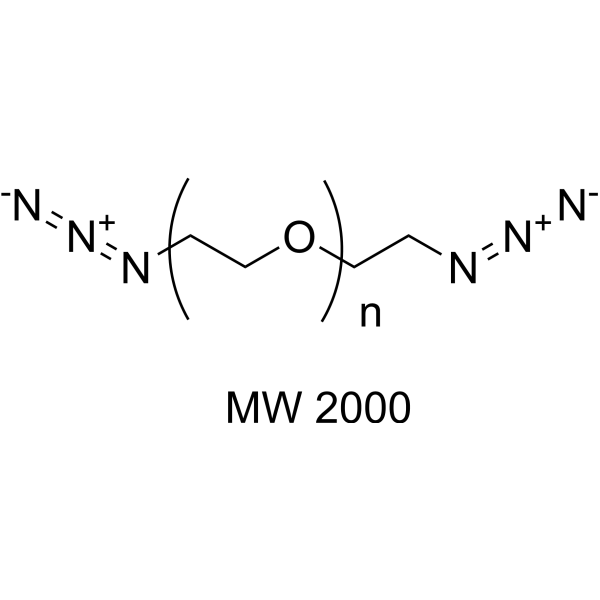
    Azide-PEG2000-azide is a PEG-based PROTAC linker that can be used in the synthesis of PROTACs . Azide-PEG2000-azide is a click chemistry reagent, it contains an Azide group and can undergo copper-catalyzed azide-alkyne cycloaddition reaction (CuAAc) with molecules containing Alkyne groups. It can also undergo strain-promoted alkyne-azide cycloaddition (SPAAC) reactions with molecules containing DBCO or BCN groups.
    Azide-PEG2000-azide
  • HY-W1123941C

    Dopamine-PEG2000-azide

    Biochemical Assay Reagents Others
    Dopamine-PEG2000-N3 (Dopamine-PEG2000-Azide) is a compound composed of dopamine, PEG segments and an azide group (-N3). Dopamine-PEG2000-N3 can be used as a crosslinker to connect different materials together to build new composite materials and improve the performance of materials. Dopamine-PEG2000-N3 is a click chemistry reagent. It contains an azide group and can undergo copper-catalyzed azide-alkyne cycloaddition reaction (CuAAc) with molecules containing an alkyne group.
    Dopamine-PEG2000-N3
  • HY-W250928C

    Fluorescent Dye Others
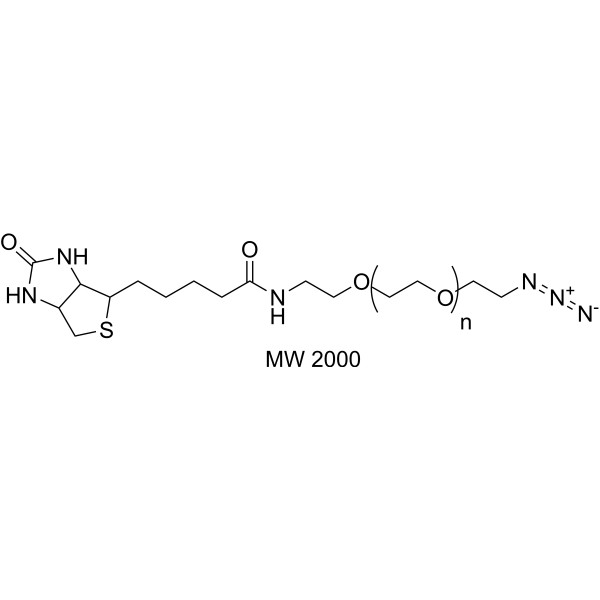
    Biotin-PEG2000-azide is a biotin labeled PEG derivative. Biotin is an enzyme co-factor, can be used for labeling protein; PEG is a hydrophilic and water-soluble polymer with low toxicity; azide, is a moderately good leaving group, can react with alkyne by Cu-catalyzation, which improve the efficiency of biotin binding targets. It contains an azide group and can undergo copper-catalyzed azide-alkyne cycloaddition (CuAAc) with molecules containing alkyne groups. It can also undergo ring strain-promoted alkyne-azide cycloaddition (SPAAC) with molecules containing DBCO or BCN groups.
    Biotin-PEG2000-azide
  • HY-P10896

    Bombesin Receptor Cancer
    NOTA-P2-RM26 is an antagonist of Bombesin (HY-P0195) analogs, and the gastrin-releasing peptide receptor (GRPR/BB2) is a molecular target for prostate cancer visualization. NOTA-P2-RM26 is labeled with 111In and 68Ga for prostate cancer imaging studies using PET and SPECT/CT .
    NOTA-P2-RM26
  • HY-W591449

    Liposome Cancer
    DOPE-PEG2000-Azide is a liposome to simulate biological phospholipid membrane. Liposomes are the main component of vesicles with concentric phospholipid bilayer membranes, which can be used to construct drug delivery systems for anti-cancer and anti-infection fields. Highly polar water-soluble payloads can be trapped in the internal aqueous space of liposomes, while lipophilic payloads can partition into and become part of the lipid bilayer. Especially for delivering antisense oligonucleotides, it can overcome problems such as inefficient cellular uptake and rapid loss in the body .
    DOPE-PEG2000-Azide
  • HY-169232

    PROTACs Cancer
    PCC16 chloride is a CRBN-based cp-PCC with an IC50 value of 102 nM for the degradation of DHHC3. PCC16 chloride has antitumor activity. (Target protein ligand: HY-169235, linker: HY-169236, E3 ligase ligand: HY-10984) .
    PCC16 chloride
  • HY-140682

    PROTAC Linkers Cancer
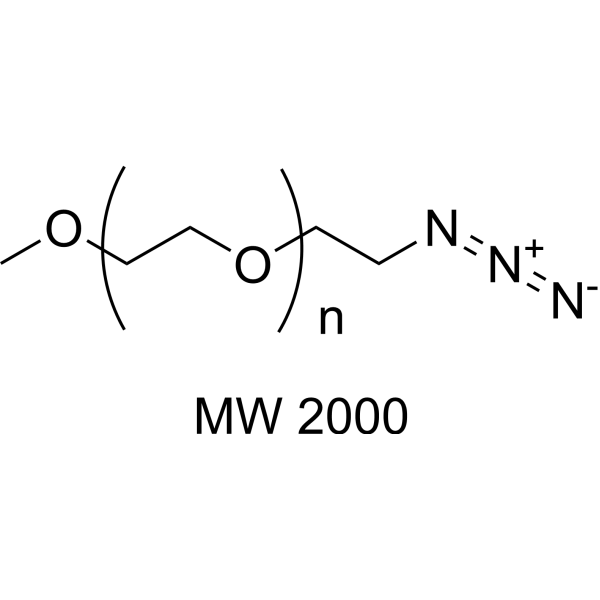
    m-PEG2000-azide is a PEG-based PROTAC linker that can be used in the synthesis of PROTACs . m-PEG2000-azide is a click chemistry reagent, it contains an Azide group and can undergo copper-catalyzed azide-alkyne cycloaddition reaction (CuAAc) with molecules containing Alkyne groups. It can also undergo strain-promoted alkyne-azide cycloaddition (SPAAC) reactions with molecules containing DBCO or BCN groups.
    m-PEG2000-azide
  • HY-173606

    Liposome Others
    DSPE-PEG2000-Azide ammonium is an azide containing lipid that can be used to form micelles as nanoparticles for drug delivery . DSPE-PEG2000-Azide ammonium is a click chemistry reagent, it contains an Azide group and can undergo copper-catalyzed azide-alkyne cycloaddition reaction (CuAAc) with molecules containing Alkyne groups. It can also undergo strain-promoted alkyne-azide cycloaddition (SPAAC) reactions with molecules containing DBCO or BCN groups.
    DSPE-PEG2000-Azide ammonium
  • HY-174970C

    Silane-PEG2000-azide

    Biochemical Assay Reagents Others
    Silane-PEG2000-N3 (Silane-PEG2000-azide) is a PEG derivative composed of silane, PEG units, and azide groups, which can be used to modify glass, silicon, or other surfaces by reacting hydroxyl groups with ethoxy (methoxy) silanes. Silane-PEG2000-N3 contains an azide group and can undergo copper-catalyzed azide-alkyne cycloaddition (CuAAc) with molecules containing alkyne groups. It can also undergo ring strain-driven alkyne-azide cycloaddition (SPAAC) with molecules containing DBCO or BCN groups .
    Silane-PEG2000-N3
  • HY-W1052051

    DPPE-PEG2000-azide

    Biochemical Assay Reagents Others
    DPPE-PEG2000-N3 (DPPE-PEG2000-Azide) is a conjugate composed of DPPE, PEG chains, and terminal azido groups (-N3). DPPE-PEG2000-Azide is a click chemistry reagent used for the targeted modification of liposomes/nanoparticles.
    DPPE-PEG2000-N3
  • HY-182836A

    DMPE-PEG2000-azide

    Biochemical Assay Reagents Others
    DMPE-PEG2000-N3 (DMPE-PEG2000-Azide) is a conjugate composed of DMPE, PEG chains, and terminal azido groups (-N3). DMPE-PEG2000-Azide is a click chemistry reagent used for the targeted modification of liposomes/nanoparticles.
    DMPE-PEG2000-N3
  • HY-183175A

    Biochemical Assay Reagents Others
    DSG-PEG2000-N3 is a conjugate composed of DSG, PEG chains, and terminal azido groups (-N3). DSG-PEG2000-Azide is a click chemistry reagent used for the targeted modification of liposomes/nanoparticles.
    DSG-PEG2000-N3
  • HY-183161A

    Glucose-PEG2000-azide

    Biochemical Assay Reagents Others
    Glucose-PEG2000-N3 (Glucose-PEG2000-Azide) is a conjugate composed of glucose, PEG chains, and an azide group (-N3). Glucose-PEG2000-N3 combines the targeted recognition ability of glucose with the azide group that can undergo click chemistry, making it suitable for applications such as constructing targeted drug delivery systems and nanoparticle modification.
    Glucose-PEG2000-N3
  • HY-P11625

    RXFP Receptor Cardiovascular Disease
    R9-13 is a fatty acid-conjugated relaxin and an agonist of LGR7 (RXFP1). R9-13 induces sustained pubic symphysis elongation in estrogen-pretreated mice. R9-13 exhibits long-acting pharmacokinetic profiles in rodents, with in vivo activity lasting up to one week after administration. R9-13 can be used in studies related to acute heart failure .
    R9-13
  • HY-P11830

    Amylin Receptor Metabolic Disease
    UDA-6 is a potent calcitonin and amylin receptor agonist (DACRA). UDA-6 induces weight loss, improves metabolic and hepatic parameters, and stabilizes active receptor states in obesity rats. UDA-6 can be used for the research of obesity .
    UDA-6
  • HY-P11596

    Integrin Cancer
    NOTA-Asp2-αvβ6L is an integrin αvβ6 binder with selective accumulation in αvβ6-positive pancreatic cancer cells and tumors. NOTA-Asp2-αvβ6L can be used as a PET/CT tracer for imaging pancreatic ductal adenocarcinoma (PDAC) .
    NOTA-Asp2-αvβ6L
  • HY-P3252AS

    Isotope-Labeled Compounds Complement System Inflammation/Immunology
    Pegcetacoplan- 13C3, 15N TFA is the 13C- and 15N-labeled Pegcetacoplan TFA. Pegcetacoplan is a pegylated complement C3/C3b inhibitor. Pegcetacoplan acts by specifically binding to and inhibiting C3 and C3b, thereby suppressing the complement cascade at its proximal stage. Pegcetacoplan is not a known inhibitor or inducer of CYP450 isoenzymes. Pegcetacoplan can be used for the research of complement-mediated diseases, including paroxysmal nocturnal hemoglobinuria (PNH) and age-related macular degeneration (AMD).
    Pegcetacoplan-13C3,15N TFA

Inquiry Online

Your information is safe with us. * Required Fields.

Salutation


Country or Region *

Applicant Name *


Organization Name *

Department *


Email Address *


Product Name *

Cat. No.


Requested quantity *

Phone Number *


Remarks

Inquiry Online

Inquiry Information

Product Name:
Cat. No.:
Quantity:
MCE Japan Authorized Agent: