9 Results for "

BY-2 cells

" in MedChemExpress (MCE) Product Catalog:
Products (9)

9 Results for "BY-2 cells" in MCE Product Catalog:

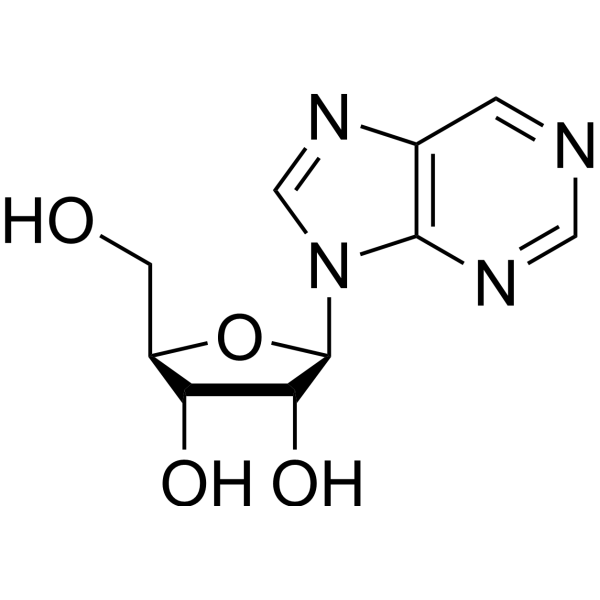
Cat. No.: HY-103694
CAS No.: 550-33-4
Purity:  98.44%
Synonyms: 9-β-D-Ribofuranosylpurine
Nebularine (9-β-D-Ribofuranosylpurine) is a naturally occurring cytotoxic purine riboside antibiotic. Nebularine competitively inhibits adenine deaminase and xanthine oxidase, and acts as a template for thymine insertion during DNA elongation and replication. Nebularine serves as a cytokinin antagonist and induces mitotic aberrations in plant cells. Nebularine exhibits cytotoxicity against plants, mammals, fungal organisms and cancer cells. Nebularine can be used in research related to fungal infections, plant growth, as well as chronic myeloid leukemia, acute lymphoblastic leukemia and breast cancer .
loading...
    loading...
Cat. No.: HY-B0941A
CAS No.: 1214-39-7
Synonyms: Benzyladenine, suitable for plant cell culture; 6-BAP, suitable for plant cell culture; N6-Benzyladenine, suitable for plant cell culture
6-Benzylaminopurine,suitable for plant cell culture is a cytokinin that induces plant growth and development by stimulating cell division, and prolongs the freshness of green vegetables through inhibiting respiratory kinases .
loading...
    loading...
Cat. No.: HY-170505
CAS No.: 2254752-21-9
Research Areas:  

Others

Icafolin-methyl is a herbicide and plant β-tubulin (Microtubule/Tubulin) inhibitor. Icafolin-methyl binds to the β-tubulin region of the Colchicine (HY-16569) binding site, thereby blocking the polymerization of plant tubulin. As a non-selective herbicide, Icafolin-methyl exhibits post-emergence activity against weeds in both cool-season and warm-season cropping systems, including resistant ryegrass and darnel biotypes. Icafolin-methyl can be used for herbicide research .
loading...
    loading...
Cat. No.: HY-N7659
CAS No.: 4356-52-9
Glucobrassicin is an indole-based anticancer agent and plant growth-regulating hormone. Glucobrassicin exerts its biological activity by disrupting the integrity of microtubule networks in both plant and mammalian cells. At high concentrations, Glucobrassicin inhibits seed germination and root growth; it can also specifically induce apoptosis in mammalian cancer cells and interfere with the intercellular transmission of viruses that rely on microtubules. In plants, Glucobrassicin can be catalyzed by myrosinase to release growth-regulating substances, exhibiting a concentration-dependent growth-regulating effect .
loading...
    loading...
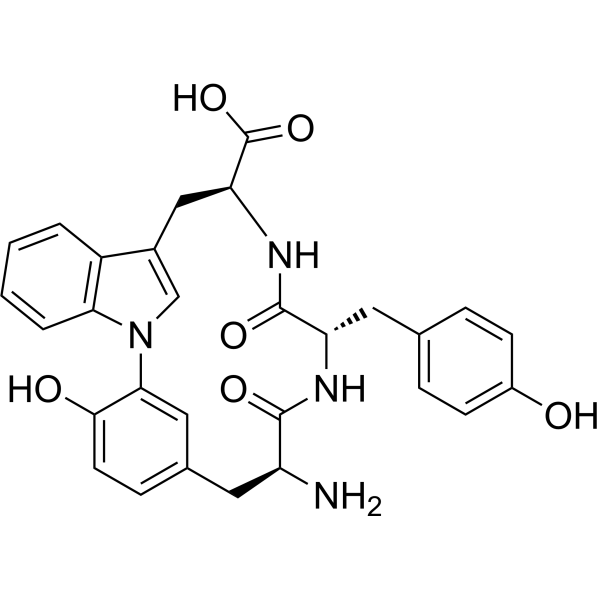
Cat. No.: HY-162397
Target:  

Others

Neopetromin is a tripeptide with a rare heteroaromatic C-N cross-link between side chains of tryptophan and tyrosine. Neopetromin causes vacuole fragmentation in an actin-independent manner .
loading...
    loading...
Cat. No.: HY-170505A
CAS No.: 2254813-53-9
Research Areas:  

Others

(S,S,S)-Icafolin-methyl is an isomer of Icafolin-methyl (HY-170505). Icafolin-methyl is a herbicide and plant β-tubulin (Microtubule/Tubulin) inhibitor. Icafolin-methyl binds to the β-tubulin region of the Colchicine (HY-16569) binding site, thereby blocking the polymerization of plant tubulin. As a non-selective herbicide, Icafolin-methyl exhibits post-emergence activity against weeds in both cool-season and warm-season cropping systems, including resistant ryegrass and darnel biotypes. Icafolin-methyl can be used for herbicide research .
loading...
    loading...
Cat. No.: HY-D3383
Target:  

Fluorescent Dye

Research Areas:  

Neurological Disease

AM4-64 is a fixable cationic styryl fluorescent dye for nerve terminals, which can be used for vesicle cycle evaluation, endocytic pathway tracing and endocytosis detection. AM4-64 inserts into the plasma membrane, is internalized via activity- or energy-dependent endocytosis, and accumulates in vesicles, endosomal compartments, vacuolar membranes, mitochondria and endolysosomal structures. The fluorescence of AM4-64 is enhanced in the membrane-bound state. AM4-64 is applicable to relevant studies on neurons, plant and fungal cells and tissues (Ex/Em = 510/750 nm) .
loading...
    loading...
Cat. No.: HY-D3148
CAS No.: 1804107-88-7
Target:  

Fluorescent Dye

Research Areas:  

Others

TPE-Ph-In is a mitochondria-targeted voltage-sensitive probe that can be used for mitochondrial membrane potential detection, mitochondrial imaging of animal and plant cells and tissues, mouse sperm activity indication, and detection of mitochondrial membrane potential changes associated with early apoptosis. TPE-Ph-In is non-fluorescent in solution, but emits strong fluorescence when aggregated via restriction of intramolecular rotation/movement, and its fluorescence intensity is directly correlated with local probe concentration or mitochondrial membrane potential level. TPE-Ph-In can penetrate cell membranes, target mitochondria through charge-dependent accumulation, has low cytotoxicity and high photostability, and enables super-resolution imaging of plant mitochondrial fission, fusion and cristae structures. The excitation wavelengths of TPE-Ph-In include 450 nm, 488 nm, and 489 nm, while its emission wavelengths include 551-661 nm, 660 nm, and 694 nm. TPE-Ph-In can be used for studies on mitochondrial dysfunction associated with early apoptosis .
loading...
    loading...
Cat. No.: HY-W547534
CAS No.: 2307-55-3
Synonyms: 2,4-Dichlorophenoxyacetic acid ammonium
Research Areas:  

Cancer

2,4-D (2, 4-dichlorophenoxyacetic acid) ammonium is a selective herbicide that can be used for the control of broad-leaved weeds. 2,4-D ammonium can induce apoptosis. 2,4-D ammonium inhibits DNA and protein synthesis, thereby preventing normal plant growth and development .
loading...
    loading...

