16 Results for "

M2 Peptide

" in MedChemExpress (MCE) Product Catalog:
Products (16)

16 Results for "M2 Peptide" in MCE Product Catalog:

Cat. No.: HY-P10449
CAS No.: 3098205-40-1
Target:  

Peptides

Research Areas:  

Inflammation/Immunology Cancer

M2 Peptide is a peptide targeting M2-like tumor-associated macrophages (TAMs). M2 Peptide is used to carry drugs or small interfering RNA (siRNA) to promote the repolarization of M2-like macrophages to M1-like macrophages, thereby altering the immunosuppressive state in the tumor microenvironment and enhancing the anti-tumor immune response. M2 Peptide can be used to study the effect of macrophage polarization and how this polarization change affects tumor growth and metastasis .
loading...
    loading...
1
1 Cited Publications
Cat. No.: HY-P1376A
Research Areas:  

Endocrinology

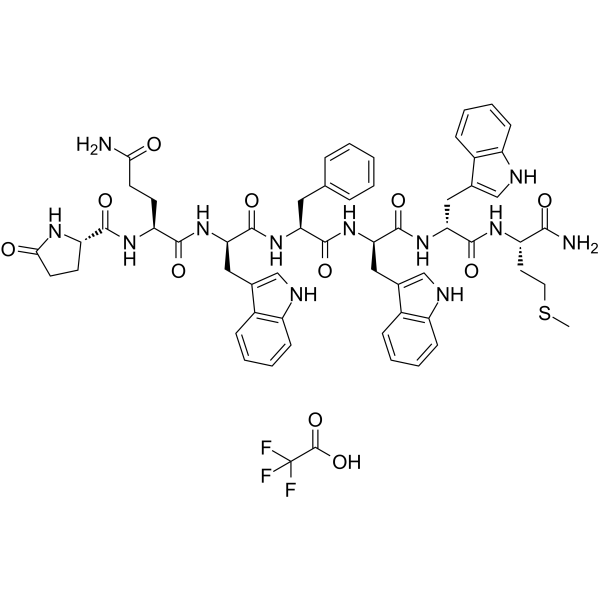
G-Protein antagonist peptide TFA is a truncated substance P-related peptide, competes with receptor for G protein binding. G-Protein antagonist peptide TFA inhibits the activation of Gi or Go by M2 muscarinic cholinergic receptor (M2 mAChR) or of Gs by beta-adrenergic receptor in the reconstituted phospholipid vesicles, assayed by receptor-promoted GTP hydrolysis .
loading...
    loading...
Cat. No.: HY-P11107
CAS No.: 2375823-45-1
Target:  

Apoptosis TNF Receptor

Research Areas:  

Inflammation/Immunology Cancer

RP-832c is a synthetic analogue of host defense peptides (HDP), targeting the mannose receptor CD206 on the surface of M2 polarized macrophages (Kd = 3.5 μM). RP-832c binding to CD206 induces a significant conformational change in the receptor, activating signaling pathways that lead to rapid apoptosis and repolarization of CD206-positive M2 macrophages to an M1 phenotype. RP-832c treatment significantly reduces CD206 gene expression in M2 macrophages while transiently increasing expression of TNF-α, a marker for M1 macrophages. RP-832c is used for the studies of T-cell lymphoma (CTCL) and idiopathic pulmonary fibrosis (IPF) .
loading...
    loading...
Cat. No.: HY-172273A
DSPE-PEG2000-Mal-Cys-YEQDPWGVKWWY is a PEG compound which composed of DSPE and a M2-polarized macrophages targeting peptide (M2pep, YEQDPWGVKWWY). M2pep is conjugated to a proapoptotic peptide as monovalent or multivalent ligands to concentrate the toxic effect of the peptide to M2 macrophages. DSPE-PEG2000-Mal-Cys-YEQDPWGVKWWY can be used for drug delivery .
loading...
    loading...
Cat. No.: HY-169089
Target:  

Drug Derivative

Research Areas:  

Cancer

RP-182-PEG3-K palmitic acid-NH2 (Compound 1a) is a fatty acid derivative of the immunomodulatory peptide RP-182. RP-182-PEG3-K palmitic acid-NH2 inhibits CD206 high M2-like macrophage (IC50 of 3.2 μM) and induces phagocytosis. RP-182-PEG3-K palmitic acid-NH2 exhibits antitumor efficacy in mouse B16 melanoma allografts .
loading...
    loading...
Cat. No.: HY-172273
DSPE-PEG1000-Mal-Cys-YEQDPWGVKWWY is a PEG compound which composed of DSPE and a M2-polarized macrophages targeting peptide (M2pep, YEQDPWGVKWWY). M2pep is conjugated to a proapoptotic peptide as monovalent or multivalent ligands to concentrate the toxic effect of the peptide to M2 macrophages. DSPE-PEG1000-Mal-Cys-YEQDPWGVKWWY can be used for drug delivery .
loading...
    loading...
Cat. No.: HY-172273C
DSPE-PEG3400-Mal-Cys-YEQDPWGVKWWY is a PEG compound which composed of DSPE and a M2-polarized macrophages targeting peptide (M2pep, YEQDPWGVKWWY). M2pep is conjugated to a proapoptotic peptide as monovalent or multivalent ligands to concentrate the toxic effect of the peptide to M2 macrophages. DSPE-PEG3400-Mal-Cys-YEQDPWGVKWWY can be used for drug delivery .
loading...
    loading...
Cat. No.: HY-P1376
CAS No.: 143675-79-0
Research Areas:  

Endocrinology

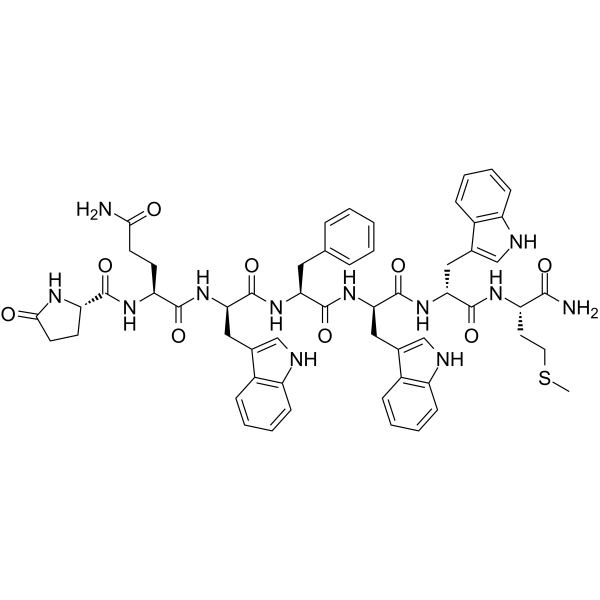
G-Protein antagonist peptide is the substance P-related peptide that inhibits binding of G proteins to their receptors. G-Protein antagonist peptide competitively and reversibly inhibits M2 muscarinic receptor activation of Gi or Go and inhibits Gs activation by β-adrenoceptors.
loading...
    loading...
Cat. No.: HY-169089A
Target:  

Drug Derivative

Research Areas:  

Cancer

RP-182-PEG3-K(palmitic acid)-NH2 (Compound 1a) TFA is a fatty acid derivative of the immunomodulatory peptide RP-182. RP-182-PEG3-K(palmitic acid)-NH2 TFA inhibits CD206 high M2-like macrophage (IC50 of 3.2 μM) and induces phagocytosis. RP-182-PEG3-K(palmitic acid)-NH2 TFA exhibits antitumor efficacy in mouse B16 melanoma allografts .
loading...
    loading...
Cat. No.: HY-172273B
DSPE-PEG5000-Mal-Cys-YEQDPWGVKWWY is a PEG compound which composed of DSPE and a M2-polarized macrophages targeting peptide (M2pep, YEQDPWGVKWWY). M2pep is conjugated to a proapoptotic peptide as monovalent or multivalent ligands to concentrate the toxic effect of the peptide to M2 macrophages. DSPE-PEG5000-Mal-Cys-YEQDPWGVKWWY can be used for drug delivery .
loading...
    loading...
Cat. No.: HY-118522
CAS No.: 688737-95-3
Research Areas:  

Cancer

TP-110 is a proteasome inhibitor. TP-110 specifically inhibits the protease-like activity of the 20S proteasome, but does not affect the trypsin-like or peptidyl-glutamyl peptide hydrolysis activity. TP-110 inhibits the NF-κB pathway, activates caspase-8, -9, and -3, and causes PARP cleavage, significantly reducing the levels of cIAP-1 and XIAP. TP-110 causes cell cycle arrest at the G2/M phase and promotes apoptosis of cancer cells. TP-110 can be used in cancer research of prostate cancer and multiple myeloma, etc .
loading...
    loading...
Cat. No.: HY-W276819
CAS No.: 893772-67-3
Research Areas:  

Cancer

PLK1-IN-9 (Compound M2) is an inhibitor for polo-like kinase 1 (PLK1), that inhibits PLK proteins modified with peptides 1010pT, cdc25c and PBIP, with IC50s of 1.6, 0.8 and 1.4 μM, respectively. PLK1-IN-9 inhibits proliferations of cancer cells HeLa, HL60, SNU387/499, HepG2, exhibits cytotoxicity and induces apoptosis. PLK1-IN-9 inhibits tumor growth in HepG2 xenograft mouse model .
loading...
    loading...
Cat. No.: HY-400684
Target:  

Bacterial

Research Areas:  

Cancer

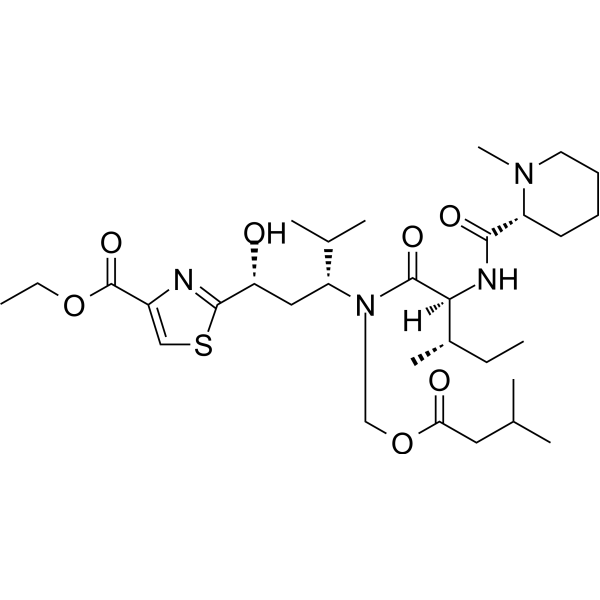
Tubulysin A intermediate-1 is an intermediate in the synthesis of the cytotoxic peptide Tubulysin A (HY-15995). Tubulysin A (TubA) is an antibiotic, anti-microtubule toxins, and apoptosis inducer isolated from myxobacteria. Tubulysin A has anti-angiogenic, anti-microtubule, anti-mitotic, and anti-proliferative activities. Tubulysin A arrests cells in the G2/M phase, effectively inhibits tubulin polymerization, and induces depolymerization of detached microtubules. Tubulysin A acts as an ADC cytotoxin (ADC Cytotoxin) to synthesize ADC .
loading...
    loading...
Cat. No.: HY-P11753A
IKVAVC acetate is a derivative peptide of IKVAV with an artificially added cysteine (Cys) at its C-terminus. IKVAVC acetate retains all the biological activities of the original IKVAV, mainly acting as a neural adhesion/differentiation signaling peptide, and is equipped with an engineered linker arm that enables covalent conjugation to molecular materials. IKVAV inhibits the migration and activation of fibroblasts, downregulates the TGF-β1 signaling pathway and endoplasmic reticulum stress, and promotes nerve repair. IKVAV regulates the phenotype of macrophages, shifting them from the pro-inflammatory M1 type to the pro-reparative M2 type .
loading...
    loading...
Cat. No.: HY-P11753
CAS No.: 1187540-64-2
IKVAVC is a derivative peptide of IKVAV with an artificially added cysteine (Cys) at its C-terminus. IKVAVC retains all the biological activities of the original IKVAV, mainly acting as a neural adhesion/differentiation signaling peptide, and is equipped with an engineered linker arm that enables covalent conjugation to molecular materials. IKVAV inhibits the migration and activation of fibroblasts, downregulates the TGF-β1 signaling pathway and endoplasmic reticulum stress, and promotes nerve repair. IKVAV regulates the phenotype of macrophages, shifting them from the pro-inflammatory M1 type to the pro-reparative M2 type .
loading...
    loading...
Cat. No.: HY-180989
PROTAC PLK1 Degrader-2 is a peptide-based N-end rule PLK1 mini-PROTAC. PROTAC PLK1 Degrader-2 utilizes Arg12 as dual-function cell-permeable N-degron to recruit UBR1/UBR2 E3 ligases, mediates PLK1 ubiquitination and proteasome-dependent degradation. PROTAC PLK1 Degrader-2 suppresses cervical cancer cell proliferation, induces G2/M cell cycle arrest and tumor cell apoptosis, and exerts potent in vivo anti-tumor efficacy in mice and can be applied to research on PLK1-driven cervical carcinoma .
loading...
    loading...
  • 1

