1. Search Result
Search Result
Results for "

OLIG2

" in MedChemExpress (MCE) Product Catalog:

9

Inhibitors & Agonists

7

Antibodies

3

Oligonucleotides

Targets Recommended:
Cat. No. Product Name Target Research Areas Chemical Structure
  • HY-19975
    RN-1734
    5+ Cited Publications

    TRP Channel Neurological Disease Cancer
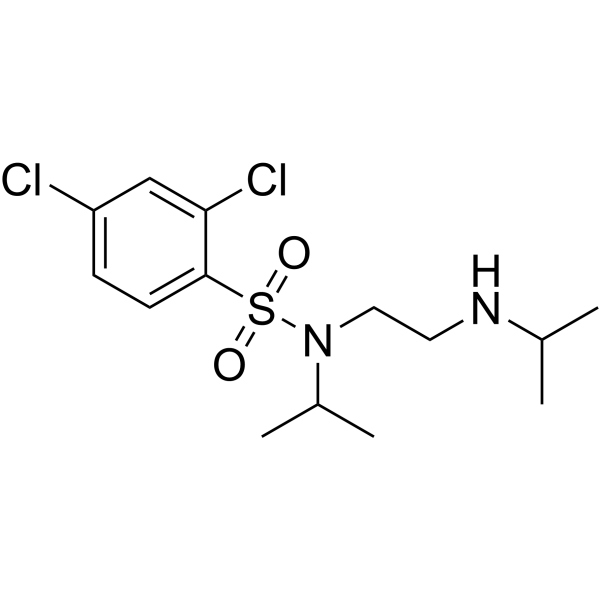
    RN-1734 is selective antagonist of the TRPV4 channel, completely antagonizes 4αPDD-mediated activation of TRPV4 with comparable, low micromolar IC50s for all three species (hTRPV4: 2.3 μM, mTRPV4: 5.9 μM, rTRPV4: 3.2 μM) . RN-1734 clearly decreases the production of tumor necrosis factor α (TNF-α) and interleukin 1β (IL-1β) without altering the number of olig2-positive cells [2].
    RN-1734
  • HY-179078

    OLIG2 Apoptosis Caspase PARP Neurological Disease Cancer
    CT-179 is a brain-penetrant and orally active OLIG2 inhibitor with a human IC50 of 1250 nM. CT-179 disrupts OLIG2 dimerization, phosphorylation, and DNA binding, blocking OLIG2-driven transcription. CT-179 induces G2/M phase arrest and increases G0 population. CT-179 induces apoptosis by reducing anti-apoptotic proteins and increasing cleaved caspase-3 and cleaved PARP. CT-179 can be used for the research of subgroup medulloblastoma .
    CT-179
  • HY-125427

    OLIG2 Cancer
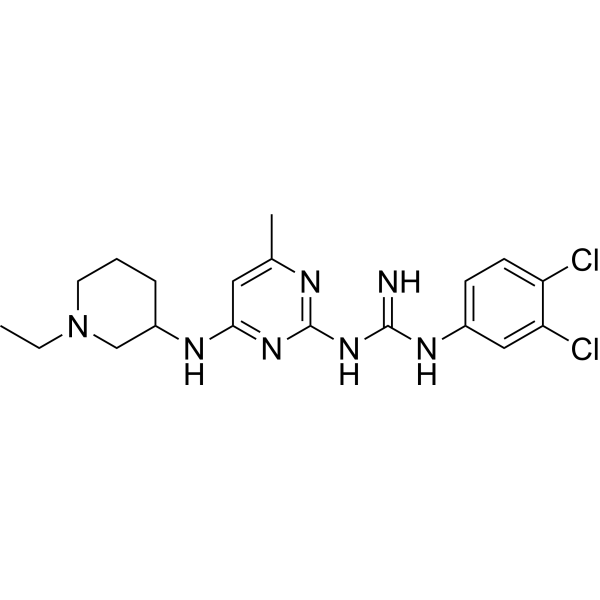
    SKOG102 is a potent OLIG2 inhibitor that is directly engaging OLIG2 and interferes with the ability of OLIG2 to bind DNA. SKOG102 can be used for the research of glioblastoma (GBM) .
    SKOG102
  • HY-150082

    CDK DNA/RNA Synthesis Cancer
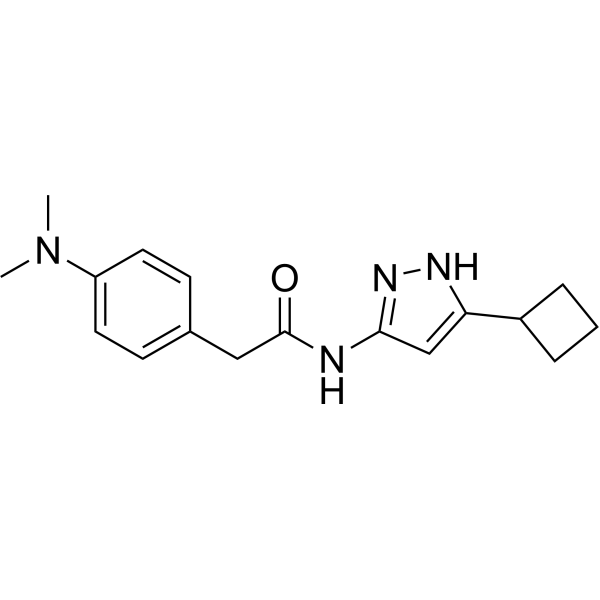
    CP681301 is a potent CDK5 inhibitor. CP681301 shows antiproliferative activity. CP681301 decreases the expression of CD133, OLIG2, SOX2, KI67, pCDK5 protein level in GSCs (Glioma stem cells). CP681301 reduces self-renewal in mouse glioma xenografts. CP681301 shows anti-tumor activity in Drosophila .
    CP681301
  • HY-175530

    OLIG2 Cancer
    OLIG2-IN-1 is a potent and selective oligodendrocyte transcription factor 2 (OLIG2) inhibitor. OLIG2-IN-1 directly and dose-dependently downregulates nuclear OLIG2 levels with an IC50 value of 0.88 μM. OLIG2-IN-1 exhibits strong anti-proliferative activity in U87 and U251 cells with IC50 values of 7.02 μM and 6.43 μM, respectively. OLIG2-IN-1 can be used for the research of cancer, such as glioblastoma multiforme .
    OLIG2-IN-1
  • HY-RS09778

    Small Interfering RNA (siRNA) Others

    OLIG2 Human Pre-designed siRNA Set A contains three designed siRNAs for OLIG2 gene (Human), as well as a negative control, a positive control, and a FAM-labeled negative control.

    OLIG2 Human Pre-designed siRNA Set A
    OLIG2 Human Pre-designed siRNA Set A
  • HY-RS17770

    Small Interfering RNA (siRNA) Others

    Olig2 Mouse Pre-designed siRNA Set A contains three designed siRNAs for Olig2 gene (Mouse), as well as a negative control, a positive control, and a FAM-labeled negative control.

    Olig2 Mouse Pre-designed siRNA Set A
    Olig2 Mouse Pre-designed siRNA Set A
  • HY-RS24237

    Small Interfering RNA (siRNA) Others

    Olig2 Rat Pre-designed siRNA Set A contains three designed siRNAs for Olig2 gene (Rat), as well as a negative control, a positive control, and a FAM-labeled negative control.

    Olig2 Rat Pre-designed siRNA Set A
    Olig2 Rat Pre-designed siRNA Set A
  • HY-163121

    Glycosyltransferase TGF-β Receptor FAK Galectin Collagen Endocrinology Cancer
    PST3.1a is an orally active and brain-penetrant N-acetylglucosamine glycosyltransferase (MGAT5) inhibitor with a human IC50 of 2 µM. PST3.1a inhibits TGFβR and FAK signaling pathway activity. PST3.1a alters β1,6-GlcNAc N-glycans and microtubule/microfilament integrity, increases OLIG2 expression, and inhibits proliferation, migration, invasiveness, and clonogenic capacities of glioblastoma initiating cells. PST3.1a reduces invasive and proliferative capacity of glioblastoma initiating cells in orthotopic graft models, increases overall survival of orthotopic graft model mice. PST3.1a blunts MGAT5 overexpression, decreases renal fibrosis via collagen 1, collagen 4, and galectin 3 downregulation in a rat chronic kidney disease model. PST3.1a can be used for the research of glioblastoma multiforme and chronic kidney disease [2].
    PST3.1a

Inquiry Online

Your information is safe with us. * Required Fields.

Salutation


Country or Region *

Applicant Name *


Organization Name *

Department *


Email Address *


Product Name *

Cat. No.


Requested quantity *

Phone Number *


Remarks

Inquiry Online

Inquiry Information

Product Name:
Cat. No.:
Quantity:
MCE Japan Authorized Agent:

