






1. Search Result
Search Result
Results for "

RNAi

" in MedChemExpress (MCE) Product Catalog:

25

Inhibitors & Agonists

3

Biochemical Assay Reagents

1

Peptides

1

Natural
Products

14

Oligonucleotides

Cat. No. Product Name Target Research Areas Chemical Structure
  • HY-145411
    PEG2000-C-DMG
    3 Publications Verification

    Liposome Endocrinology
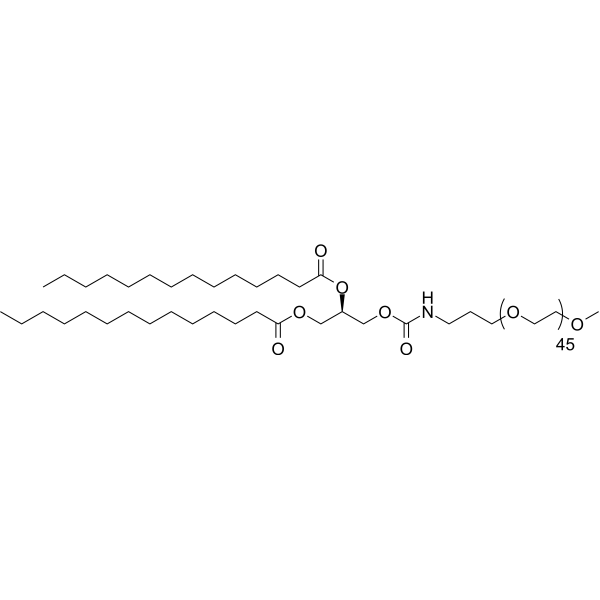
    PEG2000-C-DMG, a pegylated lipid, can be used for the preparation of Onpattro. Onpattro, a hepatically directed investigational RNAi therapeutic agent, harnesses this process to reduce the production of mutant and wild-type transthyretin by targeting the 3′ untranslated region of transthyretin mRNA .
    PEG2000-C-DMG
  • HY-132606A

    DCR-PHXC sodium

    Small Interfering RNA (siRNA) Lactate Dehydrogenase Metabolic Disease
    Nedosiran (DCR-PHXC) sodium is an RNA interference (RNAi) targeting lactate dehydrogenase (LDH). Nedosiran sodium represents an impactful potential therapeutic for primary hyperoxaluria (PH) with end-stage renal disease (ESRD). Nedosiran sodium is a GalNAc-dsRNA conjugate .
    Nedosiran sodium
  • HY-132613

    Small Interfering RNA (siRNA) Glycolate Oxidase Metabolic Disease
    Lumasiran sodium, an investigational RNA interference (RNAi) therapeutic agent, reduces hepatic oxalate production by targeting glycolate oxidase. Lumasiran sodium reduces urinary oxalate excretion, the cause of progressive kidney failure in primary hyperoxaluria type 1 (PH1) .
    Lumasiran sodium
  • HY-145720

    ALN-CC5

    Complement System Small Interfering RNA (siRNA) Metabolic Disease
    Cemdisiran (ALN-CC5) is an N-acetylgalactosamine-conjugated RNAi agent and also a complement component C5 inhibitor. Cemdisiran targets C5 mRNA, cleaves C5 mRNA via the endogenous RNA interference pathway, and inhibits the production of C5 protein in the liver. Cemdisiran exerts a dose-dependent inhibitory effect on total C5 concentrations in cynomolgus monkeys. When used in combination with Pozelimab (HY-P99786) in cynomolgus monkeys, Cemdisiran achieves a more sustained and complete inhibitory effect on complement activity. Cemdisiran can be used in the research of paroxysmal nocturnal hemoglobinuria and other complement-mediated diseases .
    Cemdisiran
  • HY-147426

    ADS-007; ARO HIF2

    Small Interfering RNA (siRNA) HIF/HIF Prolyl-Hydroxylase Cancer
    Zifcasiran (ADS-007; ARO HIF2) is an siRNA synthetic double-stranded RNAi trigger. Zifcasiran sodium selectively target hypoxia-inducible factor-2α (HIF2α) interrupting downstream pro-oncogenic signaling in clear cell renal cell carcinoma (ccRCC). Zifcasiran sodium engages the cell's RNAi machinery to target HIF2α (EPAS1) mRNA for degradation, thereby reducing the amount of free HIF2α mRNA available for translation .
    Zifcasiran
  • HY-112523A

    Liposome Others
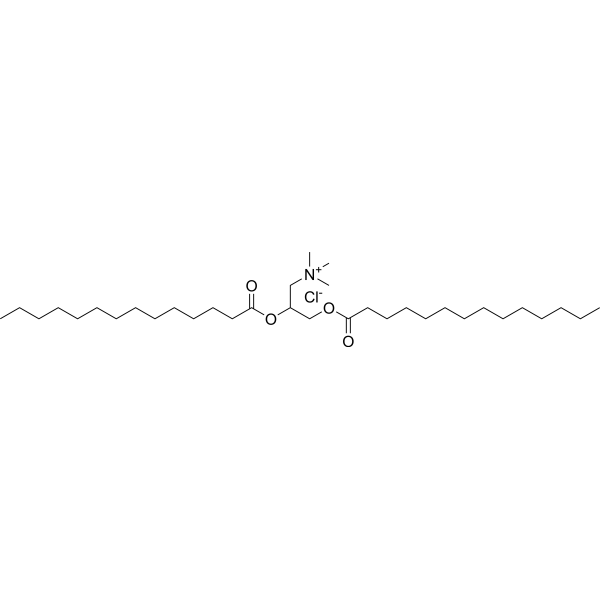
    DMTAP is a cationic lipid that can be used for delivery of DNA, RNAi and drugs .
    DMTAP
  • HY-150224

    Small Interfering RNA (siRNA) Factor Xa Others
    GalNAc unconjugated/naked Fitusiran (sodium), an small interfering RNA without GalNAc conjugation, specifically targets antithrombin (AT) messenger RNA to lower production of AT in the liver. Fitusiran increases thrombin generation and has the potential for the research of the hemophilia .
    GalNAc unconjugated/naked Fitusiran sodium
  • HY-132604A

    ARO-AAT sodium

    Small Interfering RNA (siRNA) Metabolic Disease
    Fazirsiran sodium is a second-generation RNAi agent. Fazirsiran sodium consistes of a cholesterol-conjugated RNAi trigger (chol-RNAi) to selectively degrade Alpha1-antitrypsin (AAT) mRNA by RNAi and a melittin-derived peptide conjugated to N-acetylgalactosamine (NAG) formulated as the excipient EX1 to promote endosomal escape of the chol-RNAi in hepatocytes . Fazirsiran sodium can be used in the study of Alpha-1 Antitrypsin Deficiency (AATD) liver disease. AATD is caused by mutations in the alpha-1 antitrypsin (SERPINA1) gene.
    Fazirsiran sodium
  • HY-W570886

    DNA/RNA Synthesis Cancer
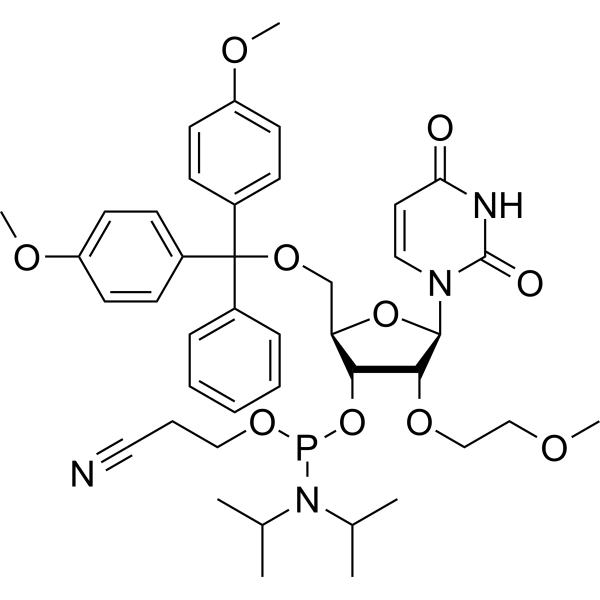
    2'-O-MOE-U is a nucleic acid modification group (Phosphoramidite) with 3'-exonuclease inhibitory activity. 2'-O-MOE-U also exhibits gene silencing activity and double-stranded oligonucleotide stability. By forming steric interactions with 3'-exonuclease residues, 2'-O-MOE-U anchors the 3'-end of the siRNA guide strand in the hAgo2 PAZ domain, thereby regulating double-stranded thermal stability and enhancing base-pairing specificity. 2'-O-MOE-U does not induce IFNα production, can be incorporated at multiple sites of siRNA to enhance RNAi activity, and produces a synergistic effect with 2'-F modification. 2'-O-MOE-U has been widely used in studies related to breast cancer and other diseases .
    2'-O-MOE-U
  • HY-132606

    DCR-PHXC

    Small Interfering RNA (siRNA) Lactate Dehydrogenase Metabolic Disease
    Nedosiran (DCR-PHXC) is an RNA interference (RNAi) targeting lactate dehydrogenase (LDH). Nedosiran represents an impactful potential therapeutic for primary hyperoxaluria (PH) with end-stage renal disease (ESRD). Nedosiran is a GalNAc-dsRNA conjugate .
    Nedosiran
  • HY-116999

    HBV Infection
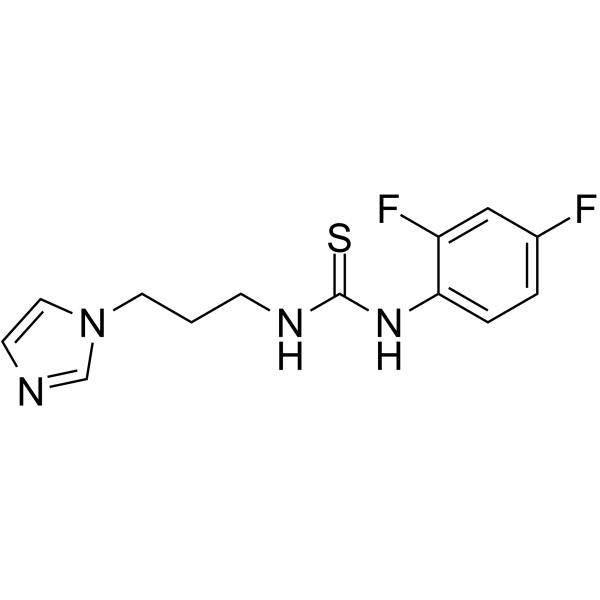
    IR415 is a potent anti-HBV agent and inhibits HBV replication by blocking the HBx activity. IR415 selectively interacts with HBx (Kd=2 nM) and blocks HBV-mediated RNAi suppression, reverses the inhibitory effect of HBx protein on the activity of the dicer endoribonuclease . HBx: hepatitis B virus X protein.
    IR415
  • HY-132604

    ARO-AAT

    Small Interfering RNA (siRNA) Metabolic Disease
    Fazirsiran (ARO-AAT) is a second-generation RNAi agent. Fazirsiran consistes of a cholesterol-conjugated RNAi trigger (chol-RNAi) to selectively reduce Alpha1-antitrypsin (AAT) synthesis and a melittin-derived peptide conjugated to N-acetylgalactosamine (NAG) formulated as the excipient EX1 to promote endosomal escape of the chol-RNAi in hepatocytes . Fazirsiran can be used in the study of Alpha-1 Antitrypsin Deficiency (AATD) liver disease. Alpha-1 antitrypsin deficiency (AATD) is caused by mutations in the alpha-1 antitrypsin (SERPINA1) gene.
    Fazirsiran
  • HY-W004287

    Amyloid-β Cholinesterase (ChE) Parasite Infection Neurological Disease
    Methyl tridecanoate is a fatty acid methyl ester. Methyl tridecanoate exhibits an IC50 of 3.26 μM and a Ki of 2.30 μM against AsOBP21f in Anopheles sinensis. Methyl tridecanoate induces electroantennographic responses in female Anopheles sinensis. Methyl tridecanoate shows a dose-dependent attractive effect on Anopheles sinensis. Methyl tridecanoate weakly inhibits β-amyloid aggregation and AChE activity. Methyl tridecanoate can be used in the research of malaria and Alzheimer's disease .
    Methyl tridecanoate
  • HY-147426A

    ADS-007 sodium; ARO HIF2 sodium

    Small Interfering RNA (siRNA) HIF/HIF Prolyl-Hydroxylase Cancer
    Zifcasiran (ADS-007) sodium is an siRNA synthetic double-stranded RNAi trigger. Zifcasiran sodium selectively target hypoxia-inducible factor-2α (HIF2α) interrupting downstream pro-oncogenic signaling in clear cell renal cell carcinoma (ccRCC). Zifcasiran sodium engages the cell's RNAi machinery to target HIF2α (EPAS1) mRNA for degradation, thereby reducing the amount of free HIF2α mRNA available for translation .
    Zifcasiran sodium
  • HY-402873

    Orexin Receptor (OX Receptor) Neurological Disease
    DMTr-2'-O-C16-rC(Ac)-3'-CE-phosphoramidite (Compound 5) is an RNAi agent and an inhibitor of Ataxin-2 (ATXN2). DMTr-2'-O-C16-rC(Ac)-3'-CE-phosphoramidite can be studied in research on ATXN2-associated neurological diseases .
    DMTr-2'-O-C16-rC(Ac)-3'-CE-phosphoramidite
  • HY-158305

    Small Interfering RNA (siRNA) Others
    SM51a is a small molecule targeting ligand. SM51a can be linked to the 3' or 5' end of a sense strand or an antisense strand of a DUX4 RNAi agent for promoting it entry into cells .
    SM51a
  • HY-158306

    Small Interfering RNA (siRNA) Others
    SM45a is a small molecule targeting ligand. SM45a can be linked to the 3' or 5' end of a sense strand or an antisense strand of a DUX4 RNAi agent for promoting it entry into cells .
    SM45a
  • HY-172328

    Liposome Cancer
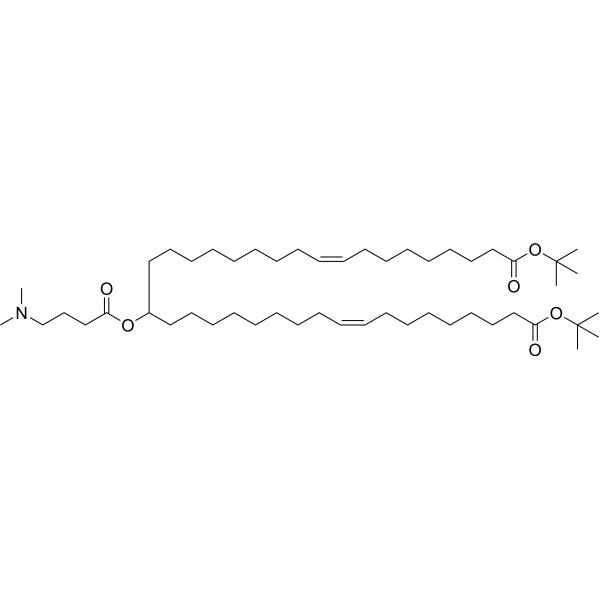
    O12-D3-I3 is an ionizable cationic lipid. O12-D3-I3 can be used in the generation of lipid nanoparticles (LNPs) for siRNA delivery in vitro and in vivo. LNPs containing O12-D3-I3 enhances LNP endosomal escape for ferroptosis RNAi therapy of cancer .
    O12-D3-I3
  • HY-176863

    Androgen Receptor Neurological Disease
    Di(5-(methylsulfonyl)-1,3,4-oxadiazol-2-yl)-benzene-amide-PEG4-ester-2,3,5,6-F-Ph (Compound L-1026) is a linker that connects Androgen Receptor (AR) RNAi agent to targeting ligands (such as antibodies). The conjugation can inhibit AR gene expression and reduce AR activity. Di(5-(methylsulfonyl)-1,3,4-oxadiazol-2-yl)-benzene-amide-PEG4-ester-2,3,5,6-F-Ph can be used for spinal and bulbar muscular atrophy (SBMA) research .
    Di(5-(methylsulfonyl)-1,3,4-oxadiazol-2-yl)-benzene-amide-PEG4-ester-2,3,5,6-F-Ph
  • HY-P10802

    Enterovirus Virus Protease Infection
    ER-DRI is a potent peptide inhibitor that tagets EV-A71. ER-DRI directly bounds to 3A and specifically abrogates viral suppressor of RNAi activity, which unlocked the antiviral RNAi response that is suppressed by 3A. ER-DRI also potently inhibits another enterovirus, Coxsackievirus-A16, dependently of RNAi .
    ER-DRI
  • HY-145797

    Liposome Others
    L343 is an ionizable cationic lipidoid and can be used to synthetic liposomes for systemic delivery of RNAi therapeutics.
    L343
  • HY-175276

    JNK MMP Cancer
    JNK-IN-24, a JNK inhibitor, is an anti-metastatic cancer agent. JNK-IN-24 downregulates JNK and MMP1 expression in Scrib knockdown induced cancer tissues. JNK-IN-24 promotes recovery from tumorous wing disc phenotype of Scrib RNAi. JNK-IN-24 can be used for the study in various epithelial cell-derived cancers .
    JNK-IN-24
  • HY-180474

    Liposome Neurological Disease
    LP293-p is a lipid with activated ester groups, which can be used for the synthesis of ATXN2 RNAi. LP293-p can be utilized to enhance the targeting of the central nervous system (CNS) .
    LP293-p
  • HY-185424

    Integrin Others
    Tri-SM6.1 is a tridentate small-molecule ligand targeting integrin αvβ6. Tri-SM6.1 binds to integrin αvβ6 on epithelial cells to deliver conjugated α-ENaC RNAi agents .
    Tri-SM6.1
  • HY-W1119956

    5'(E)-VP-2'-OMe-iBu-G Phosphoramidite

    Nucleoside Antimetabolite/Analog DNA/RNA Synthesis Infection
    5'-(E)-VPG Phosphoramidite (5'(E)-VP-2'-OMe-iBu-GPhosphoramidite) is a structurally modified phosphoramidite reagent used to synthesize biologically stable oligonucleotides. 5'-(E)-VPG Phosphoramidite (POM) carries a VP protecting group and can be coupled to the target oligonucleotide at the 5' end via solid-phase synthesis. The modified oligonucleotide is then constructed through oxidation and deprotection steps. 5'-(E)-VPG Phosphoramidite is suitable for RNAi and viral replication research .
    5’-(E)-VPG Phosphoramidite

Inquiry Online

Your information is safe with us. * Required Fields.

Salutation


Country or Region *

Applicant Name *


Organization Name *

Department *


Email Address *


Product Name *

Cat. No.


Requested quantity *

Phone Number *


Remarks

Inquiry Online

Inquiry Information

Product Name:
Cat. No.:
Quantity:
MCE Japan Authorized Agent:

