12 Results for "

axenic

" in MedChemExpress (MCE) Product Catalog:
Products (12)

12 Results for "axenic" in MCE Product Catalog:

15
15 Cited Publications
Cat. No.: HY-B0217
CAS No.: 55981-09-4
Synonyms: NTZ; NSC 697855
Research Areas:  

Infection Cancer

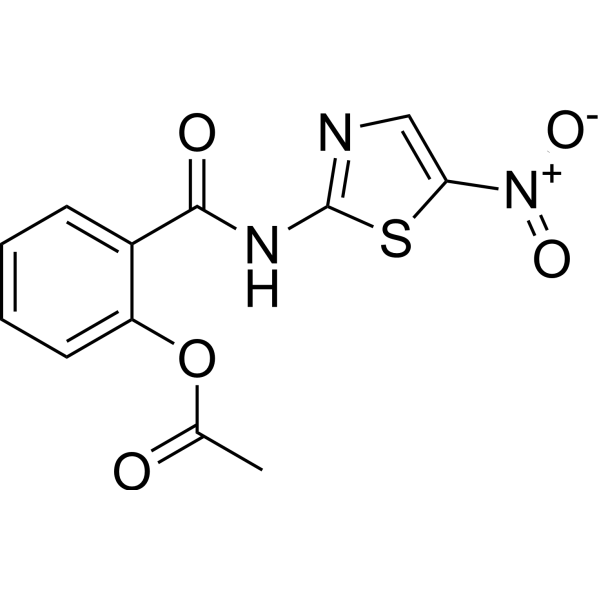
Nitazoxanide (NTZ), an anthelmintic agent, exhibits a broad spectrum of activities against a wide variety of helminths, protozoa, and enteric bacteria infecting animals and humans. Nitazoxanide inhibits Giardia lamblia trophozoite proliferation in axenic culture with an IC50 of 2.4 μM . Nitazoxanide can be used for the research of parasitic gastroenteritis. Nitazoxanide shows anti-Japanese encephalitis virus (JEV) activity in a mouse model .
loading...
    loading...
Cat. No.: HY-W011165
CAS No.: 52123-30-5
Synonyms: L-Lysyl-L-lysine dihydrochloride
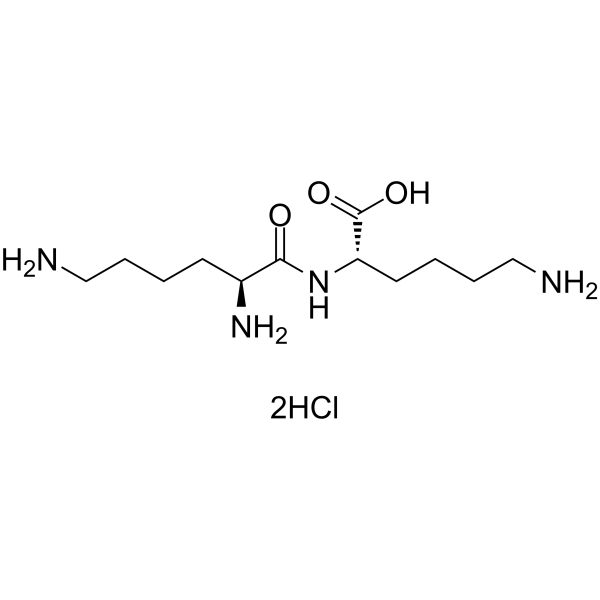
Lysyllysine dihydrochloride (L-Lysyl-L-lysine dihydrochloride) is an orally active PepT1 substrate. Lysyllysine dihydrochloride enhances whole-body protein synthesis, improves intestinal structure, alleviates intestinal mucosal inflammation, and exhibits higher lysine bioavailability in neonatal piglets with PN-induced intestinal atrophy. Lysyllysine dihydrochloride inhibits the growth of axenic cyanobacterial strains and induces their cell lysis. Lysyllysine dihydrochloride can be used in studies related to intestinal atrophy and metabolism .
loading...
    loading...
Cat. No.: HY-162066
CAS No.: 2868298-43-3
Target:  

Parasite

Research Areas:  

Infection

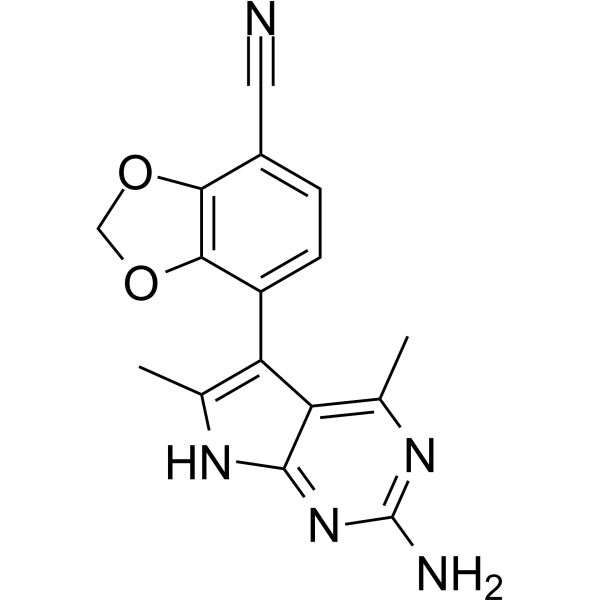
DNDI-6174 is an orally active Leishmania cytochrome b (Qi site of cytochrome bc1 complex/complex III) inhibitor. DNDI-6174 binds to the Qi site of Leishmania cytochrome b, inhibits cytochrome bc1 complex activity in the parasite's electron transport chain across promastigote and axenic amastigote stages. DNDI-6174 reduces parasite burden in rodent models, inhibits growth of various Leishmania species, drug-resistant clinical isolates, and Trypanosoma cruzi, with marginal activity against Trypanosoma brucei. DNDI-6174 can be used for the research of visceral leishmaniasis, cutaneous leishmaniasis .
loading...
    loading...
Cat. No.: HY-P11337
CAS No.: 403479-63-0
Research Areas:  

Others

Scyptolin B, a cyclic depsipeptides, is a secondary metabolite. Scyptolin B can be isolated from axenic cultures of Scytonema hofmanni PCC 7110. Scyptolin B selective inhibits porcine pancreatic Elastase with an IC50 of 3.1 μg/mL .
loading...
    loading...
Cat. No.: HY-120791
CAS No.: 13184-13-9
Synonyms: L-Lysyl-L-lysine
Lysyllysine (L-Lysyl-L-lysine ) is an orally active PepT1 substrate. Lysyllysine enhances whole-body protein synthesis, improves intestinal structure, alleviates intestinal mucosal inflammation, and exhibits higher lysine bioavailability in neonatal piglets with PN-induced intestinal atrophy. Lysyllysine inhibits the growth of axenic cyanobacterial strains and induces their cell lysis. Lysyllysine can be used in studies related to intestinal atrophy and metabolism .
loading...
    loading...
Cat. No.: HY-B0217R
CAS No.: 55981-09-4
Synonyms: NTZ (Standard); NSC 697855 (Standard)
Nitazoxanide (Standard) is the analytical standard of Nitazoxanide. This product is intended for research and analytical applications. Nitazoxanide (NTZ), an anthelmintic agent, exhibits a broad spectrum of activities against a wide variety of helminths, protozoa, and enteric bacteria infecting animals and humans. Nitazoxanide inhibits Giardia lamblia trophozoite proliferation in axenic culture with an IC50 of 2.4 μM . Nitazoxanide can be used for the research of parasitic gastroenteritis. Nitazoxanide shows anti-Japanese encephalitis virus (JEV) activity in a mouse model .
loading...
    loading...
Cat. No.: HY-151151
CAS No.: 1314875-96-1
Target:  

Parasite

Research Areas:  

Infection

Trypanothione synthetase-IN-3 is a noncompetitive mixed hyperbolic Trypanothione synthetase (TryS) inhibitor (Ki: 0.8 μM). Trypanothione synthetase-IN-3 can be used in the study of parasites, such as L. infantum .
loading...
    loading...
Cat. No.: HY-N17223
CAS No.: 111187-16-7
Target:  

Others

1,2-Di-O-linolenoylglycerol 3-O-β-D-galactopyranoside is a monogalactosyl diacylglycerol that can be found in the axenic cyanobacterium Phormidium tenue. 1,2-Di-O-linolenoylglycerol 3-O-β-D-galactopyranoside can induce lysis of Phormidium tenue .
loading...
    loading...
Cat. No.: HY-120791A
CAS No.: 73343-51-8
Synonyms: L-Lysyl-L-lysine trihydrochloride
Lysyllysine trihydrochloride (L-Lysyl-L-lysine trihydrochloride) is an orally active PepT1 substrate. Lysyllysine trihydrochloride enhances whole-body protein synthesis, improves intestinal structure, alleviates intestinal mucosal inflammation, and exhibits higher lysine bioavailability in neonatal piglets with PN-induced intestinal atrophy. Lysyllysine trihydrochloride inhibits the growth of axenic cyanobacterial strains and induces their cell lysis. Lysyllysine trihydrochloride can be used in studies related to intestinal atrophy and metabolism .
loading...
    loading...
Cat. No.: HY-N19703
CAS No.: 186204-00-2
Synonyms: 4′-O-Methylhydrangenol
(+)-Hydrangenol monomethyl ether is a hydrangenol-monomethyl ether (+)-enantiomer found in axenic cultures of the liverwort Plagiochila adianthoides .
loading...
    loading...
Cat. No.: HY-180833
Target:  

Parasite

Research Areas:  

Infection

Antileishmanial agent-39 (Compound 4h) is an antileishmanial agent. Antileishmanial agent-39 shows antileishmanial activity against the axenic amastigote form of Leishmania infantum with an IC50 of 0.42 μM .
loading...
    loading...
Cat. No.: HY-185556
CAS No.: 67119-95-3
Target:  

Parasite

Research Areas:  

Infection

14-Hydroxydehydroabietane is a ribosomal enzyme inhibitor. 14-Hydroxydehydroabietane exhibits in vitro antileishmanial activity against promastigotes, amastigotes and intracellular amastigotes of Leishmania infantum and Leishmania braziliensis. 14-Hydroxydehydroabietane induces ultrastructural changes in Leishmania braziliensis promastigotes. 14-Hydroxydehydroabietane reduces the infection rate of macrophages by Leishmania infantum and Leishmania braziliensis. 14-Hydroxydehydroabietane can be used for the research of leishmaniasis .
loading...
    loading...
  • 1

