



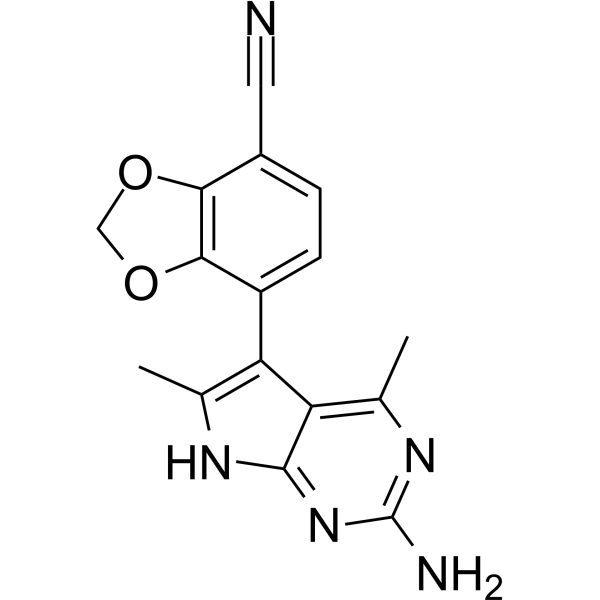
DNDI-6174

Based on 1 Customer Validation
DNDI-6174 is an orally active Leishmania cytochrome b (Qi site of cytochrome bc1 complex/complex III) inhibitor. DNDI-6174 binds to the Qi site of Leishmania cytochrome b, inhibits cytochrome bc1 complex activity in the parasite's electron transport chain across promastigote and axenic amastigote stages. DNDI-6174 reduces parasite burden in rodent models, inhibits growth of various Leishmania species, drug-resistant clinical isolates, and Trypanosoma cruzi, with marginal activity against Trypanosoma brucei. DNDI-6174 can be used for the research of visceral leishmaniasis, cutaneous leishmaniasis.
연구목적의 판매만을 진행합니다. 환자를 대상으로 한 판매는 하지 않습니다.
- Purity : 97.28%
- CAS No.: 2868298-43-3
- 화학식: C16H13N5O2
- 분자량:307.31
-
보관:Powder -20°C, 3 years , 4°C, 2 years ; In solvent -80°C, 6 months , -20°C, 1 month

To place orders, for customer services and technical support, please contact: MedChemExpress USA
Tel: 609-228-6898 E-mail: [email protected] [email protected]


-
 Biological Activity
-
Chemical Information
-
용액&용해도
- 순도&문서
- References
-
 Help & FAQs


All Parasite Isoforms
More

Biological Activity
제품 설명
In Vitro
DNDI-6174 (96 h) potently inhibits the intracellular amastigote stage of diverse Leishmania species/strains responsible for VL and CL, including drug-resistant isolates, with EC50 values ranging from 12 nM to 740 nM[1].
DNDI-6174 (72 h) inhibits growth of wild-type L. donovani promastigotes and axenic amastigotes with EC50 values of 24 nM and 75 nM, respectively; cross-resistance with DDD01716002-resistant lines and generated DNDI-6174-resistant lines confirms targeting of the cytochrome bc1 Qi site[1].
DNDI-6174 potently inhibits cytochrome bc1 complex activity in L. donovani promastigote and axenic amastigote mitochondrial lysates, with IC50 values of 8 nM and 2 nM, respectively[1].
DNDI-6174 shows a favorable in vitro safety profile with no cytotoxicity, genotoxicity, or significant mammalian mitochondrial inhibition at relevant concentrations; it exhibits moderate CYP inhibition and specific drug transporter inhibition, and high intestinal permeability[1].
MedChemExpress (MCE) has not independently confirmed the accuracy of these methods. They are for reference only. .
Parmacokinetics
| Species | Dose | Route | CLplasma | Vss | T1/2 | AUC0-inf | Cmax | Tmax | AUC0-∞ | Bioavailability |
|---|---|---|---|---|---|---|---|---|---|---|
| Mice[1] | 2 mg/kg | i.v. | 7.64 mL/min/kg | 1.12 L/kg | 2.0 h | 4.47 μg·h/mL | / | / | / | / |
| Rat[1] | 3 mg/kg | i.v. | 2.12 mL/min/kg | 1.40 L/kg | 7.9 h | 23.6 μg·h/mL | / | / | / | / |
| Dog[1] | 1 mg/kg | i.v. | 3.5 mL/min/kg | 2.50 L/kg | 9.84 h | 5.00 μg·h/mL | / | / | / | / |
| Rat[1] | 25 mg/kg | p.o. | / | / | 3.7 h | / | 10.4 μg/mL | 1.0 h | 75.5 μg·h/mL | >100 % |
| Mice[1] | 10 mg/kg | p.o. | / | / | 7.0 h | / | 4.21 μg/mL | 4.0 h | 57.7 μg·h/mL | 93 % |
| Dog[1] | 5 mg/kg | p.o. | / | / | 6.9 h | / | 2.02 μg/mL | 4.0 h | 18.5 μg·h/mL | 90 % |
| Golden hamster[1] | 12.5 mg/kg | p.o. | / | / | 2.6 h | / | 2.87 μg/mL | 2.7 h | 21.2 μg·h/mL | / |
In Vivo
DNDI-6174 (6.25-25 mg/kg; p.o.; once daily or twice daily; 5 consecutive days) achieves reduction in parasite burden across liver, spleen, and bone marrow in golden hamsters with visceral leishmaniasis, with potential to approach sterile cure[1].
MedChemExpress (MCE) has not independently confirmed the accuracy of these methods. They are for reference only.
-
Animal Model:BALB/c (female, 8-10 weeks old, 15-20 g, intravenously infected with Leishmania donovani or Leishmania infantum amastigotes)[1]
-
Dosage:6.25 mg/kg; 12.5 mg/kg; 25 mg/kg
-
Administration:p.o.; twice daily or once daily; 5 or 10 consecutive days
-
Result:Achieved >98% reduction in liver parasite burden relative to vehicle controls when dosed at 12.5 mg/kg twice daily for 5 days, 25 mg/kg once daily for 5 days, or 6.25 mg/kg twice daily for 10 days.
Reached >95% reduction in liver parasite burden in mice infected with either L. donovani or L. infantum with 5-day regimens of 12.5 mg/kg twice daily or higher.
Failed to reach >95% reduction in liver parasite burden with 6.25 mg/kg twice daily for 5 days.
-
Animal Model:(female, 75-80 g, intracardially infected with Leishmania infantum amastigotes)[1]
-
Dosage:6.25 mg/kg; 12.5 mg/kg; 25 mg/kg
-
Administration:p.o.; once daily or twice daily; 5 consecutive days
-
Result:Achieved >99% reduction in parasite burden across liver, spleen, and bone marrow relative to vehicle controls with once daily doses of 12.5 mg/kg or higher for 5 days.
Reached >95% reduction in parasite burden with twice daily dosing at 6.25 mg/kg for 5 days.
Showed no efficacy with once daily dosing at 6.25 mg/kg for 5 days.
Resulted in almost all organs being negative for viable parasites via promastigote back-transformation assay, suggesting potential to approach sterile cure, though 2 of 5 hamsters in the highest dosing group had at least one organ positive for residual parasites.


Chemical Information
-
CAS No. 2868298-43-3
-
Appearance Solid
-
분자량 307.31
-
화학식 C16H13N5O2
-
Color White to off-white
-
SMILES
N#CC1=CC=C(C2=C(C)NC3=NC(N)=NC(C)=C32)C4=C1OCO4
-
선적
Room temperature in continental US; may vary elsewhere.
-
보관
Powder -20°C 3 years 4°C 2 years In solvent -80°C 6 months -20°C 1 month


용액&용해도
In Vitro:
DMSO : 100 mg/mL (325.40 mM; Need ultrasonic; Hygroscopic DMSO has a significant impact on the solubility of product, please use newly opened DMSO)
Please refer to the solubility information to select the appropriate solvent. Once prepared, please aliquot and store the solution to prevent product inactivation from repeated freeze-thaw cycles.
Storage method and period of stock solution: -80°C, 6 months; -20°C, 1 month. When stored at -80°C, please use it within 6 months. When stored at -20°C, please use it within 1 month.
Please refer to the solubility information to select the appropriate solvent. Once prepared, please aliquot and store the solution to prevent product inactivation from repeated freeze-thaw cycles.
Storage method and period of stock solution: -80°C, 6 months; -20°C, 1 month. When stored at -80°C, please use it within 6 months. When stored at -20°C, please use it within 1 month.
Concentration (start) × Volume (start) = Concentration (final) × Volume (final)
In Vivo:
Select the appropriate dissolution method based on your experimental animal and administration route.
- For the following dissolution methods, please ensure to first prepare a clear stock solution using an In Vitro approach and then sequentially add co-solvents:
- To ensure reliable experimental results, the clarified stock solution can be appropriately stored based on storage conditions. As for the working solution for In Vivo experiments, it is recommended to prepare freshly and use it on the same day.
- The percentages shown for the solvents indicate their volumetric ratio in the final prepared solution. If precipitation or phase separation occurs during preparation, heat and/or sonication can be used to aid dissolution.
Add each solvent one by one: 10% DMSO 40% PEG300 5% Tween-80 45% Saline
Solubility: ≥ 2.5 mg/mL (8.14 mM); Clear solution
This protocol yields a clear solution of ≥ 2.5 mg/mL (saturation unknown).
Taking 1 mL working solution as an example, add 100 μL DMSO stock solution (25.0 mg/mL) to 400 μL PEG300, and mix evenly; then add 50 μL Tween-80 and mix evenly; then add 450 μL Saline to adjust the volume to 1 mL.
Preparation of Saline: Dissolve 0.9 g sodium chloride in ddH₂O and dilute to 100 mL to obtain a clear Saline solution.
Add each solvent one by one: 10% DMSO 90% (20% SBE-β-CD in Saline)
Solubility: ≥ 2.5 mg/mL (8.14 mM); Clear solution
This protocol yields a clear solution of ≥ 2.5 mg/mL (saturation unknown).
Taking 1 mL working solution as an example, add 100 μL DMSO stock solution (25.0 mg/mL) to 900 μL 20% SBE-β-CD in Saline, and mix evenly.
Preparation of 20% SBE-β-CD in Saline (4°C, storage for one week): 2 g SBE-β-CD powder is dissolved in 10 mL Saline, completely dissolve until clear.
In Vivo Dissolution Calculator
Please enter the basic information of animal experiments:
-
-
-
-
Recommended: Prepare an additional quantity of animals to account for potential losses during experiments.
Please enter your animal formula composition:
-
%DMSO +
Recommended: Keep the proportion of DMSO in working solution below 2% if your animal is weak.
-
%+
-
+%Tween-80 + +
-
%Saline +
The co-solvents required include: DMSO, . All of co-solvents are available by MedChemExpress (MCE). , Tween 80. All of co-solvents are available by MedChemExpress (MCE).
Working solution concentration: 0.22 mg/mL
Method for preparing stock solution: mg drug dissolved in μL DMSO. Stock solution concentration: mg/mL.
1. Take μL DMSO stock solution;
2. Add μL .
μL , mix evenly;
3. Then add μL Tween 80, mix evenly;
4. Then add μL
Please ensure that the stock solution in the first step is dissolved to a clear state, and add co-solvents in sequence. You can use ultrasonic heating (ultrasonic cleaner, recommended frequency 20-40 kHz), vortexing, etc. to assist dissolution.


순도&문서
-
Data Sheet (279 KB)
-
SDS (251 KB)
- English - EN (251 KB)
- Français - FR (251 KB)
- Deutsch - DE (251 KB)
- Norwegian - NO (251 KB)
- Español - ES (251 KB)
- Swedish - SV (251 KB)
- Italian - IT (251 KB)
- Korean - KR (251 KB)
- Portuguese - PT (251 KB)
-
Handling Instructions (2659 KB)
References


Complete Stock Solution Preparation Table
Please refer to the solubility information to select the appropriate solvent. Once prepared, please aliquot and store the solution to prevent product inactivation from repeated freeze-thaw cycles.
Storage method and period of stock solution: -80°C, 6 months; -20°C, 1 month. When stored at -80°C, please use it within 6 months. When stored at -20°C, please use it within 1 month.
| Optional Solvent | Concentration Solvent Mass | 1 mg | 5 mg | 10 mg | 25 mg |
|---|---|---|---|---|---|
| DMSO | 1 mM | 3.2540 mL | 16.2702 mL | 32.5404 mL | 81.3511 mL |
| 5 mM | 0.6508 mL | 3.2540 mL | 6.5081 mL | 16.2702 mL | |
| 10 mM | 0.3254 mL | 1.6270 mL | 3.2540 mL | 8.1351 mL | |
| 15 mM | 0.2169 mL | 1.0847 mL | 2.1694 mL | 5.4234 mL | |
| 20 mM | 0.1627 mL | 0.8135 mL | 1.6270 mL | 4.0676 mL | |
| 25 mM | 0.1302 mL | 0.6508 mL | 1.3016 mL | 3.2540 mL | |
| 30 mM | 0.1085 mL | 0.5423 mL | 1.0847 mL | 2.7117 mL | |
| 40 mM | 0.0814 mL | 0.4068 mL | 0.8135 mL | 2.0338 mL | |
| 50 mM | 0.0651 mL | 0.3254 mL | 0.6508 mL | 1.6270 mL | |
| 60 mM | 0.0542 mL | 0.2712 mL | 0.5423 mL | 1.3559 mL | |
| 80 mM | 0.0407 mL | 0.2034 mL | 0.4068 mL | 1.0169 mL | |
| 100 mM | 0.0325 mL | 0.1627 mL | 0.3254 mL | 0.8135 mL |


DNDI-6174 Related Classifications
HY-162066 Related Classifications
 Powered by Bioz