
11 Results for "

cell cycle assay

" in MedChemExpress (MCE) Product Catalog:
Products (11)

11 Results for "cell cycle assay" in MCE Product Catalog:

43
43 Cited Publications
Cat. No.: HY-D0952
CAS No.: 494-38-2
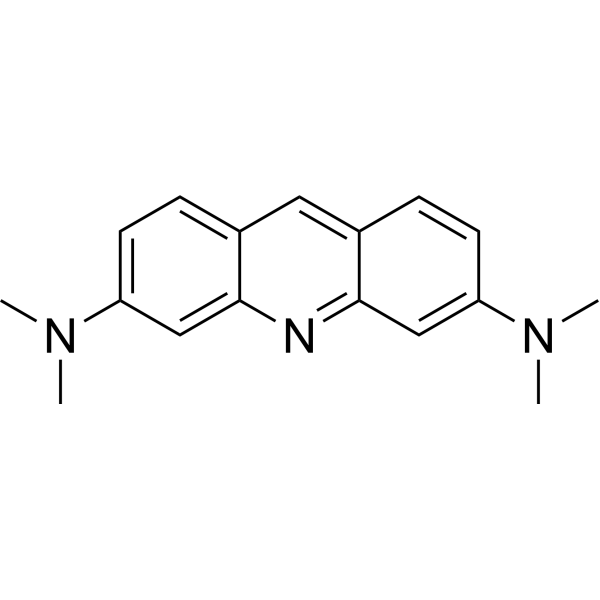
Acridine Orange base is a cell-permeable fluorescent dye that stains organisms (bacteria, parasites, viruses, etc.) bright orange and, when used under appropriate conditions (pH=3.5, Ex=460 nm), distinguishes human cells in green for detection by fluorescence microscopy. Acridine Orange base fluoresces green when bound to dsDNA (Ex=488, Em=520-524) and red when bound to ssDNA (Ex=457, Em=630-644) or ssRNA (Ex=457, Em=630-644), also can be used in cell cycle assays .
loading...
    loading...
4
4 Cited Publications
Cat. No.: HY-129046A
Target:  

DNA/RNA Synthesis

Research Areas:  

Others

RNase A (10mg/mL, DNase free) is a ribonuclease used to catalyze RNA degradation without containing DNase. RNase A is often employed in cell cycle assay .
loading...
    loading...
Cat. No.: HY-155874
CAS No.: 3034411-38-3
Purity:  99.91%
Target:  

CDK

Research Areas:  

Cancer

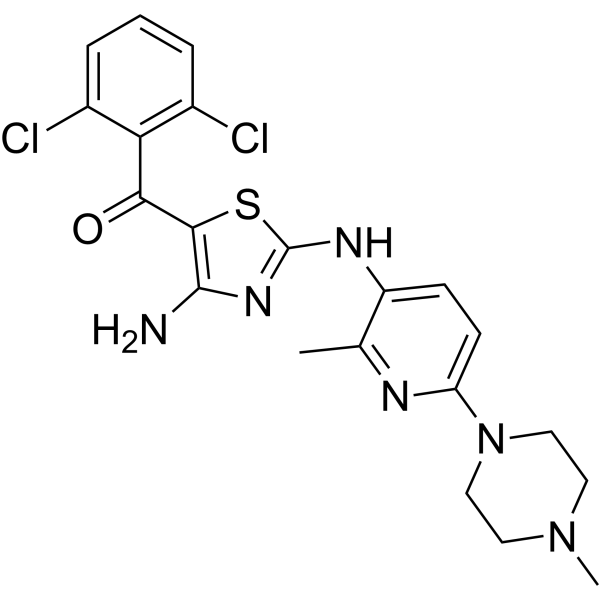
ZNL-05-044 is a CDK11 inhibitor with an IC50s of 0.23 μM and 0.27 μM against CDK11A and CDK11B, respectively (NanoBRET assay). ZNL-05-044 leads to G2/M cell cycle arrest and impairs RNA splicing .
loading...
    loading...
Cat. No.: HY-178150
CAS No.: 2803921-87-9
Target:  

Wee1

Research Areas:  

Cancer

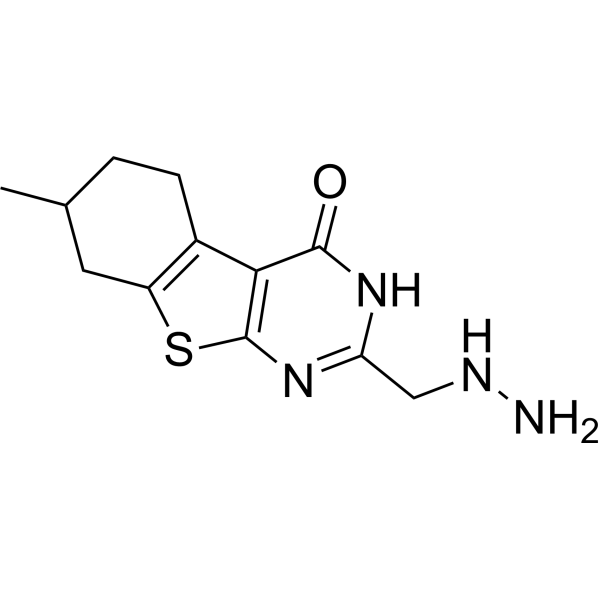
WEE1-IN-14 (Compound 14) is a selective WEE1 inhibitor (IC50: 0.5 nM in L-RB-FEP calculations, 1.0 nM in ADP-Glo kinase assay). Inhibition of Wee1 in cancer cells disrupts the G2-M checkpoint, removes the regulatory controls on the cell cycle, and leads to early onset of mitotic failure followed by apoptosis of tumor cells. Therefore, WEE1-IN-14 is a useful tool for studying cancer biology .
loading...
    loading...
Cat. No.: HY-162360
CAS No.: 3019971-97-9
Research Areas:  

Cancer

EGFR-IN-109 (compound 4) is an EGFR inhibitor, with the IC50 values of 25.8 and 182.3 nM for EGFR WT and EGFR T790M, respectively. EGFR-IN-109 arrests the cancer cells’ growth at the G2/M phase and induces both early and late apoptosis. EGFR-IN-109 can be used in cancer research .
loading...
    loading...
Cat. No.: HY-160691
CAS No.: 886599-05-9
Target:  

Aurora Kinase

Research Areas:  

Others

GW814408X is a kinase chemical genome group (KCGS) compound that inhibits the AURKC kinase involved in cell cycle progression, checkpoint regulation, and cell division. GW814408X exhibits cell line-dependent toxicity, e.g., cytotoxic effects on HeLa cells. GW814408X acts as a protein kinase inhibitor across ATP-dependent and -independent luciferases with potential implications for Fluc reporter assays .
loading...
    loading...
Cat. No.: HY-P10574
Research Areas:  

Cancer

Phosphorylated CHKtide is a synthetic peptide substrate derived from CDC25C, which is phosphorylated by CHK1/CHK2 in one of the DNA repair pathways. Phosphorylated CHKtide is used in the assays of cell cycle checkpoint kinases 1 and 2 (CHK1/CHK2) and salt-inducible kinases (SIKs) .
loading...
    loading...
Cat. No.: HY-P3904
CAS No.: 135546-44-0
Research Areas:  

Others

P34cdc2 Kinase Substrate Peptide is a synthetic peptide substrates for P34 cdc2 kinase, with a Km of 74 μM for the purified human enzyme. P34cdc2 Kinase Substrate Peptide can be used in a rapid assay of P34 cdc2 phosphorylation in vitro. P34 cdc2, a protein serinehhreonine kinase, is a cell division cycle-regulated protein kinase .
loading...
    loading...
Cat. No.: HY-L201
3,579 compounds

Cell proliferation, the increase in cell numbers resulting from cell division, is a complex and tightly regulated process. Cell proliferation is regulated by coordinated entry into the cell cycle, and changes in proliferation are closely linked to disease development. Evolutionary dynamics links tumor growth and progression with cell proliferation, cell death, and mutation rates. In addition, cell proliferation is central to degenerative diseases, the development of which is often accompanied by accelerated multiplication of cancer cells. Therefore, assays of cell proliferation levels are frequently used for laboratory research purposes and increasingly for clinical assessment of tumor aggressiveness and potentially to guide care. It has been shown that multiple key targets are collectively involved in regulating the process of cell proliferation, such as CDK, E2F, pRB, β-Catenin, and others.

MCE collects 3,579 compounds that target and regulate key targets of cell proliferation, which can be used in studies of cell proliferation mechanisms and drug discovery.

Cat. No.: HY-115569
CAS No.: 1966107-70-9
Target:  

G-quadruplex c-Myc

Research Areas:  

Cancer

DC-34 is a selective stabilizer of MYC G-quadruplexes (G4s), with measured Kd values of 9.4 μM (FIA), 1.4 μM (SPR), and 16.5 μM (NMR) across different assays. DC-34 downregulates MYC levels in cancer cells in a G4-dependent manner, reduces cell viability, and induces G0-G1 cell cycle arrest and p16-marked senescence in MYC-driven multiple myeloma cells. DC-34 can serve as a probe for G4-dependent gene regulation studies and is applicable to research on multiple myeloma .
loading...
    loading...
Cat. No.: HY-126757
CAS No.: 62462-98-0
Linichlorin A is a p27 Kip1 ubiquitination inhibitor that blocks p27 Kip1 degradation by inhibiting the Skp2-Cks1–p27 Kip1 interaction. Linichlorin A shows selective antiproliferative activity against tumor cells. Linichlorin A induces apoptosis in leukemia cells via cytochrome c release, caspase activation and PARP cleavage. Linichlorin A can be used in the study of leukemia, melanoma, cervical cancer and breast cancer .
loading...
    loading...
  • 1

