
Search Result
Results for "
covalent coupling
" in MedChemExpress (MCE) Product Catalog:
7
Biochemical Assay Reagents
| Cat. No. |
Product Name |
Target |
Research Areas |
Chemical Structure |
-
- HY-D2468
-
|
|
Fluorescent Dye
|
Others
|
|
Sulfonylurea Receptor HRP-Streptavidin is a biotin-binding signal amplifier designed to bind tightly with biotinylated anti-TSH monoclonal antibodies, thereby constituting a key component of the signal amplification system in immunoassays. HRP-Streptavidin is formed by the covalent coupling of Horseradish Peroxidase (HRP) with Streptavidin; it combines the highly efficient catalytic activity of the enzyme with the high affinity of Streptavidin for biotin, making it a potent and sensitive tool for signal amplification. HRP-Streptavidin is suitable for use in Western Blotting, ELISA, and other detection techniques .
|
-
-
- HY-130086
-
|
|
ADC Linker
|
Cancer
|
|
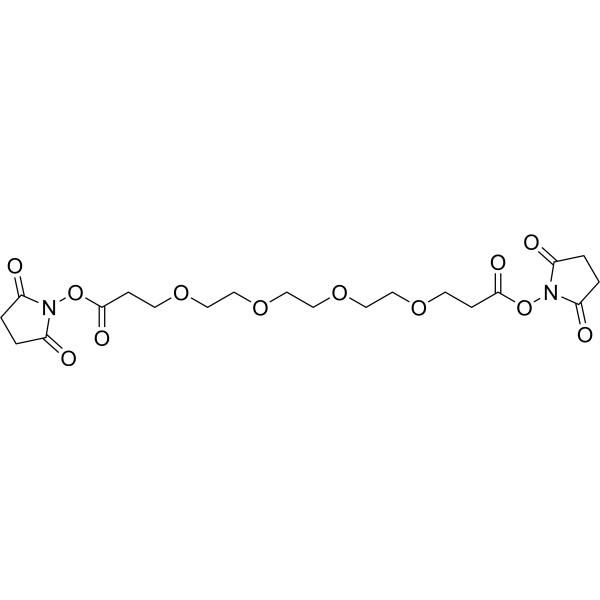
Bis-PEG4-NHS ester is a crosslinking reagent and amine-reactive modulator .Bis-PEG4-NHS ester reacts with primary amine groups on liposome surfaces via amide bond formation to covalently attach dibenzylcyclooctyne groups, with a hydrophilic PEG4 spacer reducing steric hindrance for subsequent click chemistry .Bis-PEG4-NHS ester enables site-specific antibody coupling to liposome surfaces via copper-free strain-promoted alkyne-azide cycloaddition click chemistry without disrupting liposome structure in minimal organic solvent volumes .Bis-PEG4-NHS ester undergoes hydrolysis during annealing to form -COOH groups that interact with PbI and FAI to enhance perovskite structural integrity, passivate defects, and modulate nucleation kinetics to regulate crystal growth .Bis-PEG4-NHS ester enhances device efficiency and long-term stability when used as an antisolvent additive for p-i-n perovskite solar cells .
|
-
-
- HY-D2171A
-
|
|
Fluorescent Dye
|
Others
|
|
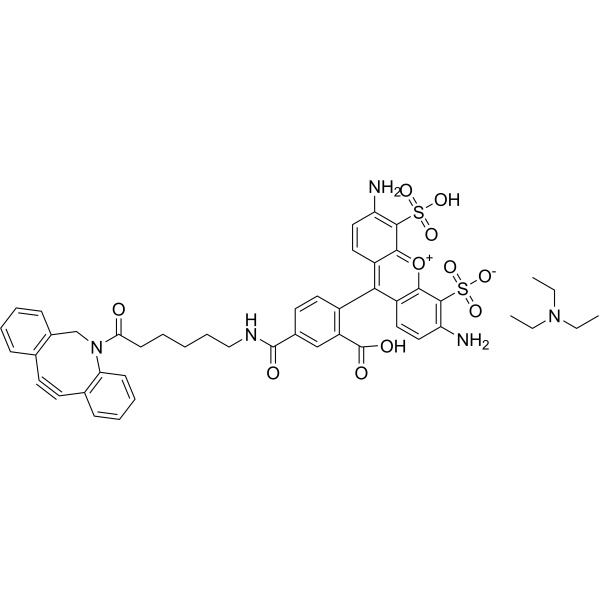
AF488 DBCO ditriethylamineis a fluorescent dye and also a click chemistry reagent that can label azide-containing biomolecules. AF488 DBCO ditriethylaminemediates the coupling reaction with azide-modified 2'-OMe RNA oligonucleotides. DBCO is a bioorthogonal partner of azides and enables covalent coupling without copper (Ex/Em = 470/520 nm) .
|
-
-
- HY-W591476
-
|
mPEG1000-SH
|
Biochemical Assay Reagents
|
Others
|
|
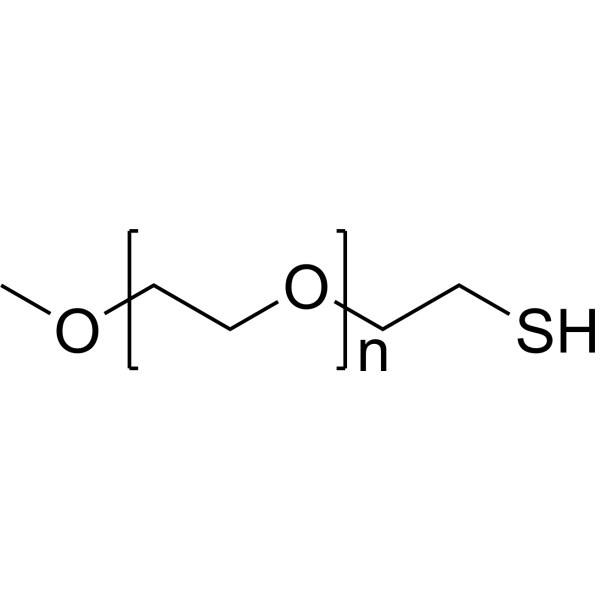
m-PEG1000-thiol is a surface modifier that can modify DNA thiolation and is used in the synthesis of gold nanorods (AuNR). m-PEG1000-thiol can load thiolated DNA onto AuNR, form a covalent bond with the surface of gold nanoparticles through the thiol group, and stabilize the nanoparticles by the steric hindrance effect of the polyethylene glycol chain, preventing aggregation and enhancing its biocompatibility. m-PEG1000-thiol can also provide a platform for the subsequent coupling of biomolecules (such as DNA, antibodies) by replacing surfactants (such as CTAB) on the surface of nanoparticles, thereby exerting its activity in promoting the functionalization of nanomaterials [2].
|
-
-
- HY-D1916
-
|
|
Fluorescent Dye
Mucin
|
Others
|
|
ATTO 594 is a Fluorescent dye (excitation/emission = 603/626 nm). ATTO 594 is covalently conjugated to Mucin via carbodiimide coupling .
|
-
-
- HY-170704
-
|
|
Liposome
|
Metabolic Disease
Cancer
|
|
DSPE-PEG2000-TCO is a click chemistry coupling partner. DSPE-PEG2000-TCO undergoes a reverse electron-demand Diels-Alder click reaction to form a covalent linkage with tetrazine-modified Cetuximab (HY-P9905). DSPE-PEG2000-TCO maintains the stability of lipid nanoparticles (LNPs) and has high mRNA encapsulation efficiency, which supports cellular uptake and mRNA transfection. DSPE-PEG2000-TCO is used to prepare EGFR-targeted and APN-targeted mRNA-loaded LNPs, mediating receptor-dependent endocytosis, mRNA delivery, and intestinal epithelial transcytosis .
|
-
-
- HY-D2171
-
|
|
Fluorescent Dye
|
Others
|
|
AF488 DBCO is a fluorescent dye and also a click chemistry reagent that can label azide-containing biomolecules. AF488 DBCO mediates the coupling reaction with azide-modified 2'-OMe RNA oligonucleotides. DBCO is a bioorthogonal partner of azides and enables covalent coupling without copper (Ex/Em = 470/520 nm) .
|
-
-
- HY-D2502
-
|
|
Fluorescent Dye
|
Others
|
|
Cy7 hydrazide is a Cy7 (HY-D0825) dye derivative with hydrazine functionality. The hydrazide group of Cy7 hydrazide can form hydrazinone coupling with molecules containing aldehydes or ketones to form covalent bonds .
|
-
-
- HY-D2956
-
|
CLIP-GLA-NHS
|
Biochemical Assay Reagents
|
Others
|
|
BC-GLA-NHS (CLIP-GLA-NHS) is a NHS-labeled CLIP tag, which is an amine-reactive crosslinker and can achieve site-specific protein labeling. The NHS ester of BC-GLA-NHS reacts with the primary amine of the target molecule (such as antibodies, quantum dots) in a pH 7.5-8.5 buffer solution to form a stable amide bond. After coupling, the BC molecule undergoes a nucleophilic substitution reaction with the active site (Cys) of the CLIP-tagged fusion protein, releasing benzylcytosine and forming an irreversible thioether bond, achieving covalent labeling. BC-GLA-NHS can be used for click chemistry labeling .
|
-
-
- HY-118112
-
|
|
Biochemical Assay Reagents
|
Others
|
|
4-N-Maleimidobenzoicacid-NHS is a PEG linker that finds utility in bioconjugation endeavors and protein labeling ventures. Specifically designed for selective reaction with thiol groups, the maleimide group establishes covalent linkages, thereby facilitating the coupling of proteins, peptides, or diverse molecules to thiol-bearing biomolecules. The NHS ester is able to react specifically and efficiently with primary amines (e.g. the side chain of lysine residues or aminosilane-coated surfaces) at neutral or slightly basic conditions to form a covalent bond.
|
-
-
- HY-D2154
-
|
|
Fluorescent Dye
|
Others
|
|
AF 430 carboxylic acid is a derivative of the yellow fluorescent dye AF 430. AF430 has an excitation wavelength of 425 nm and an emission wavelength of 542 nm. AF 430 carboxylic acid can form covalent bonds through a condensation reaction between carboxylic acid groups and molecules containing amino groups. To achieve specific coupling of dye labels and biomolecules .
|
-
-
- HY-114352
-
|
|
Fluorescent Dye
|
Others
|
|
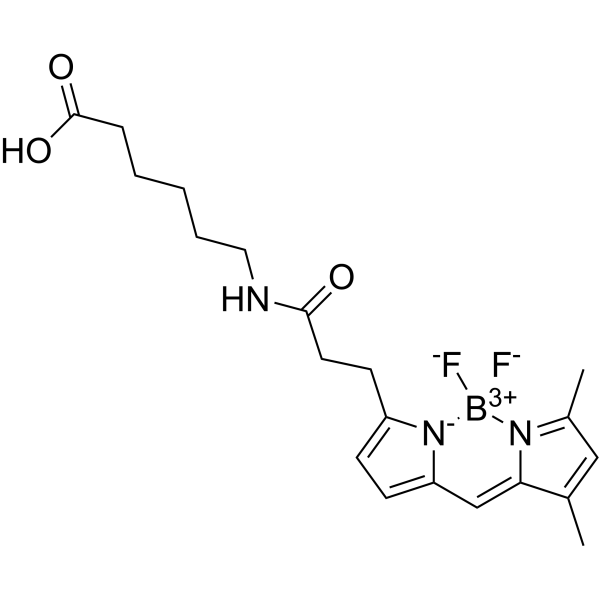
BODIPY FL-X is a green-fluorescent dye. BODIPY FL-X has the succinimidyl ester covalently coupled to proteins. BODIPY FL-X has high fluorescence quantum yield and is relatively insensitive to pH change. (λex=504 nm, λem=510 nm) .
|
-
-
- HY-D2150
-
|
|
Fluorescent Dye
|
Others
|
|
AF 430 maleimide is a derivative of the yellow fluorescent dye AF 430. AF430 has an excitation wavelength of 425 nm and an emission wavelength of 542 nm. AF 430 maleimide contains maleimide groups that react with thiol groups to form covalent bonds. To achieve specific coupling of dye labels and biomolecules .
|
-
-
- HY-W751932
-
|
|
Biochemical Assay Reagents
|
Others
|
|
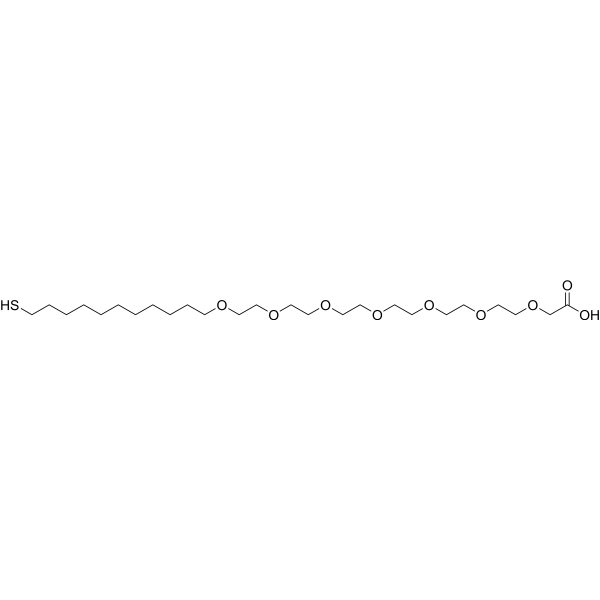
Carboxy-EG6-undecanethiol is an alkanethiol that suitable for self-assembly a gold thin-film substrate. Carboxy-EG6-undecanethiol can selectively capture HbA1c in sample by covalent coupling of 3-aminophenyl boronic acid (3-APBA) .
|
-
-
- HY-D2388
-
|
|
Fluorescent Dye
|
Others
|
|
Sulfo Cy5.5-hydrazide is a Cy5.5 (HY-D0924) dye derivative with hydrazine functionality. The hydrazide group of Sulfo Cy5.5-hydrazide can form hydrazinone coupling with molecules containing aldehydes or ketones to form covalent bonds .
|
-
-
- HY-D2163
-
|
|
Fluorescent Dye
|
Others
|
|
AF 430 amine is a derivative of the yellow fluorescent dye AF 430. AF430 has an excitation wavelength of 425 nm and an emission wavelength of 542 nm. AF 430 amine can form covalent bonds through a condensation reaction between amino groups and molecules containing carboxyl groups. To achieve specific coupling of dye labels and biomolecules .
|
-
-
- HY-P10306
-
|
|
Bacterial
|
Infection
|
|
Cys-LL37 is a biomaterial with antimicrobial properties developed by covalently fixing to the surface of titanium. Cys-LL37 uses a flexible hydrophilic polyethylene glycol spacer and selective n-terminal coupling LL37, a surface peptide layer that kills bacteria on contact is formed. Cys-LL37 can be used in research to develop new antimicrobial biomaterials .
|
-
-
- HY-174949B
-
|
FMOC-NH-PEG3400-Thiol
|
Biochemical Assay Reagents
|
Others
|
|
FMOC-NH-PEG3400-SH (FMOC-NH-PEG3400-Thiol) is a PEG derivative with an Fmoc protecting group and a thiol (-SH) reactive group. The thiol group is a highly reactive chemical group that can react specifically with a variety of molecules to form stable covalent bonds. Fmoc is a commonly used amino protecting group that protects the amino group from unwanted reactions until it is removed when a specific coupling reaction is required.
|
-
-
- HY-161910
-
|
|
Anaplastic lymphoma kinase (ALK)
|
Cancer
|
|
SH-E4A-66 is a C 2-COUPLr (COvalent Protein Ligator) with carbazole scaffold barring heterogeneous cysteine reactive warheads (acrylamide and chloroacetamide). SH-E4A-66 is capable of coupling with EML4-ALK (EC50=1.5 μM) and inhibiting the activity of EML4-ALK kinase (IC50=2.3 μM) .
|
-
-
- HY-D1861
-
|
|
Fluorescent Dye
|
Others
|
|
Sulfo-Cy3 hydrazide is a Cyanine 3 (Cy3) (HY-D0822) dye derivative with hydrazine functionality. The sulfonate ion increases the water solubility of the compound, making it suitable for use in aqueous solutions. Cy3 is a fluorescent dye with a fluorescence spectrum typically in the green to orange wavelength range. The hydrazide group of Sulfo-Cy3 hydrazide can form hydrazinone coupling with molecules containing aldehydes or ketones to form covalent bonds. Therefore, Cy3 azide plus can bind to biomolecules such as proteins and antibodies to track their location and dynamic changes in biological samples.
|
-
-
- HY-D2388A
-
|
|
Fluorescent Dye
|
Others
|
|
Sulfo Cy5.5-hydrazide sodium is a Cy5.5 (HY-D0924) dye derivative with hydrazine functionality. The hydrazide group of Sulfo Cy5.5-hydrazide sodium can form hydrazinone coupling with molecules containing aldehydes or ketones to form covalent bonds .
|
-
-
- HY-D3049
-
|
|
Fluorescent Dye
|
Others
|
|
5(6)-carbonylated rhodamine 110 NHS ester is a reactive ester fluorescent reagent based on 5(6)-carbonylated rhodamine 110. NHS ester is a highly reactive ester capable of covalently coupling with primary amine groups in molecules such as proteins, peptides, amino sugars, and nucleic acids to form stable amide bonds (Ex/Em = 502/527 nm).
|
-
-
- HY-D3050
-
|
|
Fluorescent Dye
|
Others
|
|
5(6)-carbonylated rhodamine 110 X NHS ester is a reactive ester fluorescent reagent based on 5(6)-carbonylated rhodamine 110 X. NHS ester is a highly reactive ester capable of covalently coupling with primary amine groups in molecules such as proteins, peptides, amino sugars, and nucleic acids to form stable amide bonds (Ex/Em = 496/522 nm).
|
-
-
- HY-D3053
-
|
|
Fluorescent Dye
|
Others
|
|
5(6)-Rhodamine 6G NHS ester is a reactive ester fluorescent reagent based on Rhodamine 6G (HY-D0309). NHS ester is a highly reactive ester capable of covalently coupling with primary amine groups in molecules such as proteins, peptides, amino sugars, and nucleic acids to form stable amide bonds (Ex/Em = 526/547 nm).
|
-
-
- HY-P5423D
-
|
|
Exosomes
|
Others
|
|
Ahx-GALA-Cys is a GALA peptide (HY-P5423) derivative with an N-terminal 6-aminohexanoic acid (Ahx) linker and a C-terminal cysteine residue. Ahx-GALA-Cys possesses strong covalent coupling capacity, which can be used to conjugate fluorophores and targeting ligands for investigating the surface functionalization of small extracellular vesicles (sEV) and lysosomal escape .
|
-
-
- HY-174949C
-
|
FMOC-NH-PEG5000-Thiol
|
Biochemical Assay Reagents
|
Others
|
|
FMOC-NH-PEG5000-SH (FMOC-NH-PEG5000-Thiol) is a PEG derivative with an Fmoc protecting group and a thiol (-SH) reactive group. The thiol group is a highly reactive chemical group that can react specifically with a variety of molecules to form stable covalent bonds. Fmoc is a commonly used amino protecting group that protects the amino group from unwanted reactions until it is removed when a specific coupling reaction is required.
|
-
-
- HY-174949D
-
|
FMOC-NH-PEG10000-Thiol
|
Biochemical Assay Reagents
|
Others
|
|
FMOC-NH-PEG10000-SH (FMOC-NH-PEG10000-Thiol) is a PEG derivative with an Fmoc protecting group and a thiol (-SH) reactive group. The thiol group is a highly reactive chemical group that can react specifically with a variety of molecules to form stable covalent bonds. Fmoc is a commonly used amino protecting group that protects the amino group from unwanted reactions until it is removed when a specific coupling reaction is required.
|
-
-
- HY-174949
-
|
FMOC-NH-PEG1000-Thiol
|
Biochemical Assay Reagents
|
Others
|
|
FMOC-NH-PEG1000-SH (FMOC-NH-PEG1000-Thiol) is a PEG derivative with an Fmoc protecting group and a thiol (-SH) reactive group. The thiol group is a highly reactive chemical group that can react specifically with a variety of molecules to form stable covalent bonds. Fmoc is a commonly used amino protecting group that protects the amino group from unwanted reactions until it is removed when a specific coupling reaction is required.
|
-
-
- HY-174949A
-
|
FMOC-NH-PEG2000-Thiol
|
Biochemical Assay Reagents
|
Others
|
|
FMOC-NH-PEG2000-SH (FMOC-NH-PEG2000-Thiol) is a PEG derivative with an Fmoc protecting group and a thiol (-SH) reactive group. The thiol group is a highly reactive chemical group that can react specifically with a variety of molecules to form stable covalent bonds. Fmoc is a commonly used amino protecting group that protects the amino group from unwanted reactions until it is removed when a specific coupling reaction is required.
|
-
| Cat. No. |
Product Name |
Type |
-
- HY-D2468
-
|
|
Fluorescent Dyes
|
|
Sulfonylurea Receptor HRP-Streptavidin is a biotin-binding signal amplifier designed to bind tightly with biotinylated anti-TSH monoclonal antibodies, thereby constituting a key component of the signal amplification system in immunoassays. HRP-Streptavidin is formed by the covalent coupling of Horseradish Peroxidase (HRP) with Streptavidin; it combines the highly efficient catalytic activity of the enzyme with the high affinity of Streptavidin for biotin, making it a potent and sensitive tool for signal amplification. HRP-Streptavidin is suitable for use in Western Blotting, ELISA, and other detection techniques .
|
-
- HY-D2171A
-
|
|
Fluorescent Dyes
|
|
AF488 DBCO ditriethylamineis a fluorescent dye and also a click chemistry reagent that can label azide-containing biomolecules. AF488 DBCO ditriethylaminemediates the coupling reaction with azide-modified 2'-OMe RNA oligonucleotides. DBCO is a bioorthogonal partner of azides and enables covalent coupling without copper (Ex/Em = 470/520 nm) .
|
-
- HY-D1916
-
|
|
Fluorescent Dyes
|
|
ATTO 594 is a Fluorescent dye (excitation/emission = 603/626 nm). ATTO 594 is covalently conjugated to Mucin via carbodiimide coupling .
|
-
- HY-D2171
-
|
|
Fluorescent Dyes
|
|
AF488 DBCO is a fluorescent dye and also a click chemistry reagent that can label azide-containing biomolecules. AF488 DBCO mediates the coupling reaction with azide-modified 2'-OMe RNA oligonucleotides. DBCO is a bioorthogonal partner of azides and enables covalent coupling without copper (Ex/Em = 470/520 nm) .
|
-
- HY-D2502
-
|
|
Fluorescent Dyes
|
|
Cy7 hydrazide is a Cy7 (HY-D0825) dye derivative with hydrazine functionality. The hydrazide group of Cy7 hydrazide can form hydrazinone coupling with molecules containing aldehydes or ketones to form covalent bonds .
|
-
- HY-D2956
-
|
CLIP-GLA-NHS
|
Fluorescent Dyes
|
|
BC-GLA-NHS (CLIP-GLA-NHS) is a NHS-labeled CLIP tag, which is an amine-reactive crosslinker and can achieve site-specific protein labeling. The NHS ester of BC-GLA-NHS reacts with the primary amine of the target molecule (such as antibodies, quantum dots) in a pH 7.5-8.5 buffer solution to form a stable amide bond. After coupling, the BC molecule undergoes a nucleophilic substitution reaction with the active site (Cys) of the CLIP-tagged fusion protein, releasing benzylcytosine and forming an irreversible thioether bond, achieving covalent labeling. BC-GLA-NHS can be used for click chemistry labeling .
|
-
- HY-D2154
-
|
|
Fluorescent Dyes
|
|
AF 430 carboxylic acid is a derivative of the yellow fluorescent dye AF 430. AF430 has an excitation wavelength of 425 nm and an emission wavelength of 542 nm. AF 430 carboxylic acid can form covalent bonds through a condensation reaction between carboxylic acid groups and molecules containing amino groups. To achieve specific coupling of dye labels and biomolecules .
|
-
- HY-114352
-
|
|
Fluorescent Dyes
|
|
BODIPY FL-X is a green-fluorescent dye. BODIPY FL-X has the succinimidyl ester covalently coupled to proteins. BODIPY FL-X has high fluorescence quantum yield and is relatively insensitive to pH change. (λex=504 nm, λem=510 nm) .
|
-
- HY-D2150
-
|
|
Fluorescent Dyes
|
|
AF 430 maleimide is a derivative of the yellow fluorescent dye AF 430. AF430 has an excitation wavelength of 425 nm and an emission wavelength of 542 nm. AF 430 maleimide contains maleimide groups that react with thiol groups to form covalent bonds. To achieve specific coupling of dye labels and biomolecules .
|
-
- HY-D2388
-
|
|
Fluorescent Dyes
|
|
Sulfo Cy5.5-hydrazide is a Cy5.5 (HY-D0924) dye derivative with hydrazine functionality. The hydrazide group of Sulfo Cy5.5-hydrazide can form hydrazinone coupling with molecules containing aldehydes or ketones to form covalent bonds .
|
-
- HY-D2163
-
|
|
Fluorescent Dyes
|
|
AF 430 amine is a derivative of the yellow fluorescent dye AF 430. AF430 has an excitation wavelength of 425 nm and an emission wavelength of 542 nm. AF 430 amine can form covalent bonds through a condensation reaction between amino groups and molecules containing carboxyl groups. To achieve specific coupling of dye labels and biomolecules .
|
-
- HY-D1861
-
|
|
Fluorescent Dyes
|
|
Sulfo-Cy3 hydrazide is a Cyanine 3 (Cy3) (HY-D0822) dye derivative with hydrazine functionality. The sulfonate ion increases the water solubility of the compound, making it suitable for use in aqueous solutions. Cy3 is a fluorescent dye with a fluorescence spectrum typically in the green to orange wavelength range. The hydrazide group of Sulfo-Cy3 hydrazide can form hydrazinone coupling with molecules containing aldehydes or ketones to form covalent bonds. Therefore, Cy3 azide plus can bind to biomolecules such as proteins and antibodies to track their location and dynamic changes in biological samples.
|
-
- HY-D2388A
-
|
|
Fluorescent Dyes
|
|
Sulfo Cy5.5-hydrazide sodium is a Cy5.5 (HY-D0924) dye derivative with hydrazine functionality. The hydrazide group of Sulfo Cy5.5-hydrazide sodium can form hydrazinone coupling with molecules containing aldehydes or ketones to form covalent bonds .
|
-
- HY-D3049
-
|
|
Fluorescent Dyes
|
|
5(6)-carbonylated rhodamine 110 NHS ester is a reactive ester fluorescent reagent based on 5(6)-carbonylated rhodamine 110. NHS ester is a highly reactive ester capable of covalently coupling with primary amine groups in molecules such as proteins, peptides, amino sugars, and nucleic acids to form stable amide bonds (Ex/Em = 502/527 nm).
|
-
- HY-D3050
-
|
|
Fluorescent Dyes
|
|
5(6)-carbonylated rhodamine 110 X NHS ester is a reactive ester fluorescent reagent based on 5(6)-carbonylated rhodamine 110 X. NHS ester is a highly reactive ester capable of covalently coupling with primary amine groups in molecules such as proteins, peptides, amino sugars, and nucleic acids to form stable amide bonds (Ex/Em = 496/522 nm).
|
-
- HY-D3053
-
|
|
Fluorescent Dyes
|
|
5(6)-Rhodamine 6G NHS ester is a reactive ester fluorescent reagent based on Rhodamine 6G (HY-D0309). NHS ester is a highly reactive ester capable of covalently coupling with primary amine groups in molecules such as proteins, peptides, amino sugars, and nucleic acids to form stable amide bonds (Ex/Em = 526/547 nm).
|
| Cat. No. |
Product Name |
Type |
-
- HY-W591476
-
|
mPEG1000-SH
|
Biochemical Assay Reagents
|
|
m-PEG1000-thiol is a surface modifier that can modify DNA thiolation and is used in the synthesis of gold nanorods (AuNR). m-PEG1000-thiol can load thiolated DNA onto AuNR, form a covalent bond with the surface of gold nanoparticles through the thiol group, and stabilize the nanoparticles by the steric hindrance effect of the polyethylene glycol chain, preventing aggregation and enhancing its biocompatibility. m-PEG1000-thiol can also provide a platform for the subsequent coupling of biomolecules (such as DNA, antibodies) by replacing surfactants (such as CTAB) on the surface of nanoparticles, thereby exerting its activity in promoting the functionalization of nanomaterials [2].
|
-
- HY-W751932
-
|
|
Biochemical Assay Reagents
|
|
Carboxy-EG6-undecanethiol is an alkanethiol that suitable for self-assembly a gold thin-film substrate. Carboxy-EG6-undecanethiol can selectively capture HbA1c in sample by covalent coupling of 3-aminophenyl boronic acid (3-APBA) .
|
-
- HY-174949B
-
|
FMOC-NH-PEG3400-Thiol
|
Biochemical Assay Reagents
|
|
FMOC-NH-PEG3400-SH (FMOC-NH-PEG3400-Thiol) is a PEG derivative with an Fmoc protecting group and a thiol (-SH) reactive group. The thiol group is a highly reactive chemical group that can react specifically with a variety of molecules to form stable covalent bonds. Fmoc is a commonly used amino protecting group that protects the amino group from unwanted reactions until it is removed when a specific coupling reaction is required.
|
-
- HY-174949C
-
|
FMOC-NH-PEG5000-Thiol
|
Biochemical Assay Reagents
|
|
FMOC-NH-PEG5000-SH (FMOC-NH-PEG5000-Thiol) is a PEG derivative with an Fmoc protecting group and a thiol (-SH) reactive group. The thiol group is a highly reactive chemical group that can react specifically with a variety of molecules to form stable covalent bonds. Fmoc is a commonly used amino protecting group that protects the amino group from unwanted reactions until it is removed when a specific coupling reaction is required.
|
-
- HY-174949D
-
|
FMOC-NH-PEG10000-Thiol
|
Biochemical Assay Reagents
|
|
FMOC-NH-PEG10000-SH (FMOC-NH-PEG10000-Thiol) is a PEG derivative with an Fmoc protecting group and a thiol (-SH) reactive group. The thiol group is a highly reactive chemical group that can react specifically with a variety of molecules to form stable covalent bonds. Fmoc is a commonly used amino protecting group that protects the amino group from unwanted reactions until it is removed when a specific coupling reaction is required.
|
-
- HY-174949
-
|
FMOC-NH-PEG1000-Thiol
|
Biochemical Assay Reagents
|
|
FMOC-NH-PEG1000-SH (FMOC-NH-PEG1000-Thiol) is a PEG derivative with an Fmoc protecting group and a thiol (-SH) reactive group. The thiol group is a highly reactive chemical group that can react specifically with a variety of molecules to form stable covalent bonds. Fmoc is a commonly used amino protecting group that protects the amino group from unwanted reactions until it is removed when a specific coupling reaction is required.
|
-
- HY-174949A
-
|
FMOC-NH-PEG2000-Thiol
|
Biochemical Assay Reagents
|
|
FMOC-NH-PEG2000-SH (FMOC-NH-PEG2000-Thiol) is a PEG derivative with an Fmoc protecting group and a thiol (-SH) reactive group. The thiol group is a highly reactive chemical group that can react specifically with a variety of molecules to form stable covalent bonds. Fmoc is a commonly used amino protecting group that protects the amino group from unwanted reactions until it is removed when a specific coupling reaction is required.
|
| Cat. No. |
Product Name |
Target |
Research Area |
-
- HY-P10306
-
|
|
Bacterial
|
Infection
|
|
Cys-LL37 is a biomaterial with antimicrobial properties developed by covalently fixing to the surface of titanium. Cys-LL37 uses a flexible hydrophilic polyethylene glycol spacer and selective n-terminal coupling LL37, a surface peptide layer that kills bacteria on contact is formed. Cys-LL37 can be used in research to develop new antimicrobial biomaterials .
|
-
- HY-P5423D
-
|
|
Exosomes
|
Others
|
|
Ahx-GALA-Cys is a GALA peptide (HY-P5423) derivative with an N-terminal 6-aminohexanoic acid (Ahx) linker and a C-terminal cysteine residue. Ahx-GALA-Cys possesses strong covalent coupling capacity, which can be used to conjugate fluorophores and targeting ligands for investigating the surface functionalization of small extracellular vesicles (sEV) and lysosomal escape .
|
-
- HY-K0264
-
|
|
|
MCE Butyl Agarose 4FF is a hydrophobic chromatography medium formed by covalently coupling butyl ligands to agarose. It is suitable for both laboratory use and large-scale industrial purification.
|
-
- HY-K0266
-
|
|
|
MCE Octyl Agarose 6FF is a hydrophobic chromatography medium formed by covalently coupling butyl ligands to agarose. It is suitable for both laboratory use and large-scale industrial purification.
|
-
- HY-K0270
-
|
|
|
MCE Phenyl Agarose HP is a high-resolution hydrophobic chromatography medium formed by covalently coupling phenyl ligands to agarose. It is suitable for laboratory-scale and industrial-scale purification of biomolecules.
|
-
- HY-K0265
-
|
|
|
MCE Butyl Agarose HP is a high-resolution hydrophobic chromatography medium formed by covalently coupling butyl ligands to agarose. It is suitable for both laboratory use and large-scale industrial purification.
|
-
- HY-K0267
-
|
|
|
MCE Octyl Agarose HP is a high-resolution hydrophobic chromatography medium formed by covalently coupling octyl ligands to agarose. It is suitable for both laboratory use and large-scale industrial purification.
|
-
- HY-K0257
-
|
|
|
MCE CM Agarose 6FF is a weak cation exchanger formed by covalently coupling carboxymethyl (CM) groups to agarose microspheres. It is suitable for both laboratory research and large-scale industrial purification processes.
|
-
- HY-K0258
-
|
|
|
MCE SP Agarose 6FF is a strong cation exchanger formed by covalently coupling sulfopropyl (SP) groups to agarose microspheres. It is suitable for both laboratory research and large-scale industrial purification processes.
|
-
- HY-K0259
-
|
|
|
MCE DEAE Agarose 6FF is a weak cation exchanger formed by covalently coupling diethylaminoethyl (DEAE) groups to agarose microspheres. It is suitable for both laboratory research and large-scale industrial purification processes.
|
-
- HY-K0260
-
|
|
|
MCE Q Agarose 6FF is a strong cation exchanger formed by covalently coupling quarternary ammonium (Q) groups to agarose. It is suitable for both laboratory research and large-scale industrial purification processes.
|
-
- HY-K0268
-
|
|
|
MCE Phenyl Agarose (Low Sub) 6FF is a low-substitution hydrophobic chromatography medium formed by covalently coupling phenyl ligands to agarose. It is suitable for laboratory-scale and industrial-scale purification of biomolecules with relatively weak hydrophobicity.
|
-
- HY-K0269
-
|
|
|
MCE Phenyl Agarose (High Sub) 6FF is a high-substitution hydrophobic chromatography medium formed by covalently coupling phenyl ligands to agarose. It is suitable for laboratory-scale and industrial-scale purification of biomolecules with relatively weak hydrophobicity.
|
-
- HY-K0252
-
|
|
|
MCE MBP Agarose (Dextrin) 6FF is prepared by covalently coupling dextrin to an agarose matrix. It features high binding capacity, excellent specificity, and superior ligand stability. It can achieve one-step purification of MBP fusion protein.
|
-
- HY-K0261
-
|
|
|
MCE SP Agarose HP is a high-resolution strong cation exchanger formed by covalently coupling sulfopropyl (SP) groups to agarose. This medium offers high binding capacity, high specificity, and excellent ligand stability, making it suitable for both laboratory-scale and large-scale industrial purification applications.
|
-
- HY-K0262
-
|
|
|
MCE DEAE Agarose HP is a high-resolution weak anion exchanger formed by covalently coupling diethylaminoethyl (DEAE) groups to agarose. This medium offers high binding capacity, high specificity, and excellent ligand stability, making it suitable for both laboratory-scale and large-scale industrial purification applications.
|
-
- HY-K0263
-
|
|
|
MCE Q Agarose HP is a high-resolution strong anion exchanger formed by covalently coupling quaternary ammonium (Q) groups to agarose. This medium offers high binding capacity, high specificity, and excellent ligand stability, making it suitable for both laboratory-scale and large-scale industrial purification applications.
|
-
- HY-K0255
-
|
|
|
MCE IMAC Agarose (NTA) 6FF is prepared by covalently coupling tetradentate nitrilotriacetic acid (NTA) to an agarose matrix. It features high binding capacity, excellent specificity, and superior ligand stability. The resin allows flexible chelation with metal ions such as Zn2+, Ni2+, or Cu2+, and is suitable for the purification of His-tagged recombinant proteins expressed in bacterial, mammalian, insect, and baculovirus systems.
|
| Cat. No. |
Product Name |
|
Classification |
-
- HY-D2171A
-
|
|
|
DBCO
|
|
AF488 DBCO ditriethylamineis a fluorescent dye and also a click chemistry reagent that can label azide-containing biomolecules. AF488 DBCO ditriethylaminemediates the coupling reaction with azide-modified 2'-OMe RNA oligonucleotides. DBCO is a bioorthogonal partner of azides and enables covalent coupling without copper (Ex/Em = 470/520 nm) .
|
-
- HY-D2171
-
|
|
|
DBCO
|
|
AF488 DBCO is a fluorescent dye and also a click chemistry reagent that can label azide-containing biomolecules. AF488 DBCO mediates the coupling reaction with azide-modified 2'-OMe RNA oligonucleotides. DBCO is a bioorthogonal partner of azides and enables covalent coupling without copper (Ex/Em = 470/520 nm) .
|
| Cat. No. |
Product Name |
|
Classification |
-
- HY-W591476
-
|
mPEG1000-SH
|
|
Polymers
|
|
m-PEG1000-thiol is a surface modifier that can modify DNA thiolation and is used in the synthesis of gold nanorods (AuNR). m-PEG1000-thiol can load thiolated DNA onto AuNR, form a covalent bond with the surface of gold nanoparticles through the thiol group, and stabilize the nanoparticles by the steric hindrance effect of the polyethylene glycol chain, preventing aggregation and enhancing its biocompatibility. m-PEG1000-thiol can also provide a platform for the subsequent coupling of biomolecules (such as DNA, antibodies) by replacing surfactants (such as CTAB) on the surface of nanoparticles, thereby exerting its activity in promoting the functionalization of nanomaterials [2].
|
Your information is safe with us. * Required Fields.
Inquiry Information
- Product Name:
- Cat. No.:
- Quantity:
- MCE Japan Authorized Agent:

