



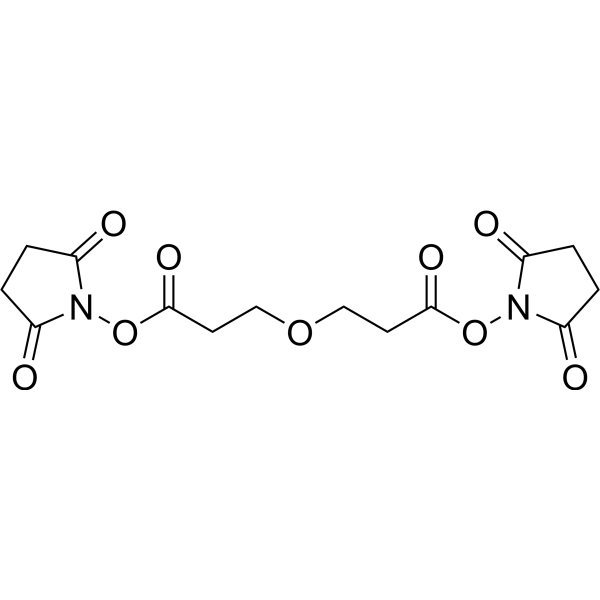
Bis-PEG4-NHS ester

Based on 1 Customer Validation
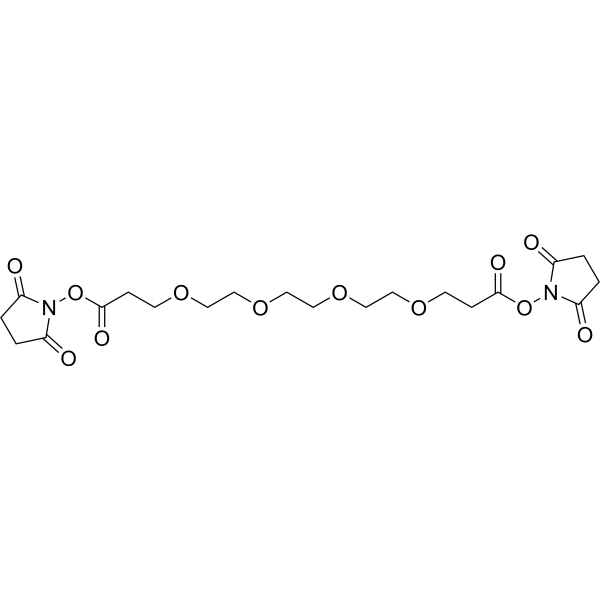
Bis-PEG4-NHS ester is a crosslinking reagent and amine-reactive modulator.Bis-PEG4-NHS ester reacts with primary amine groups on liposome surfaces via amide bond formation to covalently attach dibenzylcyclooctyne groups, with a hydrophilic PEG4 spacer reducing steric hindrance for subsequent click chemistry.Bis-PEG4-NHS ester enables site-specific antibody coupling to liposome surfaces via copper-free strain-promoted alkyne-azide cycloaddition click chemistry without disrupting liposome structure in minimal organic solvent volumes.Bis-PEG4-NHS ester undergoes hydrolysis during annealing to form -COOH groups that interact with PbI and FAI to enhance perovskite structural integrity, passivate defects, and modulate nucleation kinetics to regulate crystal growth.Bis-PEG4-NHS ester enhances device efficiency and long-term stability when used as an antisolvent additive for p-i-n perovskite solar cells.
For research use only. We do not sell to patients.
- Purity : 97.0%
- CAS No.: 1314378-11-4
- Formula: C20H28N2O12
- Molecular Weight:488.44
-
Storage:Powder -20°C, 3 years ; In solvent -80°C, 6 months , -20°C, 1 month

To place orders, for customer services and technical support, please contact: MedChemExpress USA
Tel: 609-228-6898 E-mail: [email protected] [email protected]


-
 Biological Activity
-
Chemical Information
-
Solvent & Solubility
- Protocols
- Purity & Documentation
- References
-
 Help & FAQs


-
HY-126889
Bis-PEG5-NHS esterADC/PROTAC Linker -
HY-130087
Bis-PEG3-NHS esterPROTAC Linker -
HY-130088
Bis-PEG2-NHS esterADC Linker -
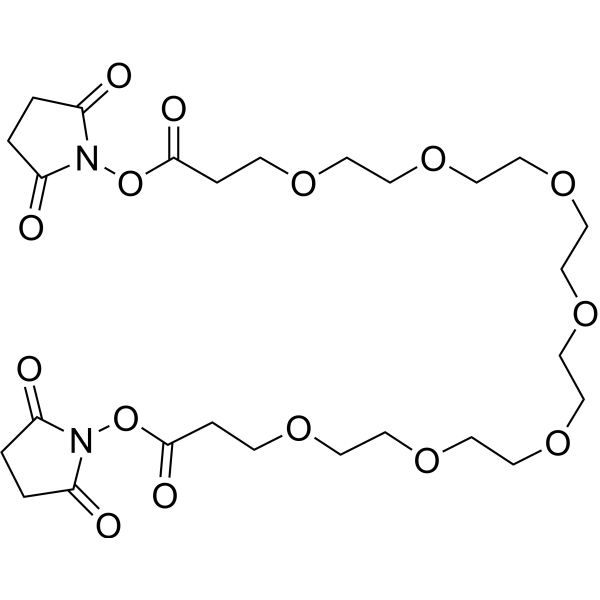
HY-126890
Bis-PEG7-NHS esterADC/PROTAC Linker -
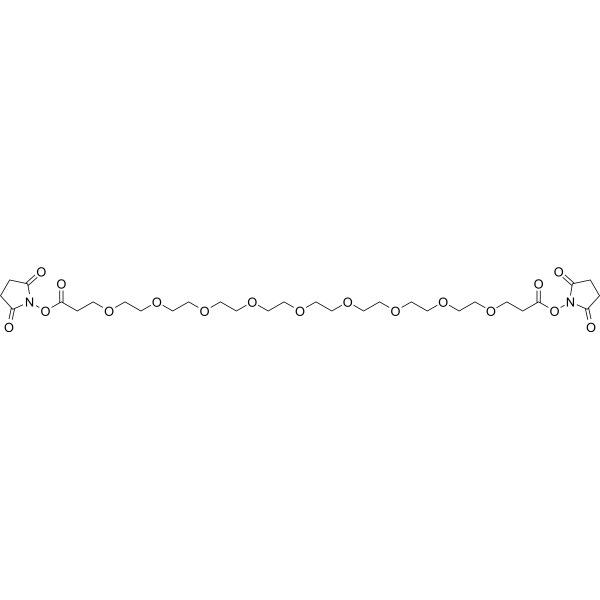
HY-117009
Bis-PEG9-NHS esterADC/PROTAC Linker -
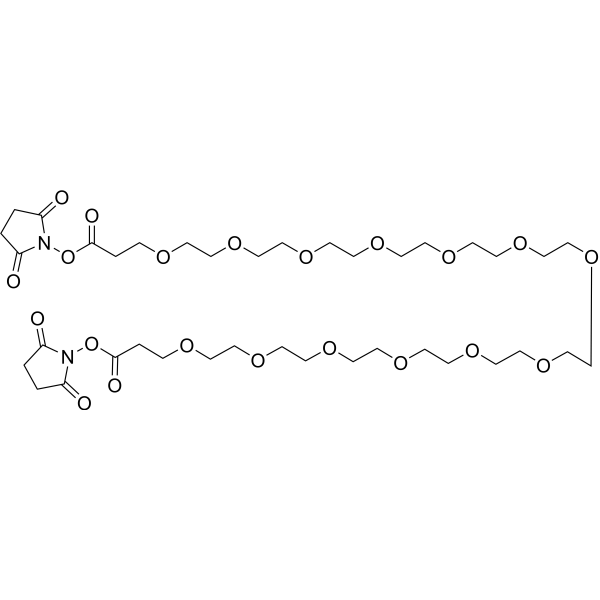
HY-130825
Bis-PEG13-NHS esterADC/PROTAC Linker -
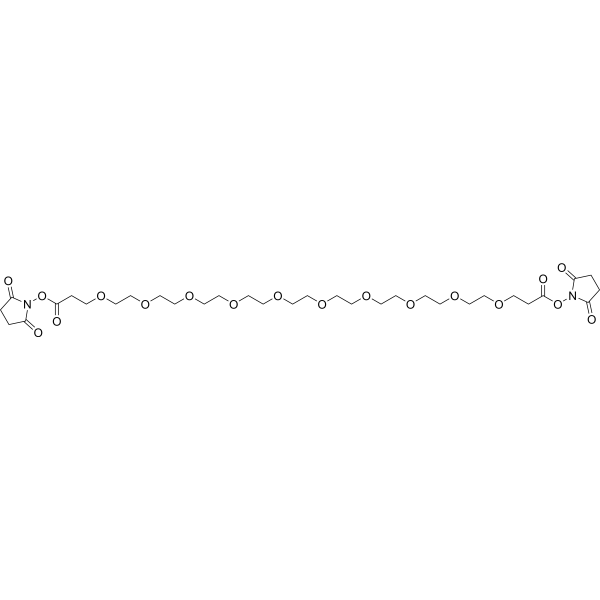
HY-130824
Bis-PEG10-NHS esterADC/PROTAC Linker -
HY-130089
Bis-PEG1-NHS esterADC Linker


Biological Activity
Description
IC50 & Target
|
Non-cleavable Linker |
In Vitro
Bis-PEG4-NHS ester can be used for the preparation of highly efficient and stable p-i-n perovskite solar cells, acting as an anti-solvent additive to regulate crystallization kinetics and passivate defects. When Bis-PEG4-NHS ester is added to the anti-solvent as a carboxyl precursor, irreversible hydrolysis occurs during the annealing process of the perovskite film, enabling in-situ conversion of functional groups[2].
MedChemExpress (MCE) has not independently confirmed the accuracy of these methods. They are for reference only. Further protocols information, click here.


Chemical Information
-
CAS No. 1314378-11-4
-
Appearance Solid
-
Molecular Weight 488.44
-
Formula C20H28N2O12
-
Color White to off-white
-
SMILES
O=C(ON1C(CCC1=O)=O)CCOCCOCCOCCOCCC(ON2C(CCC2=O)=O)=O
-
Shipping
Room temperature in continental US; may vary elsewhere.
-
Storage
Powder -20°C 3 years In solvent -80°C 6 months -20°C 1 month


Solvent & Solubility
In Vitro:
DMSO : 66.67 mg/mL (136.50 mM; Need ultrasonic; Hygroscopic DMSO has a significant impact on the solubility of product, please use newly opened DMSO)
Please refer to the solubility information to select the appropriate solvent. Once prepared, please aliquot and store the solution to prevent product inactivation from repeated freeze-thaw cycles.
Storage method and period of stock solution: -80°C, 6 months; -20°C, 1 month. When stored at -80°C, please use it within 6 months. When stored at -20°C, please use it within 1 month.
Please refer to the solubility information to select the appropriate solvent. Once prepared, please aliquot and store the solution to prevent product inactivation from repeated freeze-thaw cycles.
Storage method and period of stock solution: -80°C, 6 months; -20°C, 1 month. When stored at -80°C, please use it within 6 months. When stored at -20°C, please use it within 1 month.
Concentration (start) × Volume (start) = Concentration (final) × Volume (final)

Protocols
-
EdU Incorporation Assay (Click Chemistry-Based DNA Synthesis Measurement)
The EdU incorporation assay measures DNA synthesis by adding the thymidine analog 5-ethynyl-2′-deoxyuridine to cells or tissues, where it is incorporated into newly synthesized DNA during S phase. Incorporated EdU is detected by copper-catalyzed azide-alkyne cycloaddition, in which a fluorescent azide covalently reacts with the ethynyl group on EdU, allowing S-phase cells to be detected by fluorescence microscopy, flow cytometry, or high-content imaging. EdU detection does not require DNA denaturation or anti-BrdU antibody access, which preserves sample structure and improves compatibility with immunostaining and multiparameter cytometry compared with BrdU-based detection. EdU can be cytotoxic in a cell-type- and exposure-dependent manner, so pulse duration, concentration, and continuous-labeling designs should be validated for each cell type.


Purity & Documentation
-
Data Sheet (269 KB)
-
SDS (394 KB)
- English - EN (394 KB)
- Français - FR (394 KB)
- Deutsch - DE (394 KB)
- Norwegian - NO (394 KB)
- Español - ES (394 KB)
- Swedish - SV (394 KB)
- Italian - IT (394 KB)
- Korean - KR (394 KB)
- Portuguese - PT (394 KB)
-
Handling Instructions (2659 KB)
References


Complete Stock Solution Preparation Table
Please refer to the solubility information to select the appropriate solvent. Once prepared, please aliquot and store the solution to prevent product inactivation from repeated freeze-thaw cycles.
Storage method and period of stock solution: -80°C, 6 months; -20°C, 1 month. When stored at -80°C, please use it within 6 months. When stored at -20°C, please use it within 1 month.
| Optional Solvent | Concentration Solvent Mass | 1 mg | 5 mg | 10 mg | 25 mg |
|---|---|---|---|---|---|
| DMSO | 1 mM | 2.0473 mL | 10.2367 mL | 20.4733 mL | 51.1834 mL |
| 5 mM | 0.4095 mL | 2.0473 mL | 4.0947 mL | 10.2367 mL | |
| 10 mM | 0.2047 mL | 1.0237 mL | 2.0473 mL | 5.1183 mL | |
| 15 mM | 0.1365 mL | 0.6824 mL | 1.3649 mL | 3.4122 mL | |
| 20 mM | 0.1024 mL | 0.5118 mL | 1.0237 mL | 2.5592 mL | |
| 25 mM | 0.0819 mL | 0.4095 mL | 0.8189 mL | 2.0473 mL | |
| 30 mM | 0.0682 mL | 0.3412 mL | 0.6824 mL | 1.7061 mL | |
| 40 mM | 0.0512 mL | 0.2559 mL | 0.5118 mL | 1.2796 mL | |
| 50 mM | 0.0409 mL | 0.2047 mL | 0.4095 mL | 1.0237 mL | |
| 60 mM | 0.0341 mL | 0.1706 mL | 0.3412 mL | 0.8531 mL | |
| 80 mM | 0.0256 mL | 0.1280 mL | 0.2559 mL | 0.6398 mL | |
| 100 mM | 0.0205 mL | 0.1024 mL | 0.2047 mL | 0.5118 mL |


Bis-PEG4-NHS ester Related Classifications
HY-130086 Related Classifications
 Powered by Bioz
Keywords
- Bis-PEG4-NHS ester
- 1314378-11-4
- ADC Linkers
- liposome surfaces
- primary amine groups
- PbI 2
- FAI 0 . 90 MA 0 . 05 Cs 0 . 05 PbI 3
- perovskite
- copper-free strain-promoted alkyne-azide cycloaddition click chemistry
- amide bond formation
- cubic perovskite
- p?i?n perovskite solar cells
- dibenzylcyclooctyne groups
- Inhibitor
- inhibitor
- inhibit