



2,5-Dioxopyrrolidin-1-yl acrylate

Based on 1 Customer Validation
2,5-Dioxopyrrolidin-1-yl acrylate (N-Succinimidyl acrylate) is a lysine residue modifier and coupling monomer. 2,5-Dioxopyrrolidin-1-yl acrylate covalently modifies the primary amines of lysine residues on monoclonal anti-horseradish peroxidase IgG antibodies, neutralizes positive charges and replaces them with low-affinity acrylate groups. 2,5-Dioxopyrrolidin-1-yl acrylate inhibits the formation of rapid hard coronas on citrate-coated gold nanoparticles, induces antibody unfolding and loss of antigen-binding function, but does not affect the antigen-binding function of antibodies in free solution. 2,5-Dioxopyrrolidin-1-yl acrylate reacts with the ε-amino groups on lysine residues of L-asparaginase, introduces vinyl groups and generates N-hydroxysuccinimide. 2,5-Dioxopyrrolidin-1-yl acrylate regulates the activity of L-asparaginase.
For research use only. We do not sell to patients.
- Purity : 99.81%
- CAS No.: 38862-24-7
- Formula: C7H7NO4
- Molecular Weight:169.13
-
Storage:
-20°C, stored under nitrogen, away from moisture
* In solvent : -80°C, 6 months; -20°C, 1 month (stored under nitrogen, away from moisture)

To place orders, for customer services and technical support, please contact: MedChemExpress USA
Tel: 609-228-6898 E-mail: [email protected] [email protected]


-
 Biological Activity
-
Chemical Information
-
Solvent & Solubility
- Purity & Documentation
- References
-
 Help & FAQs


-
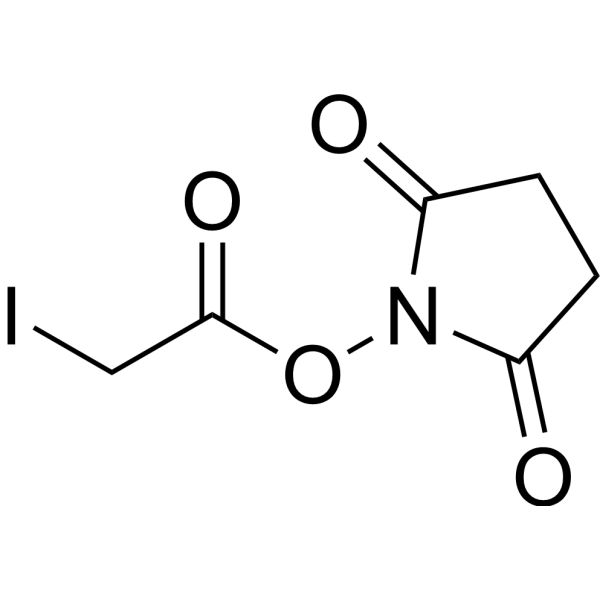
HY-W011541
SIA Crosslinker -
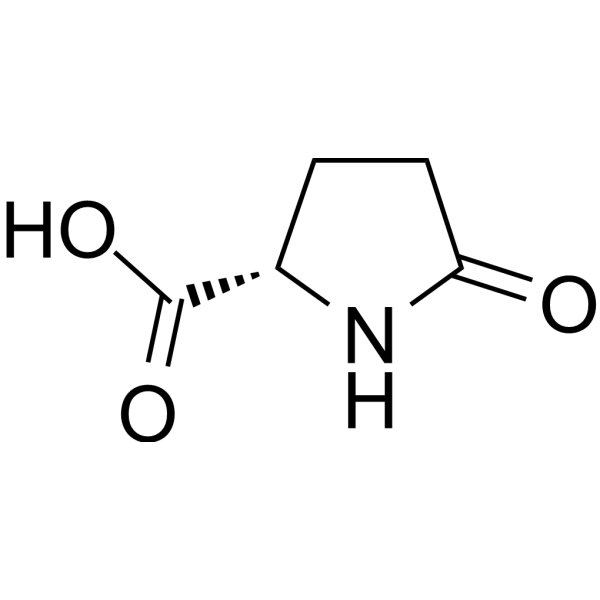
HY-76082
L-Pyroglutamic acid -

HY-76082R
L-Pyroglutamic acid (Standard) -

HY-W105423
Methacrylic acid N-hydroxysuccinimide ester -
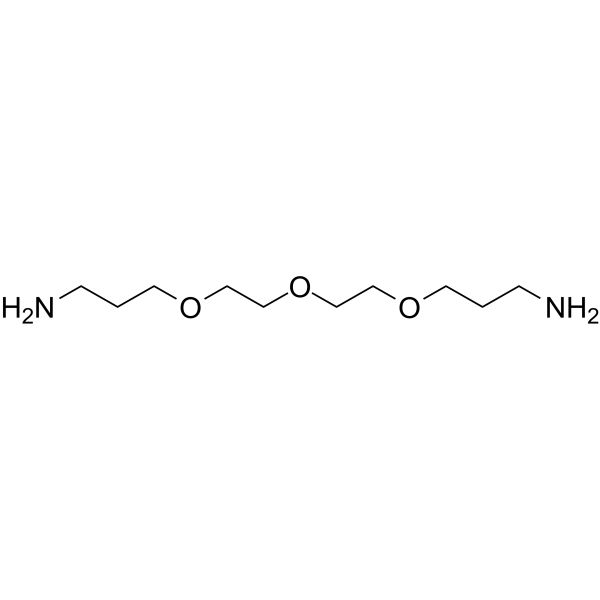
HY-128844
Bis-NH2-C1-PEG3 -
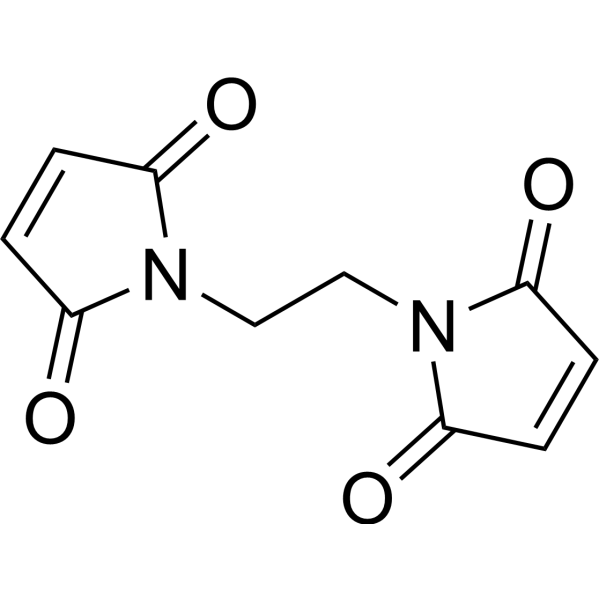
HY-W013538
1,2-Bis(maleimido)ethane -

HY-W011957
1,4-Bis-maleimidobutane -
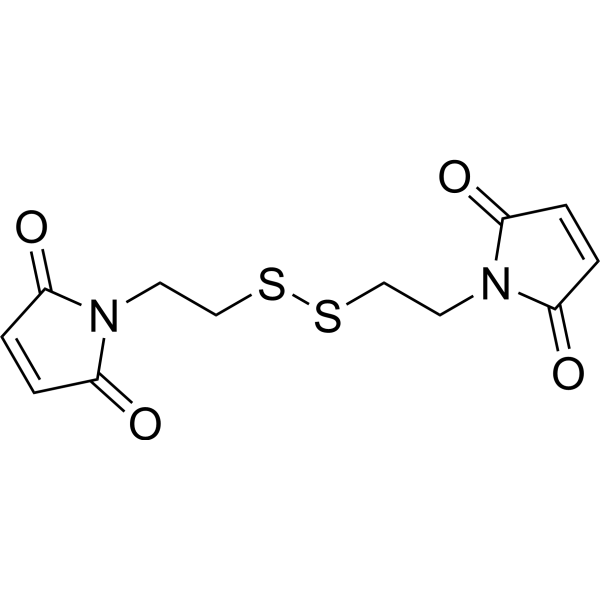
HY-W106411
DTME -

HY-119526
Bismaleimide -

HY-W104249R
N,N-1,3-Phenylenedimaleimide (Standard) -

HY-W011693
1,4-Phenylenebismaleimide


Biological Activity
Description
In Vitro
2,5-Dioxopyrrolidin-1-yl acrylate-modified anti-HRP monoclonal IgG antibodies retain complete antigen-binding activity in solution and can fully capture HRP during equilibrium dialysis[1].
The conjugation of 2,5-Dioxopyrrolidin-1-yl acrylate with purified L-asparaginase follows a linear dose-response relationship, requiring a molar ratio of NSA to enzyme of 9.5:1 to achieve an average of 1 vinyl group attached per enzyme molecule[2].
MedChemExpress (MCE) has not independently confirmed the accuracy of these methods. They are for reference only.


Chemical Information
-
CAS No. 38862-24-7
-
Appearance Solid
-
Molecular Weight 169.13
-
Formula C7H7NO4
-
Color White to light yellow
-
SMILES
O=C(C=C)ON1C(CCC1=O)=O
-
Synonyms
N-Succinimidyl acrylate
-
Shipping
Room temperature in continental US; may vary elsewhere.
-
Storage
-20°C, stored under nitrogen, away from moisture
* In solvent : -80°C, 6 months; -20°C, 1 month (stored under nitrogen, away from moisture)


Solvent & Solubility
In Vitro:
DMSO : 100 mg/mL (591.26 mM; Need ultrasonic; Hygroscopic DMSO has a significant impact on the solubility of product, please use newly opened DMSO)
H2O : 50 mg/mL (295.63 mM; Need ultrasonic)
Please refer to the solubility information to select the appropriate solvent. Once prepared, please aliquot and store the solution to prevent product inactivation from repeated freeze-thaw cycles.
Storage method and period of stock solution: -80°C, 6 months; -20°C, 1 month (stored under nitrogen, away from moisture). When stored at -80°C, please use it within 6 months. When stored at -20°C, please use it within 1 month.
* Note: If you choose water as the stock solution, please dilute it to the working solution, then filter and sterilize it with a 0.22 μm filter before use.
Please refer to the solubility information to select the appropriate solvent. Once prepared, please aliquot and store the solution to prevent product inactivation from repeated freeze-thaw cycles.
Storage method and period of stock solution: -80°C, 6 months; -20°C, 1 month (stored under nitrogen, away from moisture). When stored at -80°C, please use it within 6 months. When stored at -20°C, please use it within 1 month.
* Note: If you choose water as the stock solution, please dilute it to the working solution, then filter and sterilize it with a 0.22 μm filter before use.
Concentration (start) × Volume (start) = Concentration (final) × Volume (final)
In Vivo:
Select the appropriate dissolution method based on your experimental animal and administration route.
- For the following dissolution methods, please ensure to first prepare a clear stock solution using an In Vitro approach and then sequentially add co-solvents:
- To ensure reliable experimental results, the clarified stock solution can be appropriately stored based on storage conditions. As for the working solution for In Vivo experiments, it is recommended to prepare freshly and use it on the same day.
- The percentages shown for the solvents indicate their volumetric ratio in the final prepared solution. If precipitation or phase separation occurs during preparation, heat and/or sonication can be used to aid dissolution.
Add each solvent one by one: 10% DMSO 40% PEG300 5% Tween-80 45% Saline
Solubility: ≥ 2.5 mg/mL (14.78 mM); Clear solution
This protocol yields a clear solution of ≥ 2.5 mg/mL (saturation unknown).
Taking 1 mL working solution as an example, add 100 μL DMSO stock solution (25.0 mg/mL) to 400 μL PEG300, and mix evenly; then add 50 μL Tween-80 and mix evenly; then add 450 μL Saline to adjust the volume to 1 mL.
Preparation of Saline: Dissolve 0.9 g sodium chloride in ddH₂O and dilute to 100 mL to obtain a clear Saline solution.
Add each solvent one by one: 10% DMSO 90% (20% SBE-β-CD in Saline)
Solubility: ≥ 2.5 mg/mL (14.78 mM); Clear solution
This protocol yields a clear solution of ≥ 2.5 mg/mL (saturation unknown).
Taking 1 mL working solution as an example, add 100 μL DMSO stock solution (25.0 mg/mL) to 900 μL 20% SBE-β-CD in Saline, and mix evenly.
Preparation of 20% SBE-β-CD in Saline (4°C, storage for one week): 2 g SBE-β-CD powder is dissolved in 10 mL Saline, completely dissolve until clear.
In Vivo Dissolution Calculator
Please enter the basic information of animal experiments:
-
-
-
-
Recommended: Prepare an additional quantity of animals to account for potential losses during experiments.
Working solution concentration: 0.22 mg/mL
This product has good water solubility, please refer to the measured solubility data in water/PBS/Saline for details.


Purity & Documentation
-
Data Sheet (278 KB)
-
SDS (393 KB)
- English - EN (393 KB)
- Français - FR (393 KB)
- Deutsch - DE (393 KB)
- Norwegian - NO (393 KB)
- Español - ES (393 KB)
- Swedish - SV (393 KB)
- Italian - IT (393 KB)
- Korean - KR (393 KB)
- Portuguese - PT (393 KB)
-
Handling Instructions (2659 KB)
References
[1]. Okyem S, et al. High-Affinity Points of Interaction on Antibody Allow Synthesis of Stable and Highly Functional Antibody-Gold Nanoparticle Conjugates. Bioconjugate chemistry. 2021 Aug 18;32(8):1753-1762. [Content Brief]
[2]. Shoemaker SG, et al. Synthesis and properties of vinyl monomer/enzyme conjugates. Conjugation of L-asparaginase with N-succinimidyl acrylate. Appl Biochem Biotechnol. 1987 Jun;15(1):11-24. [Content Brief]


Complete Stock Solution Preparation Table
Please refer to the solubility information to select the appropriate solvent. Once prepared, please aliquot and store the solution to prevent product inactivation from repeated freeze-thaw cycles.
Storage method and period of stock solution: -80°C, 6 months; -20°C, 1 month (stored under nitrogen, away from moisture). When stored at -80°C, please use it within 6 months. When stored at -20°C, please use it within 1 month.
| Optional Solvent | Concentration Solvent Mass | 1 mg | 5 mg | 10 mg | 25 mg |
|---|---|---|---|---|---|
| H2O / DMSO | 1 mM | 5.9126 mL | 29.5631 mL | 59.1261 mL | 147.8153 mL |
| 5 mM | 1.1825 mL | 5.9126 mL | 11.8252 mL | 29.5631 mL | |
| 10 mM | 0.5913 mL | 2.9563 mL | 5.9126 mL | 14.7815 mL | |
| 15 mM | 0.3942 mL | 1.9709 mL | 3.9417 mL | 9.8544 mL | |
| 20 mM | 0.2956 mL | 1.4782 mL | 2.9563 mL | 7.3908 mL | |
| 25 mM | 0.2365 mL | 1.1825 mL | 2.3650 mL | 5.9126 mL | |
| 30 mM | 0.1971 mL | 0.9854 mL | 1.9709 mL | 4.9272 mL | |
| 40 mM | 0.1478 mL | 0.7391 mL | 1.4782 mL | 3.6954 mL | |
| 50 mM | 0.1183 mL | 0.5913 mL | 1.1825 mL | 2.9563 mL | |
| 60 mM | 0.0985 mL | 0.4927 mL | 0.9854 mL | 2.4636 mL | |
| 80 mM | 0.0739 mL | 0.3695 mL | 0.7391 mL | 1.8477 mL | |
| 100 mM | 0.0591 mL | 0.2956 mL | 0.5913 mL | 1.4782 mL |
* Note: If you choose water as the stock solution, please dilute it to the working solution, then filter and sterilize it with a 0.22 μm filter before use.


2,5-Dioxopyrrolidin-1-yl acrylate Related Classifications
HY-W043748 Related Classifications
 Powered by Bioz
Keywords
- 2,5-Dioxopyrrolidin-1-yl acrylate
- 38862-24-7
- N-Succinimidyl acrylate
- Biochemical Assay Reagents
- vinyl groups
- N-hydroxy succinimide
- monoclonal anti-horse-radish peroxidase IgG antibody
- HRP
- citrate-capped gold nanoparticles
- ε-amino groups
- L-asparaginase
- lysine residues
- primary amines
- anti-HRP monoclonal IgG antibody
- Inhibitor
- inhibitor
- inhibit