15 Results for "

electron carrier

" in MedChemExpress (MCE) Product Catalog:
Products (15)

15 Results for "electron carrier" in MCE Product Catalog:

Cat. No.: HY-125857C
CAS No.: 9007-43-6
Purity:  95.00%
Cytochrome C (bovine heart) is composed of 104 amino acids and is a nuclear-encoded mitochondrial protein. Cytochrome C (bovine heart) acts as an effective ROS scavenger, but when combined with the cofactor p66Shc, it promotes the generation of ROS to initiate apoptosis. Cytochrome C (bovine heart) can act as a single electron carrier .
loading...
    loading...
Cat. No.: HY-P2907
CAS No.: 9028-85-7
Research Areas:  

Others

Formate dehydrogenase is a class of oxidoreductases widely distributed in bacteria, fungi, plants and animals. Formate dehydrogenase catalyzes the reversible conversion between formic acid and carbon dioxide, accompanied by redox reactions of the coenzyme NAD +/NADH or other electron carriers .
loading...
    loading...
Cat. No.: HY-125857A
CAS No.: 9007-43-6
Cytochrome C (equine heart) is composed of 104 amino acids and is a nuclear-encoded mitochondrial protein. Cytochrome C (equine heart) is involved in mitochondrial electron transport and intrinsic type II apoptosis. Cytochrome C (equine heart) can act as a single electron carrier .
loading...
    loading...
Cat. No.: HY-113355
CAS No.: 58-68-4
NADH is an orally active dehydrogenase coenzyme that acts as a crucial electron carrier in cellular respiration and participates in ATP production. NADH promotes metabolism, supports brain function, and counteracts oxidative stress by transferring electrons to the electron transport chain. As a signaling molecule, NADH regulates multiple biological processes, including anti-apoptosis, synaptic plasticity, gene expression, and calcium homeostasis. Redox imbalance of NADH/NAD⁺ is one of the key pathological mechanisms of various diseases, such as diabetic nephropathy, neurodegenerative diseases, and ischemia-reperfusion injury.
loading...
    loading...
Cat. No.: HY-107869
CAS No.: 476-34-6
Purity:  99.12%
Target:  

Fluorescent Dye

Research Areas:  

Cancer

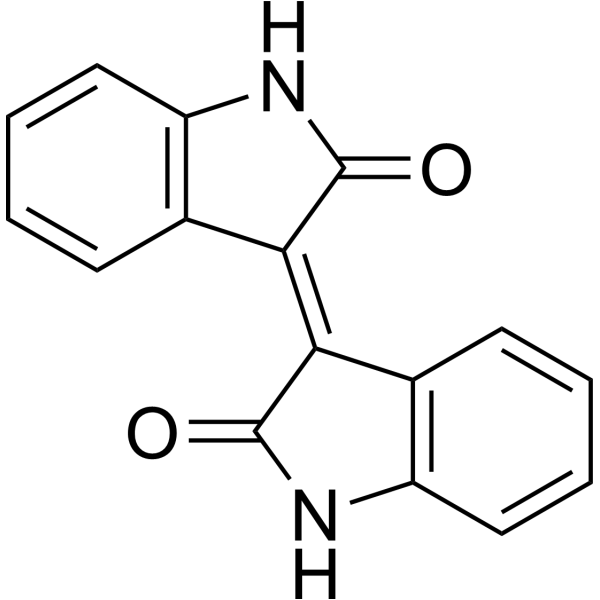
Isoindigo acts as the acceptor unit in donor-acceptor (D-A) conjugated polymers and belongs to the indigo dye family. Isoindigo contains two lactam rings and exhibits strong electron-withdrawing properties. Isoindigo can be used in dyeing and pigment preparation. Isoindigo shows high mobility and excellent environmental stability in field-effect transistors (FETs). Isoindigo possesses the activity to inhibit tumor cell proliferation and has certain anti-tumor activity .
loading...
    loading...
Cat. No.: HY-E70517
CAS No.: 89190-47-6
Target:  

Histamine Receptor

Research Areas:  

Others

Histamine dehydrogenase, Microorganism (EC 1.4.99) is a homodimeric enzyme which catalyzes oxidative deamination of histamine in the presence of electron carrier .
loading...
    loading...
Cat. No.: HY-D1509
CAS No.: 10510-77-7
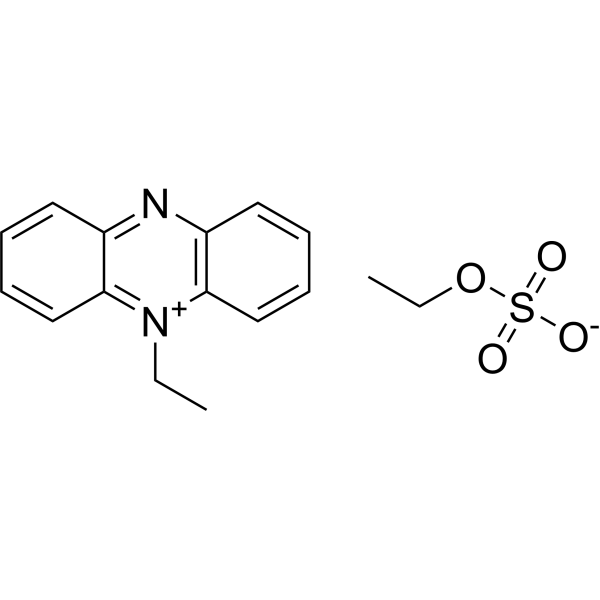
Phenazine ethosulfate is a cationic dye (Ex=390 nm, Em=530 nm) and electron acceptor that can be used in dye-linked enzyme assays . Phenazine ethosulfate exhibits weak, pH-dependent fluorescence properties and serves as an oxidative substrate. Phenazine ethosulfate promotes the reduction of equine heart metmyoglobin to ferrohemoglobin. As an intermediate, Phenazine ethosulfate can be used in combination with ascorbic acid for the detection of nitric oxide reductase activity .
loading...
    loading...
Cat. No.: HY-125857B
CAS No.: 9007-43-6
Cytochrome C (Saccharomyces cerevisiae) is a type C cytochrome located in the intermembrane space of the mitochondria. As an electron carrier, Cytochrome C (Saccharomyces cerevisiae) transfers electrons between complex III (cytochrome c reductase) and complex IV (cytochrome c oxidase, CIV) of the respiratory chain. Cytochrome C (Saccharomyces cerevisiae) can play a crucial role in triggering apoptosis by being released from the mitochondria into the cytosol .
loading...
    loading...
Cat. No.: HY-N11882
CAS No.: 4299-57-4
Synonyms: PQ-9
Plastoquinone (PQ-9) is a photosynthetic electron carrier as well as a redox sensor capable of regulating state transitions and gene expression. Plastoquinone transfers electrons to the cytochrome b6/f complex via the Q cycle, and participates in the establishment of the thylakoid transmembrane pH gradient. Plastoquinone can react with ROS. Plastoquinone is used in plant photosynthesis research .
loading...
    loading...
Cat. No.: HY-17659
CAS No.: 112055-76-2
Target:  

Drug Derivative

Research Areas:  

Others

Decylplastoquinone is lipid-soluble derivative of plastoquinone (HY-N11882). Plastoquinone (PQ-9), a potent electron carrier, is an essential component of photosynthesis. Plastoquinone is also a redox sensor that regulates state transitions and gene expression .
loading...
    loading...
Cat. No.: HY-124357
CAS No.: 127685-30-7
Synonyms: S-Norfluoxetine hydrochloride; LY 215229 hydrochloride
Target:  

Dopamine Receptor

Research Areas:  

Neurological Disease

Seproxetine (S-Norfluoxetine) hydrochloride is a selective serotonin reuptake inhibitor (SSRI) that enhances serotonin levels in the brain by specifically inhibiting the serotonin uptake carrier. Seproxetine hydrochloride exhibits strong charge transfer interactions with π-electron acceptors, forming stable complexes that enhance its binding affinity to multiple receptors, including serotonin and dopamine receptors. Seproxetine hydrochloride demonstrates improved biological activity when interacting with charge transfer complexes, leading to increased stability and efficacy in therapeutic applications.
loading...
    loading...
Cat. No.: HY-W251143
CAS No.: 83054-80-2
N,N′-Bis(2,5-di-tert-butylphenyl)-3,4,9,10-perylenedicarboximide is an organic semiconductor material with excellent electron transport activity. N,N′-Bis(2,5-di-tert-butylphenyl)-3,4,9,10-perylenedicarboximide is widely used in organic field effect transistors (OFETs) and organic photovoltaic (OPV) devices due to its high carrier mobility. The chemical structure design of N,N′-Bis(2,5-di-tert-butylphenyl)-3,4,9,10-perylenedicarboximide enables it to perform well in light absorption and photoelectric conversion, thereby improving the efficiency of organic photoelectric devices.
loading...
    loading...
Cat. No.: HY-E71486
Research Areas:  

Others

2-Carboxy-1,4-naphthoquinone phytyltransferase (EC 2.5.1.130) , found in plants and cyanobacteria, catalyses a step in the synthesis of phylloquinone (vitamin K1), an electron carrier associated with photosystem I.
loading...
    loading...
Cat. No.: HY-W251144
CAS No.: 76372-75-3
Synonyms: PTCDI-C5
N,N′-Dipentyl-3,4,9,10-perylenedicarboximide (PTCDI-C5) is an organic semiconductor compound with excellent electron transport activity. N,N′-Dipentyl-3,4,9,10-perylenedicarboximide exhibits high performance in organic field effect transistors (OFETs) and can effectively improve the carrier mobility of the device. The application of N,N′-Dipentyl-3,4,9,10-perylenedicarboximide in organic photovoltaic (OPV) materials enhances the light absorption performance, thereby improving the photoelectric conversion efficiency. N,N′-Dipentyl-3,4,9,10-perylenedicarboximide has also been widely studied for the development of high-performance sensors and fluorescent materials.
loading...
    loading...
Cat. No.: HY-107869R
CAS No.: 476-34-6
Research Areas:  

Cancer

Isoindigo (Standard) is the analytical standard of Isoindigo (HY-107869). This product is intended for research and analytical applications. Isoindigo acts as the acceptor unit in donor-acceptor (D-A) conjugated polymers and belongs to the indigo dye family. Isoindigo contains two lactam rings and exhibits strong electron-withdrawing properties. Isoindigo can be used in dyeing and pigment preparation. Isoindigo shows high mobility and excellent environmental stability in field-effect transistors (FETs). Isoindigo possesses the activity to inhibit tumor cell proliferation and has certain anti-tumor activity .
loading...
    loading...
  • 1

