6 Results for "

literature

" in MedChemExpress (MCE) Product Catalog:
Products (6)

6 Results for "literature" in MCE Product Catalog:

Cat. No.: HY-151829
CAS No.: 2616562-74-2
Target:  

ADC Linkers

Research Areas:  

Others

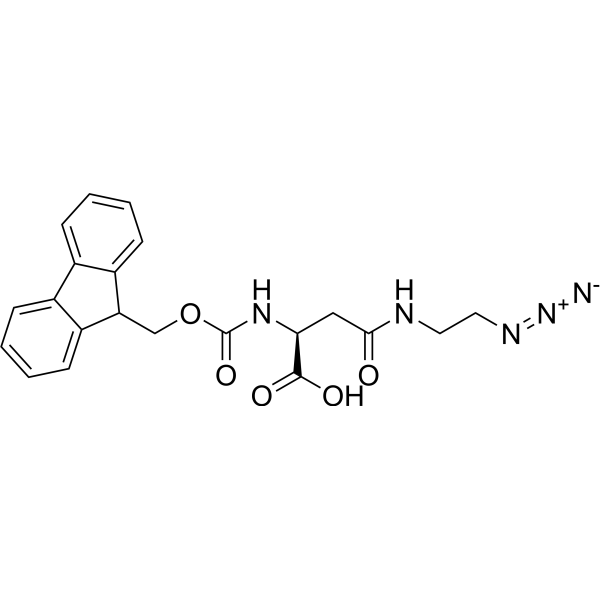
Fmoc-L-Asn(EDA-N3)-OH is a click chemistry reagent containing an azide group. This building block is reported in literature for the modification of Amanitin via Click Chemistry. Alpha-Amanitin is the deadliest member of the amatoxin peptide family produced by the death-cap mushroom A. phalloides. It is an orally available, rigid, bicyclic octapeptide and one of the most lethal known natural products (LD50 = 50-100 μg/kg) acting as highly selective allosteric inhibitor of the RNA polymerase II . It contains an azide group and can undergo copper-catalyzed azide-alkyne cycloaddition (CuAAc) with molecules containing alkyne groups. It can also undergo ring strain-promoted alkyne-azide cycloaddition (SPAAC) with molecules containing DBCO or BCN groups.
loading...
    loading...
Cat. No.: HY-130310A
CAS No.: 330800-90-3
Research Areas:  

Others

11(S)-HEDE is isolated by the chromatographic resolution of 11(S)-HEDE. There are no reports of biological activity associated with 11(S)-HEDE in the literature.
loading...
    loading...
Cat. No.: HY-P5415
CAS No.: 127134-13-8
Target:  

HIV

Research Areas:  

Others

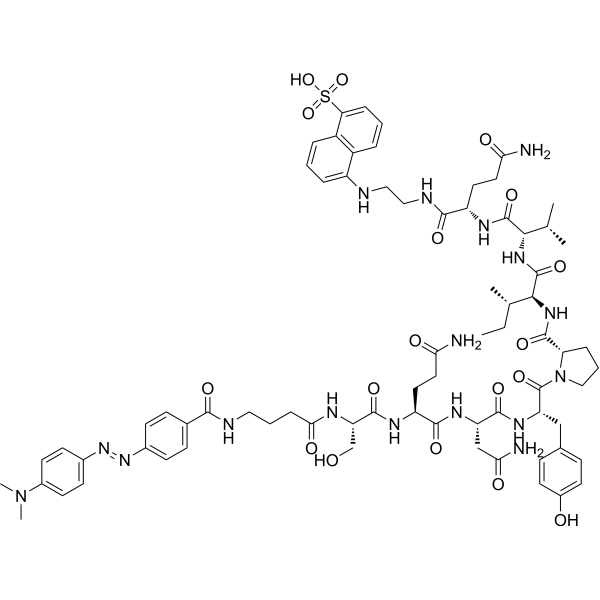
DABCYL-GABA-Ser-Gln-Asn-Tyr-Pro-Ile-Val-Gln-EDANS is a biological active peptide. (DABCYL-GABA-Ser-Gln-Asn-Tyr-Pro-Ile-Val-Gln-EDANS is also called HIV protease substrate I in some literature. It is widely used for the continuous assay for HIV protease activity. The 11-Kd protease (PR) encoded by the human immunodeficiency virus 1 (HIV-1) is essential for the correct processing of viral polyproteins and the maturation of infectious virus, and is therefore a target for the design of selective acquired immunodeficiency syndrome (AIDS) therapeutics. The FRET-based fluorogenic substrate is derived from a natural processing site for HIV-1 PR. Incubation of recombinant HIV-1 PR with the fluorogenic substrate resulted in specific cleavage at the Tyr-Pro bond and a time-dependent increase in fluorescence intensity that is linearly related to the extent of substrate hydrolysis. The fluorescence quantum yields of the HIV-1 PR substrate in the FRET assay increased by 40.0- and 34.4-fold, respectively, per mole of substrate cleaved. Because of its simplicity and precision in the determination of reaction rates required for kinetic analysis, this substrate offers many advantages over the commonly used HPLC or electrophoresis-based assays for peptide substrate hydrolysis by retroviral PRs. Abs/Em = 340nm/490nm.)
loading...
    loading...
Cat. No.: HY-K2032

MCE Polybrene (10 mg/mL) is provided as a ready-to-use solution, prepared in 0.9% saline and sterilized by filtration through a 0.22 μm membrane. For use, it is typically diluted 1:1000-1:2000 to the working concentration. The optimal working concentration may vary depending on cell type and experimental conditions and should be empirically optimized based on relevant literature or preliminary experiments.

loading...
    loading...
Cat. No.: HY-L099
2,294 compounds

MCE Targeted Diversity Library contains 2,294 compounds, covering more than 1000 targets and isoforms, such as GPCRs, Ion channel, variety of kinases, etc. 1-3 compounds with high potency and selectivity were carefully selected for each target and isoform. The bioactivity information of each compound has been clearly reported in the literatures. This library is a concise collection of small molecule compounds with comprehensive target coverage, which can be used for phenotypic screening at low cost.

Cat. No.: HY-181607
Target:  

YAP

Research Areas:  

Others

TEAD ligand-Linker Conjugate 3 (the blue structure + black structure of A536 in the literature) is a conjugate of a TEAD1-targeting ligand and a linker. TEAD ligand-Linker Conjugate 3 can be coupled with an IAP ligand (HY-181531) to form an IAP-recruiting bifunctional protein degrader (IPD) (HY-181594), also known as a SNIPER degrader. This TEAD SNIPER simultaneously binds to the TEAD1 palmitoylation pocket and the BIR3 domain of cIAP1 to form a ternary complex, efficiently inducing the ubiquitination and degradation of both TEAD1 and cIAP1 (DC50=110 nM, Dmax=51%; IC50=122 nM for cIAP1). TEAD ligand-Linker Conjugate 3 and its synthesized SENIPER molecule can be utilized in research on Hippo pathway dysregulation-related diseases, such as NF2-mutant tumors .
loading...
    loading...

