11 Results for "

microsomal hydroxylation

" in MedChemExpress (MCE) Product Catalog:
Products (11)

11 Results for "microsomal hydroxylation" in MCE Product Catalog:

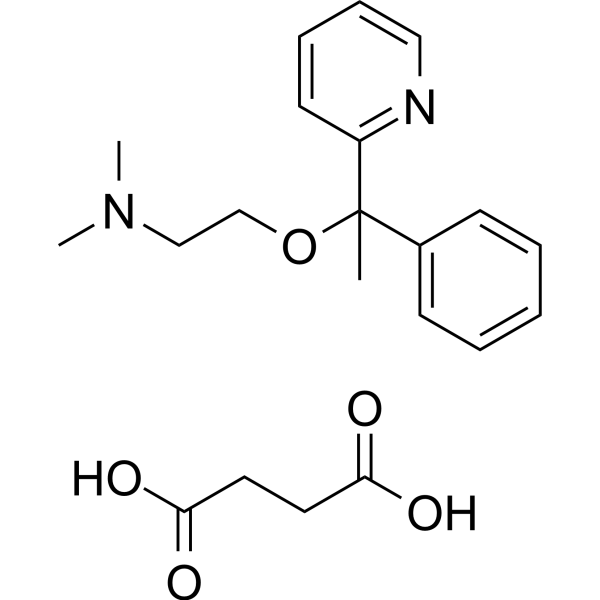
Cat. No.: HY-A0069
CAS No.: 562-10-7
Doxylamine succinate is a first-generation antihistamine and acts as a histamine H1 receptor antagonist. Doxylamine succinate is orally active, possessing analgesic and hypnotic activities. Doxylamine succinate enhances the activities of CYP2B, CYP2A, CYP3A and thyroxine-glucuronosyltransferase via promoting substrate hydroxylation and thyroxine metabolic pathways. Doxylamine succinate decreases serum thyroxine (T4) level and elevates serum thyroid-stimulating hormone (TSH) level. Doxylamine succinate induces liver enlargement and increases the activities of hepatic microsomal cytochrome P450, cytochrome b5 and NADPH-cytochrome c reductase. Doxylamine succinate can be used for the research of nausea, allergy, insomnia .
loading...
    loading...
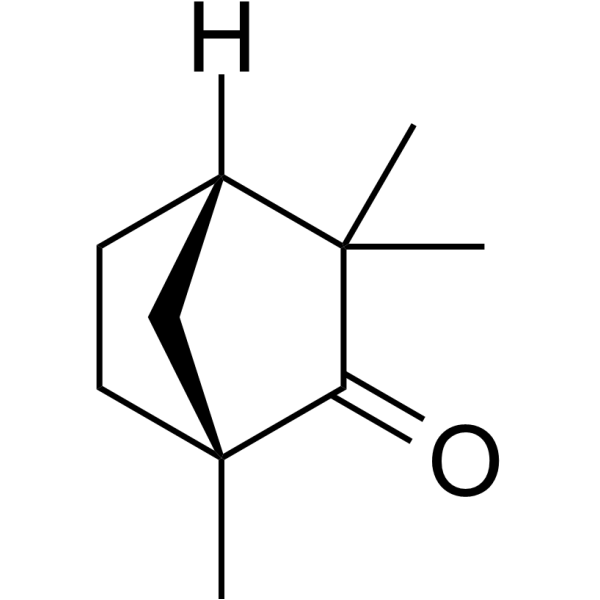
Cat. No.: HY-N5132
CAS No.: 7787-20-4
(-)-Fenchone is a bicyclic monoterpene and serves as a substrate for human liver microsomal cytochrome P450 enzymes CYP2A6 and CYP2B6. (-)-Fenchone is not metabolized by human CYP1A1, CYP1A2, CYP1B1, CYP2C8, CYP2C9, CYP2C19, CYP2D6, CYP2E1, or CYP3A4 enzymes. (-)-Fenchone undergoes hydroxylation to produce 6-exo-hydroxyfenchone, 6-endo-hydroxyfenchone, and 10-hydroxyfenchone. During the metabolism of (-)-Fenchone, CYP2A6 may play a more important role than CYP2B6 .
loading...
    loading...
Cat. No.: HY-A0069A
CAS No.: 469-21-6
Doxylamine is a first-generation antihistamine and acts as a histamine H1 receptor antagonist. Doxylamine is orally active, possessing analgesic and hypnotic activities. Doxylamine enhances the activities of CYP2B, CYP2A, CYP3A and thyroxine-glucuronosyltransferase via promoting substrate hydroxylation and thyroxine metabolic pathways. Doxylamine decreases serum thyroxine (T4) level and elevates serum thyroid-stimulating hormone (TSH) level. Doxylamine induces liver enlargement and increases the activities of hepatic microsomal cytochrome P450, cytochrome b5 and NADPH-cytochrome c reductase. Doxylamine can be used for the research of nausea, allergy, insomnia .
loading...
    loading...
Cat. No.: HY-A0069R
CAS No.: 562-10-7
Doxylamine succinate (Standard) is the analytical standard of Doxylamine succinate (HY-A0069). This product is intended for research and analytical applications. Doxylamine succinate is a first-generation antihistamine and acts as a histamine H1 receptor antagonist. Doxylamine succinate is orally active, possessing analgesic and hypnotic activities. Doxylamine succinate enhances the activities of CYP2B, CYP2A, CYP3A and thyroxine-glucuronosyltransferase via promoting substrate hydroxylation and thyroxine metabolic pathways. Doxylamine succinate decreases serum thyroxine (T4) level and elevates serum thyroid-stimulating hormone (TSH) level. Doxylamine succinate induces liver enlargement and increases the activities of hepatic microsomal cytochrome P450, cytochrome b5 and NADPH-cytochrome c reductase. Doxylamine succinate can be used for the research of nausea, allergy, insomnia .
loading...
    loading...
Cat. No.: HY-177148
CAS No.: 134867-97-3
Research Areas:  

Cardiovascular Disease

G256 is a cytochrome P450 substrate with antiarrhythmic properties. In recombinant monooxygenase systems, G256 undergoes N-hydroxylation of the terminal aminoguanidine nitrogen, as well as ring hydroxylation catalyzed by cytochrome P4502C3. G256 generates N-hydroxyaminoguanidine metabolites via N-hydroxylation in liver microsomal fractions. G256 produces phenol metabolites through ring hydroxylation in both liver microsomal fractions and recombinant cytochrome P450 systems. G256 can be used for research on arrhythmias .
loading...
    loading...
Cat. No.: HY-177148A
CAS No.: 134867-96-2
Research Areas:  

Cardiovascular Disease

G256 dihydrochloride is a cytochrome P450 substrate with antiarrhythmic properties. In recombinant monooxygenase systems, G256 dihydrochloride undergoes N-hydroxylation of the terminal aminoguanidine nitrogen, as well as ring hydroxylation catalyzed by cytochrome P4502C3. G256 dihydrochloride generates N-hydroxyaminoguanidine metabolites via N-hydroxylation in liver microsomal fractions. G256 dihydrochloride produces phenol metabolites through ring hydroxylation in both liver microsomal fractions and recombinant cytochrome P450 systems. G256 dihydrochloride can be used for research on arrhythmias .
loading...
    loading...
Cat. No.: HY-A0069AS
CAS No.: 1173020-59-1
Doxylamine-d5 is deuterium labeled Doxylamine (HY-A0069A). Doxylamine is a first-generation antihistamine and acts as a histamine H1 receptor antagonist. Doxylamine is orally active, possessing analgesic and hypnotic activities. Doxylamine enhances the activities of CYP2B, CYP2A, CYP3A and thyroxine-glucuronosyltransferase via promoting substrate hydroxylation and thyroxine metabolic pathways. Doxylamine decreases serum thyroxine (T4) level and elevates serum thyroid-stimulating hormone (TSH) level. Doxylamine induces liver enlargement and increases the activities of hepatic microsomal cytochrome P450, cytochrome b5 and NADPH-cytochrome c reductase. Doxylamine can be used for the research of nausea, allergy, insomnia .
loading...
    loading...
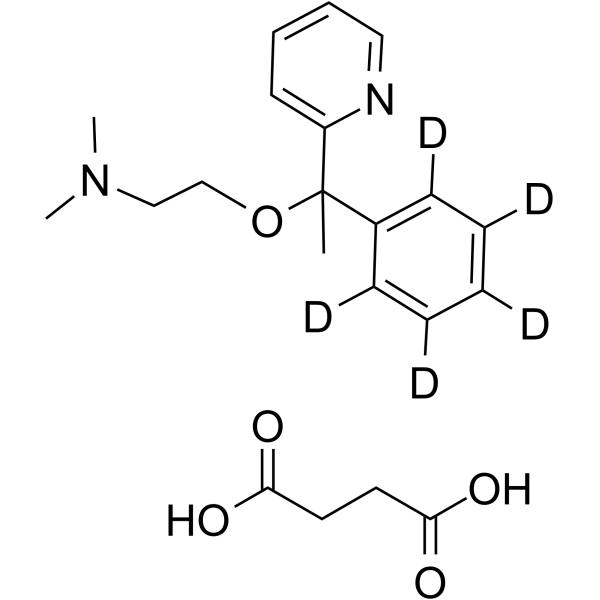
Cat. No.: HY-A0069S
CAS No.: 1216840-94-6
Doxylamine-d5 succinate is deuterium labeled Doxylamine succinate (HY-A0069A). Doxylamine succinate is a first-generation antihistamine and acts as a histamine H1 receptor antagonist. Doxylamine succinate is orally active, possessing analgesic and hypnotic activities. Doxylamine succinate enhances the activities of CYP2B, CYP2A, CYP3A and thyroxine-glucuronosyltransferase via promoting substrate hydroxylation and thyroxine metabolic pathways. Doxylamine succinate decreases serum thyroxine (T4) level and elevates serum thyroid-stimulating hormone (TSH) level. Doxylamine succinate induces liver enlargement and increases the activities of hepatic microsomal cytochrome P450, cytochrome b5 and NADPH-cytochrome c reductase. Doxylamine succinate can be used for the research of nausea, allergy, insomnia .
loading...
    loading...
Cat. No.: HY-177148B
CAS No.: 136623-15-9
Research Areas:  

Cardiovascular Disease

(E/Z)-G256 (dihydrochloride) is an isomer of G256 dihydrochloride (HY-177148A). G256 dihydrochloride is a cytochrome P450 substrate with antiarrhythmic properties. In recombinant monooxygenase systems, G256 dihydrochloride undergoes N-hydroxylation of the terminal aminoguanidine nitrogen, as well as ring hydroxylation catalyzed by cytochrome P4502C3. G256 dihydrochloride generates N-hydroxyaminoguanidine metabolites via N-hydroxylation in liver microsomal fractions. G256 dihydrochloride produces phenol metabolites through ring hydroxylation in both liver microsomal fractions and recombinant cytochrome P450 systems. G256 dihydrochloride can be used for research on arrhythmias .
loading...
    loading...
Cat. No.: HY-W421914
CAS No.: 500-28-7
Target:  

Insecticide

Research Areas:  

Infection

Chlorthion is an organic phosphorothionate insecticide. Chlorthion inhibits liver microsomal hydroxylation of testosterone .
loading...
    loading...
Cat. No.: HY-W040305
CAS No.: 99-30-9
2,6-Dichloro-4-nitroaniline is an orally active Herbicide, Fungicide and uncoupler. 2,6-Dichloro-4-nitroaniline uncouples oxidative phosphorylation and inhibits electron transport. 2,6-Dichloro-4-nitroaniline induces biphenyl hydroxylase activity in rat liver. 2,6-Dichloro-4-nitroaniline increases the relative liver weight of rats via hepatomegaly without altering their body weight .
loading...
    loading...
  • 1

