1. Search Result
Search Result
Results for "

neuromuscular blocking activity

" in MedChemExpress (MCE) Product Catalog:

10

Inhibitors & Agonists

2

Natural
Products

Cat. No. 상품명 Target 연구분야 Chemical Structure
  • HY-13831
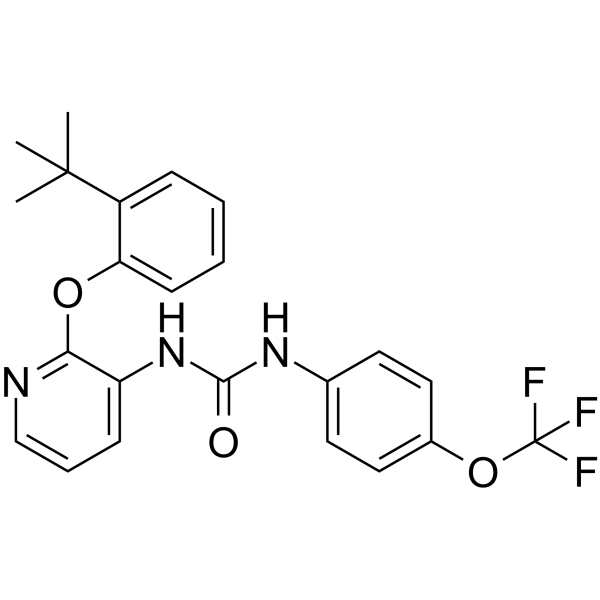
    BPTU
    1 Publications Verification

    BMS-646786

    P2Y Receptor Neurological Disease Cancer
    BPTU (BMS-646786) is a non-nucleotide P2Y1 receptor allosteric antagonist with antithrombotic activity. BPTU is able to block the P2Y1 receptor located at the neuromuscular junction of the gastrointestinal tract .
    BPTU
  • HY-B1194

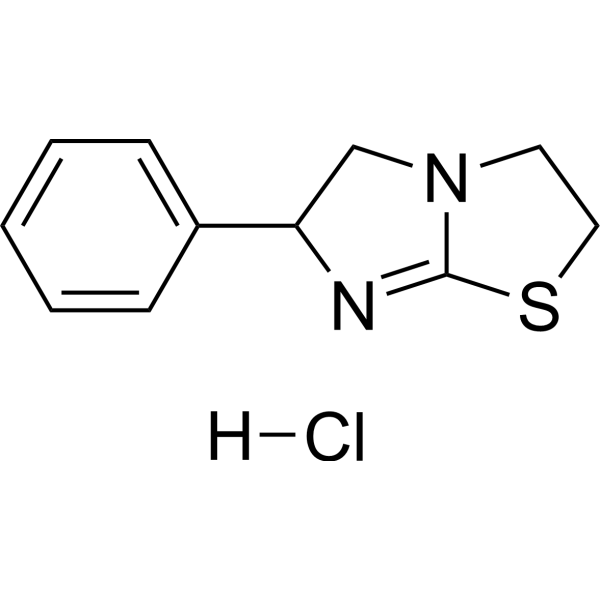
    (±)-Tetramisole hydrochloride; DL-Tetramisole hydrochloride; R-829

    Potassium Channel Parasite PKA Infection Cardiovascular Disease
    Tetramisole hydrochloride is an orally active, selective inward rectifier potassium channel agonist with an EC50 of approximately 30 μM for the Kir2.1 subunit. Tetramisole hydrochloride is also an anti-nematode agent that blocks neuromuscular transmission by non-competitive depolarization. Tetramisole hydrochloride promotes the forward transport of Kir2.1 channels, hyperpolarizes the resting potential (RP), shortens the action potential duration (APD), inhibits intracellular calcium overload and the PKA signaling pathway, and exerts anti-arrhythmic and anti-myocardial remodeling activities. Tetramisole hydrochloride can be used in cardiac electrophysiology research and research related to myocardial ischemia and heart failure .
    Tetramisole hydrochloride
  • HY-148629

    JNK Neurological Disease
    GDC-0134 (RG6000) is a modulator targeting dual leucine zipper kinase (DLK) that can cross the blood-brain barrier. By inhibiting the kinase activity of DLK, GDC-0134 blocks the activation of the downstream JNK signaling pathway, suppresses DLK-dependent retrograde signal transduction of axon-to-soma degeneration, and exerts neuroprotective activity. GDC-0134 reduces TDP-43 protein aggregation and decreases the degree of neuromuscular junction denervation in motor neurons. GDC-0134 can be used in the research of amyotrophic lateral sclerosis (ALS), Alzheimer's disease and other DLK-related neurodegenerative diseases .
    GDC-0134
  • HY-A0258A

    Metocurine iodide; Dimethylchondrocurarine iodide

    nAChR Neurological Disease
    Metubine (Metocurine iodide) is a non-depolarizing muscle relaxant. Metubine has neuromuscular blocking activities .
    Metubine
  • HY-N6609

    nAChR Others
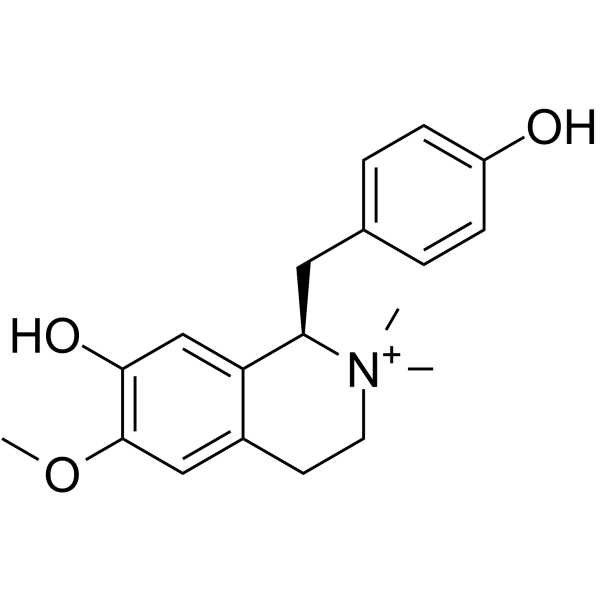
    Magnocurarine is a neuromuscular junction blocker that inhibits muscle contraction by functionally blocking signal transmission without directly damaging nerve or muscle tissues. In frog, mouse and rabbit models, Magnocurarine exerts a dose-dependent paralytic effect, which progresses gradually from limb weakness and loss of righting reflex to respiratory depression and even cardiac arrest. Although high doses cause complete cessation of movement, Magnocurarine does not affect the spinal multineuronal reflex in frogs. Magnocurarine exhibits biological activity similar to that of tubocurarine (HY-125901) in various animal models .
    Magnocurarine
  • HY-B1194A

    Potassium Channel Parasite PKA Infection Cardiovascular Disease
    Tetramisole is an orally active, selective inward rectifier potassium channel agonist with an EC50 of approximately 30 μM for the Kir2.1 subunit. Tetramisole is also an anti-nematode agent that blocks neuromuscular transmission by non-competitive depolarization. Tetramisole promotes the forward transport of Kir2.1 channels, hyperpolarizes the resting potential (RP), shortens the action potential duration (APD), inhibits intracellular calcium overload and the PKA signaling pathway, and exerts anti-arrhythmic and anti-myocardial remodeling activities. Tetramisole can be used in cardiac electrophysiology research and research related to myocardial ischemia and heart failure .
    Tetramisole
  • HY-B1194R

    (±)-Tetramisole hydrochloride (Standard); DL-Tetramisole hydrochloride (Standard); R-829 (Standard)

    Reference Standards Potassium Channel Parasite PKA Infection Cardiovascular Disease
    Tetramisole hydrochloride (Standard) is the analytical standard of Tetramisole (hydrochloride). This product is intended for research and analytical applications. Tetramisole hydrochloride is an orally active, selective inward rectifier potassium channel agonist with an EC50 of approximately 30 μM for the Kir2.1 subunit. Tetramisole hydrochloride is also an anti-nematode agent that blocks neuromuscular transmission by non-competitive depolarization. Tetramisole hydrochloride promotes the forward transport of Kir2.1 channels, hyperpolarizes the resting potential (RP), shortens the action potential duration (APD), inhibits intracellular calcium overload and the PKA signaling pathway, and exerts anti-arrhythmic and anti-myocardial remodeling activities. Tetramisole hydrochloride can be used in cardiac electrophysiology research and research related to myocardial ischemia and heart failure .
    Tetramisole hydrochloride (Standard)
  • HY-180384

    Drug Derivative Neurological Disease
    1,10-Bis(methylsulfinyl)decane (Compound IIf) is a decamethonium analogue and is a non-electrolytic sulfoxide compound. 1,10-Bis(methylsulfinyl)decane has low lethal (LD50 >37.5 mg/kg) effect in mice and neuromuscular blocking (ED50 >7 mg/kg) effects in cat .
    1,10-Bis(methylsulfinyl)decane
  • HY-180402

    Drug Derivative Neurological Disease
    1,10-Bis(ethylsulfinyl)decane (Compound IIg) is a decamethonium analogue and is a non-electrolytic . 1,10-Bis(ethylsulfinyl)decane has low lethal (LD50 >30 mg/kg) effect in mice and neuromuscular blocking (ED50 >10 mg/kg) effects in cat .
    1,10-Bis(ethylsulfinyl)decane
  • HY-N6609B

    nAChR Cardiovascular Disease
    Magnocurarine chloride is a neuromuscular junction blocker that inhibits muscle contraction by functionally blocking signal transmission without directly damaging nerve or muscle tissues. In frog, mouse and rabbit models, Magnocurarine chloride exerts a dose-dependent paralytic effect, which progresses gradually from limb weakness and loss of righting reflex to respiratory depression and even cardiac arrest. Although high doses cause complete cessation of movement, Magnocurarine chloride does not affect the spinal multineuronal reflex in frogs. Magnocurarine chloride exhibits biological activity similar to that of tubocurarine (HY-125901) in various animal models .
    Magnocurarine chloride

온라인 문의

Your information is safe with us. * Required Fields.

호칭


Country or Region *

고객명 *


회사명 *

Department *


메일주소 *


상품명 *

Cat. No.


Requested quantity *

전화번호 *


비고

온라인 문의

Inquiry Information

상품명:
Cat. No.:
수량:
MCE Japan Authorized Agent:

